


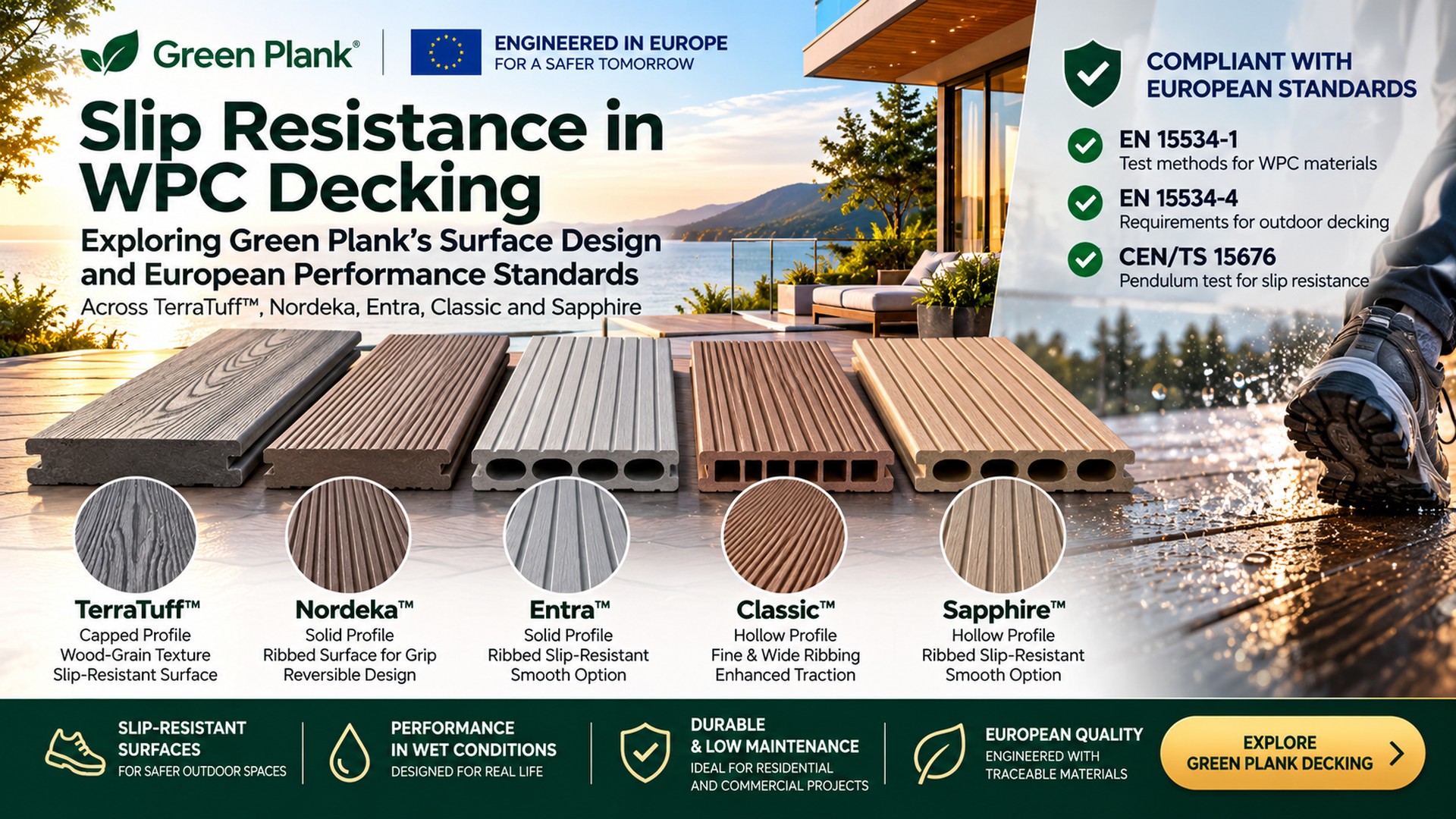
Slip resistance begins with surface design – but must be verified by testing
Rain, frost, moisture, leaves and everyday contamination can change how an outdoor deck behaves underfoot. This makes slip resistance an important consideration when selecting WPC decking for homes, hotels, restaurants, balconies, walkways, pool areas and public outdoor environments.
Green Plank approaches this challenge through purpose-designed surface structures across TerraTuff™, Nordeka™, Entra™, Classic™ and Sapphire™. Depending on the profile, these include embossed wood-grain textures, fine or wide ribbing and reversible smooth/ribbed surfaces. However, surface appearance alone does not establish a formal slip classification. European standards provide test methods for measuring that performance objectively.
https://www.standards.iteh.ai/catalog/standards/cen/3d35c30b-4587-415e-9ec9-a504f0adc67c/en-15534-1-2014a1-2017" target="_blank" rel="noopener noreferrer">EN 15534-1:2014+A1:2017 covers test methods for composites made from cellulose-based materials and thermoplastics and specifically includes slipperiness among its physical properties.
Important distinction: "Slip-resistant surface" describes a product design characteristic. Formal compliance with a specified slip-resistance threshold should be supported by test documentation for the exact board, surface and test condition.
How European standards evaluate WPC decking
The EN 15534 series provides a European technical framework for WPC/NFC products. EN 15534-1 defines test methods, while EN 15534-4:2014 establishes requirements for decking profiles and tiles intended for external use.
The verified text of https://cdn.standards.iteh.ai/samples/34950/bf742e0784964d9c8f14abcfcf911a53/SIST-EN-15534-4-2014.pdf" target="_blank" rel="noopener noreferrer">EN 15534-4:2014 identifies three alternative routes for slipperiness assessment.
| Method | EN 15534-4 requirement | Reference |
|---|---|---|
| Pendulum test | Pendulum value ≥ 36 | EN 15534-1, 6.4.2 |
| Inclination-plane test | Class C, ≥24° | EN 15534-1, 6.4.3 |
| Dynamic coefficient of friction | ≥0.43 in dry condition | EN 15534-1, 6.4.4 |
The standard states that the manufacturer selects the assessment method while considering relevant national regulations and the intended field of use. EN 15534-1 also specifies that the dynamic coefficient method is applicable only to surfaces that are dry in use. The pendulum method refers to CEN/TS 15676; the https://www.sis.se/en/produkter/environment-health-protection-safety/protective-equipment/protection-against-falling-and-slipping/siscents156762008/" target="_blank" rel="noopener noreferrer">Swedish Institute for Standards describes CEN/TS 15676 as the method for applying the pendulum test to determine slip resistance.
Five Green Plank profiles – five approaches to surface character
Green Plank's current decking collection includes capped, solid and hollow profiles. Their surfaces are not identical, which gives architects, contractors and homeowners options for balancing traction, barefoot comfort, aesthetics and project requirements. The https://greenplank.eu/products/composite-decking" target="_blank" rel="noopener noreferrer">Green Plank composite decking collection provides an overview of these systems.
| Profile | Construction | Surface concept | Typical positioning |
|---|---|---|---|
| TerraTuff™ | Capped composite | Slip-resistant wood-grain surface | Premium, hospitality, poolside and commercial |
| Nordeka™ | Solid reversible | Ribbed grip / flat surface | Residential, semi-public and commercial |
| Entra™ | Solid reversible | Ribbed slip-resistant / smooth barefoot side | Entrances, balconies and access areas |
| Classic™ | Hollow reversible | Fine ribbing / wide ribbing | Terraces, balconies and residential projects |
| Sapphire™ | Hollow reversible | Ribbed slip-resistant / smooth side | Refined residential outdoor spaces |
TerraTuff™: wood-grain traction with capped protection
TerraTuff™ uses a co-extruded capped construction with Green Plank's FortiShell™ protective layer. Its current product information describes a slip-resistant wood-grain surface together with moisture resistance, enhanced scratch resistance and suitability for demanding outdoor environments.
The https://greenplank.eu/products/composite-decking/terratuff" target="_blank" rel="noopener noreferrer">TerraTuff™ product specification positions the board for commercial terraces, hospitality projects, public outdoor spaces, luxury residential developments, poolside installations and waterfront areas.
For wet-use projects, that surface design is an important starting point, but a specification requiring a defined slip value should still reference the current test result for the exact TerraTuff™ surface being supplied.
Nordeka™: ribbed traction or flat barefoot comfort
Nordeka™ is a solid reversible profile designed to offer two distinct surface experiences. One side features a rounded ribbed texture intended to enhance traction, while the reverse provides a flatter, barefoot-friendly finish.
The https://greenplank.eu/products/composite-decking/nordeka" target="_blank" rel="noopener noreferrer">Nordeka™ technical product information describes the profile as having a slip-resistant texture and lists public walkways, promenades, hotel and restaurant terraces, shared courtyards and commercial outdoor areas among its applications.
This reversible approach is useful because surface selection can be considered alongside the intended use of each project rather than treating all outdoor spaces identically.
Entra™: a ribbed side designed for grip
Entra™ is another solid reversible profile, combining a smooth barefoot-friendly face with a ribbed slip-resistant side. Green Plank also describes a textured finish intended to provide additional grip at entrance zones.
According to the https://greenplank.eu/products/composite-decking/entra-solid-composite-decking" target="_blank" rel="noopener noreferrer">Entra™ product page, recommended applications include building entrances, balconies, loggias, walkways, access paths, residential thresholds and semi-covered outdoor areas.
For designers, the practical advantage is clear: the surface orientation can be selected according to the architectural expression and intended pedestrian environment, while formal slip-performance requirements remain subject to applicable test evidence.
Classic™: fine ribbing for grip, wide ribbing for comfort
Classic™ takes a different approach through a reversible hollow profile. Green Plank describes its two surfaces as fine ribbing for grip and wider ribbing for barefoot comfort. This makes the board particularly relevant for private terraces, balconies, gardens, courtyards and residential developments.
The current https://greenplank.eu/products/composite-decking/classic-hollow-composite-decking" target="_blank" rel="noopener noreferrer">Classic™ product specification identifies it as a Swedish-designed, European-made reversible WPC profile and documents its construction and intended applications.
Sapphire™: smooth comfort with a ribbed slip-resistant alternative
Sapphire™ combines a smooth barefoot-friendly surface with a ribbed slip-resistant reverse side. This allows projects to achieve a refined Scandinavian visual expression while retaining the option of a more structured walking surface.
The https://greenplank.eu/products/composite-decking/sapphire-hollow-composite-decking" target="_blank" rel="noopener noreferrer">Sapphire™ product information confirms its reversible hollow construction and identifies the ribbed face specifically as a slip-resistant surface.
Green Plank design principle: Surface texture should be selected according to use, exposure and desired comfort. For projects with contractual slip-performance requirements, surface design should then be paired with the appropriate product-specific technical documentation.
Why wet conditions change the specification conversation
A terrace that remains mostly dry and a waterfront promenade exposed to rain require different risk assessments. EN 15534-1 reflects this distinction by allowing different slipperiness methods and limiting its dynamic coefficient method to products whose surfaces are dry in use. The standard's slipperiness section can be reviewed in the https://cdn.standards.iteh.ai/samples/65614/53ab3d95d1614e7cac09681778b11ce1/SIST-EN-15534-1-2014-A1-2018.pdf" target="_blank" rel="noopener noreferrer">published EN 15534-1:2014+A1:2017 text.
Real-world slip behaviour is also affected by conditions after installation. Specifiers and owners should consider:
- rainwater and drainage;
- algae, leaves and organic deposits;
- snow, frost and ice;
- food, oils and other contamination in hospitality areas;
- deck gradients and local drainage details;
- cleaning and inspection frequency;
- surface orientation on reversible profiles.
Even a tested surface requires appropriate installation and maintenance. Slip resistance should therefore be viewed as a combination of product selection, verified performance, installation, drainage and ongoing care.
How architects and buyers should specify Green Plank decking
Rather than using only phrases such as "anti-slip WPC", a professional specification can be more precise. Before selecting TerraTuff™, Nordeka™, Entra™, Classic™ or Sapphire™, consider the following:
- Identify the exact product and surface face to be installed.
- Define whether the project is residential, commercial or publicly accessible.
- Establish whether the decking will regularly become wet.
- Identify the applicable EN 15534 slip-assessment method.
- Request current test documentation where a defined slip value is required.
- Confirm that the tested surface corresponds to the supplied profile.
- Design suitable drainage and follow the installation requirements.
- Create an appropriate cleaning and maintenance programme.
For professional projects: Specify measurable performance wherever required. A product name, exact surface, applicable test method and documented result provide a stronger specification than an unsupported "non-slip" claim.
Find the right Green Plank surface for your project
From private terraces to demanding public outdoor environments
Green Plank offers multiple surface concepts rather than a one-surface-fits-all approach. TerraTuff™ provides capped wood-grain character; Nordeka™ and Entra™ combine solid construction with reversible surface choices; Classic™ offers two ribbed expressions; and Sapphire™ combines smooth barefoot comfort with a ribbed slip-resistant alternative.
Planning a terrace, hotel, restaurant, poolside, promenade, entrance or commercial development? Explore the https://greenplank.eu/products/composite-decking" target="_blank" rel="noopener noreferrer">Green Plank composite decking collection and contact Green Plank for samples, profile recommendations and project-specific technical information.
Green Plank – European composite decking designed around surface choice, documented performance and demanding outdoor use.
Conclusion
Slip resistance in WPC decking cannot be judged by appearance alone. Surface geometry matters, but European standards provide the framework for objective evaluation. EN 15534-1 defines slipperiness test methods, while EN 15534-4 establishes performance routes for exterior WPC/NFC decking.
Across TerraTuff™, Nordeka™, Entra™, Classic™ and Sapphire™, Green Plank uses different textures and reversible surfaces to address traction, barefoot comfort and architectural design. Where a project requires a formal slip-resistance value, the responsible next step is to verify the current test documentation for the exact product and surface being specified.
Sources
- https://www.standards.iteh.ai/catalog/standards/cen/3d35c30b-4587-415e-9ec9-a504f0adc67c/en-15534-1-2014a1-2017" target="_blank" rel="noopener noreferrer">EN 15534-1:2014+A1:2017 – WPC/NFC test methods – European test methods including slipperiness.
- https://cdn.standards.iteh.ai/samples/34950/bf742e0784964d9c8f14abcfcf911a53/SIST-EN-15534-4-2014.pdf" target="_blank" rel="noopener noreferrer">EN 15534-4:2014 – Decking profiles and tiles – verified slip-resistance requirements for exterior WPC/NFC decking.
- https://www.sis.se/en/produkter/environment-health-protection-safety/protective-equipment/protection-against-falling-and-slipping/siscents156762008/" target="_blank" rel="noopener noreferrer">SIS-CEN/TS 15676:2008 – Wood flooring slip resistance – pendulum test method referenced by EN 15534-1.
- https://greenplank.eu/products/composite-decking/terratuff" target="_blank" rel="noopener noreferrer">Green Plank TerraTuff™ – capped construction, wood-grain surface and application information.
- https://greenplank.eu/products/composite-decking/nordeka" target="_blank" rel="noopener noreferrer">Green Plank Nordeka™ – reversible ribbed and flat surface information.
- https://greenplank.eu/products/composite-decking/entra-solid-composite-decking" target="_blank" rel="noopener noreferrer">Green Plank Entra™ – reversible solid profile and surface information.
- https://greenplank.eu/products/composite-decking/classic-hollow-composite-decking" target="_blank" rel="noopener noreferrer">Green Plank Classic™ – reversible fine- and wide-ribbed surface information.
- https://greenplank.eu/products/composite-decking/sapphire-hollow-composite-decking" target="_blank" rel="noopener noreferrer">Green Plank Sapphire™ – smooth and ribbed reversible surface information.
Specify the product
Use this guide with a Green Plank specification
Technical articles support the commercial catalogue — category, product, evidence, then samples or quotes.