



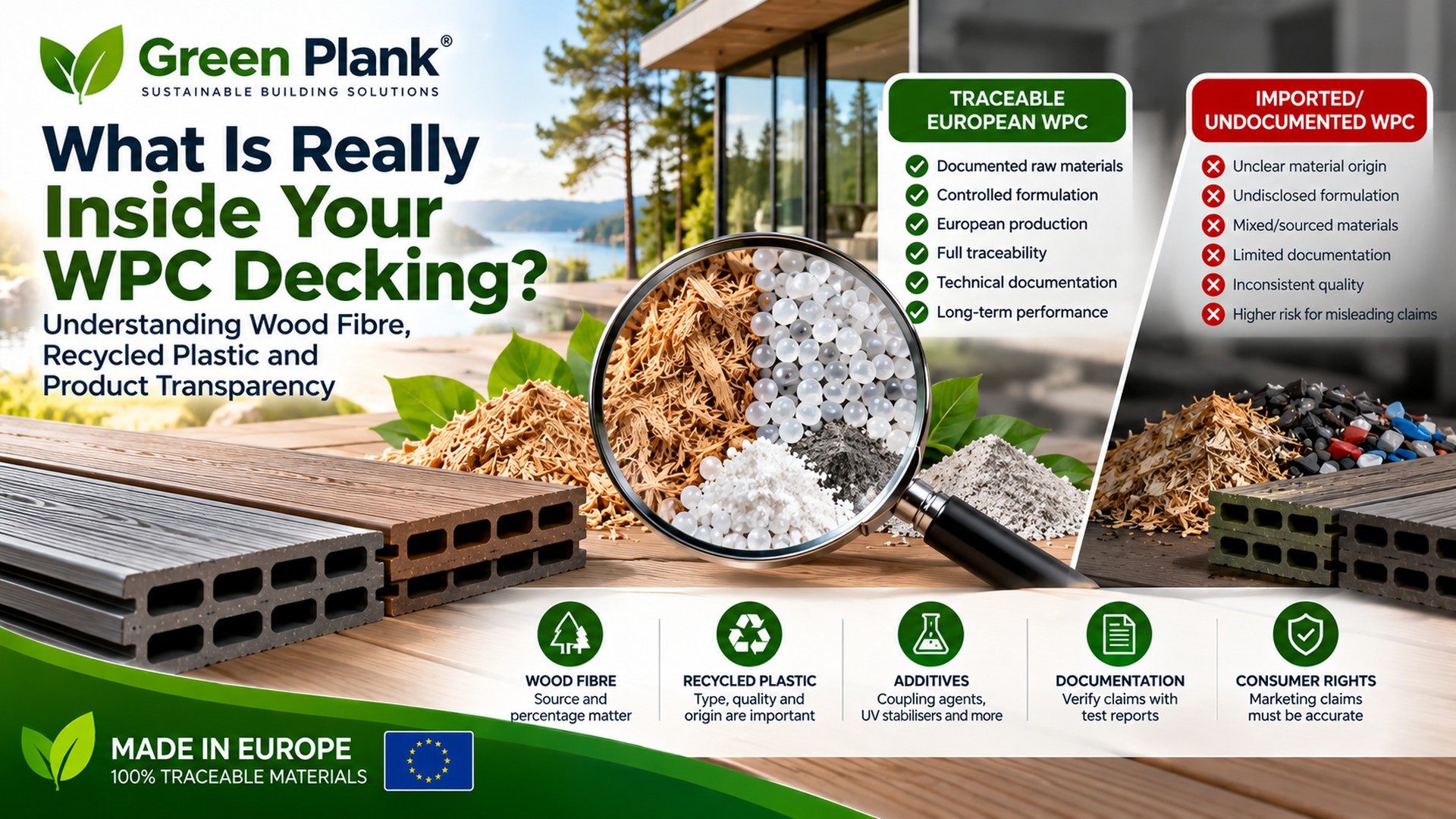
What Is Really Inside Your WPC Decking? Understanding Wood Fibre, Recycled Plastic and Product Transparency
Wood-plastic composite (WPC) decking is increasingly used for terraces, balconies, walkways and other outdoor applications. Yet two boards that look almost identical can have very different formulations, raw-material sources, technical documentation and performance characteristics.
For architects, merchants, installers and homeowners, the important question should therefore not simply be: “Where was this decking manufactured?” A better question is: “What is actually inside the product, and can the supplier document the claims being made about it?”
WPC Is a Formulated Composite Material
A typical WPC decking profile combines wood or natural fibres with a thermoplastic polymer and a package of functional additives. Depending on the formulation, additives may include coupling agents, lubricants, UV stabilisers, antioxidants, pigments and mineral fillers.
The percentages can vary considerably between manufacturers. A higher percentage of wood fibre does not automatically make one product superior, just as a higher percentage of polymer does not automatically mean better performance.
What matters is whether the formulation has been engineered for its intended application and whether claims concerning composition, durability, recycled content, origin and performance can be supported by reliable documentation.
Why Wood-Fibre Percentage Matters
The ratio between wood fibre and polymer can influence processing and several properties of a WPC profile. Wood fibres contribute stiffness, appearance and material efficiency, while the polymer forms the continuous matrix that binds and protects the fibres.
Coupling agents and other additives also play important roles because wood fibres and polyolefin plastics such as HDPE do not naturally bond efficiently without appropriate formulation technology.
This means buyers should avoid judging a WPC board by a single percentage. Instead, they should consider the complete formulation together with independent or documented performance information.
Ask for measurable information
- Declared wood or natural-fibre percentage
- Polymer type, such as HDPE, PP or PVC
- Declared recycled content, where this is marketed
- Origin and traceability where origin claims are made
- Relevant technical test reports
- UV, moisture and durability information
- Installation requirements and joist spacing
- Warranty conditions and exclusions
What If a WPC Product Is Advertised as “70% Wood Fibre”?
This is a different issue because “70% wood fibre” is a specific and measurable product claim.
If a supplier or retailer markets a board as containing 70% wood fibre, customers can reasonably understand that statement as information about the composition of the product they are purchasing.
If reliable testing were to establish that the actual product contained materially less wood fibre, the discrepancy could raise questions under consumer and marketing law.
Swedish Law Requires Marketing Claims to Be Accurate
Sweden's Marketing Act (Marknadsföringslagen) prohibits businesses from using incorrect or misleading statements in marketing. The rules specifically cover representations concerning a product's nature, quantity, quality, characteristics, origin and method of manufacture.
The Act also addresses the omission of material information. Therefore, businesses selling WPC in Sweden should be able to substantiate concrete factual statements used in advertising, product descriptions and other marketing.
This principle is especially relevant to claims such as:
- “70% wood fibre”
- “100% recycled plastic”
- “Made in Europe”
- “European raw materials”
- “30-year durability”
- “Lower carbon footprint”
- “100% traceable materials”
Such statements should be used only when the supplier has appropriate evidence supporting them.
Swedish Consumers Also Have Rights After Purchase
The Swedish Consumer Sales Act (Konsumentköplagen 2022:260) provides another important layer of protection.
A product must correspond to the agreed description, quantity, quality and other characteristics. Swedish law also provides that goods should correspond to statements concerning their characteristics or use made by the seller, or by an earlier party in the supply chain, in marketing or otherwise before purchase.
This reflects the broader EU framework. Directive (EU) 2019/771 provides that consumer goods should possess the qualities and other characteristics consumers may reasonably expect, taking into account public statements made by the seller, producer or others earlier in the transaction chain, particularly in advertising or labelling.
Consequently, a measurable composition statement can have significance beyond advertising. If a product is sold on the basis of a particular specification but does not correspond to that specification, consumer remedies may potentially become relevant depending on the circumstances.
Does the Consumer Have a Right to the Complete WPC Recipe?
Product transparency should not be confused with an automatic right to obtain a manufacturer's confidential formulation.
A producer may have legitimate proprietary information concerning exact additive packages, processing technology and formulation know-how. However, confidentiality does not make misleading marketing acceptable.
If a business voluntarily advertises a measurable characteristic—for example, a particular wood-fibre percentage—that statement should be accurate and capable of substantiation.
How Should Buyers Compare WPC Products?
Country of origin alone is not an adequate quality test. High- and lower-performing products can be manufactured in many different countries.
A more professional purchasing decision compares documented characteristics.
| Comparison point | What to request |
|---|---|
| Composition | Declared wood-fibre, polymer and relevant material information |
| Raw materials | Origin and traceability documentation where such claims are made |
| Recycled content | Evidence supporting the stated recycled percentage |
| Performance | Relevant laboratory reports and applicable test standards |
| Durability | Technical evidence together with clear warranty conditions |
| Manufacturing | Identifiable manufacturer and production location |
| Environmental claims | Evidence supporting specific environmental or CO₂ statements |
Transparency Is More Valuable Than Country-of-Origin Stereotypes
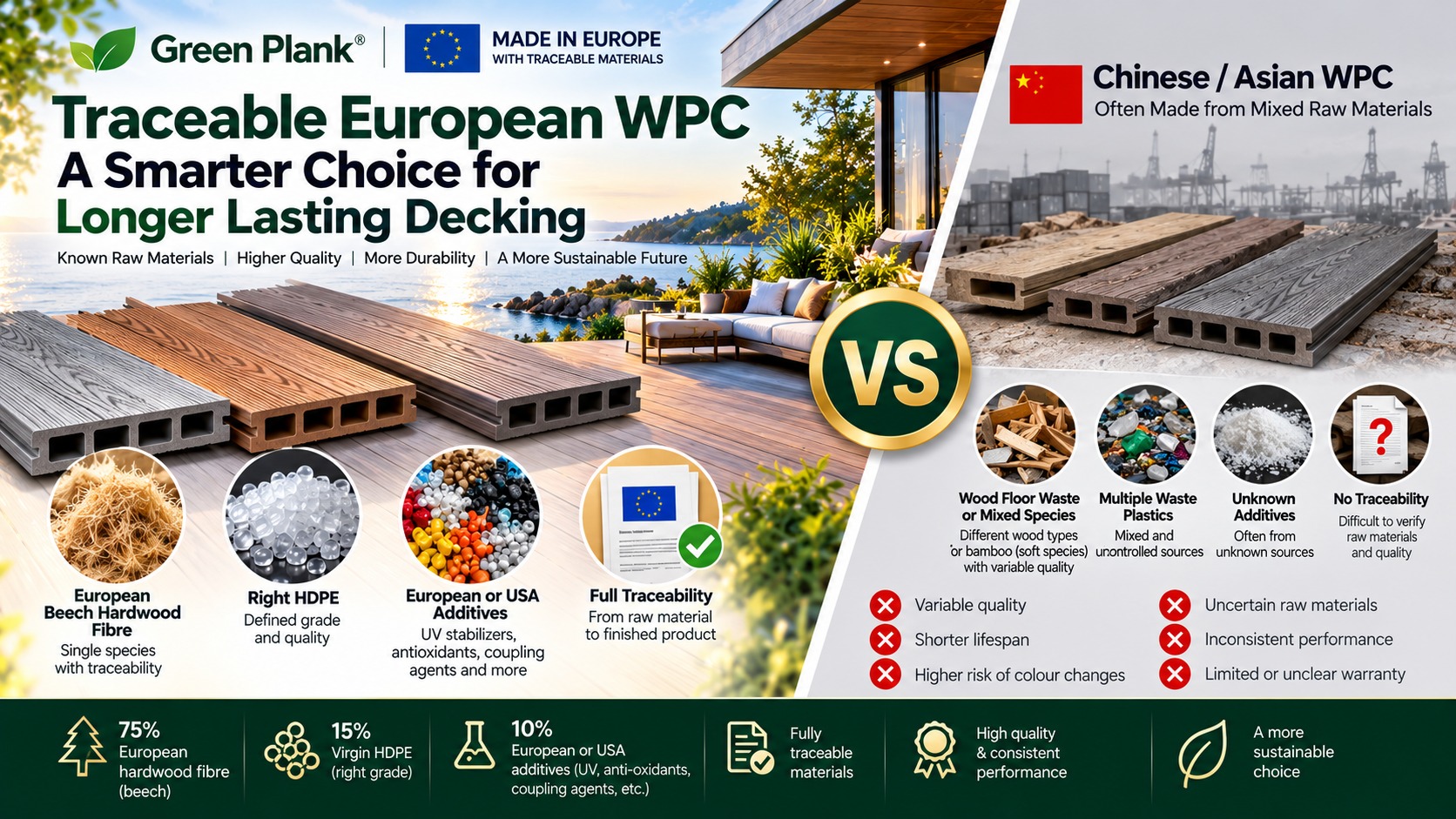
The WPC industry should not reduce the quality discussion to “European versus Chinese.” Geography alone cannot demonstrate formulation quality or product performance.
The meaningful distinction is between documented and undocumented claims.
A manufacturer that states the composition, identifies its raw materials, provides appropriate technical documentation and can substantiate its marketing gives architects, merchants, contractors and consumers a much stronger basis for evaluating the product.
Green Plank's Approach: Document What You Claim
At Green Plank, we believe buyers should be able to make informed comparisons based on measurable information rather than appearance or price alone. Material traceability, controlled formulation, technical documentation and transparent product specifications are therefore important parts of how we present our WPC solutions.
When comparing composite decking, ask more than “How much does it cost?” Ask what it contains, where the claimed materials originate, what technical evidence supports its performance and whether the supplier can document the statements used to sell it.
Good WPC should not depend on unclear claims. Quality starts with knowing what you are buying.
Sources & Further Reading
- European Commission – Commission Implementing Regulation (EU) No 276/2013: WPC decking customs classification under CN 3918 90 00.
- Sveriges Riksdag – Marknadsföringslag (2008:486).
- Sveriges Riksdag – Konsumentköplag (2022:260).
- European Union – Directive (EU) 2019/771 on certain aspects concerning contracts for the sale of goods.
Specify the product
Use this guide with a Green Plank specification
Technical articles support the commercial catalogue — category, product, evidence, then samples or quotes.