



Why Pay for Decking Boards That You End Up Cutting Off? Choose the Right Length, Save Money, and Reduce Waste – Made in Europe
Smarter composite decking starts long before the first board is installed. Discover how Green Plank's flexible decking lengths can help you build a beautiful outdoor space with less unnecessary material, fewer cuts, and better control over your project budget.
The Hidden Cost of Decking That Nobody Talks About
Imagine spending months planning your perfect terrace.
You have chosen the colour, measured the available space, compared materials, and finally decided to invest in high-quality composite decking.
Everything seems ready.
Then the installation begins.
Your terrace requires boards measuring 4.6 metres, but the available decking boards are 5 metres long. Your installer cuts 40 centimetres from every board.
At first, those small pieces may not seem important.
But what happens when your project requires 100 boards?
Suddenly, you have 40 linear metres of leftover material.
You paid for those 40 metres. They were manufactured, packaged, transported, delivered, carried to the installation area, measured, and cut.
And unless those offcuts can be reused somewhere else, they may never become part of your terrace.
This is one of the most overlooked costs in outdoor construction.
The real cost of decking is not simply the price of the boards you buy. It is the cost of the decking you actually install, together with the labour and materials required to complete the project.
At Green Plank, we believe there is a better way to approach this problem.
Instead of asking customers to adapt their projects to a limited selection of standard board lengths, why not offer more lengths so customers can choose boards that fit their projects more closely?
That simple idea is at the heart of Green Plank's flexible-length composite decking programme.
Why Decking Board Length Matters More Than You Think
When people compare decking materials, they usually focus on colour, surface finish, thickness, durability, warranty, and price per linear metre or square metre.
These are important considerations.
However, board length deserves just as much attention.
A decking board that costs slightly less per metre may become the more expensive choice if a large proportion of it must be cut away.
Consider two decking suppliers.
Supplier A offers an attractive price, but only a few standard lengths.
Supplier B offers a wider selection of lengths, allowing you to order boards much closer to your required dimensions.
Even if Supplier B has a slightly higher unit price, the final installed cost may be lower because less material is purchased unnecessarily and fewer cuts are required.
The difference becomes particularly significant for larger terraces, commercial developments, residential projects, and public outdoor spaces.
Choosing the right length is therefore not merely a matter of convenience.
It is an important part of project planning, material efficiency, and cost management.
Green Plank: Composite Decking in 31 or 41 Length Options
Green Plank is a Swedish brand offering European-made wood-plastic composite products for outdoor applications.
Our decking collections are designed to combine natural-looking finishes, practical performance, and flexible project planning.
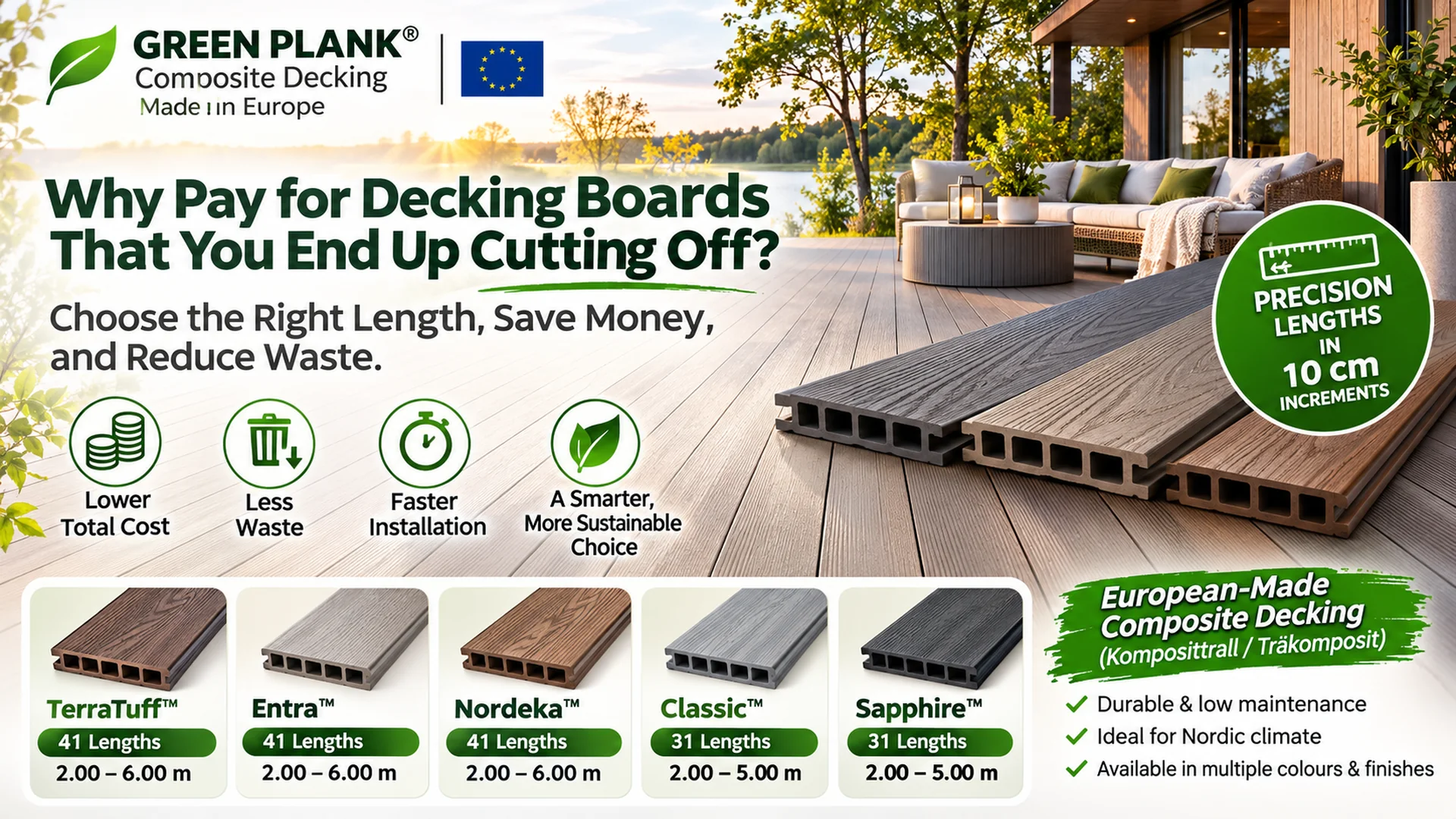
One of the most distinctive features of our expanded decking programme is the opportunity to select board lengths in 10 cm increments.
Instead of choosing only between a few common lengths, customers can specify dimensions that more closely match their terrace design.
Green Plank decking collections and available length options
| Green Plank collection | Length options | Length range | Increments |
|---|---|---|---|
| TerraTuff™ | 41 | 2.00–6.00 m | 10 cm |
| Entra™ | 41 | 2.00–6.00 m | 10 cm |
| Nordeka™ | 41 | 2.00–6.00 m | 10 cm |
| Classic™ | 31 | 2.00–5.00 m | 10 cm |
| Sapphire™ | 31 | 2.00–5.00 m | 10 cm |
The table describes Green Plank's specified length-selection programme. Individual length availability, minimum order quantities, production scheduling, and delivery times should be confirmed before ordering.
What does a 10 cm length increment actually mean?
It means that instead of jumping from 4.0 metres to 5.0 metres, you can select:
4.00 m, 4.10 m, 4.20 m, 4.30 m, 4.40 m, 4.50 m, 4.60 m, 4.70 m, 4.80 m, 4.90 m, or 5.00 m.
If your project requires 4.7-metre boards, you can select that length rather than automatically purchasing 5-metre boards.
If your terrace needs 3.3-metre boards, you can choose 3.3 metres rather than buying 3.6 or 4 metres and cutting every board.
The principle is simple:
Buy closer to what you need. Install more of what you buy. Waste less of what you pay for.
That is a practical improvement for homeowners, professional installers, architects, and building-material merchants.
How Much Money Can the Right Decking Length Save?
The easiest way to understand the financial benefits is to look at a realistic example.
Imagine you are building a terrace that requires 100 composite decking boards, each measuring 4.70 metres.
You have two purchasing options.
Option A: Buy 5.00-metre boards
- Number of boards: 100
- Purchased length per board: 5.00 m
- Total decking purchased: 500 linear metres
- Required installed length: 470 linear metres
- Potential cutting waste: 30 linear metres
Option B: Buy 4.70-metre boards
- Number of boards: 100
- Purchased length per board: 4.70 m
- Total decking purchased: 470 linear metres
- Required installed length: 470 linear metres
- Potential length-related cutting waste: approximately zero before allowing for installation tolerances
The difference is 30 linear metres of decking.
At an illustrative material price of SEK 100 per linear metre:
30 linear metres × SEK 100 = SEK 3,000 in potentially avoidable material purchases.
Now consider installation labour.
Suppose measuring and cutting each board takes an average of two additional minutes.
For 100 boards, that represents approximately 200 minutes, or 3 hours and 20 minutes.
At an illustrative labour rate of SEK 500 per hour, the additional cutting work represents approximately SEK 1,667.
Combined, the example suggests a potential gross saving of approximately SEK 4,667.
This does not mean every customer will save that amount.
Actual savings depend on board prices, available lengths, cutting requirements, reuse of offcuts, delivery charges, installation methods, and whether special lengths carry a price premium.
Nevertheless, the example demonstrates something important.
A decking board's purchase price does not tell the whole story.
The amount of material you can actually use matters just as much.
The True Cost of Decking Waste
When a decking board is cut, the visible offcut is only one part of the cost.
There are several other expenses that can accompany unnecessary cutting.
1. The material you purchased but did not install
This is the most obvious cost.
Every unused piece represents material that was paid for but may not contribute to the finished terrace.
2. Additional installation labour
Cutting takes time.
Boards must be measured, marked, positioned, cut, and checked.
Some cuts require additional finishing or preparation before installation.
Across a large project, these repeated operations can become significant.
3. Cutting equipment and consumables
Saw blades, equipment maintenance, electricity, dust extraction, and personal protective equipment all contribute to installation costs.
4. Material handling
Offcuts must be collected, moved, sorted, stored, reused, or disposed of.
This can create additional work, particularly on commercial construction sites.
5. Waste management
Construction waste may require collection, transport, and appropriate disposal or recycling.
6. Project delays
When cutting and material handling take longer than expected, installation schedules can become less predictable.
The value of choosing the right decking length is therefore broader than the cost of the material itself.
It can simplify the entire installation process.
Why Less Cutting Can Mean Faster Installation
Professional decking installers understand that efficiency is essential.
A successful project depends on good planning, suitable materials, reliable delivery, and a clear installation process.
When boards arrive closer to their required lengths, the installation team may spend less time making repetitive cuts.
This can help simplify site organisation and reduce the number of tools and workstations needed for cutting.
It may also make the work area easier to manage.
For homeowners completing their own decking projects, fewer cuts can mean a less complicated installation experience.
For professional contractors, it may support more predictable labour planning.
However, correctly selected board lengths do not eliminate the need for careful installation.
Composite decking must still be installed according to the manufacturer's instructions, including the required support spacing, ventilation, drainage, expansion allowances, and fastening details.
The aim is not to eliminate every cut.
It is to eliminate as many unnecessary cuts as practical.
Why Green Plank Offers Different Decking Collections
Not every outdoor project has the same requirements.
A small residential balcony is different from a large family terrace.
A garden walkway is different from a restaurant's outdoor seating area.
A private pool deck is different from a public outdoor development.
That is why Green Plank offers several decking collections.
Each collection provides a different design and product option while supporting the same overall principle: choosing materials that suit the project rather than forcing the project to fit a limited range of materials.
TerraTuff™ – Premium Composite Decking with 41 Length Options
TerraTuff™ is positioned as a premium decking solution for customers seeking attractive outdoor finishes and the benefits of protective capped composite technology.
Its protective outer layer is designed to improve resistance to everyday outdoor exposure and help simplify maintenance.
TerraTuff™ is particularly relevant for homeowners and professionals who want a refined appearance and a durable outdoor surface.
Under Green Plank's expanded length-selection programme, TerraTuff™ offers 41 length options from 2.00 to 6.00 metres.
That means customers can plan terraces with lengths such as 3.70 m, 4.20 m, 4.90 m, or 5.60 m without automatically selecting the next larger standard board.
The practical advantage is greater freedom during design and material planning.
For large terraces and architect-designed outdoor spaces, this flexibility can be especially valuable.
Entra™ – Flexible Composite Decking for Modern Outdoor Spaces
Entra™ is part of Green Plank's decking range for customers seeking a balance of appearance, practical performance, and project flexibility.
Its proposed 41-length programme covers 2.00 to 6.00 metres in 10 cm increments.
This range can accommodate different terrace layouts, garden configurations, and installation requirements.
For example, a homeowner planning a 3.80-metre terrace can specify boards closer to that length rather than automatically buying 4.00-metre boards.
The difference may appear small on one board, but it becomes more meaningful across an entire installation.
Entra™ is an option worth considering when comparing project dimensions, board profiles, colours, and overall installation costs.
Nordeka™ – Scandinavian-Inspired Composite Decking in 41 Lengths
Nordeka™ reflects the practical design approach associated with Scandinavian outdoor living.
The collection's expanded programme includes 41 length options from 2.00 to 6.00 metres.
This makes it suitable for planning outdoor spaces with varying dimensions, from compact residential terraces to larger decking projects.
The ability to choose lengths in 10 cm increments helps designers and contractors coordinate board sizes with their intended layouts.
For customers comparing träkomposit and traditional timber decking, Nordeka™ offers another opportunity to consider the advantages of composite materials and more flexible purchasing.
Classic™ – Practical Composite Decking in 31 Lengths
Not every project requires boards longer than five metres.
For many residential terraces, garden platforms, and outdoor seating areas, a range from 2.00 to 5.00 metres provides ample flexibility.
Green Plank Classic™ is included in the 31-length programme.
Available length selections run from 2.00 metres to 5.00 metres, with a difference of just 10 cm between consecutive lengths.
This gives homeowners and installers greater control over material ordering.
A terrace requiring 3.40-metre boards, for example, can be planned around that dimension rather than relying on a limited selection of longer boards.
Classic™ offers a practical route for customers who want to manage material costs while benefiting from the characteristics of composite decking.
Sapphire™ – Smart Length Selection in 31 Options
Sapphire™ completes Green Plank's five-collection decking programme.
Like Classic™, Sapphire™ offers 31 proposed length options from 2.00 to 5.00 metres in 10 cm increments.
It is intended to provide another choice for customers comparing composite decking profiles, finishes, budgets, and installation requirements.
For a project requiring 4.30-metre boards, the ability to specify that length can help reduce unnecessary cutting compared with purchasing 5.00-metre boards.
Sapphire™ therefore supports the same practical objective as the other Green Plank collections: helping customers make better use of the decking they purchase.
A Smarter Way to Design Your Terrace
The benefits of choosing the right decking length begin during the planning stage.
Before selecting a board, it is worth thinking carefully about the shape and dimensions of the terrace.
A rectangular terrace may be relatively simple to plan.
An L-shaped terrace, a terrace with steps, or a deck built around an existing structure requires more detailed measurements.
In either case, good planning can help reduce unnecessary purchases.
Start with the finished dimensions
Measure the intended decking area accurately.
Identify the direction in which the decking boards will run.
Then calculate the length required for each board or section.
If the design contains several different areas, calculate them separately.
Consider the board direction
The direction of the decking boards affects the visual appearance, the supporting structure, and the lengths required.
Long boards can create a clean, continuous appearance.
Shorter boards may be more practical for certain layouts.
The best choice depends on the project.
Account for expansion and installation gaps
Wood-plastic composite decking expands and contracts with temperature changes.
The correct expansion allowances depend on the product, board length, installation temperature, and manufacturer's instructions.
Do not order boards solely according to the finished visible dimension without considering these requirements.
Calculate quantities accurately
The number of boards required depends on the deck area, the actual board width, and the specified spacing between boards.
A decking calculator can help estimate material quantities, but final orders should be checked against the installation drawing.
Compare total installed cost
Instead of comparing only the price per linear metre, compare the full cost of each option.
Include material quantities, expected offcuts, accessories, delivery, installation labour, and any additional charges for special lengths.
This provides a more meaningful basis for choosing the right product.
What Is Komposittrall, and Why Is It Popular in Scandinavia?
In Sweden, composite decking is commonly called komposittrall.
The material is also described as träkomposit, which refers to wood-plastic composite materials combining wood fibres or wood flour with a polymer matrix and selected additives.
These materials are designed to offer an alternative to conventional timber decking.
The exact performance of komposittrall depends on its formulation, manufacturing process, profile construction, surface treatment, and installation.
Many homeowners are attracted to träkomposit because it can provide a wood-inspired appearance with reduced routine surface maintenance compared with traditional timber.
Unlike conventional untreated timber, appropriately formulated composite decking generally does not require regular oiling to preserve the composite material.
However, komposittrall still requires cleaning and appropriate care.
Outdoor surfaces can collect dirt, pollen, leaves, and biological growth.
The manufacturer's cleaning and maintenance instructions should always be followed.
For customers searching online for komposittrall, Green Plank's flexible length programme adds another important consideration.
Instead of focusing only on colour and appearance, buyers can also compare how well the available board lengths match their intended terrace.
That can make a meaningful difference to both material efficiency and project costs.
Träkomposit Versus Traditional Timber Decking
Traditional timber remains a familiar choice for terraces and outdoor structures.
It has a natural appearance, is widely available, and can be suitable for many applications when properly specified and maintained.
Träkomposit offers a different combination of characteristics.
It combines wood-based material with polymers and additives to create a manufactured composite board.
Depending on the product, träkomposit can offer advantages such as reduced need for oiling, consistent manufactured profiles, and resistance to certain forms of moisture-related deterioration.
However, no decking material is perfect for every project.
Traditional timber may be easier to modify or repair in some situations.
Composite decking may have different thermal expansion characteristics and surface temperatures.
Some composite boards can become hot in direct sunlight, particularly in dark colours.
The right choice depends on the application, performance requirements, maintenance expectations, environmental documentation, and budget.
Green Plank encourages customers to compare products on their verified characteristics rather than assuming that one material is always superior.
Why European Manufacturing Matters
For Green Plank, European manufacturing is an important part of the brand's identity.
Producing decking in Europe can offer practical advantages for customers purchasing building materials within the European market.
These may include closer communication with suppliers, more manageable transport routes, access to technical documentation, and opportunities for coordinated production planning.
For merchants and distributors, dependable supply arrangements are particularly important.
Stock availability, lead times, product consistency, and the ability to obtain replacement materials all affect customer satisfaction.
European manufacturing can also support closer coordination between product development, material sourcing, quality control, and the needs of regional markets.
However, being manufactured in Europe does not automatically make a product more sustainable.
Environmental performance depends on the materials used, production energy, transport, service life, maintenance, and end-of-life treatment.
These factors should be assessed using suitable evidence.
Green Plank's goal is to combine European production with practical product design and responsible material use.
Reducing Waste Is Better Than Simply Managing Waste
Waste management is an important part of construction.
But there is an even more useful question:
What if some of that waste could be prevented before it was created?
Consider a decking project where the contractor orders unnecessarily long boards.
The excess material arrives at the site.
It is cut away.
The offcuts are collected.
Someone must then decide whether they can be reused, recycled, stored, or discarded.
Now consider the same project with boards ordered closer to the required dimensions.
Some of those offcuts may never be created.
This is the principle of waste prevention.
For Green Plank, offering more board lengths is one practical way to help customers reduce unnecessary material consumption.
It does not mean that every installation will become completely waste-free.
Some cutting will still be necessary around edges, steps, corners, posts, and other architectural details.
Nevertheless, reducing avoidable cutting can be an important improvement.
The Environmental Value of Better Material Planning
Construction materials require resources.
Raw materials must be sourced and processed.
Products must be manufactured, packaged, and transported.
Installation can require additional energy, equipment, and labour.
When usable materials are discarded unnecessarily, some of those resources have been consumed without contributing to the finished project.
Reducing material waste can therefore support more efficient resource use.
The European Union has identified construction and demolition waste as a major waste stream and encourages waste prevention, reuse, and recycling.
For decking projects, practical steps may include ordering appropriate lengths, optimizing layouts, reusing suitable offcuts, and following local recycling arrangements.
The environmental benefit of a particular decking product must still be assessed using product-specific evidence.
For example, an environmental product declaration or lifecycle assessment can help quantify impacts under defined assumptions.
Green Plank's flexible length programme should therefore be understood as a practical material-efficiency initiative, not as proof of a specific percentage reduction in carbon emissions.
Why Architects Should Consider Decking Length During Design
Architects often influence material selection long before construction begins.
They define the intended appearance, dimensions, and functional requirements of outdoor spaces.
These decisions can also influence how efficiently materials are used.
When decking lengths are considered during the design process, architects may be able to coordinate board dimensions with terrace layouts.
For example, a design that requires boards of 4.40 metres can be evaluated against products offering that exact length.
This may reduce the need to purchase 4.80- or 5.00-metre boards.
For larger developments, the potential benefits extend beyond material cost.
Reducing unnecessary cutting may simplify installation planning and site logistics.
It can also support more accurate material schedules.
Green Plank's range of 31 and 41 length options gives architects another variable to consider when developing efficient outdoor designs.
Benefits for Professional Contractors
For professional decking installers, time is money.
The profitability of a project depends on many factors, including labour productivity, material management, transport, and scheduling.
Every unnecessary cut adds a small task.
Across hundreds or thousands of boards, those tasks can accumulate.
Ordering closer to the required lengths may help reduce repetitive cutting and make installation more predictable.
Contractors can also benefit from more accurate material planning.
Instead of estimating quantities around a small number of standard lengths, they can prepare orders that better reflect the actual design.
This may be especially useful for larger residential developments, hospitality projects, and commercial terraces.
However, contractors should confirm whether the requested lengths are available within the required delivery schedule.
The most efficient board length is only useful when it can be supplied at the right time and at a competitive total cost.
Benefits for Building-Material Retailers and Distributors
Retailers and distributors face a different challenge.
They must balance customer choice against stock complexity.
A wide range of lengths can create commercial opportunities, but it also requires careful inventory planning.
Green Plank's length-selection programme may be particularly valuable when supported by made-to-order arrangements or coordinated project deliveries.
Retailers can help customers select lengths that better match their projects.
This can create a more consultative sales experience.
Rather than selling decking solely by colour and price, merchants can offer practical advice about material quantities, board lengths, installation accessories, and potential waste reduction.
For professional customers, this service can be an important reason to choose a particular supplier.
Why Homeowners Should Think Beyond the Lowest Price
A terrace is an investment in the way people use their homes.
It may become a place for family meals, summer evenings, outdoor entertaining, or simply relaxing after a busy day.
Naturally, homeowners want good value.
But the lowest advertised decking price does not always produce the lowest final project cost.
A more expensive board that fits the required dimensions may be competitive with a cheaper board that creates significant offcuts.
The same applies to maintenance.
The long-term cost of a terrace includes cleaning, repairs, replacement materials, and other maintenance requirements.
For that reason, it is sensible to compare decking products based on their expected total cost rather than their initial purchase price alone.
Green Plank's flexible lengths are designed to make this comparison more practical.
How to Calculate Your Decking Waste Before Ordering
You do not need complicated software to make a basic waste calculation.
Start with three numbers:
- The number of boards required.
- The length of each board you plan to purchase.
- The length of each board that will actually be installed.
Subtract the installed length from the purchased length.
Then multiply the difference by the number of boards.
Example: 80 boards
Suppose your terrace requires 80 boards measuring 3.70 metres.
Your supplier only offers 4.00-metre boards.
The potential offcut per board is:
4.00 − 3.70 = 0.30 metres.
For 80 boards:
80 × 0.30 = 24 linear metres.
At SEK 100 per linear metre, that represents SEK 2,400 of potentially avoidable material.
Now imagine ordering 3.70-metre boards instead.
The length-related offcut can be greatly reduced, subject to installation allowances.
This is why choosing the correct length matters.
More Examples of Potential Savings
| Required board length | Purchased standard length | Number of boards | Potential offcut |
|---|---|---|---|
| 2.70 m | 3.00 m | 100 | 30 LM |
| 3.30 m | 3.60 m | 100 | 30 LM |
| 3.80 m | 4.00 m | 100 | 20 LM |
| 4.30 m | 5.00 m | 100 | 70 LM |
| 4.70 m | 5.00 m | 100 | 30 LM |
| 5.40 m | 6.00 m | 100 | 60 LM |
These are illustrative comparisons.
Actual waste may be lower if offcuts can be used elsewhere in the project.
For example, a 70 cm offcut might be useful for a step, edge detail, or another suitable component.
A well-planned cutting schedule should always consider reuse before classifying material as waste.
Nevertheless, the examples demonstrate why length selection can have a significant financial effect.
Why 10 cm Increments Are So Practical
A 10 cm difference may not sound significant.
But it provides a useful balance between flexibility and manageable production planning.
For customers, it means a wider selection without requiring every board to be individually cut to a completely unique dimension.
For manufacturers, a structured length programme can support organized production and order management.
For installers, it provides the opportunity to choose lengths closer to the project dimensions.
For retailers, it creates a clear product-selection system that can be explained easily to customers.
The principle is straightforward:
More suitable length choices can lead to better material utilization.
The Importance of Choosing the Right Decking Width
Board length is only one part of the calculation.
Board width also affects material consumption.
A terrace built using 140 mm boards will require a different number of boards than a terrace built using 150 mm boards, even if the total area is identical.
The gap between boards must also be included.
For example, a nominal 140 mm board installed with a 5 mm gap occupies approximately 145 mm across the deck, except at perimeter details.
That means the approximate linear metres of decking required per square metre can be calculated from the effective coverage width.
However, actual quantities depend on the layout, board dimensions, edge details, and installation requirements.
Green Plank recommends calculating board quantities using the exact profile selected.
This helps avoid ordering too little material or purchasing excessive quantities.
Long Boards Versus Short Boards: Which Are Better?
Long boards can create an attractive, continuous appearance.
They may reduce the number of visible end joints and simplify certain terrace layouts.
However, long boards can also be more difficult to transport, carry, and handle.
Shorter boards may be easier to manage and can work well for smaller terraces or designs with multiple sections.
The ideal length depends on the project.
For a terrace measuring 4.20 metres in the board direction, 4.20-metre boards may be convenient.
For a terrace divided into shorter sections, a combination of lengths may be more efficient.
Green Plank's flexible programme allows customers to explore these possibilities rather than relying on a few fixed dimensions.
Composite Decking and the Nordic Climate
Outdoor decking in Northern Europe must withstand changing weather conditions.
Rain, snow, frost, sunlight, and seasonal temperature differences all affect outdoor materials.
A well-designed composite decking product must be selected and installed with these conditions in mind.
Important factors include moisture management, surface performance, thermal movement, and suitable supporting structures.
Drainage and ventilation are especially important.
Water should not be allowed to remain trapped beneath the decking.
The supporting structure must be designed to provide adequate stability and airflow.
Appropriate gaps must be maintained between boards and around fixed structures.
These details are essential regardless of whether the decking is installed in Sweden, Denmark, Norway, Germany, or elsewhere in Europe.
Low Maintenance Does Not Mean No Maintenance
One of the reasons people choose composite decking is the desire to spend less time maintaining their terrace.
Traditional timber may require periodic oiling, staining, or other protective treatments depending on the species, exposure, and desired appearance.
Composite decking generally offers a different maintenance profile.
Routine cleaning is still important.
Leaves, soil, pollen, food residue, and other contaminants should be removed according to the product instructions.
Outdoor furniture should be used with suitable protection where necessary.
The surface should be inspected periodically, and drainage routes should remain clear.
The aim is to enjoy the terrace without unnecessary maintenance work.
For many homeowners, that is an important part of the value of composite decking.
A More Practical Approach to Sustainable Outdoor Living
Sustainability is sometimes presented as a complicated subject.
In practice, many useful improvements begin with ordinary decisions.
Buying only what is needed is one of them.
Choosing appropriate materials is another.
Designing for durability and repairability also matters.
Green Plank's flexible length programme connects these principles with everyday outdoor construction.
Instead of treating waste as an unavoidable consequence of installation, it encourages customers to think about material efficiency before placing an order.
That is a useful approach whether the project is a small garden terrace or a large commercial outdoor development.
Frequently Asked Questions
What is composite decking?
Composite decking is an outdoor decking material manufactured using a combination of wood-based fibres or flour, polymers, and selected additives. Its characteristics depend on the formulation and product design.
What is komposittrall?
Komposittrall is the Swedish term commonly used for composite decking. It is frequently used by homeowners searching for alternatives to traditional timber decking.
What is träkomposit?
Träkomposit means wood composite. In the context of outdoor decking, it commonly refers to wood-plastic composite materials that combine wood fibres with a polymer matrix.
How many decking lengths does Green Plank offer?
Green Plank's expanded length-selection programme specifies 41 length options for TerraTuff™, Entra™, and Nordeka™, and 31 options for Classic™ and Sapphire™. Actual ordering availability should be confirmed.
What lengths are available for TerraTuff?
The specified TerraTuff™ programme covers 2.00 to 6.00 metres in 10 cm increments, giving 41 possible lengths.
What lengths are available for Entra?
The specified Entra™ programme covers 2.00 to 6.00 metres in 10 cm increments, giving 41 possible lengths.
What lengths are available for Nordeka?
The specified Nordeka™ programme covers 2.00 to 6.00 metres in 10 cm increments, giving 41 possible lengths.
What lengths are available for Classic?
The specified Classic™ programme covers 2.00 to 5.00 metres in 10 cm increments, giving 31 possible lengths.
What lengths are available for Sapphire?
The specified Sapphire™ programme covers 2.00 to 5.00 metres in 10 cm increments, giving 31 possible lengths.
Can choosing the right length reduce decking waste?
Yes. Selecting boards closer to the required dimensions can reduce avoidable cutting and offcuts. The actual reduction depends on the project layout and whether leftover pieces can be reused.
Can I save money by choosing shorter boards?
Potentially. Savings depend on the material price, labour requirements, delivery costs, length premiums, and the amount of cutting avoided.
Does composite decking require oiling?
Many composite decking products do not require routine oiling to protect the material in the same way as traditional timber. Cleaning and product-specific maintenance are still necessary.
Is composite decking waterproof?
Composite decking is generally designed for outdoor exposure, but it should not automatically be described as completely waterproof. Water absorption, dimensional changes, and moisture-related performance depend on the formulation and construction.
Is European-made composite decking more sustainable?
European manufacturing can offer logistical and supply-chain advantages, but sustainability must be evaluated using evidence such as material sourcing information, product-specific environmental data, and lifecycle assessments.
Can architects specify custom decking lengths?
Architects can incorporate the Green Plank length-selection programme into their project planning, subject to the relevant product's ordering and production conditions.
Can contractors order several different lengths for one project?
A project may benefit from a combination of lengths. The availability of mixed-length orders, minimum quantities, and delivery conditions should be confirmed with Green Plank.
Is longer decking always better?
No. The most appropriate length is the one that meets the design, structural, installation, handling, and budget requirements.
Can composite decking offcuts be recycled?
Recycling possibilities depend on the product composition, available recycling systems, and local waste-handling arrangements. Customers should check the relevant product and recycling guidance.
Conclusion: Stop Paying for Decking You Do Not Need
A beautiful terrace should be designed around the people who will enjoy it.
It should also be planned intelligently.
Every decking project involves decisions about materials, dimensions, appearance, installation, and cost.
Board length is one of those decisions, and it can have a much greater effect than many people realize.
When decking boards are unnecessarily long, customers may pay for material that never becomes part of the finished terrace.
That can mean extra cutting, additional labour, and more offcuts.
Green Plank believes customers deserve more flexibility.
With 41 length options in the TerraTuff™, Entra™, and Nordeka™ programmes and 31 length options in the Classic™ and Sapphire™ programmes, Green Plank aims to help customers choose composite decking that better matches their projects.
The benefit is not simply a wider product range.
It is a more thoughtful way to buy and install outdoor building materials.
A way to make better use of resources.
A way to improve project planning.
And a way to help customers invest in the decking they actually need.
Why pay for decking boards that you end up cutting off?
Choose the right length.
Save money where possible.
Reduce unnecessary waste.
And build your outdoor space with European-made Green Plank composite decking.
Green Plank – Made in Europe. Designed for Smarter Outdoor Living. Built to Last.
Discover our decking collections at www.greenplank.eu.
European Commission — Construction and Demolition Waste
Explains the importance of reducing construction waste and improving resource efficiency across Europe.
European Commission
Read European Commission guidance
US Environmental Protection Agency — Sustainable Management of Construction and Demolition Materials
Supports the principle that preventing waste at source can reduce material consumption and associated environmental impacts.
US EPA
European Commission — Circular Economy
Provides background on circular material use, waste prevention, and resource efficiency.
European Commission
Boverket — Questions and Answers About Climate Declarations
Explains construction-stage climate reporting, including transport and construction waste.
Specify the product
Use this guide with a Green Plank specification
Technical articles support the commercial catalogue — category, product, evidence, then samples or quotes.