



If your architectural project still relies on traditional timber to achieve a natural aesthetic, are you inadvertently designing a maintenance liability that won't meet the mandatory LEED v5 embodied carbon prerequisites starting July 1, 2026? You likely understand the frustration of watching premium wood weather, warp, and demand costly annual treatments, all while struggling to document its true environmental impact for modern certifications. It's a common challenge for professionals who refuse to sacrifice quality for sustainability.
This article explores how hardwood fiber composite benefits extend far beyond simple aesthetics, offering a high-performance alternative that balances engineering precision with environmental ethics. We'll show you how these materials outperform both timber and synthetic alternatives in durability and long-term value. You'll learn about the material science behind our 75% hardwood fiber and 25% HDPE blend, its role in supporting Cradle to Cradle ownership, and how a high strength-to-weight ratio ensures an efficient, reliable installation. By the end, you'll see why European-manufactured composites are the definitive choice for the next generation of sustainable architecture.
Key Takeaways
- Understand the engineering of Natural Fiber Composite (NFC) technology, where a 75% hardwood fiber reinforcement provides the structural integrity required for high-end architectural applications.
- Evaluate the primary hardwood fiber composite benefits, specifically the superior strength-to-weight ratio and dimensional stability that prevent warping in extreme climates.
- Support a circular economy through the Cradle to Cradle ownership model, ensuring your materials contribute to long-term sustainability and reduced CO2 footprints.
- Achieve a premium, maintenance-free aesthetic by utilizing UV-stabilized pigments that preserve the natural warmth of wood without the weathering that's common in traditional timber.
- Master technical specifications for commercial infrastructure, including the specific load-bearing requirements and 600 cc joist spacing necessary for professional-grade installations.
What is Hardwood Fiber Composite (NFC) Technology?
In the evolution of sustainable building materials, Natural Fiber Composites (NFC) represent a sophisticated leap forward. While early iterations of Wood-plastic composites (WPCs) often relied on generic biomass, modern NFC technology focuses on the precise interaction between organic reinforcements and polymer matrices. We are moving away from the reductive wood-plastic label toward the more accurate engineered fiber terminology. This shift reflects a material designed for structural predictability rather than just visual imitation. It represents a commitment to material science over simple recycling.
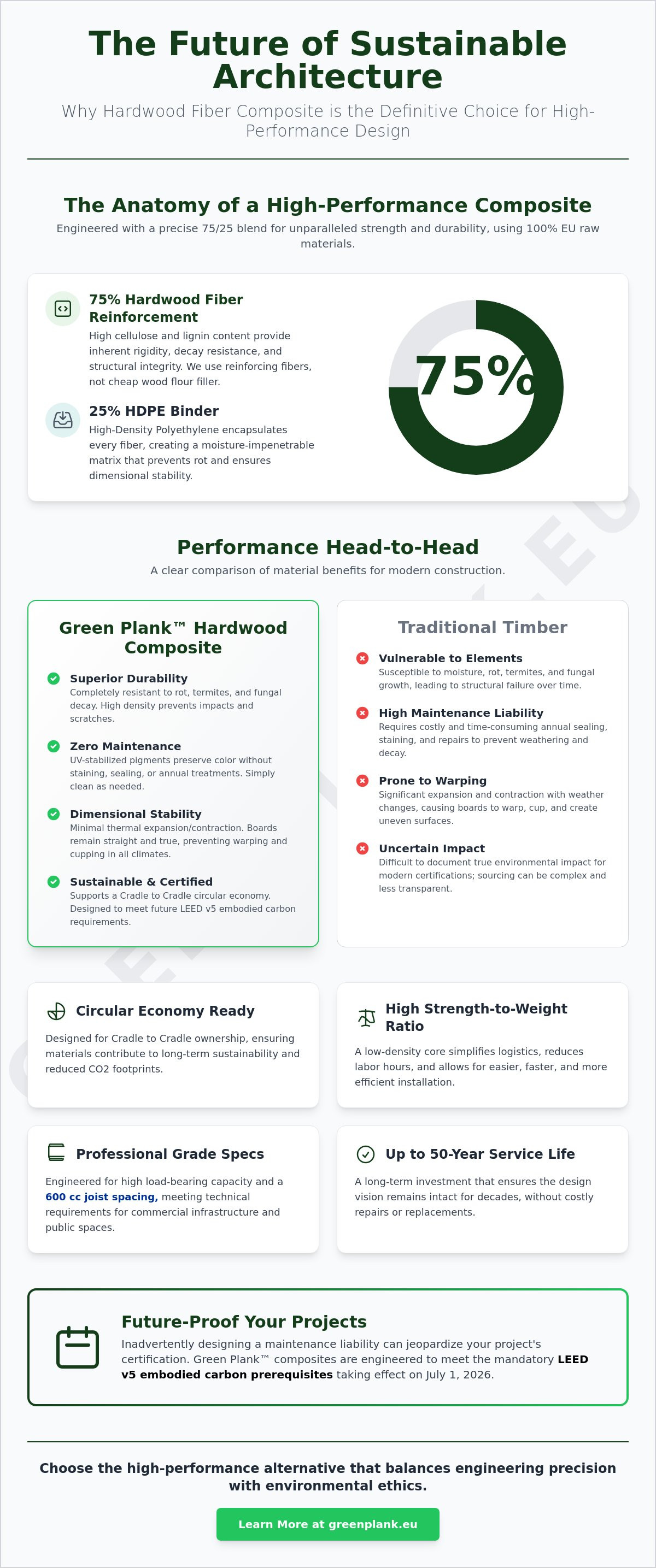
A core pillar of hardwood fiber composite benefits lies in the specific ratio of its components. By utilizing 75% hardwood fiber combined with a 25% High-Density Polyethylene (HDPE) binder, the material achieves a density and resilience that traditional timber cannot sustain. Hardwood is selected specifically for its high cellulose and lignin content. These natural polymers provide the inherent rigidity and decay resistance that define high-end architectural profiles. The result is a profile that feels like wood but performs like an industrial-grade polymer.
The Anatomy of a High-Performance Composite
The manufacturing process creates a rigorous molecular bond between the hardwood fibers and the HDPE. In this system, the polymer doesn't simply coat the wood; it encapsulates every fiber to create a moisture-impenetrable matrix. Using 100% EU raw materials ensures that these fibers are consistent in size and quality. This distinction is vital. Many products use wood flour as a filler to reduce costs, whereas our technology treats hardwood as a reinforcing element to enhance mechanical performance. This structural integrity is what allows for long service lives reaching up to 50 years.
Hardwood vs. Softwood Reinforcement
The choice of fiber species determines the long-term stability of the exterior cladding or decking. Hardwood fibers offer several advantages over softwood alternatives:
- Higher density cores provide better impact resistance for commercial foot traffic.
- Reduced moisture absorption prevents internal rot and swelling in humid environments.
- Low thermal expansion ensures the boards remain straight and true across extreme seasons.
The Core Hardwood Fiber Composite Benefits for Construction
Efficiency on a construction site depends on material predictability. Hardwood fiber composites provide a high strength-to-weight ratio that simplifies logistics and onsite handling. Because these profiles have a low-density core, installers can move and place materials with less physical strain and fewer specialized tools. This efficiency reduces labor hours and project timelines, allowing teams to focus on precision rather than muscle. It's a practical advantage that translates directly to lower installation costs for large-scale developments.
One of the most critical hardwood fiber composite benefits is dimensional stability. Traditional wood expands and contracts significantly when exposed to moisture and temperature swings. In contrast, the encapsulated hardwood fibers within our 75/25 matrix resist these forces. This stability ensures that gaps remain consistent and boards don't bow or cup, even in extreme climates. For public infrastructure, this translates to enhanced slip resistance and safety. The surface remains flat and predictable underfoot, which is vital for meeting modern accessibility standards.
The hardwood fiber composite benefits also include a natural resistance to rot, termites, and fungal decay. Unlike pressure-treated timber, these materials achieve this protection without the use of toxic chemical treatments. The HDPE binder acts as a shield, preventing moisture from reaching the organic fibers. This creates a hostile environment for biological threats, ensuring the structure remains sound without the need for periodic pesticide applications or hazardous preservatives.
Mechanical Strength and Durability
The inclusion of hardwood fibers significantly increases the flexural modulus of the board compared to softwood or pure plastic options. This rigidity is essential for maintaining the integrity of the surface under heavy foot traffic or environmental impacts like hail. We understand that infrastructure is a long-term investment. By analyzing the mechanical properties of wood composites, it's clear that the dense cellular structure of hardwood creates a more resilient core. This engineering confidence allows us to offer a service life supported by a 50-year warranty.
Low Maintenance and Lifecycle Savings
Choosing low maintenance decking provides a measurable return on investment over a 25-year period. You eliminate the need for annual sanding, staining, or sealing. These recurring costs for traditional timber often exceed the initial material price within the first decade. Our composites require only simple soap and water for cleaning, removing the need for harsh industrial chemicals that damage the environment. This ease of care ensures your outdoor space remains beautiful with minimal effort.
If you're planning a large-scale development, consider how our composite wall cladding can reduce your long-term operational costs while maintaining a premium aesthetic.
Sustainability: Hardwood Fibers and the Circular Economy
True sustainability requires a shift from linear consumption to a circular model where materials are designed for infinite lifecycles. Our Cradle to Cradle ownership model ensures that every board produced isn't just a durable building component but a resource for the future. By utilizing 75% bio-based content, we significantly reduce the reliance on fossil-fuel-derived polymers. This high concentration of organic material is a cornerstone of hardwood fiber composite benefits, allowing projects to meet strict CO2 reduction targets without compromising on structural performance.
The integrity of sustainable building materials depends heavily on their origin. We prioritize 100% EU sourcing for all raw materials to ensure transparency and ethical manufacturing. This regional approach eliminates the environmental costs associated with long-distance global shipping. Furthermore, we help eliminate deforestation by exclusively using FSC-certified hardwood by-products. Instead of harvesting new timber, we transform industrial residuals into high-value architectural assets, effectively closing the loop on wood waste.
Carbon Sequestration in Exterior Facades
When specified for large-scale projects, composite wall cladding acts as a functional carbon sink. The hardwood fibers within the matrix lock away carbon that would otherwise be released through decomposition or combustion. Compared to the high embodied energy required to produce aluminum or concrete, the manufacturing of wood-plastic composites is far less energy-intensive. European manufacturing further optimizes this footprint by utilizing cleaner energy grids and shorter transport routes, ensuring that the net environmental impact remains as low as possible throughout the product's life.
Toxicity and Safety in Public Spaces
Safety in the built environment extends beyond structural stability to the chemical composition of the materials used. Our profiles are entirely PVC-free and phthalate-free, utilizing High-Density Polyethylene (HDPE) as the primary binder. HDPE is a safer, more stable polymer that doesn't off-gas harmful chemicals over time.
- Compliance with EU REACH standards ensures the absence of hazardous substances.
- High fire safety ratings provide peace of mind in densely populated commercial zones.
- Low smoke toxicity levels protect occupants during emergency situations.
Engineered Aesthetics: The 'Natural' Feel Without the Flaws
Architects often face a difficult compromise between the organic beauty of tropical hardwood and the ethical implications of sourcing it. Hardwood fiber composites resolve this tension effectively. They provide the deep, visual warmth of rare timber without the environmental guilt. By utilizing proprietary brushing techniques, each profile mimics the irregular, organic grain found in nature. This isn't a plastic imitation. It's an engineered evolution of wood that maintains its character across diverse applications, from sophisticated wall cladding to composite fencing systems.
The design flexibility of these materials allows for a cohesive aesthetic across an entire property. You can match the texture of your deck to your perimeter fencing and vertical cladding, creating a unified architectural statement. This level of coordination is difficult to achieve with natural timber, where grain patterns and color variations can differ wildly between batches. Hardwood fiber composites offer the predictability required for high-end design while retaining the soul of natural materials. For those looking to extend this natural aesthetic to their interior spaces, you can check out WoodSnap for creative ways to display wood-themed decor without permanent wall damage.
Color Retention and Weathering
One of the most visible hardwood fiber composite benefits is long-term color stability. Natural timber inevitably turns grey within months due to UV exposure and moisture. Our materials utilize UV-stabilized pigments that are deeply absorbed by the hardwood fibers during the extrusion process. This creates a saturated, lasting hue that resists fading. While a subtle 'first-season' weathering occurs as the surface fibers acclimate to the environment, the core color remains vibrant for decades. For large-scale commercial branding, we offer custom color possibilities that allow architects to match specific design palettes while ensuring the facade remains maintenance-free.
Texture and Tactile Quality
The tactile experience of our composite is defined by its high organic content. Because the matrix contains 75% hardwood fiber, the boards lack the artificial plastic sheen common in lower-quality alternatives. They feel substantial and warm to the touch. To preserve this clean aesthetic, we employ the HidLoc™ Hidden Fastening System. This technology eliminates visible screws, creating a seamless surface that highlights the material's natural beauty. Safety remains a priority alongside style. Our surfaces achieve high R-ratings for slip resistance, ensuring they are as functional in wet poolside environments as they are in high-traffic public walkways. The combination of hidden fasteners and textured finishes creates a professional, high-end result.
View our WPC composite decking collections to see how engineered aesthetics can transform your outdoor architectural vision.
Specifying Hardwood Fiber Composites for Infrastructure
Architects and engineers require precise performance data to ensure structural longevity in modern developments. One of the primary hardwood fiber composite benefits is the predictability of span ratings and load-bearing capacities. Unlike natural wood, which can harbor hidden knots or internal grain defects, these engineered profiles offer uniform strength across every millimeter. When you design for private projects, maintaining a 600 cc joist spacing is essential. This specific spacing prevents deflection and ensures a stable, rigid walking surface that feels solid underfoot.
Proper specification also involves verifying rigorous third-party certifications. You should look for FSC-certified wood content to guarantee ethical forestry, CE marking for European safety compliance, and Cradle to Cradle credentials to support circular economy goals. These standards provide the necessary documentation for projects aiming for high LEED v5 ratings. Following a specialized deck installation guide is critical because fiber-rich composites have unique thermal expansion profiles. They don't behave like hollow-core or pure plastic alternatives; they require the precision of a sustainable craftsman.
Commercial vs. Residential Specifications
Public infrastructure projects like boardwalks, piers, and urban plazas require infrastructure-grade profiles capable of withstanding heavy pedestrian loads. Our high-density cores are designed to resist degradation even in saltwater environments and extreme climates. While residential applications often focus on the aesthetic warmth of the Entra or Classic lines, commercial specifications prioritize the rugged durability of the Terra Tuff series. These boards maintain their structural integrity under constant exposure to moisture and high-traffic friction. They've proven their resilience in diverse regional climates, from coastal humidity to sub-zero winters.
The Green Plank Advantage
The industry gold standard for performance is found in our 75% hardwood fiber content. This specific ratio provides the optimal balance of organic rigidity and polymer protection, maximizing the hardwood fiber composite benefits for the end-user. Our proprietary Smart System and Terra Tuff technologies represent the peak of "Responsible Innovation," offering low-density profiles that don't sacrifice strength. We deliver engineering confidence through:
- Profiles engineered for extreme durability.
- Materials manufactured for environmental responsibility.
- Systems designed for architectural elegance.
Designing for the Next Decade of Architectural Excellence
As the architectural landscape moves toward stricter carbon reporting and mandatory lifecycle assessments, the choice of exterior materials becomes a statement of both engineering precision and environmental ethics. We've explored how transitioning to engineered fibers allows projects to bypass the maintenance liabilities of timber while achieving superior dimensional stability. The core hardwood fiber composite benefits lie in this unique balance of high-performance durability and circular economy principles. By integrating 100% EU-sourced raw materials and a Cradle to Cradle ownership model, you ensure your designs respect nature as much as they do the client's long-term investment.
Our commitment to quality is backed by an up to 50-year limited warranty, providing the confidence required for large-scale infrastructure and high-end residential projects. You don't have to choose between a beautiful aesthetic and a responsible footprint. These materials are designed to endure, maintaining their structural integrity and visual warmth long after traditional alternatives have faded. To complement these exterior solutions with premium interior craftsmanship, Indoor Wood offers a range of high-quality wood products that bring a timeless Scandinavian aesthetic to indoor spaces.
Request a Technical Specification Pack for Your Next Project to see how these advanced materials can elevate your future designs. We look forward to helping you build a more resilient, maintenance-free world.
Frequently Asked Questions
What exactly is hardwood fiber composite?
Hardwood fiber composite is an engineered material consisting of 75% hardwood fibers and 25% High-Density Polyethylene (HDPE) binders. Unlike generic wood-plastic products, it uses high-density organic fibers as structural reinforcement rather than simple filler. This precise blend creates a profile with high impact resistance and long-term stability. It's a professional-grade alternative to traditional timber for exterior cladding, fencing, and decking applications.
How does hardwood fiber compare to softwood fiber in WPC?
Hardwood fibers offer superior density and lower moisture absorption compared to softwood alternatives. The complex cellular structure of hardwood provides a more rigid core, which reduces the risk of internal rot and swelling in humid environments. This engineering choice results in better dimensional stability. It ensures your outdoor surfaces remain flat and true across decades of seasonal shifts without the warping common in softer fibers.
Is hardwood fiber composite really more sustainable than natural wood?
Yes, because it utilizes industrial by-products and eliminates the need for ongoing chemical treatments. While natural wood requires periodic staining and sealing with hazardous substances, these composites remain maintenance-free. Our 100% EU-sourced materials and Cradle to Cradle ownership model further reduce the carbon footprint. You're transforming wood waste into a durable asset with a service life of up to 50 years.
Does hardwood fiber composite expand and contract like plastic?
No, the 75% hardwood fiber content significantly stabilizes the material against thermal expansion. While pure plastic or low-fiber composites move considerably with temperature changes, the organic fibers in our profiles act as a restraining matrix. This stability is one of the primary hardwood fiber composite benefits for architects. It allows for tighter tolerances and more predictable installations in regions with extreme weather fluctuations.
Can hardwood fiber composite be recycled at the end of its life?
Yes, our materials are designed within a circular economy framework for full recyclability. Through the Cradle to Cradle ownership model, the boards can be reclaimed and processed into new high-quality architectural profiles. This approach prevents building materials from entering landfills. It ensures that the organic and polymer components remain valuable resources for future generations of sustainable construction rather than becoming waste.
What is the expected lifespan of a hardwood fiber reinforced deck?
You can expect a service life of up to 50 years under normal residential or commercial use. This longevity is supported by our comprehensive limited warranty and the inherent resistance of hardwood to biological decay. The material doesn't warp, splinter, or rot like traditional timber. It provides a reliable, high-end outdoor space that retains its structural integrity and aesthetic appeal for half a century with minimal intervention.
Does the high fiber content make the boards more susceptible to mold?
No, because each hardwood fiber is completely encapsulated by the HDPE polymer matrix during extrusion. This manufacturing process creates a moisture-impenetrable shield that prevents the organic material from becoming a food source for mold or fungi. While surface pollen or dirt can host temporary growth, it won't penetrate the board's core. A simple cleaning routine keeps the surface pristine and hygienic throughout the seasons.
How do I clean and maintain hardwood fiber composite surfaces?
Maintenance involves nothing more than periodic cleaning with mild soap and water. You'll never need to sand, stain, or seal the surface to preserve its performance or color. For stubborn debris, a soft-bristle brush is sufficient to restore the original texture. This low-effort requirement is a key highlight of hardwood fiber composite benefits, saving you significant time and money over the material's lifespan.
Produkt spezifizieren
Diese Anleitung in einer Green Plank-Ausschreibung nutzen
Technische WPC-Artikel sollen die kommerziellen Seiten stärken — nicht mit ihnen konkurrieren. Weiter zu WPC-Terrasse, TerraTuff, Nordeka oder den technischen Downloads.