



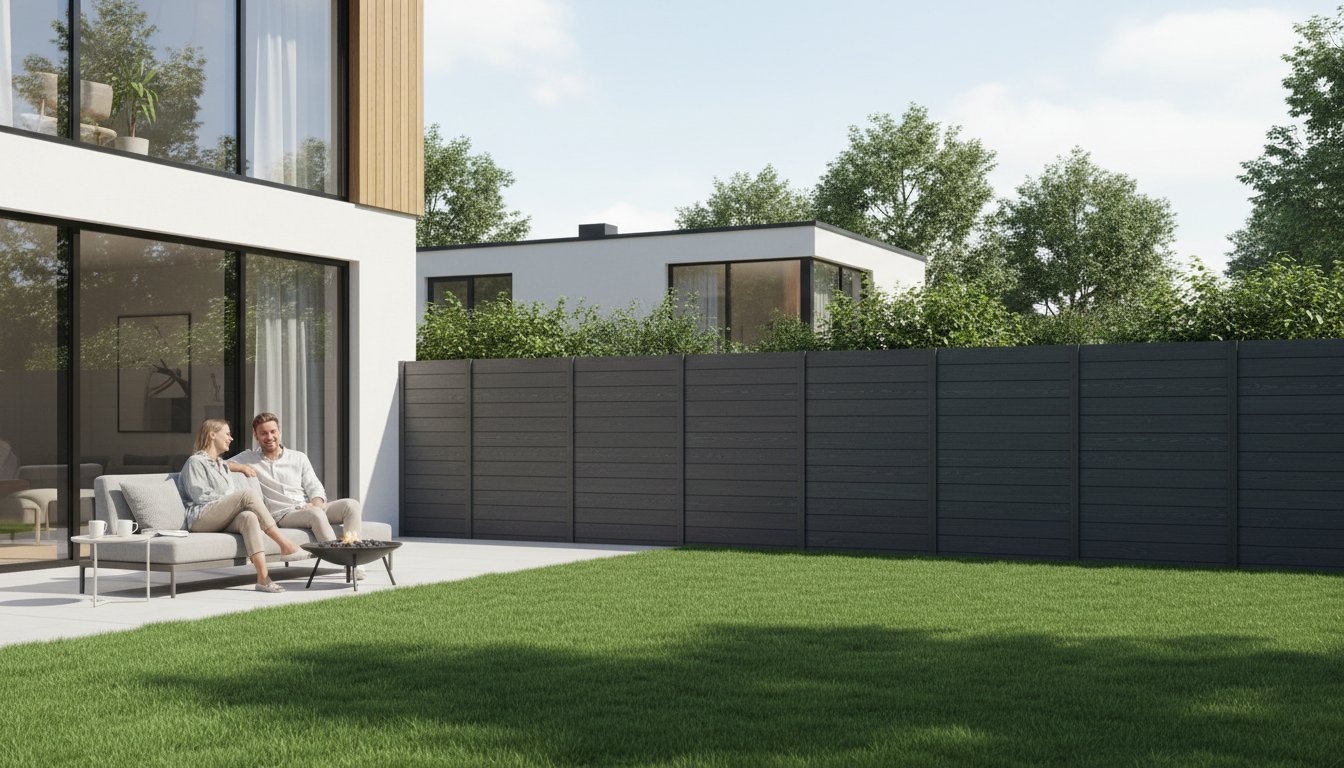
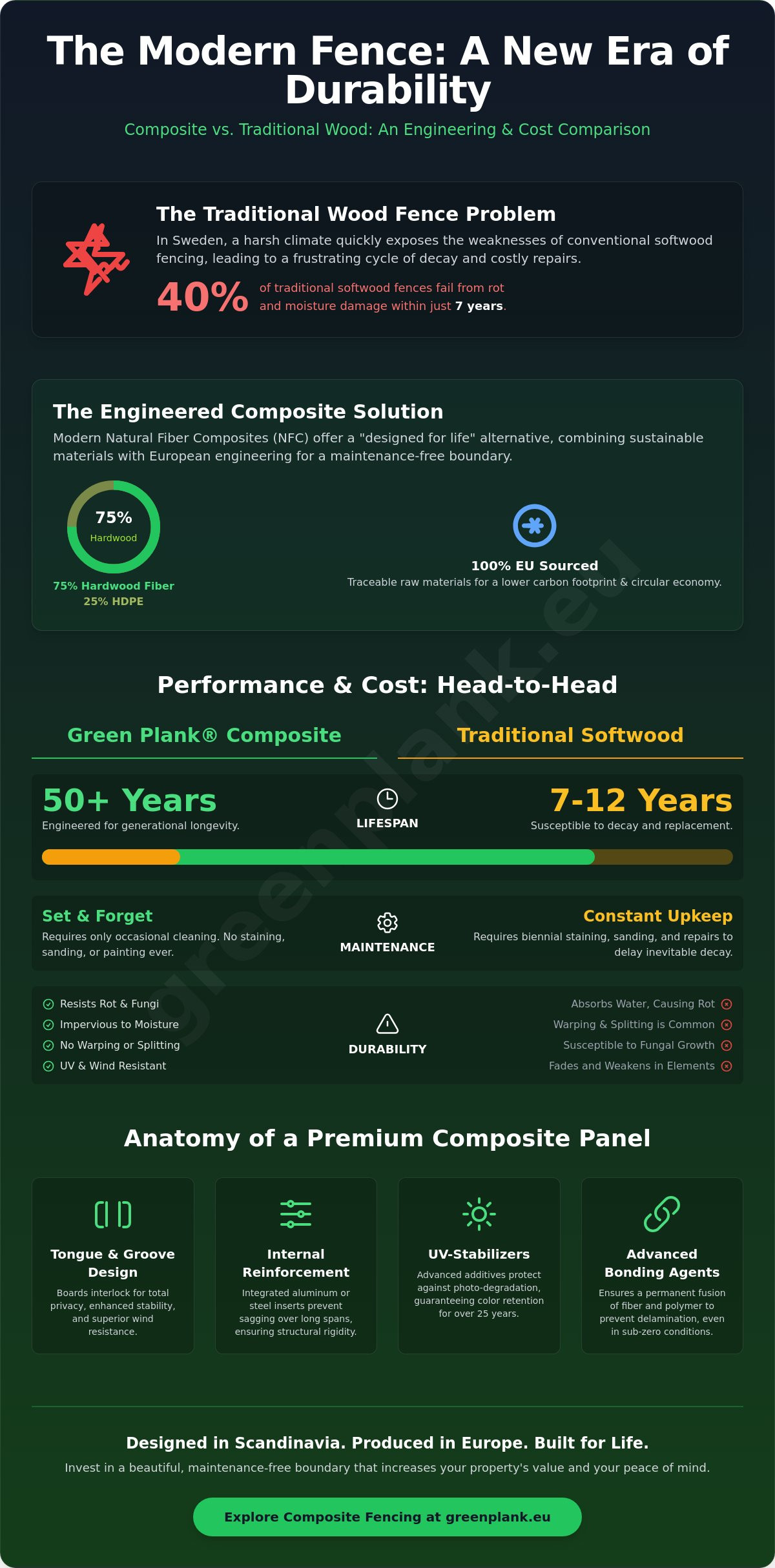
In Sweden, nearly 40% of traditional softwood fences succumb to rot and moisture damage within just seven years, making the shift toward professional-grade composite fencing a logical choice for the modern homeowner. You likely agree that a property boundary should provide security and beauty, not a perpetual cycle of sanding, staining, and expensive repairs. It's frustrating to watch a significant investment weather away after a few harsh winters or lose its structural integrity during a seasonal storm.
This guide explores how modern composite systems combine refined Scandinavian design with precision European engineering to deliver a maintenance-free solution. You'll learn how to achieve a premium aesthetic that withstands the elements while upholding genuine environmental responsibility through circular manufacturing. We'll examine the technical durability of natural-fiber composites, the benefits of traceable raw materials, and the long-term ROI of a boundary that's truly built to last and designed for life.
Key Takeaways
- Master the technical ratio of 75% hardwood fiber to 25% HDPE that delivers professional-grade durability and a refined Nordic character.
- Discover modern composite fencing ideas that combine Scandinavian minimalism with functional engineering for a maintenance-free property boundary.
- Evaluate the long-term financial benefits of a 50-year lifespan compared to traditional timber, saving thousands of SEK in maintenance and replacement costs.
- Align your outdoor space with the circular economy by choosing European-made, traceable materials designed for a sustainable future.
- Transition from biennial staining and repairs to a "designed for life" solution engineered to withstand the rigors of the Swedish climate.
What is Composite Fencing? Understanding WPC Technology
As we enter 2026, the demand for resilient, eco-conscious infrastructure has redefined the perimeter of the modern Swedish home. Wood-plastic composites (WPCs) represent a high-performance hybrid material that merges the aesthetic warmth of timber with the industrial durability of advanced polymers. While traditional fences rely on raw softwood, composite fencing utilizes an engineered blend of reclaimed natural fibers, recycled plastics, and high-grade bonding agents. This synergy creates a circular product that resists the biological decay common in organic materials.
Leading manufacturers now prefer the term Natural Fiber Composite (NFC) for premium ranges. This distinction is vital. It highlights the use of high-purity wood flour or rice husks rather than generic waste. NFC signifies a shift toward traceable, professional-grade materials that offer superior structural integrity and a more authentic tactile experience. It's an evolution from basic plastic-heavy boards to sophisticated, fiber-dense solutions that respect both the environment and architectural aesthetics.
The Evolution of Fencing Materials
For decades, Swedish homeowners relied on pressure-treated softwood to define their property lines. These materials require frequent staining and often succumb to the intense moisture and temperature fluctuations of the Nordic climate within 7 to 12 years. Traditional wood fails because it absorbs water, leading to warping, splitting, and fungal growth. Modern outdoor living prioritizes time and property value. A maintenance-free boundary increases a home's market appeal by removing the labor-intensive cycle of sanding and painting. The transition to composite fencing reflects a broader move toward "set-and-forget" home improvements that don't sacrifice beauty for longevity.
Anatomy of a WPC Fence Panel
A premium composite panel is an exercise in engineering precision. Most systems utilize a tongue-and-groove design. This allows boards to slot together perfectly, providing total privacy and exceptional wind resistance. Unlike thin timber slats, these panels are designed to withstand the heavy snow loads and coastal winds typical of Scandinavia.
- Internal Reinforcement: High-end panels often feature integrated aluminum or steel inserts. This adds structural rigidity to prevent sagging over long spans.
- UV-Stabilizers: Integrated chemical blockers protect the material from photo-degradation. This ensures color retention stays consistent for 25 years or more.
- Bonding Agents: High-quality coupling agents ensure the plastic and fiber molecules stay fused, preventing delamination even in sub-zero temperatures.
Designed in Scandinavia. Produced in Europe. These products are built to last and designed for life. By choosing an engineered solution, you invest in a boundary that maintains its integrity long after traditional timber has decayed.
The Engineering of Durability: 75% Hardwood vs. 25% HDPE
Stability in outdoor construction depends on the precise balance of raw materials. Green Plank utilizes a signature ratio of 75% hardwood fiber to 25% High-Density Polyethylene (HDPE). This high wood content ensures the final product retains the tactile warmth and aesthetic depth of natural timber while the polymer component provides a necessary structural shield. By sourcing 100% of these raw materials from within the EU, we maintain full traceability and a lower carbon footprint. This commitment to local sourcing ensures that every plank meets strict European environmental standards and supports a circular economy.
Hardwood Fiber vs. Softwood Fillers
Hardwood fibers offer a distinct density advantage over common softwood fillers like pine or spruce. This increased density results in superior impact resistance; it's vital for high-traffic residential or commercial areas where fences face daily wear. Our engineering process achieves a specific "low density" profile that makes composite fencing easier to handle during installation without compromising its core strength. This balance prevents the boards from feeling hollow or brittle. For a deeper look at the molecular benefits of our material selection, you can explore The Role of Hardwood Fiber in Composite Durability.
HDPE vs. PVC: Why the Polymer Choice Matters
The choice of polymer determines how a fence reacts to the harsh Swedish seasons. HDPE is a superior choice over PVC because it's effectively moisture-resistant and remains stable during extreme temperature fluctuations. While PVC often becomes brittle in freezing temperatures, HDPE maintains its flexibility and integrity. This is crucial for managing thermal expansion in high-performance fencing systems. From a sustainability perspective, HDPE is a circular material that's easily recyclable at the end of its life cycle.
Research in a Life Cycle Assessment (LCA) highlights how these material choices impact long-term environmental performance. Unlike PVC, which can release toxic chemicals during production and is difficult to recycle, HDPE aligns with our Nordic commitment to clean, responsible manufacturing. This engineering choice ensures that your composite fencing won't warp, rot, or splinter, even when exposed to heavy snow or coastal salt air.
Engineered for the elements. Built for the future. You can see how these materials come together to create a premium finish by exploring our range of sustainable fencing solutions. Our 20 to 30 year warranties reflect the confidence we have in this specific 75/25 ratio, providing a maintenance-free boundary that respects both your property and the planet.
Scandinavian Design: Modern Fence Ideas for 2026
Scandinavian design remains rooted in the principles of minimalism, functionality, and a deep-seated respect for the natural environment. As we look toward 2026, these values are manifesting through clean lines and textures that blend into the Swedish landscape rather than competing with it. High-quality composite fencing serves as the ideal canvas for this aesthetic. It offers the warmth of natural timber without the intensive maintenance requirements of traditional wood.
The "Designed for Life" philosophy ensures that your boundary stays as striking in ten years as it is on the day of installation. While natural wood often greys or warps in the harsh Nordic climate, engineered composites maintain their structural integrity and color. Choosing a palette is a strategic decision. Charcoal provides a sharp, architectural contrast against green foliage, while Nordic Ash offers a softer, weathered look that mimics the silvering of aged oak. These tones are selected to reflect the shifting light of the Swedish seasons, ensuring the garden feels inviting even during the shorter days of winter.
Modern homeowners are increasingly using these systems to create distinct "outdoor rooms." By zoning your garden with privacy screens, you can establish dedicated areas for dining, relaxation, or play. This modular approach transforms a simple boundary into a functional architectural element that adds tangible value to your property. Designed in Scandinavia. Produced in Europe.
Visual Textures and Finishes
The choice between woodgrain and sanded finishes depends on your home's architecture. Deeply embossed woodgrain textures provide an organic feel that complements traditional villas. In contrast, smooth, sanded finishes offer a refined, matte appearance suited for contemporary new-builds. We recommend dual-faced panels for all boundary projects. This design ensures the fence looks identical from both sides, maintaining a professional relationship with neighbors and a cohesive look for the entire streetscape. Integrating black or silver aluminium posts adds a touch of industrial-chic, providing a rigid frame that enhances the durability of the natural-fiber composite boards.
Privacy and Height Considerations
In Sweden, residential boundary heights typically range between 1.8m and 2.1m to provide effective acoustic and visual privacy. However, a solid wall of that height can sometimes feel imposing. Using trellis tops or slatted sections allows for light penetration while maintaining security. This balance is essential for smaller urban gardens where sunlight is a premium commodity. For more inspiration on how to layout your boundary, you can explore these Modern Fence Ideas to Enhance Your Property. Every installation should consider the local wind loads, especially in coastal regions, where the strength of professional-grade composite fencing becomes a critical safety feature. Built to last. Designed for life.
Composite vs. Wood: Performance and Cost Comparison
Choosing the right material for a perimeter boundary requires a balance between immediate aesthetics and long-term structural integrity. Traditional timber fences, while initially attractive, often succumb to the volatile Swedish climate within 5 to 10 years. In contrast, composite fencing engineered by Green Plank offers a lifespan of 30 to 50 years. This longevity stems from a precise blend of natural fibers and high-density polymers that resist the fundamental weaknesses of organic wood. While timber absorbs moisture, leading to internal rot and fungal growth, our natural-fiber composites remain impervious to biological threats. You won't find algae blooms or insect infestations compromising the core of a professional-grade WPC installation.
- Lifespan: Wood typically requires replacement every decade; WPC lasts up to half a century.
- Maintenance: Wood demands biennial staining and sealing; composite requires only an occasional wash.
- Weather Resistance: Green Plank systems are tested against Nordic wind loads to ensure stability during extreme autumn storms.
- Biological Integrity: 100% resistance to rot, termites, and wood-boring beetles common in Scandinavian gardens.
The True Cost of Ownership
The financial logic of composite fencing becomes clear when looking at a 20-year horizon. A standard timber fence in Sweden might have a lower upfront price, but the recurring costs of premium oils, brushes, and labor quickly add up. Maintenance for a wooden boundary typically costs thousands of SEK every two years. When you factor in the total cost of materials and labor over two decades, wood often becomes twice as expensive as a single WPC installation. Additionally, maintenance-free materials are a proven asset for property resale value. Prospective buyers in 2026 prioritize "set-and-forget" solutions over high-maintenance chores. For a detailed breakdown of these financial metrics, consult our Fence Material Comparison: The 2026 Guide.
Addressing the Expansion and Contraction Myth
It's a common misconception that all composites warp or buckle in the sun. While cheap DIY alternatives may fail, professional-grade WPC is engineered to manage thermal movement. The science involves the material's reaction to temperature shifts, which is why we utilize the HidLoc™ fastening system. This technology allows the boards to move slightly within their tracks without compromising the fence's alignment. By providing precise expansion gaps during installation, the fence maintains its straight, clean lines through freezing winters and hot summers alike. Our European-made boards use traceable raw materials to ensure consistent density, which significantly reduces the risk of the uneven movement seen in lower-quality imports.
Ready to upgrade your property with a boundary built for the Swedish climate? Explore our sustainable fencing range today.
Sustainability and the Circular Economy in Fencing
The fencing industry is shifting away from the traditional linear model toward a circular economy. Green Plank operates on the Cradle to Cradle principle. We view our products as technical nutrients rather than disposable goods. This approach ensures that every piece of composite fencing we manufacture can be repurposed or recycled at the end of its functional life. It's a closed-loop system designed to eliminate waste entirely. Designed in Scandinavia. Produced in Europe.
Manufacturing within the European Union is a deliberate choice. It allows us to maintain a transparent supply chain. We track every fiber. Shipping a container from Asia to a Swedish port like Gothenburg involves a massive CO2 toll. By producing locally, we reduce transport emissions significantly. We source raw materials from European suppliers who adhere to strict environmental and ethical standards. This guarantees that no illegal logging or exploitative labor enters our production line. Our composite fencing delivers stability and refined Nordic character without compromising global ethics.
Reducing Your Projects Carbon Footprint
Choosing Green Plank over imported timber yields measurable environmental benefits. Our production process utilizes up to 90% recycled materials. This includes wood fibers sourced from certified sustainable forests and recycled polymers. You can reduce a project’s carbon footprint by roughly 1.5 kg of CO2 for every meter of fencing compared to non-recycled alternatives. This commitment to resource efficiency diverts thousands of tonnes of waste from Swedish landfills annually. You can explore our full methodology in our Sustainable Building Materials: The 2026 Guide.
Installation for Longevity
Sustainability is tied to durability. A product that fails prematurely creates waste and consumes more resources for replacement. Professional installation is mandatory to secure the full 50-year service life of our systems. In the Swedish climate, foundations must account for ground heave. We recommend post spacing of exactly 1800 mm to maintain structural integrity under heavy snow loads. Correct drainage at the base of each post prevents long-term moisture accumulation, protecting your investment for decades. Built to last. Designed for life. For a deep dive into technical specifications, consult our guide on Mastering Composite Fence Installation.
Secure Your Sustainable Future with Nordic Engineering
Choosing the right boundary for your home is a balance of aesthetics, durability, and environmental ethics. High-performance composite fencing replaces the constant maintenance of traditional timber with a sophisticated blend of 75% hardwood fibers and 25% high-density polyethylene. This engineered composition withstands the harsh Swedish climate without warping or rot. Because we use 100% EU raw materials, every plank supports a circular economy and reduces transport emissions. Our Cradle to Cradle Certified approach ensures that your investment respects the planet as much as it enhances your property.
Green Plank systems are designed for life and built to last. We back our engineering with a warranty of up to 50 years, providing a level of security that standard wood can't match. By eliminating the need for toxic paints and frequent replacements, you save both time and resources over the decades. It's a professional-grade solution for those who value quality and sustainability in equal measure.
Explore Green Plank’s Sustainable Fencing Systems and discover how Nordic reliability can redefine your landscape for 2026 and beyond.
Frequently Asked Questions
Is composite fencing more expensive than wood?
Composite fencing requires a higher initial investment than pressure-treated timber, but it offers a lower total cost of ownership over its lifespan. While a standard wooden fence might cost 400 kr to 600 kr per meter, maintenance expenses like staining and repairs add 1,500 kr or more over a decade. Green Plank systems eliminate these recurring costs. You'll typically see a return on your investment within 8 years because you don't need to buy paints or chemical sealants.
Does composite fencing fade in direct sunlight?
Our composite boards undergo a natural weathering process called extractive bleeding during the first 12 weeks of sun exposure. After this initial period, the color stabilizes and resists further UV degradation. We engineer our panels with high-grade UV inhibitors to maintain aesthetic integrity in harsh Nordic summers. Unlike wood, which greys and cracks, our products retain their saturated tones for decades without additional staining or oiling.
Can I install composite fence panels using existing concrete posts?
You can install our composite panels into existing concrete posts if the post grooves are at least 45mm wide. Many Swedish homeowners retrofitting older gardens find this a cost-effective way to upgrade their boundaries. If your current posts are narrower, we offer specialized adapter profiles to ensure a secure, rattle-free fit. This circular approach reduces waste by repurposing sound structural elements while updating the visual appeal of your property.
How do you clean and maintain a composite fence?
Cleaning your fence involves a simple wash with warm, soapy water and a soft-bristled brush twice a year. This routine removes pollen and surface dust that can accumulate in the Swedish climate. You don't need to sand, seal, or paint the surface ever. For stubborn spots, a mild household detergent is sufficient. Avoiding harsh chemicals protects the surrounding soil and maintains the material's refined Nordic character.
Is composite fencing resistant to high winds?
Our engineered fencing systems are designed to withstand wind speeds exceeding 100 kilometers per hour when installed with our reinforced aluminum post systems. The tongue-and-groove design creates a solid, interlocking barrier that distributes wind pressure evenly across the entire structure. Proper post-setting in 60cm deep concrete foundations ensures stability during heavy autumn storms. This professional-grade durability provides peace of mind for coastal properties and exposed highland areas.
Is composite fencing truly eco-friendly?
Green Plank composite fencing is a cornerstone of circular design, manufactured from 90% recycled wood fibers and high-density polyethylene. By using traceable raw materials, we prevent plastic from entering landfills and reduce the demand for virgin timber. Our production process in Europe adheres to strict environmental regulations, ensuring a lower carbon footprint than imported alternatives. It's a sustainable choice that respects nature while delivering a long-lasting, maintenance-free boundary.
What is the lifespan of a Green Plank composite fence?
A Green Plank fence is built to last for 25 to 30 years in the demanding Scandinavian climate. We back this engineering confidence with a 20-year limited warranty against rot, decay, and fungal attack. Because the material doesn't absorb moisture like traditional wood, it won't warp or split over time. This longevity makes it a permanent solution for homeowners who value quality and environmental responsibility over temporary fixes.
Can composite fencing be cut and drilled like wood?
You can cut, drill, and handle our composite boards using standard woodworking tools like circular saws and power drills. We recommend using carbide-tipped blades with a low tooth count to achieve the cleanest finish on your cuts. Since the material is consistent throughout, you don't have to worry about knots or splinters during the installation process. It's a professional-grade product that simplifies the craftsman's work while ensuring a precision fit. Built to last. Designed for life.
Specify the product
Use this guide with a Green Plank specification
Technical articles support the commercial catalogue — category, product, evidence, then samples or quotes.