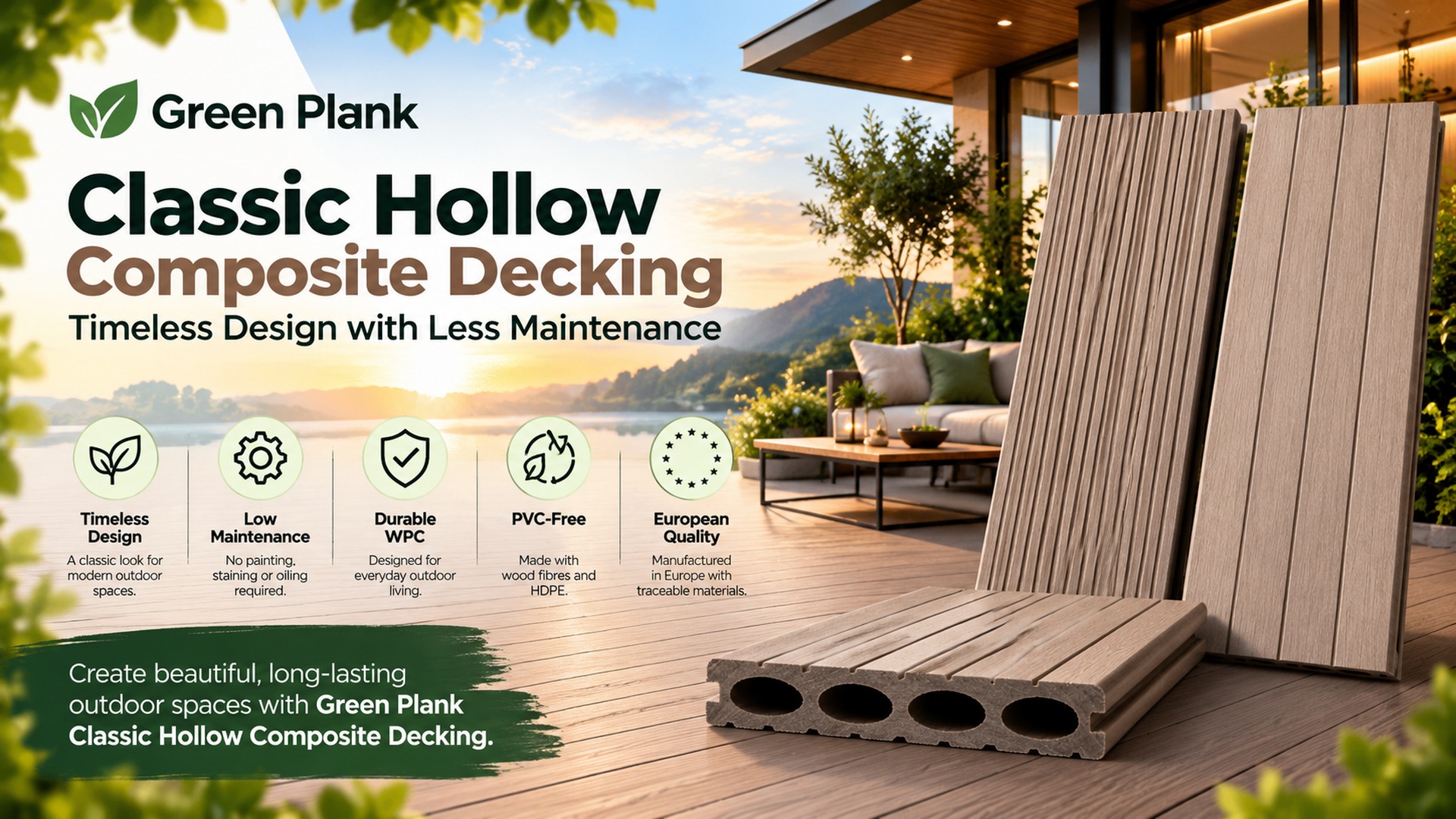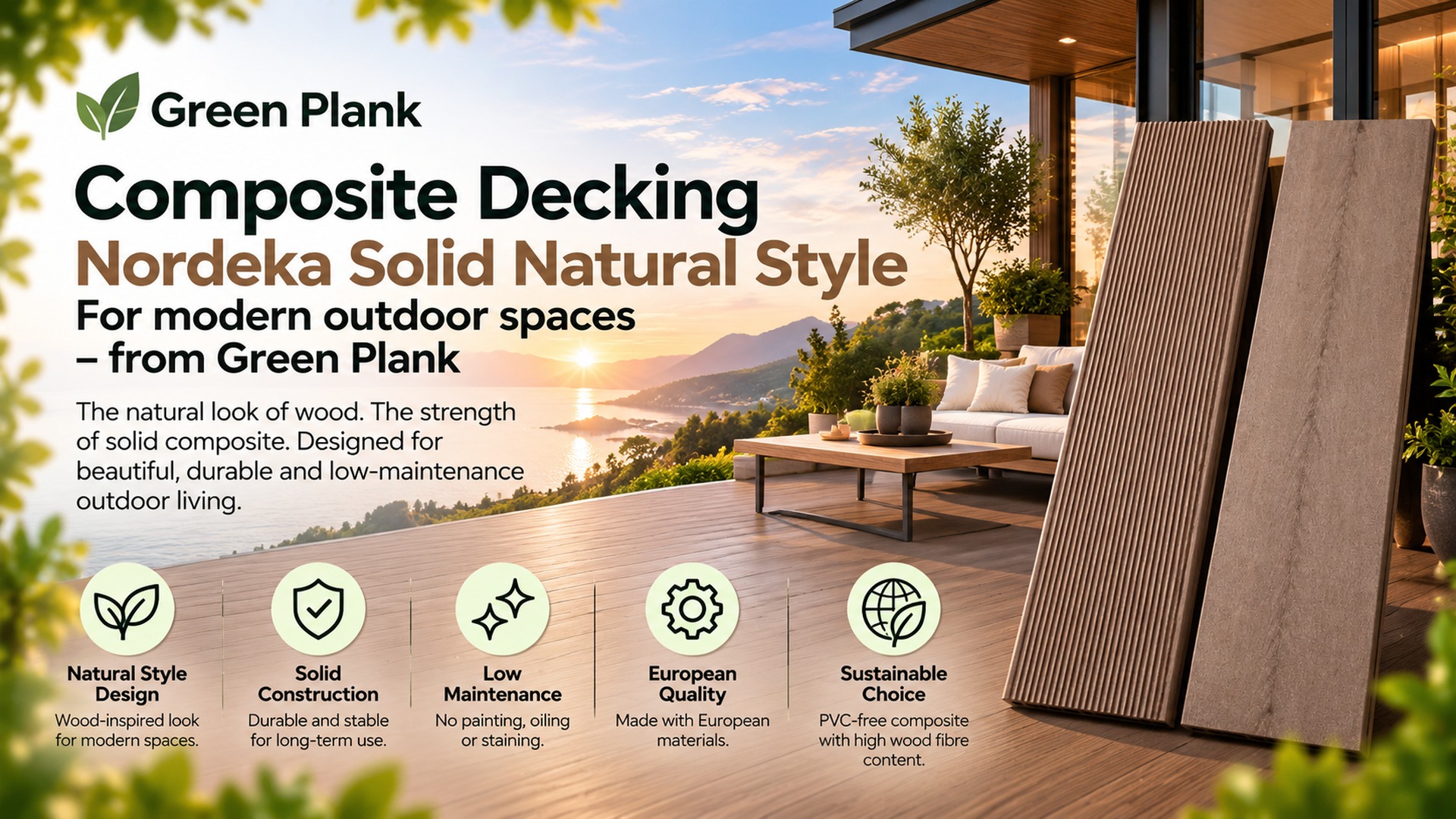




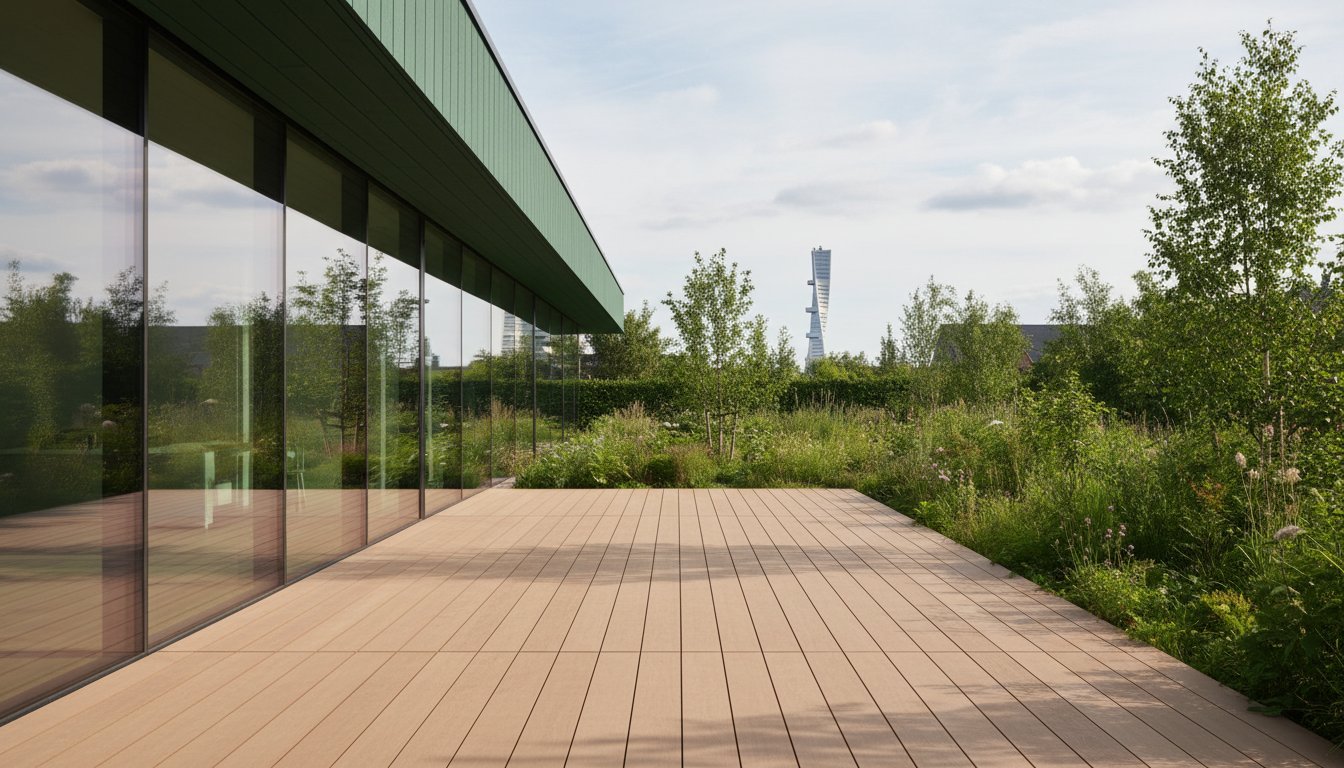
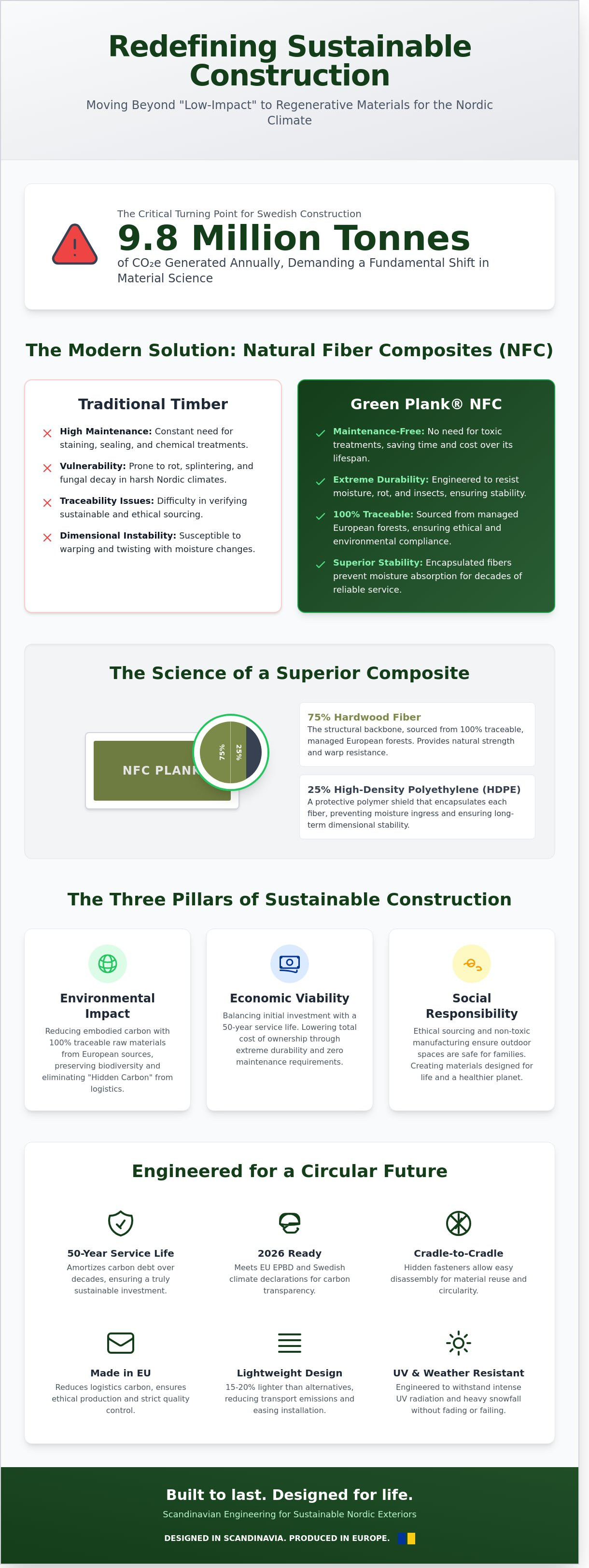
With the Swedish construction sector generating 9.8 million tonnes of CO2e annually according to Boverket, the industry faces a critical turning point. You likely feel the mounting pressure of balancing strict CO2 reduction targets with the high maintenance costs and traceability issues of traditional timber. It's difficult to source sustainable building materials that look premium without compromising your environmental ethics or your project budget. We understand that professional-grade projects require both aesthetic excellence and engineering precision to meet the rigorous demands of the Nordic climate.
This guide reveals how modern material science and circular design are redefining sustainability in the European construction industry. You'll discover how to identify materials with low CO2 footprints and understand the long-term ROI of European-made, traceable composites. We'll explore the shift toward circularity and the specific engineering choices that ensure your projects are built to last and designed for life. From 2026 climate benchmarks to the stability of natural-fiber composites, we provide the technical clarity you need to build with confidence and character.
Key Takeaways
- Learn why the European industry is shifting from low-impact to regenerative sustainable building materials by adopting Life Cycle Assessment (LCA) as the gold standard for performance.
- Discover how high-performance natural fiber composites combine hardwood fiber with HDPE to deliver superior durability and stability in the demanding Swedish climate.
- Understand the impact of "Hidden Carbon" in logistics and the vital importance of sourcing European-produced materials to ensure environmental and ethical traceability.
- Implement circular design through the Cradle to Cradle (C2C) ownership model and hidden fastening systems designed for easy disassembly and material reuse.
- Explore how 20 years of Scandinavian engineering provides the foundation for maintenance-free exteriors that are built to last and designed for life.
Defining Sustainable Building Materials in 2026
The construction industry in Sweden has reached a pivotal turning point. By 2026, the focus has shifted from simply "low-impact" products to regenerative and circular material selection. We no longer settle for materials that do less harm. We demand systems that contribute to a circular economy. This evolution requires a rigorous approach to Defining Sustainable Building Materials through the lens of Life Cycle Assessment (LCA). As the gold standard for sustainability, LCA evaluates the total environmental footprint from raw extraction through manufacturing to final disposal.
Exterior materials face the steepest hurdles in this new era. Unlike interior finishes, facades and decking must withstand harsh Nordic climates, including heavy snowfall and intense UV radiation. If a material fails after ten years, it isn't sustainable, regardless of its initial carbon footprint. True sustainable building materials must offer extreme durability to ensure the carbon debt of production is amortized over decades of reliable service. Our engineered composites are designed to meet these challenges, providing a professional-grade solution that withstands environmental exposure without the need for toxic chemical treatments.
The Three Pillars of Sustainable Construction
Sustainable building involves a delicate balance of three core factors. First, environmental impact focuses on reducing embodied carbon and preserving biodiversity. We use 100% traceable raw materials to ensure every plank respects the ecosystem. Second, economic viability is essential. We balance initial investment with 50-year service lives, effectively lowering the total cost of ownership for Swedish property managers. Third, social responsibility ensures ethical sourcing and non-toxic manufacturing. It's about creating outdoor spaces that are safe for families and the planet alike. Built to last. Designed for life.
Regulatory Landscape: From EPBD to National Standards
The Energy Performance of Buildings Directive (EPBD) now dictates material choices across the European Union. In Sweden, these regulations have integrated with national climate declarations, making carbon transparency a legal requirement. For commercial projects launching in 2026, detailed carbon reporting is mandatory. This regulatory shift highlights the importance of made in eu building materials for compliance and traceability.
Choosing European-made products ensures strict adherence to environmental laws and provides the verified data required for modern certification. Designed in Scandinavia and produced in Europe, our materials align with these 2026 requirements. They provide the reliability architects need to meet carbon-neutral construction site goals. By prioritizing local, high-quality production, we eliminate the high carbon costs of long-distance shipping and ensure every project meets the highest standards of Nordic excellence.
The Science of Natural Fiber Composites (NFC)
Engineering high-performance sustainable building materials requires a precise balance of organic strength and synthetic resilience. Green Plank utilizes a specific matrix of 75% hardwood fiber and 25% High-Density Polyethylene (HDPE). This ratio isn't arbitrary; it's the result of rigorous testing to solve the inherent weaknesses of traditional timber. While natural wood is prone to rot, splintering, and fungal decay, composite engineering encapsulates organic fibers within a protective polymer shield. This prevents moisture from reaching the core, ensuring the boards remain dimensionally stable even in the humid coastal climates of Sweden.
Logistics efficiency plays a vital role in the environmental profile of construction. Our low-density composites are engineered to be approximately 15% to 20% lighter than traditional high-weight alternatives like solid Ipe or Cumaru. This weight reduction allows for more efficient transport, reducing fuel consumption and carbon emissions during delivery. Designed in Scandinavia. Produced in Europe. Our products reflect a commitment to regional manufacturing that minimizes the distance from forest to site.
Hardwood Fiber: The Structural Backbone
We source 100% traceable hardwood fiber exclusively from managed European forests. The quality of the fiber is paramount. We select specific fiber lengths and densities to ensure the internal skeleton of the board resists structural warping. Shorter, inferior fibers often found in low-grade imports lead to brittle products that crack under stress. The synergy between organic hardwood fibers and high-density polymers creates a reinforced matrix that exceeds the structural load-bearing capacity of its individual components. This structural integrity is why our products carry a professional-grade reputation across the Nordics.
HDPE and Additives: Protecting the Core
High-Density Polyethylene (HDPE) is our preferred choice because it supports a truly circular economy. It's a robust material that can be recycled multiple times without significant degradation of its mechanical properties. Implementing Circular Design in modern architecture means choosing materials that don't end up in landfills. Our HDPE matrix is enhanced with high-grade UV stabilizers that prevent the material from becoming brittle or losing its color depth after decades of exposure to harsh sunlight.
Safety is never compromised for the sake of aesthetics. We incorporate specialized mineral additives to achieve fire-retardant properties that meet strict European safety standards. Unlike traditional pressure-treated lumber, which often relies on heavy metals, our sustainable building materials achieve these ratings without toxic chemical leaching. This ensures a safe environment for both the installer and the end-user. Built to last. Designed for life. If you're ready to specify these materials for your next project, you can explore our full range of technical profiles to find the right fit for your design.
Criteria for Selecting Exterior Sustainable Materials
Selecting materials for a building's exterior requires a rigorous evaluation of lifecycle performance rather than just initial aesthetics. True sustainability is measured by the chemical load a material places on the environment over decades. In the Swedish climate, traditional materials often require annual applications of oils, paints, or toxic fungicides to prevent rot. These chemicals leach into the soil and groundwater, creating a recurring environmental debt. Choosing sustainable building materials that are engineered for low maintenance eliminates this chemical cycle. Our natural fiber composites provide a high-performance alternative that remains stable without harmful treatments.
Logistics represent the "hidden carbon" of the construction industry. Importing materials from outside Europe can increase a project's carbon footprint by as much as 30 percent due to transoceanic shipping. Local European production is a non-negotiable standard for reducing emissions. By sourcing raw materials within the EU, we ensure that transportation distances are minimized and environmental regulations are strictly enforced. This regional focus supports a circular economy and guarantees that the energy used in manufacturing aligns with stringent European standards.
Durability serves as a primary sustainability metric. A product that lasts 50 years is twice as sustainable as one that requires replacement after 25 years. Short-term thinking leads to excessive landfill waste and repeated resource extraction. We provide long-term warranties of 20 to 30 years because engineering confidence is the ultimate proof of quality. This reliability allows architects to match refined Scandinavian design with technical performance that withstands heavy snow loads and intense UV exposure.
Comparing Wood, Plastic, and Composites
Traditional timber remains a popular choice, yet it faces significant challenges regarding deforestation and high maintenance costs. In Sweden, the cost of professional deck staining can exceed 150 kr per square meter every few years. Pure plastic or PVC options often fail due to poor thermal expansion properties, leading to warping in fluctuating temperatures. Natural Fiber Composites (NFC) offer a balanced approach, combining the warmth of wood with the resilience of modern polymers. They don't splinter, rot, or require painting—and for those also considering aluminum as a durable alternative, you can visit Elite L.A. Patios to explore how different architectural systems compare. Built to last. Designed for life.
Traceability and Ethical Sourcing
Non-EU raw materials carry high risks of ethical breaches and opaque supply chains. Verifying a "100 percent EU raw materials" claim is essential for modern procurement. This level of traceability is a requirement for projects seeking BREEAM or LEED certification; to navigate these complexities, many professionals explore LEED Green Rater Services to ensure full compliance. Architects and contractors must demand documentation that proves the origin of every fiber. Our commitment to European manufacturing ensures that every plank can be traced back to responsible sources. This transparency builds trust and ensures that your project contributes to a cleaner, more ethical future. Designed in Scandinavia. Produced in Europe.
Implementing Circular Design in Modern Architecture
Modern construction requires a fundamental shift from linear consumption to circular loops. Architects across Sweden are increasingly prioritizing systems that treat buildings as material banks rather than temporary structures. By selecting cradle to cradle building materials, projects move away from the traditional "take-make-waste" industrial model. These materials aren't destined for a landfill; they're engineered for recovery and high-value reuse. High-performance natural fiber composites act as effective carbon sinks over 50 years, sequestering CO2 within the building's exterior envelope. This long-term storage is a core pillar of high-performance sustainable building materials.
The Cradle to Cradle Philosophy
The C2C framework views materials as biological or technical nutrients. In the Swedish building sector, this means choosing cladding and decking that can be returned to the production cycle without losing quality. It's about intentionality at the drawing board. When a project utilizes sustainable building materials designed for circularity, it ensures that the environmental cost is amortized over decades. Durable natural fiber materials act as carbon sinks over 50 years, providing a stable storage solution for atmospheric CO2 while maintaining structural integrity in harsh Nordic climates.
To effectively reduce co2 footprint building projects must prioritize material efficiency. Modular fencing and cladding systems arrive pre-engineered to specific dimensions, which virtually eliminates the 10% to 15% waste margin typically seen with traditional timber. This precision reduces the volume of raw materials required and lowers transport-related emissions. It's a logical approach that aligns with Sweden's strict Klimatdeklaration regulations, where every kilogram of waste avoided is a step toward carbon neutrality.
Beyond exterior cladding, this focus on material efficiency extends to all wood-based components; for instance, the guide by Sklejka HDF explores how precision-cut birch plywood and HDF can be optimized for sustainability in 2026 construction projects.
Similarly, for interior applications where sound management is key, you can learn more about Sonaspray to see how recycled cellulose is used for high-performance, eco-friendly acoustic insulation.
Additionally, for professionals looking to optimize the lifespan of the entire facade, MAD Fenster offers technical insights into the longevity and maintenance requirements of modern window installations within the European building sector.
Furthermore, for projects requiring high-performance glass structures, Vansta Trädgård offers exclusive orangeries and greenhouses designed to meet the same aesthetic and technical benchmarks as modern sustainable architecture.
Innovation in Fastening and Infrastructure
Circular design depends entirely on the ability to take things apart without destruction. Our HidLoc™ technology facilitates this by eliminating surface penetrations. Traditional top-down screwing damages the material's core, making it nearly impossible to repurpose the planks later. HidLoc™ secures the profiles from the side; it protects the aesthetic surface while allowing for clean, non-destructive disassembly. This feature-benefit logic ensures that the material remains a valuable asset even if the building's purpose changes.
Commercial infrastructure profiles designed for high-traffic public spaces take this further. By utilizing "Smart Systems" and engineered profiles, contractors can reduce installation time and labor costs by up to 35% compared to conventional methods. These systems are:
- Designed for disassembly: Allowing for easy maintenance or relocation.
- Waste-efficient: Precision-cut components minimize on-site offcuts.
- Nordic-reliable: Built to withstand temperature fluctuations from -30°C to +40°C.
This engineering precision doesn't just save time; it ensures the longevity of the installation. When a system is built to last and designed for life, the need for frequent replacements vanishes. It's a quiet confidence in quality that respects both the craftsman's time and the planet's resources.
Green Plank: Engineering Sustainable Nordic Exteriors
Green Plank represents a 20-year legacy of Scandinavian design excellence and rigorous European production standards. Since 2004, the company has focused on creating sustainable building materials that bridge the gap between natural aesthetics and industrial durability. By manufacturing exclusively in Europe using 100% traceable raw materials, Green Plank ensures every plank meets strict environmental and quality benchmarks. This commitment to a circular economy isn't just a goal; it's the foundation of their engineering process. Designed in Scandinavia. Produced in Europe.
The product architecture centers on two primary lines: Terra Tuff and the Smart System. Terra Tuff utilizes high-density natural-fiber composite technology to provide maximum impact resistance and structural integrity. The Smart System offers an integrated approach to installation, reducing labor time while ensuring a seamless, professional finish. Unlike many mass-market options, Green Plank excludes direct-to-consumer retail. This strategic choice prioritizes professional project quality. It ensures that every installation is handled by experts who value technical precision over retail convenience. Built to last. Designed for life.
Engineered for the Nordic Climate
Swedish weather demands materials that can survive extreme thermal cycles. Green Plank products are engineered to withstand temperature fluctuations ranging from -30°C to +60°C without warping or splitting. Their saltwater resistance makes them ideal for coastal infrastructure and public boardwalks in cities like Gothenburg or Stockholm. The aesthetic of Refined Nordic Character defines these facades. They offer the warmth of wood without the intensive maintenance schedules required by traditional timber. These materials are built for life and engineered for the harshest environments.
- Durability: Resistant to rot, decay, and fungal growth.
- Stability: Low expansion and contraction rates in high-humidity environments.
- Aesthetics: UV-stable pigments that retain their depth for decades.
The 50-Year Commitment
A 50-year warranty serves as a primary signature of Green Plank's engineering confidence. This isn't a mere marketing claim; it's a calculated promise based on two decades of performance data. Architects and developers in Sweden can specify Green Plank for large-scale commercial or residential projects knowing the material is sustainable building materials at their peak. This longevity significantly reduces the lifecycle cost of a building, making it a sound financial and environmental investment. If you're ready to elevate your architectural standards, you can Partner with Green Plank for your sustainable project to ensure a carbon-neutral future for your exterior designs.
Building the Future of Circular Architecture
The transition toward circular construction in 2026 requires more than just intent; it demands engineering precision and traceable sourcing. By prioritizing natural fiber composites and circular design principles, architects across Sweden can significantly reduce carbon footprints while ensuring long-term structural integrity. Choosing high-performance sustainable building materials that adhere to the Cradle to Cradle ownership model ensures every component remains within a productive technical cycle. This shift eliminates waste and secures the value of your investment for decades.
Green Plank delivers this Nordic reliability through a rigorous commitment to 100% European raw materials. Our engineered solutions provide a service life warranty of up to 50 years, offering a stable foundation for projects that value both refined aesthetics and environmental ethics. It's a practical, professional approach to modern architecture that balances premium quality with grounded responsibility. You don't have to choose between durability and ecology when your materials are designed for life and built to last.
Request a Technical Specification for Your Sustainable Project
We're ready to help you create a maintenance-free outdoor space that honors the landscape it inhabits.
Frequently Asked Questions
What makes a building material truly sustainable?
A building material is truly sustainable when it prioritizes resource circularity and minimizes environmental impact throughout its entire lifecycle. High-quality sustainable building materials utilize up to 90% recycled content, such as reclaimed wood fibers and recycled polymers. These materials must be 100% traceable to ensure ethical sourcing. By choosing products designed for longevity, you reduce the need for frequent replacements and lower the total carbon output of your property.
How does WPC composite decking compare to traditional wood in terms of CO2 footprint?
WPC composite decking reduces CO2 emissions by eliminating the need for toxic chemical treatments and frequent replacements. Traditional pressure-treated timber requires chemical staining or oiling every 24 months to prevent rot. Modern composites utilize recycled wood fibers, preventing deforestation and sequestering carbon for 25 to 30 years. This long-term stability ensures your outdoor space remains environmentally responsible without the recurring carbon cost of maintenance chemicals.
Can sustainable building materials withstand harsh weather conditions?
Engineered sustainable building materials are specifically designed to endure the rigorous Nordic climate, including temperatures ranging from -30°C to +40°C. Unlike traditional wood that swells or cracks, high-performance composites feature a moisture-resistant core that prevents structural decay. These products undergo accelerated weathering tests to ensure they maintain their integrity against heavy snow loads and intense UV exposure. It's professional-grade durability built for the harshest environments.
What is the "Cradle to Cradle" model in construction?
The "Cradle to Cradle" model is a circular design framework where products are manufactured to be fully recycled at the end of their functional life. Instead of ending up in a landfill, these materials serve as raw inputs for new products. This closed-loop system eliminates waste and preserves natural resources. It's a fundamental shift from the traditional "take-make-waste" linear economy toward a regenerative approach to modern construction.
Why is European manufacturing important for sustainable materials?
European manufacturing ensures strict adherence to the EU Timber Regulation (EUTR) and high labor standards. Producing materials within Europe reduces transport-related CO2 emissions by thousands of kilometers compared to overseas imports. This local proximity allows for 100% traceability of raw materials. Designed in Scandinavia and produced in Europe, these products represent a commitment to ethical supply chains and superior engineering precision.
Are sustainable building materials more expensive in the long run?
Sustainable materials offer a lower total cost of ownership by eliminating annual maintenance expenses. While the initial investment might be higher, you save thousands of kronor over two decades by avoiding the costs of oils, stains, and specialized cleaners. A typical wooden deck in Sweden requires maintenance costing approximately 800 kr annually for materials alone. Choosing a low-maintenance composite means your investment pays for itself through longevity and labor savings.
How do hidden fastening systems contribute to sustainability?
Hidden fastening systems enhance sustainability by preserving the structural integrity of the boards. By avoiding surface-penetrating screws, you eliminate entry points for moisture that lead to internal rot. These systems also facilitate easier disassembly and board replacement without damaging the surrounding structure. This modularity supports the circular economy by allowing materials to be salvaged and reused rather than discarded during renovations.
What is the lifespan of modern composite cladding?
Modern composite cladding is engineered for a service life exceeding 25 years. Most professional-grade products come with a 25-year limited warranty, reflecting the manufacturer's confidence in the material's durability. This extended lifespan reduces the environmental impact associated with manufacturing and transporting replacement materials. It's a long-term solution that stays beautiful and functional for decades. Built to last. Designed for life.
Specify the product
Use this guide with a Green Plank specification
Technical articles support the commercial catalogue — category, product, evidence, then samples or quotes.