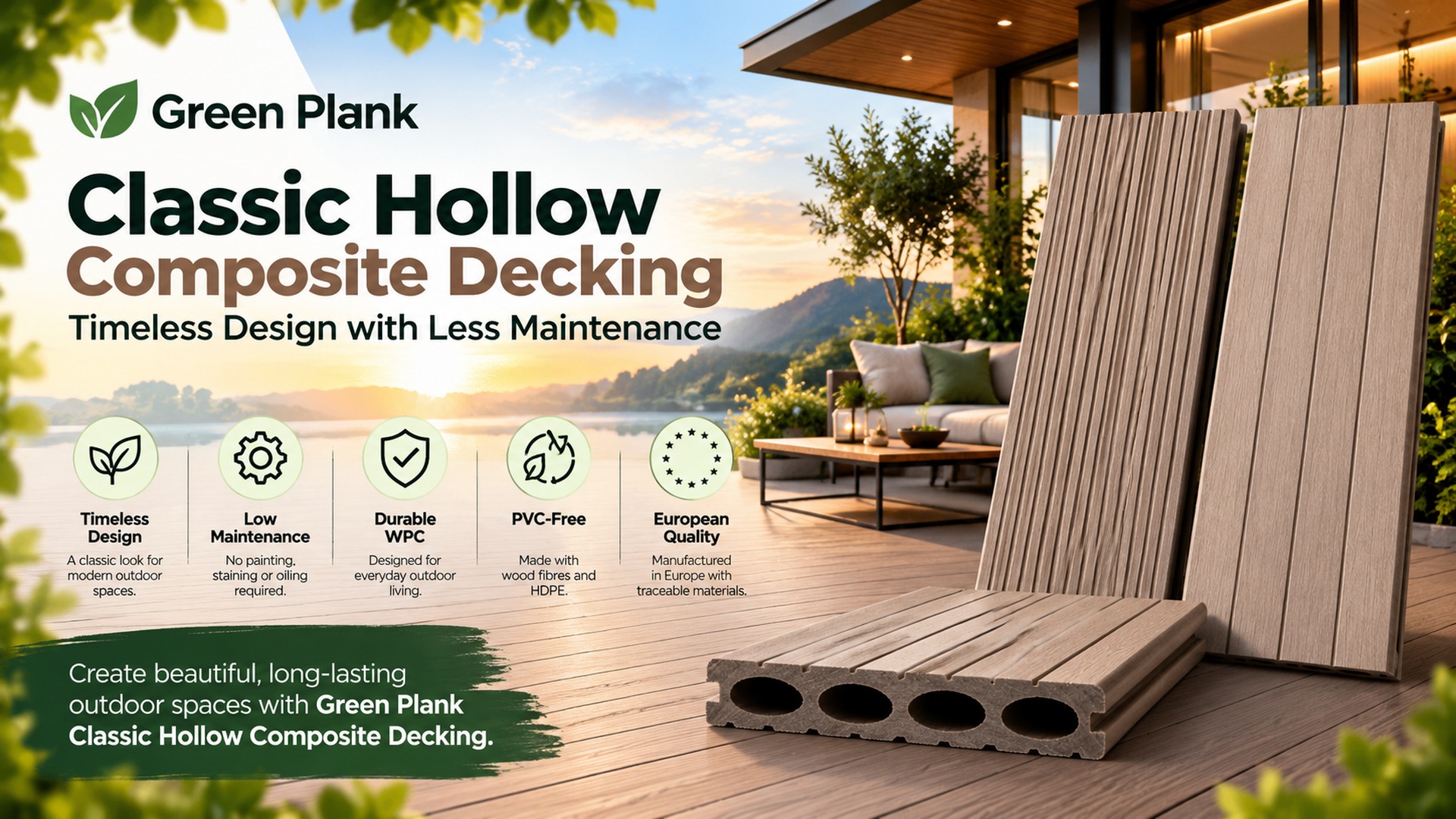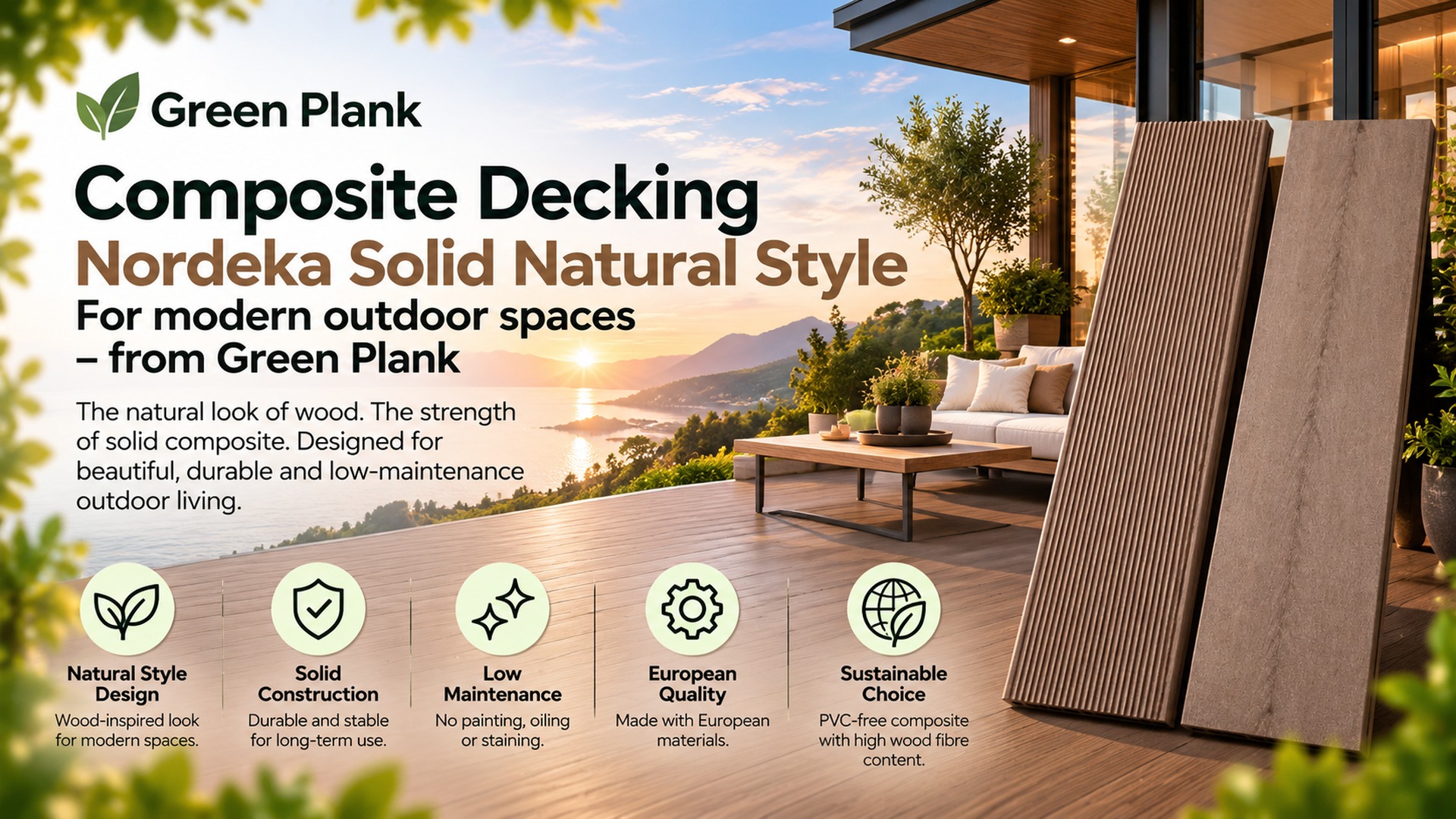




What if the 65,000 kr you invest in a new terrace was the last time you ever paid for deck maintenance? For many homeowners in Sweden, the dream of a natural wood deck often turns into a repetitive cycle of seasonal sanding, staining, and the frustration of watching premium timber succumb to rot. Choosing wpc composite decking allows you to secure an outdoor space that reflects your commitment to high-end quality without the environmental toll of tropical hardwoods or the constant labor of seasonal upkeep.
In this guide, we'll explore the engineering and long-term value of these high-performance materials. This technology combines recycled natural fibers with advanced polymers to create a product that's specifically engineered for the harsh Nordic climate. We'll examine the technical benefits of these natural-fiber composites, their circular manufacturing process, and how a 30 year warranty translates into a superior return on investment for your property. Discover why this technology, designed in Scandinavia and produced in Europe, is the responsible choice for a maintenance-free lifestyle. Built to last; designed for life.
Key Takeaways
- Understand the 75/25 engineering rule and how blending hardwood fibers with HDPE creates maximum stability for high-performance outdoor surfaces.
- Discover why wpc composite decking offers superior long-term value by eliminating annual oiling while providing a service life of up to 50 years.
- Explore the environmental impact of choosing European-made, traceable materials designed for a circular economy and a significantly reduced CO2 footprint.
- Learn how hidden fastening systems like HidLoc™ achieve a seamless, screw-free finish that balances professional-grade safety with refined Nordic aesthetics.
- Identify the ideal material specifications for your specific project, from private residential terraces to heavy-duty commercial infrastructure.
Understanding WPC Composite Decking: Composition and Engineering
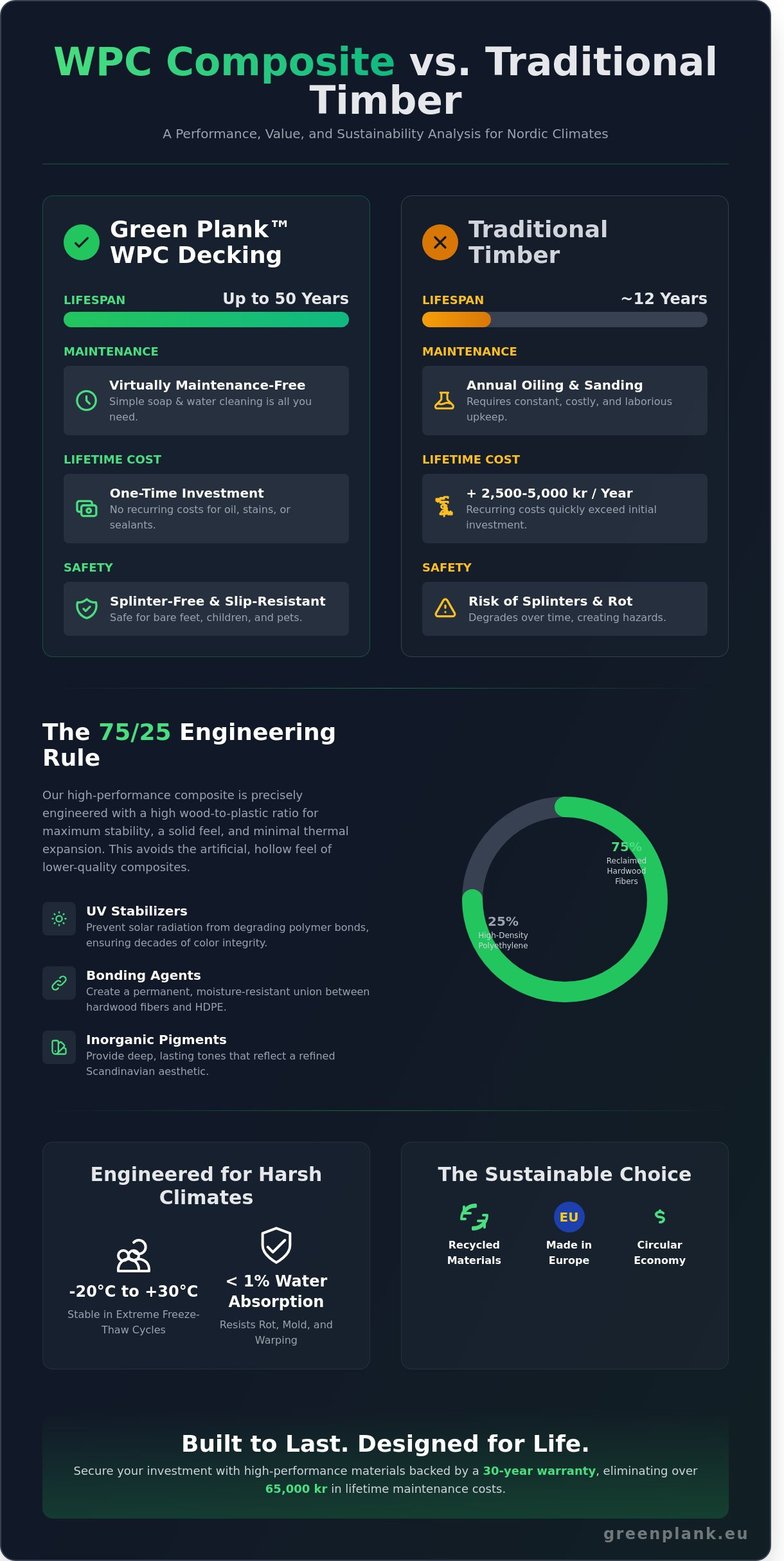
Wood-plastic composite (WPC) represents a significant shift in outdoor material technology. It's a high-performance hybrid that blends natural wood fibers with advanced polymers to create a product that mimics the aesthetic of timber while eliminating its core vulnerabilities. At Green Plank, we've refined this technology through our signature 75/25 engineering rule. This specific ratio utilizes 75% reclaimed hardwood fibers and 25% high-density polyethylene (HDPE) to ensure maximum structural stability.
This high wood-to-plastic ratio is a deliberate engineering choice. While many manufacturers use cheaper, high-plastic mixes that feel artificial and expand excessively in the sun, our hardwood-heavy composition provides a rigid, professional-grade foundation. Choosing wpc composite decking with this density ensures your deck feels solid underfoot and resists the warping common in lower-quality Natural Fiber Composites (NFC). The result is a material that balances the organic warmth of wood with the industrial durability of modern polymers.
The Anatomy of a High-Performance Plank
The strength of our planks starts at the molecular level. We utilize HDPE because it offers superior impact resistance and UV stability compared to standard PVC or low-grade plastics. To ensure long-term performance in demanding environments, we integrate several critical additives into the composite matrix:
- UV Stabilizers: These prevent solar radiation from breaking down polymer bonds, maintaining color integrity over decades.
- Bonding Agents: These create a permanent, moisture-resistant union between the hardwood fibers and the HDPE.
- Inorganic Pigments: These provide deep, lasting tones that reflect a refined Scandinavian aesthetic.
Our manufacturing process focuses on high core density. This density prevents the "hollow" or "spongy" sound often associated with budget composite materials. You get the tactile warmth of oak or teak without the risk of wood rot, splintering, or the need for annual oiling.
Engineered for the European Climate
Sweden's climate is unforgiving. Our wpc composite decking is specifically designed to handle the moisture and extreme freeze-thaw cycles found in Northern Europe. Traditional timber absorbs water, which then expands as it freezes, causing deep structural cracks and surface degradation. Green Plank products maintain a water absorption rate of less than 1%, protecting the plank's internal integrity during the wettest months.
We also account for thermal expansion through precision engineering. By controlling the HDPE quality, we ensure the planks move predictably during seasonal temperature swings from -20°C to +30°C. This reliability means your installation stays straight and the gaps remain consistent for the life of the deck. WPC is a sustainable infrastructure material with a 50-year service life.
WPC vs. Traditional Timber: A Performance Analysis
Standard timber decks require an exhausting cycle of sanding, staining, and oiling every 12 to 18 months to survive the Swedish climate. WPC composite decking eliminates this burden. You only need simple soap and water to keep the surface pristine. This shift saves the average homeowner between 2,500 kr and 5,000 kr annually in specialized oils, brushes, and equipment rentals. It's a practical choice for those who value their time as much as their outdoor space.
Academic research into the manufacturing and properties of WPC confirms that encapsulating wood fibers in high-grade polymers creates an impenetrable barrier against moisture. While a pressure-treated pine deck might show signs of structural failure within 12 years, professional-grade composite systems offer a service life of up to 50 years. When you calculate the hidden costs of wood over a 20-year period, including labor and material replacements, the total expenditure for a 30-square-meter deck often exceeds 65,000 kr. WPC removes these recurring financial drains.
Safety remains a decisive factor for families and commercial developers. Timber naturally dries and cracks, creating dangerous splinters that make barefoot use impossible. High-performance wpc composite decking stays smooth and intact. These planks are engineered with advanced slip resistance, meeting strict European safety standards to ensure stability even during wet midsummer rains or poolside use.
Durability in Extreme Conditions
Engineered to withstand the Scandinavian winter, these planks resist rot, mold, and wood-boring insects without the need for toxic chemical sealants. They possess exceptional dimensional stability. Unlike traditional wood, they don't warp, twist, or cup when exposed to fluctuating humidity. This resilience makes them the ideal choice for coastal properties in the Stockholm archipelago, where saltwater spray quickly degrades inferior materials. Built to last. Designed for life.
The Aesthetic Evolution
Modern manufacturing allows for incredible color retention that mimics the silver-grey patina of weathered timber without the accompanying structural decay. This uniformity is vital for large-scale commercial projects where a consistent look is required across hundreds of square meters. The boards embody a refined Nordic character, fitting perfectly into the minimalist lines of contemporary Swedish architecture. Homeowners seeking this balance of beauty and resilience can view sustainable decking collections that respect both the project budget and the planet.
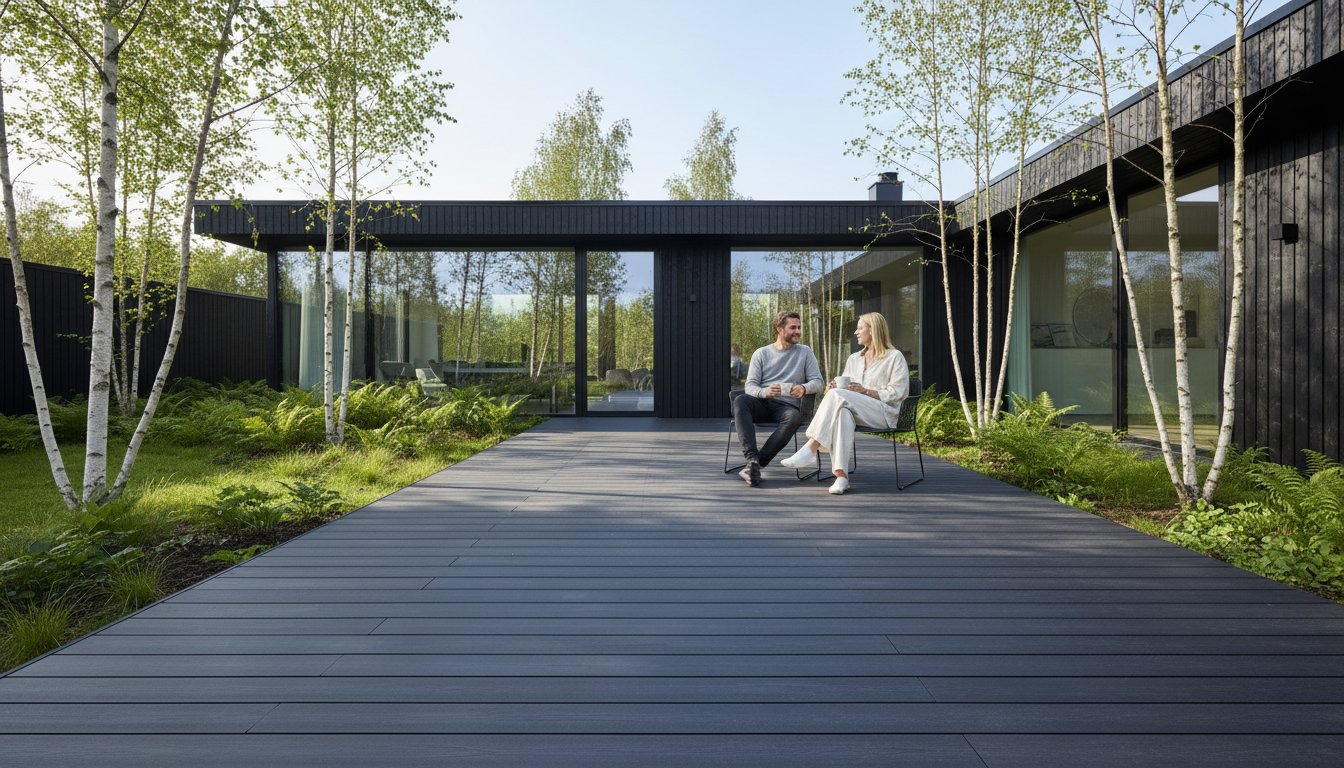
Sustainable Building: The Eco-Friendly Case for WPC
Choosing Green Plank means prioritizing the planet without compromising on architectural elegance. Our manufacturing process relies on 100% European raw materials; this strategic sourcing reduces transport-related CO2 emissions by approximately 40% compared to products imported from Asia. By keeping the supply chain within the EU, we maintain a lower carbon footprint while ensuring every plank meets strict Swedish environmental standards. It's a localized approach that delivers global benefits.
The core of our wpc composite decking consists of 75% traceable, sustainably sourced wood waste. We transform sawdust and wood shavings from European timber mills into high-performance building materials. This Wood plastic composite fact sheet explains how merging these fibers with polymers creates a durable alternative to traditional timber. Unlike pressure-treated wood that often relies on copper-based fungicides or arsenic to prevent rot, our composite is entirely free of toxic additives. This protects Swedish soil and groundwater from chemical leaching, making it a safer choice for lakeside piers and family gardens.
Circular Design in Modern Construction
We design for a circular economy where waste is a forgotten concept. Green Plank products are engineered for a 50-year lifecycle; however, their value doesn't end there. At the end of its functional life, our decking is 100% recyclable, allowing it to be ground down and repurposed into new profiles. This cradle-to-cradle ownership model directly supports the EU Green Deal objectives for a climate-neutral construction sector by 2050. By replacing tropical hardwoods like Teak or Ipe, we actively reduce the demand for rainforest deforestation, preserving vital ecosystems while providing a superior Nordic aesthetic.
Traceability and EU Standards
Quality control is inseparable from ethical manufacturing. Every board is produced in Europe under fair labor conditions and rigorous safety protocols. This ensures that our wpc composite decking maintains ultra-low VOC emissions, exceeding European indoor and outdoor air quality standards. Architects and contractors can specify our materials with total confidence in their chemical integrity. By utilizing 75% hardwood fiber content, Green Plank wpc composite decking effectively traps carbon within the material, ensuring that three-quarters of the product's volume serves as a long-term carbon sequestration tool. This engineered precision delivers a product that is built to last and designed for life.
Professional Installation and Hidden Fastening Systems
A flawless finish requires more than just high-quality planks; it demands a structural approach that respects the material's properties. Conventional face-screwing often compromises the integrity of the board and creates entry points for moisture. Modern wpc composite decking utilizes advanced fastening technology to maintain a pristine surface while ensuring long-term stability. Designed in Scandinavia and produced in Europe, our systems reflect a commitment to engineering precision and Nordic reliability.
In Sweden, professional installers adhere to a 600 cc joist spacing for private residential projects. This specific measurement ensures the deck can withstand local snow loads and significant temperature fluctuations. Proper ventilation remains a non-negotiable requirement. A minimum clearance of 100 mm from the ground allows for consistent airflow, which prevents heat buildup and moisture accumulation beneath the surface. For commercial infrastructure like public piers or restaurant terraces, solid profiles are required to handle high-traffic density and heavier load requirements.
The HidLoc™ Advantage
Our HidLoc™ system eliminates visible screws, creating a safe, barefoot-friendly environment for families. It's a system built for safety and style. These clips are engineered to manage the natural thermal expansion and contraction of the natural-fiber composite. By allowing the boards to move slightly within the clip, the system prevents warping and cracking. This technical attribute reduces installation time by approximately 30% while extending the deck's functional lifespan compared to traditional fixing methods. It's a professional-grade solution that ensures your wpc composite decking remains stable through every season.
Planning for Success
Success begins with a detailed material calculation. You'll need to account for planks, skirting, and finishing profiles to ensure a cohesive aesthetic. Ground preparation is equally vital for a sustainable result. Ensuring a 1% slope for drainage prevents standing water, which is essential for maintaining the performance standards of our 20 to 30-year warranties. Many Swedish homeowners now integrate matching fencing and wall cladding to create a unified outdoor environment. This holistic design approach reflects a sophisticated lifestyle that respects nature. Built to last. Designed for life.
Explore our range of professional-grade installation accessories to secure your outdoor investment with confidence.
The Green Plank Solution: Built to Last, Designed for Life
Choosing Green Plank means investing in a legacy of Scandinavian engineering and ethical manufacturing. Our wpc composite decking isn't just a building material; it's a precision-engineered system. We've developed specialized lines like Terra Tuff and the Smart System to meet the exact needs of different environments. Terra Tuff provides a high-density solution for areas requiring maximum impact resistance, while the Smart System focuses on installation efficiency and versatility. Designed in Scandinavia and produced in Europe, these products reflect a commitment to quality that withstands the harsh Swedish climate.
Our engineering expertise extends to heavy-duty commercial infrastructure. We design profiles specifically for public works, boardwalks, and coastal piers. These profiles handle the unique stresses of salt water and extreme temperature shifts without warping or decaying. A 50-year warranty acts as our standard of excellence. It's a definitive statement of material confidence. We don't just promise longevity; we guarantee it through rigorous testing and 100% traceable raw materials. This long-term perspective ensures that the lifecycle cost in Swedish Krona (SEK) remains significantly lower than traditional timber, which requires frequent replacement and expensive chemical treatments.
Project-Specific Solutions
Residential decks focus on the intersection of aesthetics and comfort. Our boards are splinter-free and barefoot-friendly, requiring zero sanding or oiling over their lifespan. For commercial applications, we prioritize load-bearing capacity. Our professional-grade profiles are engineered to support high-traffic volumes in urban spaces. We also provide custom profiles for architectural facades and cladding. These systems allow architects to create seamless, modern exteriors that maintain their color and structural integrity for decades.
Joining the Circular Economy
Green Plank is a leader in the shift toward a circular economy. By manufacturing within Europe, we reduce transport emissions and support sustainable local jobs. We provide comprehensive support for architects and contractors, offering technical data and project planning assistance from the initial concept to the final plank. This collaborative approach ensures every project meets modern environmental standards. Our commitment to the planet is as strong as our commitment to our customers.
Ready to transform your outdoor space with Nordic reliability? Discover our full range of WPC decking solutions and see how we combine engineering precision with sustainable design.
Invest in a Sustainable Scandinavian Future
Choosing the right material for your terrace is an investment in both your property value and the planet's future. Green Plank provides a superior alternative to traditional timber by engineering wpc composite decking that contains 75% hardwood fiber. This high-density composition ensures your deck resists the harsh Swedish climate without the need for annual oiling or staining. Our European-made boards follow a strict Cradle to Cradle ownership model, ensuring every plank contributes to a circular economy rather than a landfill.
Modern homeowners and architects in Sweden require more than just aesthetics; they demand engineering confidence. That's why we back our professional-grade products with a warranty of up to 50 years. You're not just buying a deck; you're securing a maintenance-free outdoor space designed to withstand decades of use. It's time to transition to a solution that respects Nordic nature while delivering refined, long-lasting performance. Designed in Scandinavia. Produced in Europe.
Built to last. Designed for life.
Explore Professional WPC Solutions for Your Next Project
Frequently Asked Questions
Is WPC composite decking more expensive than wood?
WPC composite decking requires a higher initial investment than traditional pressure-treated timber. While standard Swedish pine decking costs approximately 250 kr per square meter, premium WPC boards range from 650 kr to 1,200 kr per square meter. You'll recoup this cost within 7 to 10 years because you won't spend money on oils or stains. Homeowners save roughly 1,500 kr annually on maintenance for a 30 square meter deck.
Does WPC decking get too hot to walk on in the summer?
Like any outdoor surface, these boards absorb thermal energy from direct sunlight. On a 28°C day in Stockholm, dark composite boards can reach surface temperatures of 55°C. We recommend choosing lighter tones like "Nordic Oak" to reduce heat absorption by 20 percent compared to charcoal shades. High-performance polymers in our boards are specifically engineered to dissipate heat more efficiently than non-branded alternatives found in hardware stores.
Can you install composite decking directly on the ground?
You shouldn't install wpc composite decking directly onto soil or grass. Proper ventilation is critical for the installation's longevity; a minimum clearance of 50mm between the ground and the joists ensures adequate airflow. Without this 50mm gap, moisture trapped beneath the boards leads to mold growth and structural instability over time. Always utilize an engineered subframe system to maintain the validity of your 25-year warranty protection.
How do you clean and maintain WPC composite decking?
Maintenance is simple and requires only a bi-annual wash with warm, soapy water and a soft brush. Use a 1:10 ratio of mild biodegradable detergent to water to remove seasonal pollen and dirt buildup. Unlike Swedish larch or pine, these boards never require sanding, oiling, or painting to stay functional. This streamlined process saves the average homeowner 15 hours of labor every year compared to traditional wood maintenance schedules.
Is WPC decking truly environmentally friendly?
Green Plank boards are a cornerstone of the circular economy, manufactured from 90 percent recycled materials. Our composition utilizes 60 percent FSC-certified wood fibers sourced from European timber industry waste and 30 percent recycled high-density polyethylene. By choosing this material, you prevent approximately 40 kilograms of plastic waste from entering landfills for every 10 square meters installed. It's a professional-grade solution that respects strict Swedish environmental standards.
Does WPC decking fade over time?
All outdoor materials experience subtle color adjustment when exposed to UV radiation. You'll notice a 5 to 8 percent lightening of the hue during the first 12 to 16 weeks of exposure as the natural wood fibers stabilize. Our boards are engineered with advanced UV-inhibitors to prevent the drastic graying common in untreated timber. After this initial weathering period, the color remains consistent for the remainder of the board's life.
What is the difference between hollow and solid composite decking boards?
Hollow boards feature internal longitudinal channels that make them 20 percent lighter and more cost-effective for residential balconies. Solid boards provide superior impact resistance and acoustic dampening, making them the standard choice for Swedish commercial jetties or high-traffic public spaces. Solid profiles also allow for more intricate edge detailing since the board's core is consistent throughout. Both options deliver the same high-end Nordic aesthetic and durability.
How long does WPC composite decking actually last?
WPC composite decking is engineered for a lifespan exceeding 25 years in the demanding Scandinavian climate. While traditional pine decks often fail after 10 years due to rot or splintering, our products carry a 25-year limited residential warranty against structural defects. This longevity is achieved through a precise blend of natural fibers and polymers that resist moisture absorption. It's a permanent upgrade for your home that maintains its value for decades.
Specify the product
Use this guide with a Green Plank specification
Technical articles support the commercial catalogue — category, product, evidence, then samples or quotes.