



WPC vs. Wood: What Does a Deck Really Cost?
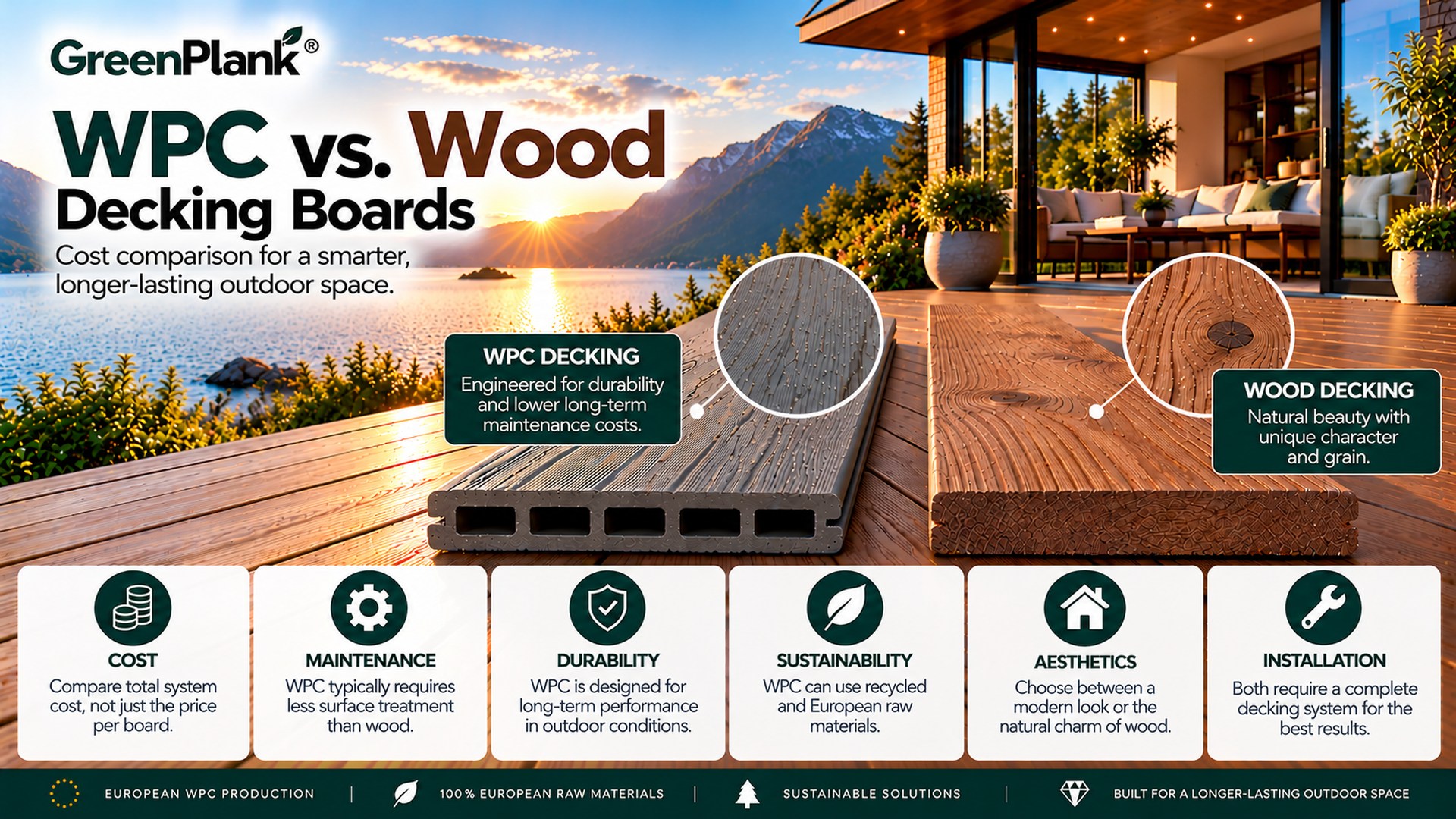
Choosing between WPC composite decking and traditional wood is often presented as a simple price comparison. In practice, the price of the decking boards is only one part of the investment. Substructure, fixings, waste, installation, cleaning, maintenance and possible future repairs can all influence the real cost of an outdoor deck.
A useful WPC vs. wood cost comparison should therefore look beyond the initial price tag and compare complete systems over an appropriate period of use. The lowest board price does not automatically mean the lowest total project cost, just as a higher initial price does not automatically guarantee better value.
Key point: Compare the cost of a complete installed square metre of decking, not simply the price of one board or one linear metre.
1. Initial Price vs. Total Decking Cost
Timber decking is available in many species, grades and price categories. WPC also varies considerably according to formulation, profile construction, surface technology and manufacturer. Comparing two quotations without checking what is included can therefore be misleading.
| Cost factor | WPC decking | Wood decking |
|---|---|---|
| Decking boards | Depends on profile, formulation and surface | Depends strongly on species, grade and treatment |
| Substructure | System and project dependent | System and project dependent |
| Fasteners | Often clips, screws and start/end fixings | Often screws or concealed fixing systems |
| Surface treatment | Traditional oiling or staining is generally not required | May require treatment depending on timber and desired appearance |
| Cleaning | Periodic cleaning required | Periodic cleaning required |
| Long-term cost | Depends on product, installation and use | Depends on timber, maintenance, installation and use |
2. Price per Linear Metre Can Be Misleading
One decking board may appear cheaper per linear metre while requiring more metres to cover the same area. Board width and the specified spacing between boards therefore matter when converting a quotation into a price per square metre.
A simple coverage example
Assume, purely for illustration, that a decking board is 150 mm wide and the specified spacing is 5 mm. The effective module is therefore 155 mm, or 0.155 m.
Linear metres required per m² = 1 ÷ 0.155 = approximately 6.45 lm/m².
If the illustrative board price were €10 per linear metre, the board-only cost would be approximately €64.50/m². This still excludes waste, substructure, clips, screws, edge details, freight and installation.
This calculation is an example only. It is not a Green Plank price or a universal installation recommendation. Always use the spacing and installation requirements specified for the actual decking product.
| Board width | Example gap | Effective module | Approx. lm/m² |
|---|---|---|---|
| 140 mm | 5 mm | 145 mm | 6.90 |
| 146 mm | 5 mm | 151 mm | 6.62 |
| 150 mm | 5 mm | 155 mm | 6.45 |
3. Calculate the Complete Decking System
A more meaningful quotation includes all components needed to build the planned deck. When comparing WPC with timber, ask each supplier to calculate the same project area and scope.
- Decking boards plus an appropriate waste allowance
- Substructure and supports
- Clips, screws and other fasteners
- Start and end fixings
- Edge and finishing profiles where required
- Transport and site logistics
- Installation labour
- Cleaning and planned maintenance
- Potential repair or replacement costs
A better purchasing question
Instead of asking only How much does the board cost?, ask What is the estimated system cost per finished square metre for my project?
4. Maintenance Is Part of the Cost Comparison
Natural timber changes with exposure and age. Depending on the wood species, environment and desired appearance, owners may choose or need periodic surface maintenance. Labour and maintenance materials should therefore be considered when calculating longer-term costs.
WPC combines wood or other natural fibres with a thermoplastic polymer and additional functional components. Conventional painting, staining or oiling associated with many timber decks is generally not part of normal WPC maintenance. However, composite decking still requires appropriate cleaning and care.
Neither material should be judged by an absolute statement such as maintenance-free. Location, product specification, construction, drainage and use all influence maintenance requirements.
5. Profile Construction Can Affect Value
WPC decking is available in different constructions. Comparing profile type helps buyers understand what they are purchasing rather than comparing price alone.
| Profile type | Typical characteristic | What to evaluate |
|---|---|---|
| Solid WPC | Solid cross-section | Weight, span requirements, formulation and application |
| Hollow WPC | Engineered internal chambers | Wall geometry, installation requirements and intended use |
| Capped / co-extruded WPC | Core with an additional surface layer | Cap construction, core formulation, finish and warranty terms |
| Timber | Natural solid material | Species, grade, moisture, treatment and origin |
6. Installation Costs Matter
Correct installation is important for both timber and WPC. For composite decking, professional planning should consider joist spacing, support conditions, ventilation, drainage, fastening and temperature-related movement.
There is no single expansion gap suitable for every WPC board. Material formulation, profile geometry, board length and installation temperature can affect dimensional movement. The product-specific installation guide should therefore be used when calculating materials and labour.
A quotation that excludes important installation components can initially appear cheaper but may not be directly comparable with a complete system quotation.
7. Compare Lifecycle Cost, Not Only Purchase Price
For long-term comparisons, buyers can use a lifecycle-cost approach. ISO 15686-5 provides principles for life-cycle costing of buildings and constructed assets. Applied practically to decking, this means considering relevant costs over an agreed period rather than focusing only on the first invoice.
A simplified calculation can be expressed as:
Total cost = purchase + installation + maintenance + repairs + replacement + other relevant lifecycle costs.
The correct comparison period depends on the project. A private terrace, hospitality deck and commercial outdoor area may have very different use patterns and maintenance expectations.
8. When Can WPC Be the Right Choice?
WPC may be attractive when a project prioritises a consistent appearance, system-based installation and reduced dependence on periodic surface treatments such as oiling or staining. It can also be relevant where documented product specifications, raw-material traceability and repeatable supply are important purchasing criteria.
Wood may be preferred when:
- the client specifically wants a natural solid-wood material,
- natural grain variation and ageing are part of the design concept,
- a particular timber species is central to the architecture,
- the expected maintenance programme is acceptable.
WPC may be preferred when:
- a more uniform board appearance is desired,
- traditional oiling or staining is to be reduced or avoided,
- a coordinated decking and fixing system is preferred,
- traceability and documented specifications are purchasing priorities.
9. Green Plank: European WPC Production
Green Plank is a Swedish brand with European production in Klaipėda, Lithuania. Its outdoor product portfolio includes TerraTuff™, Nordeka™, Classic™ and Sapphire™ decking solutions as well as composite products for other exterior applications.
Green Plank uses 100% European raw materials with 100% traceability. Selected formulations combine European wood fibres, including beech and oak, with HDPE and functional additives. Different profiles and surface technologies allow products to be selected according to the requirements of the project.
Selected TerraTuff™ products can carry residential warranty coverage of up to 50 years, depending on the specific product and applicable warranty conditions. Professional and commercial applications should always be checked against the relevant warranty terms.
10. Ten Questions to Ask Before Comparing Quotes
- What is the effective coverage per board?
- How many linear metres are required per m²?
- What waste allowance has been included?
- Is the substructure included?
- Are clips, screws and finishing components included?
- What are the product-specific installation requirements?
- What maintenance is expected?
- What technical documentation is available?
- What exactly does the warranty cover?
- What is the estimated total cost over the chosen comparison period?
Conclusion: Compare Value on the Same Basis
The real question is not simply whether WPC or wood has the lower board price. A useful comparison considers the complete installed system, required maintenance, technical requirements and relevant costs over time.
By converting quotations to a common cost per finished square metre and checking what is actually included, homeowners, architects, contractors and professional buyers can make a more transparent comparison between WPC and timber decking.
Sources
- Green Plank – Composite decking and product information
- ISO 15686-5 – Buildings and constructed assets: Life-cycle costing
- European Commission – Construction Products Regulation
- USDA Forest Products Laboratory – Wood Handbook
Specify the product
Use this guide with a Green Plank specification
Technical articles support the commercial catalogue — category, product, evidence, then samples or quotes.