



Sustainable Outdoor Living for Modern Living Spaces – by Green Plank
Outdoor spaces have become a natural extension of the modern home. A well-designed terrace can serve as a dining area, a place to relax, a social space and a visual connection between architecture and landscape. As expectations for outdoor living evolve, material origin, maintenance, traceability and long-term planning are becoming increasingly important considerations.
Sustainable outdoor living is therefore about more than choosing one particular material. It means looking at the complete project: where materials come from, how the system is designed, how much maintenance it requires, how components can be managed over time and how clearly the supply chain can be documented.
A better approach to outdoor design: Consider decking, substructure, fastening, drainage, ventilation, maintenance and material documentation as one complete system rather than separate purchasing decisions.
1. What does sustainable outdoor living really mean?
The word sustainability is widely used, but meaningful decisions require more specific questions. A product should not be considered sustainable simply because of its country of origin, material category or marketing description.
For homeowners, architects, developers and professional buyers, useful questions include:
- Where do the principal raw materials originate?
- Can materials and production be traced?
- What technical documentation is available?
- What maintenance does the installed system require?
- Can individual components be replaced when necessary?
- How complex is the supply and transport chain?
- What warranty applies to the actual application?
This broader approach helps move the conversation from individual product claims towards responsible material selection and better project planning.
2. WPC decking in modern outdoor architecture
WPC stands for Wood Plastic Composite. It combines wood or other natural fibres with a thermoplastic polymer and additional components. Different formulations and manufacturing methods can create decking, cladding and fencing products with different profiles, surfaces and technical characteristics.
Not all WPC products are the same. Fibre content, polymer type, additives, profile geometry, surface technology and manufacturing control can vary significantly. Buyers should therefore compare the actual product specification rather than assuming that all composite decking performs identically.
| Evaluation point | Why it matters |
|---|---|
| Raw materials | Identifies the main components used in the product |
| Material origin | Provides greater visibility into the supply chain |
| Traceability | Supports procurement, documentation and repeat ordering |
| Profile design | Affects material use, installation and intended application |
| Installation system | Defines support, fastening and movement requirements |
| Warranty | Should be checked against the exact product and application |
3. European raw materials and traceability
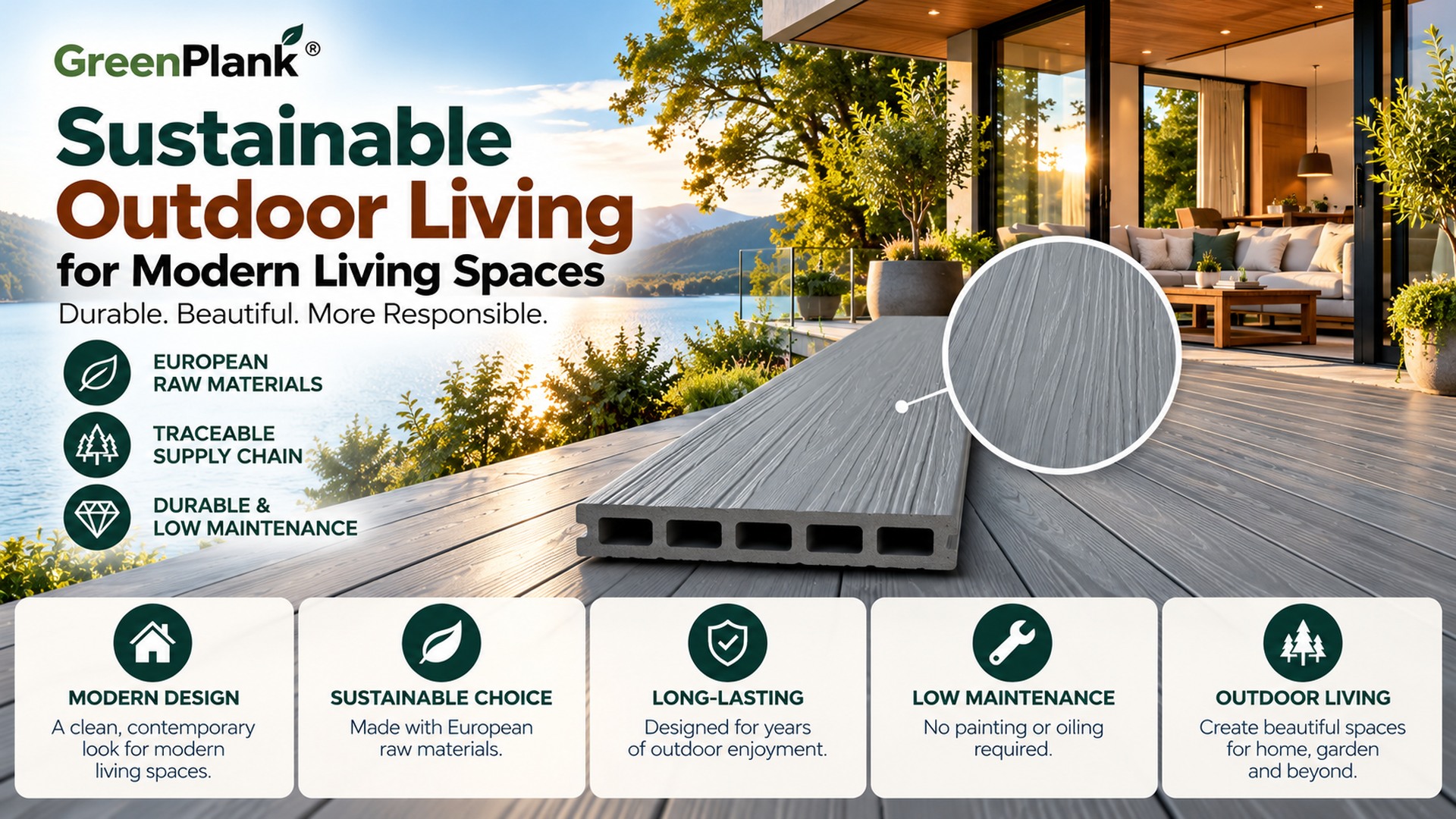
Green Plank is a Swedish brand with production in Klaipėda, Lithuania. The company works with European raw materials and traceability through its supply and production chain. Selected formulations combine European wood fibres, including beech and oak, with HDPE and other functional components.
Traceability is valuable because it can provide greater visibility into material sourcing, manufacturing and product identification. For professional projects, it can also support procurement procedures, quality control and future repeat orders.
4. A more transparent European supply chain
European production can provide practical advantages for projects located within Europe. Geographic proximity may simplify communication, logistics, product replenishment and coordination between manufacturer, distributor and customer.
Transport distance, however, should not be used alone to make a carbon-footprint claim. Actual environmental impact can depend on transport mode, load efficiency, raw materials, manufacturing energy, service life and end-of-life scenarios. Meaningful carbon comparisons require appropriate product-specific evidence or life-cycle assessment.
5. Design outdoor spaces for long-term use
A thoughtfully planned terrace considers more than the initial price of the decking boards. The complete project includes the substructure, clips, screws, trims, installation, logistics, cleaning and possible future replacement of components.
| Project stage | Considerations |
|---|---|
| Product selection | Profile, dimensions, surface, raw materials and documentation |
| Construction | Foundation, substructure, drainage and ventilation |
| Installation | Fasteners, support spacing and movement allowances |
| Use | Cleaning, inspection and normal care |
| Long-term planning | Repair, replacement and lifecycle costs |
ISO 15686-5 provides principles for life-cycle costing in buildings and constructed assets. For larger projects, this type of approach can provide a more useful comparison than purchase price alone.
6. Low maintenance does not mean maintenance-free
One reason homeowners and professionals consider composite decking is the different maintenance routine compared with many traditional timber solutions. WPC decking normally does not require conventional painting, staining or oiling, although it still needs routine cleaning and inspection.
A practical maintenance plan can include:
- removing leaves and loose dirt regularly
- keeping gaps and drainage paths clear
- cleaning spills according to product instructions
- using cleaning products suitable for the surface
- checking drainage and ventilation
- periodically inspecting decking and substructure
Designing the terrace so that important areas remain accessible can make routine care considerably easier.
7. Good construction is part of responsible design
Material choice alone cannot create a successful outdoor space. A stable foundation, correctly designed substructure, effective drainage and sufficient ventilation are essential parts of the complete decking system.
Temperature movement must also be considered with WPC. There is no single universal expansion gap suitable for every composite board. Board length, installation temperature, colour, direct sunlight and profile construction can all influence movement. Always follow the current installation instructions for the specific product.
Key construction considerations
- stable and suitable foundation
- product-specific joist spacing
- effective water drainage
- adequate airflow below the decking
- correct clips and fasteners
- product-specific movement allowances
8. Outdoor design for contemporary homes
Modern architecture increasingly connects indoor and outdoor living. A terrace can continue the visual language of the house through colour, texture, board direction and carefully planned transitions between interior floors, façades and landscaped areas.
Composite systems offer defined colours, surface structures and different profile types, giving architects and homeowners flexibility when designing contemporary outdoor spaces. Technical requirements should, however, remain part of the design process from the beginning.
A residential garden terrace, apartment development, hotel terrace and public outdoor space may each require different profiles, support structures and installation solutions.
9. Green Plank solutions for outdoor living
The Green Plank range includes different WPC decking systems for different project requirements, including TerraTuff™, Nordeka™, Classic™ and Sapphire™. The ranges differ in profile construction, surface design and intended application.
Selected TerraTuff™ products are offered with residential warranties of up to 50 years, depending on the specific product and applicable warranty terms. Commercial and professional applications should always be checked against the relevant product warranty and technical requirements.
Rather than selecting a decking product by appearance alone, compare profile construction, effective coverage, substructure requirements, fastening system, technical documentation, warranty and intended use.
10. A practical checklist for sustainable outdoor planning
- Define how the outdoor space will be used.
- Compare materials using technical information, not marketing claims alone.
- Ask for information about raw-material origin and traceability.
- Select the profile according to the project requirements.
- Plan the foundation and substructure as part of the complete system.
- Provide effective drainage and ventilation.
- Allow for product-specific thermal movement.
- Use the specified fastening components.
- Consider cleaning, inspection and future accessibility.
- Compare complete project and lifecycle costs rather than board price alone.
Creating better outdoor living spaces
Sustainable outdoor living is not created by a single material claim. It comes from informed choices about raw materials, traceability, construction, maintenance, logistics and long-term use.
For modern homes and professional projects, the strongest approach is to combine attractive design with transparent product information and careful technical planning. By considering the complete outdoor system from the beginning, designers and property owners can create spaces that are practical, visually coherent and better aligned with responsible material choices.
Sources
- Green Plank – official product and company information
- ISO 15686-5:2017 – Life-cycle costing
- European Commission – Circular Economy
Specify the product
Use this guide with a Green Plank specification
Technical articles support the commercial catalogue — category, product, evidence, then samples or quotes.