



Why municipalities are opting for composite materials by Green Plank
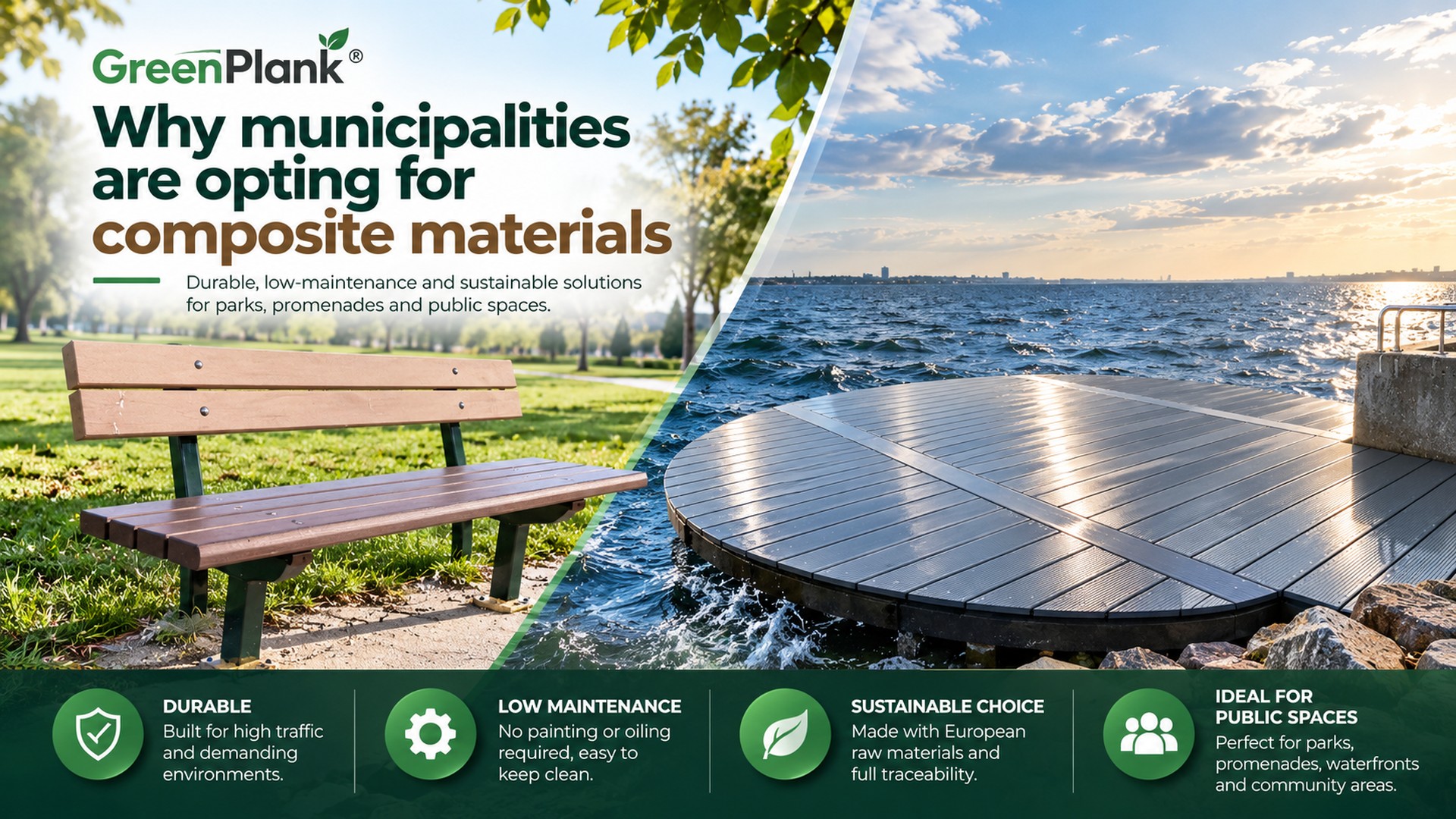
Municipalities design outdoor spaces for years of public use. Parks, promenades, waterfront areas, public terraces, schools and community spaces must combine attractive design with practical maintenance, predictable procurement and technically appropriate construction. This is one reason composite materials such as WPC are increasingly considered for professional outdoor projects.
WPC, or Wood Plastic Composite, combines wood or natural fibre with a thermoplastic polymer and functional components. But specifying WPC alone does not guarantee performance. For public projects, municipalities should evaluate the complete decking system: board construction, substructure, fixings, drainage, ventilation, installation requirements, documentation and maintenance.
A better procurement principle: Compare complete installed systems per square metre rather than selecting a decking product solely by its price per linear metre.
Where can composite decking be used in public spaces?
WPC decking can be considered for a wide range of municipal and commercial environments. The correct product and construction must always be matched to the actual use, expected loading and site conditions.
- Parks and public seating areas
- Waterfront promenades and boardwalks
- Community and residential outdoor spaces
- Terraces around public buildings
- Schools and recreational facilities
- Hospitality and restaurant terraces
- Urban regeneration and landscape projects
1. Municipalities look beyond the initial purchase price
Public procurement is increasingly concerned with the cost of operating an asset, not simply buying it. The board price is only one component of a finished deck. Substructure, clips, screws, installation, cleaning, inspection, repairs and future replacement can all influence total project cost.
ISO 15686-5 provides principles for life-cycle costing of buildings and constructed assets. Applying a lifecycle approach can help procurement teams compare alternatives using a broader economic framework instead of focusing exclusively on the lowest initial material price.
| Cost area | What to include | Why it matters |
|---|---|---|
| Decking | Boards and required quantities | Board width and layout affect material use |
| System | Substructure, clips, screws and finishing components | Creates a more realistic cost per m² |
| Installation | Preparation, cutting and labour | Systems can have different installation requirements |
| Maintenance | Cleaning, inspection and repairs | Costs continue after installation |
| Logistics | Transport, storage and future reorders | Relevant to project planning and supply continuity |
2. Maintenance-friendly does not mean maintenance-free
One reason municipalities may consider WPC is its different maintenance profile compared with many traditional timber decking systems. Composite boards generally do not require conventional periodic painting, staining or oiling. Public WPC surfaces still require cleaning and inspection.
A practical maintenance programme can include:
- removing leaves, sand and loose debris,
- keeping drainage paths and board gaps clear,
- cleaning spills according to manufacturer guidance,
- checking edges, transitions and fixing points,
- inspecting areas exposed to concentrated traffic.
The frequency of maintenance should be determined by location, surrounding vegetation, traffic levels and the type of public activity taking place on the surface.
3. Not all WPC boards are the same
WPC is a material category rather than a single technical specification. Fibre content, polymer type, additives, profile geometry, manufacturing process and surface construction can differ significantly between products.
This means two boards that look similar in a catalogue may have different installation requirements and intended applications. Professional buyers should compare documented product characteristics rather than relying only on appearance or marketing terminology.
| Profile type | Basic construction | What to evaluate |
|---|---|---|
| Solid | Continuous composite cross-section | Weight, support, fixing and intended application |
| Hollow | Engineered internal cavities | Geometry, support spacing and edge detailing |
| Capped / co-extruded | Composite core with an additional surface layer | Cap construction, core, surface and warranty |
4. The substructure is part of the product system
A high-quality visible surface cannot compensate for an incorrectly designed base. The foundation and substructure must provide suitable support while allowing the decking system to manage water, ventilation and movement.
There is no universal joist spacing suitable for every WPC board. Profile geometry, load, board orientation and intended use influence support requirements. Diagonal installation or demanding applications may require different spacing from a conventional residential layout.
Project tip: Specify the decking board, substructure, support spacing, fastening system and installation method together. Changing one component can affect the performance of the complete construction.
5. Drainage and ventilation should be designed early
Public decking is exposed to rainfall, cleaning water, debris and seasonal weather. Drainage should therefore be incorporated during design rather than treated as a detail at the end of installation.
Water needs a clear route away from the structure, while appropriate airflow should be maintained below and around the deck. Connections to walls, steps, planters and other fixed elements should follow the requirements of the selected decking system.
6. Thermal movement must be product-specific
WPC responds to temperature changes. The degree of movement depends on factors including formulation, profile, board length, colour, installation temperature and solar exposure.
For this reason, municipalities and contractors should avoid applying one universal expansion gap to every composite product. End gaps, joints and distances to fixed structures should follow the current installation instructions for the selected profile.
This becomes particularly important on large public areas where long board runs and different levels of sun exposure may occur across the same project.
7. Traceability can support professional procurement
For public buyers, traceability can make it easier to identify the supplied product, understand the origin of principal materials, maintain project documentation and manage future reorders.
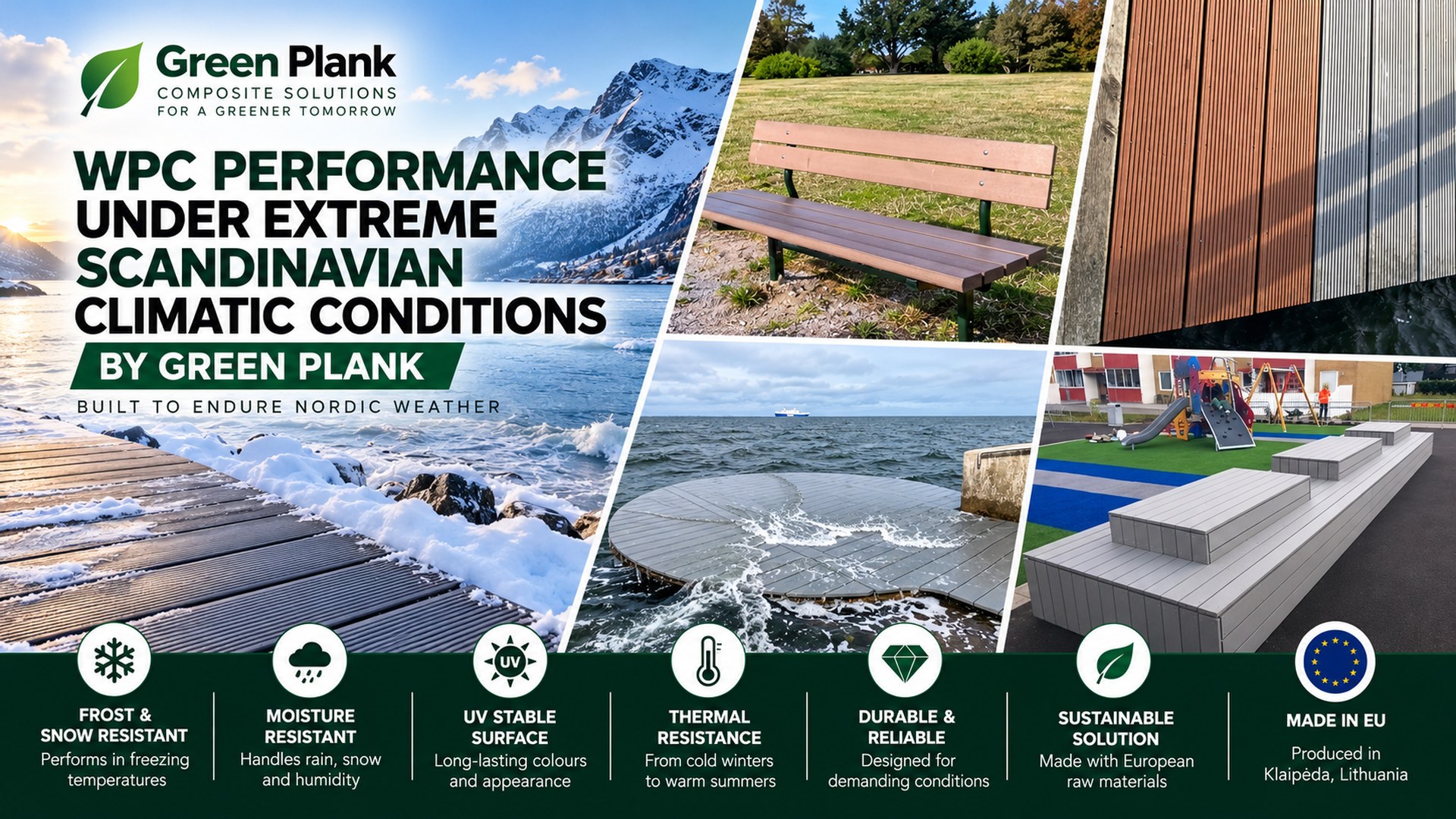
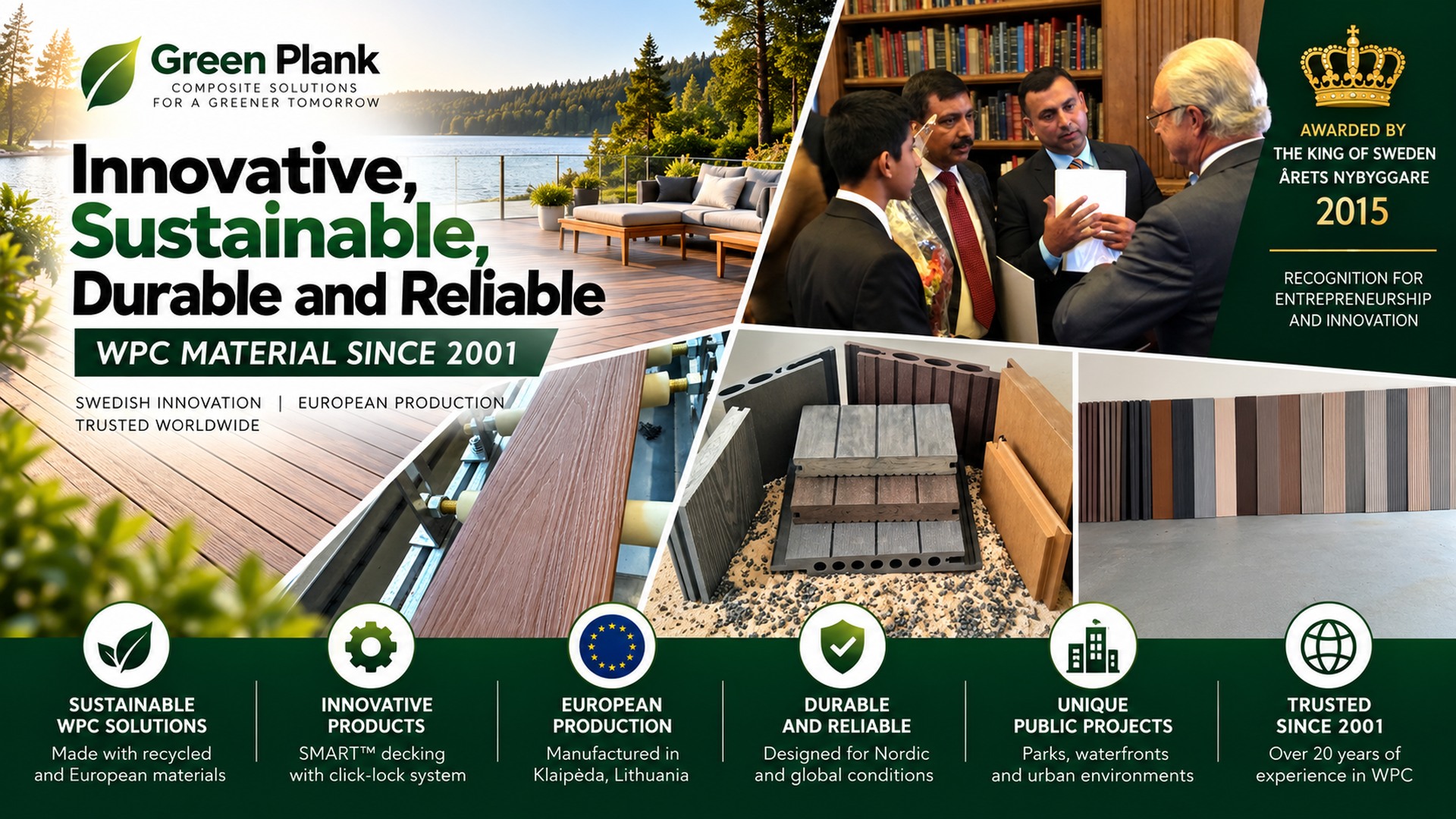
Green Plank is a Swedish brand with European production in Klaipėda, Lithuania. The company works with European raw materials and traceability through its supply and production chain. Selected formulations use European wood fibres, including beech and oak, combined with HDPE and functional components.
European origin and traceability are useful procurement criteria, but they should not automatically be interpreted as proof of superior performance or lower environmental impact. Those conclusions require relevant product-specific evidence.
8. Sustainability requires measurable information
Municipalities increasingly include environmental considerations in procurement. A credible assessment should look beyond broad terms such as “green” or “eco-friendly” and examine information that can actually be documented.
Relevant considerations may include material origin, material efficiency, expected use, maintenance, transport, repairability and end-of-life options. Where environmental impacts between competing products are compared, appropriate product-specific lifecycle information should be used.
9. Documentation matters in public projects
The EU Construction Products Regulation (EU) 2024/3110 establishes an updated regulatory framework for construction products. The documentation applicable to a particular WPC product depends on the product, intended use and relevant technical specifications.
Before tendering, municipal project teams should establish which technical information and evidence are required. This may include product data, installation instructions, intended applications, warranty conditions and applicable performance documentation.
A procurement file should consider:
- exact product and profile identification,
- dimensions and effective coverage,
- intended application,
- substructure and support requirements,
- fixing system and installation instructions,
- thermal movement requirements,
- maintenance guidance,
- applicable warranty conditions.
10. Green Plank solutions for professional outdoor projects
Green Plank offers several WPC product families, including TerraTuff™, Nordeka™, Classic™ and Sapphire™. These ranges provide different profile constructions and surfaces that can be evaluated against the requirements of individual public and commercial projects.
Warranty terms should always be checked against the intended application. Selected TerraTuff™ products, for example, are offered with residential warranties of up to 50 years, depending on the product and applicable warranty terms. Public and commercial applications must be assessed separately under the relevant conditions.
10 questions municipalities should ask before specifying WPC
- What traffic and loading will the area experience?
- Is the selected profile intended for this application?
- What raw-material and traceability information is available?
- What substructure and support spacing are required?
- How will water drain from the construction?
- How will adequate ventilation be maintained?
- How should thermal movement be accommodated?
- Which clips, screws and finishing components form the system?
- Which technical documents and warranty conditions apply?
- What is the total system and lifecycle cost rather than the board price alone?
Conclusion: Specify the complete system
Municipal interest in composite materials is best understood as part of a wider move toward system-based procurement. WPC can offer a useful combination of design flexibility and a maintenance profile suited to many outdoor applications, but successful public projects depend on correct specification and installation.
By evaluating the board, substructure, fixings, drainage, ventilation, documentation, traceability and lifecycle costs together, municipalities can make better-informed comparisons between available solutions. For Green Plank, the focus is on European production, traceable European raw materials and complete WPC solutions that can be evaluated against the technical requirements of each professional project.
Sources
- Green Plank – product and company information
- ISO 15686-5:2017 – Life-cycle costing
- EUR-Lex – Regulation (EU) 2024/3110
- European Commission – Construction Products Regulation
Specify the product
Use this guide with a Green Plank specification
Technical articles support the commercial catalogue — category, product, evidence, then samples or quotes.