



Green Plank – High-Performance WPC: Why Quality and Durability Matter
Not all wood-plastic composite products are engineered in the same way. Two decking boards may look similar in a showroom, yet differ substantially in raw materials, formulation, profile construction, manufacturing consistency, surface technology and installation requirements. These differences can influence how a WPC system performs in real outdoor applications.
For homeowners, architects, contractors and professional buyers, the important question is therefore not simply which WPC looks best or has the lowest price per metre. A more useful question is: what makes a well-specified WPC product capable of delivering consistent long-term performance?
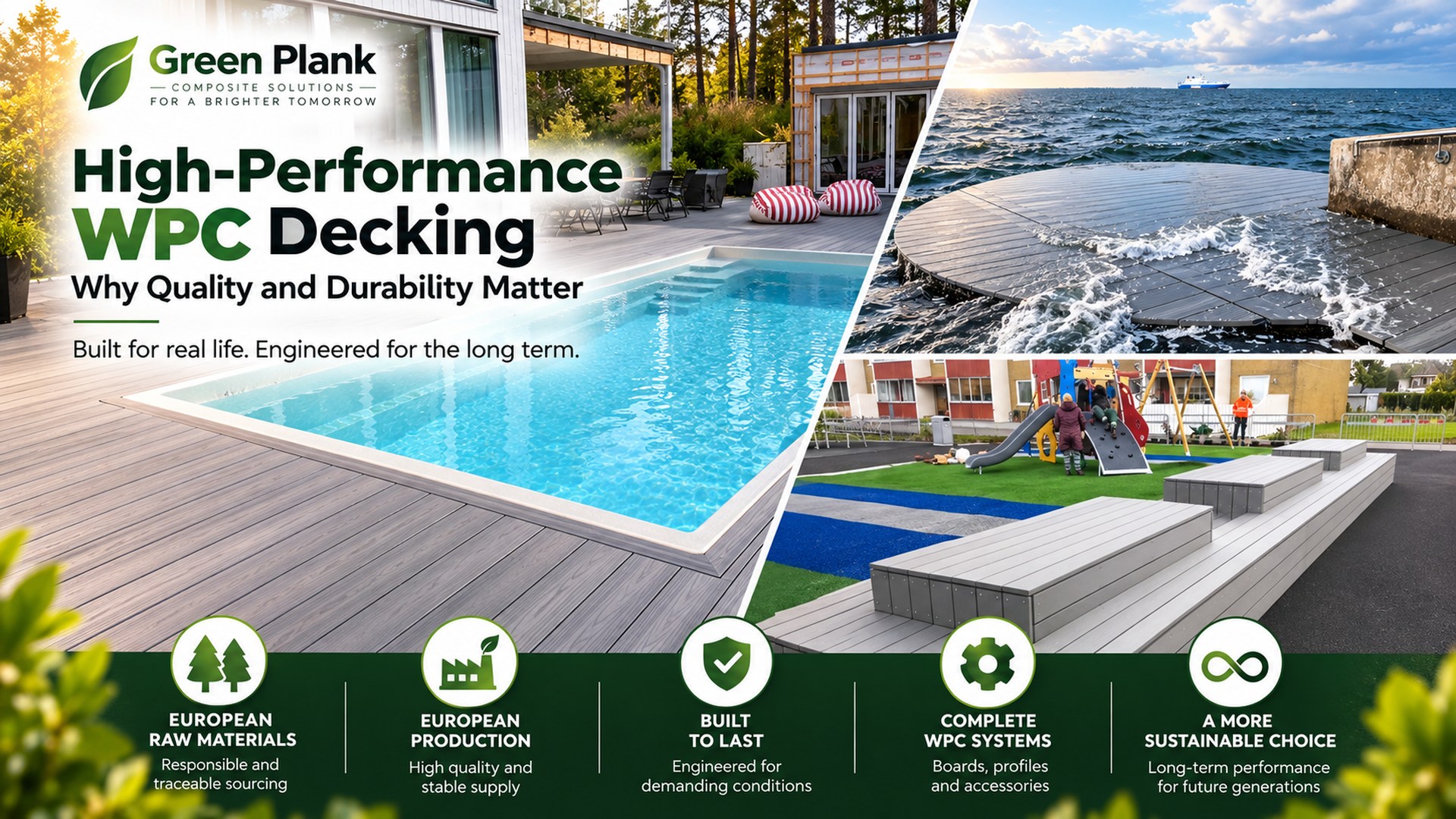
Green Plank is a Swedish brand with European production in Klaipėda, Lithuania. Its approach combines European raw materials, traceability, different profile technologies and complete decking systems designed for clearly defined applications.
High-performance WPC is a complete system. Raw materials matter, but so do formulation, profile geometry, manufacturing control, substructure, fixings, drainage, ventilation and correct installation.
What Does High-Performance WPC Actually Mean?
WPC, or Wood Plastic Composite, typically combines wood or natural fibres with a thermoplastic polymer and functional additives. There is no single WPC formulation that represents every product on the market. Fibre content, polymer type, additives, density, profile design and processing technology can all vary.
This means quality should be evaluated through measurable and product-specific information rather than broad labels such as premium or best. A professional assessment should consider the complete construction of the product and the system in which it will be installed.
| Quality factor | Why it matters |
|---|---|
| Raw materials | Influence processing, consistency and material properties |
| Formulation | Controls the balance between fibre, polymer and functional additives |
| Profile design | Affects weight, geometry, support requirements and intended use |
| Surface technology | Changes appearance and surface characteristics |
| Manufacturing control | Supports dimensional and batch consistency |
| Installation system | Helps the product function as designed in the finished deck |
1. Raw Materials Are the Starting Point
The performance of a composite board begins with its material system. Selected Green Plank products use a high proportion of European hardwood fibres, including beech and oak, combined with HDPE and functional additives. Exact formulations vary by product and should always be confirmed against the current technical specification.
Professional buyers should ask more than simply how much wood or plastic a product contains. Useful questions include:
- What type of wood or natural fibre is used?
- What polymer forms the matrix?
- Are the principal raw materials traceable?
- Is the formulation controlled between production batches?
- Which technical information is available for the specific product?
A high wood-fibre percentage alone does not prove that one board will outperform another. The interaction between fibre, polymer, additives, processing and profile geometry is what matters.
2. Profile Engineering Matters
WPC decking is available in hollow, solid and capped or co-extruded constructions. Each approach can be suitable when correctly engineered for its intended application.
| Profile type | Typical characteristic | What buyers should evaluate |
|---|---|---|
| Hollow | Internal chamber construction | Wall geometry, support spacing and intended application |
| Solid | Material through most or all of the cross-section | Weight, dimensions, support requirements and application |
| Capped / co-extruded | Composite core with an additional surface layer | Core construction, cap technology, surface and installation system |
Green Plank offers several profile families, including TerraTuff™, Nordeka™, Classic™ and Sapphire™, allowing a project to be specified according to design, construction and application requirements rather than relying on one profile for every situation.
3. Manufacturing Consistency Is Critical
Even a carefully designed formulation depends on controlled production. Extrusion conditions influence dimensions, surface finish and the consistency of the finished profile. For professional projects, repeatability is especially important when products are supplied over several deliveries or later need to be reordered.
Green Plank combines Swedish brand management with production in Klaipėda, Lithuania. European production also provides a geographically closer supply structure for many EU and Nordic customers. However, manufacturing location alone should never be treated as proof of technical quality; product-specific documentation remains essential.
Green Plank European Product Approach
Swedish brand • European production • European raw materials • Traceability • Product-specific systems
These characteristics should be assessed together with technical specifications, installation instructions and the requirements of each project.
4. Capped and Uncapped WPC Serve Different Requirements
Co-extruded or capped WPC includes an additional surface layer around part or all of the composite core. This creates a different surface construction from traditional uncapped WPC, where the composite material itself forms the exposed surface.
Neither description should be used as a shortcut for quality. Buyers should evaluate the cap material, core formulation, profile geometry, surface characteristics and intended application as a complete package.
TerraTuff™ represents Green Plank's capped decking approach, while other Green Plank families provide alternative constructions for different specifications and budgets.
5. Durability Depends on More Than the Board
A technically capable decking board can still perform poorly when the surrounding construction is incorrect. The finished deck is a system that includes the supporting structure, board spacing, clips, screws, perimeter details, drainage and ventilation.
Important installation factors include:
- a stable and appropriately designed foundation;
- correct support spacing for the selected profile;
- sufficient drainage beneath and around the deck;
- ventilation according to the installation conditions;
- product-specific allowance for thermal movement;
- approved clips, screws and system components;
- correct detailing around walls and other fixed structures.
There is no universal expansion gap or joist spacing suitable for every WPC board. Profile geometry, board length, temperature, installation orientation and application can affect the requirements. Current product-specific installation instructions should therefore always take priority over generic rules.
6. Durability Is Not the Same as Zero Maintenance
Composite decking is often selected because it can reduce some routine treatments associated with certain timber decking systems. That does not make WPC maintenance-free.
Outdoor surfaces still require cleaning, and leaves, dirt and organic material should not be allowed to accumulate. Drainage routes should remain clear, and the deck should be inspected periodically, particularly in heavily used or exposed locations.
A credible WPC specification should therefore focus on manageable maintenance and appropriate long-term performance rather than unrealistic promises of zero care.
7. Warranty Must Be Read Product by Product
Warranty length can be useful when comparing products, but the number of years alone does not describe the complete technical performance of a decking system. Coverage, application, installation requirements and exclusions must also be considered.
For example, selected TerraTuff™ products are offered with residential warranty coverage of up to 50 years, depending on the product and applicable warranty terms. Other Green Plank ranges have different warranty periods and conditions. Commercial and professional applications may also be subject to separate terms.
A warranty should not be interpreted as a guaranteed technical service life. Buyers should always review the current warranty documentation for the exact product and application.
8. Quality Should Be Compared by Finished Square Metre
Comparing WPC only by price per linear metre can be misleading. Board width, required spacing, substructure, clips, screws, trims, waste and installation all influence the cost of the completed deck.
For example, a 150 mm board with an assumed 5 mm installation gap has an effective coverage width of 155 mm. The approximate requirement would be:
1 ÷ 0.155 = approximately 6.45 linear metres of decking per m².
This is a calculation example only. The actual installation gap must follow the instructions for the selected product.
9. Think in Terms of Life-Cycle Cost
The lowest purchase price does not necessarily represent the lowest cost over a chosen analysis period. ISO 15686-5 provides principles for life-cycle costing of buildings and constructed assets, encouraging decision-makers to consider relevant costs over time rather than focusing exclusively on initial expenditure.
For a decking project, a structured comparison can include:
- decking boards and system components;
- substructure and installation;
- routine cleaning and maintenance;
- repairs or component replacement where relevant;
- logistics and future availability;
- costs associated with the chosen analysis period.
10 Questions Before Choosing a WPC Product
- What are the principal raw materials?
- Where is the product manufactured?
- Can the materials and product identity be traced?
- Is the board hollow, solid or capped?
- What application is the profile designed for?
- What support spacing does the manufacturer specify?
- What are the product-specific thermal movement requirements?
- Which clips, screws and accessories form the complete system?
- What technical and installation documentation is available?
- What exactly does the warranty cover for the intended application?
Why Quality and Durability Matter
The best-performing WPC for a project is not necessarily the board with the highest wood content, the thickest profile, the longest headline warranty or the highest price. It is the product whose materials, engineering, documentation and installation system are appropriate for the intended application.
Green Plank's approach combines European production, European raw materials, traceability and multiple product technologies for different project requirements. For buyers, the most reliable comparison is therefore based on the complete system and verified product information rather than marketing claims alone.
Conclusion
Quality in WPC begins with raw materials but extends through formulation, extrusion, profile engineering, surface technology, documentation and installation. Durability is similarly the result of the entire system working together.
Whether specifying a residential terrace, commercial outdoor area or professional project, compare products using measurable, product-specific information. A well-documented WPC system, correctly selected and installed for its intended application, provides a much stronger basis for long-term performance than price or appearance alone.
Sources
- Green Plank – European composite products and product information
- ISO 15686-5 – Buildings and constructed assets: Life-cycle costing
- EUR-Lex – Regulation (EU) 2024/3110 on construction products
Specify the product
Use this guide with a Green Plank specification
Technical articles support the commercial catalogue — category, product, evidence, then samples or quotes.