


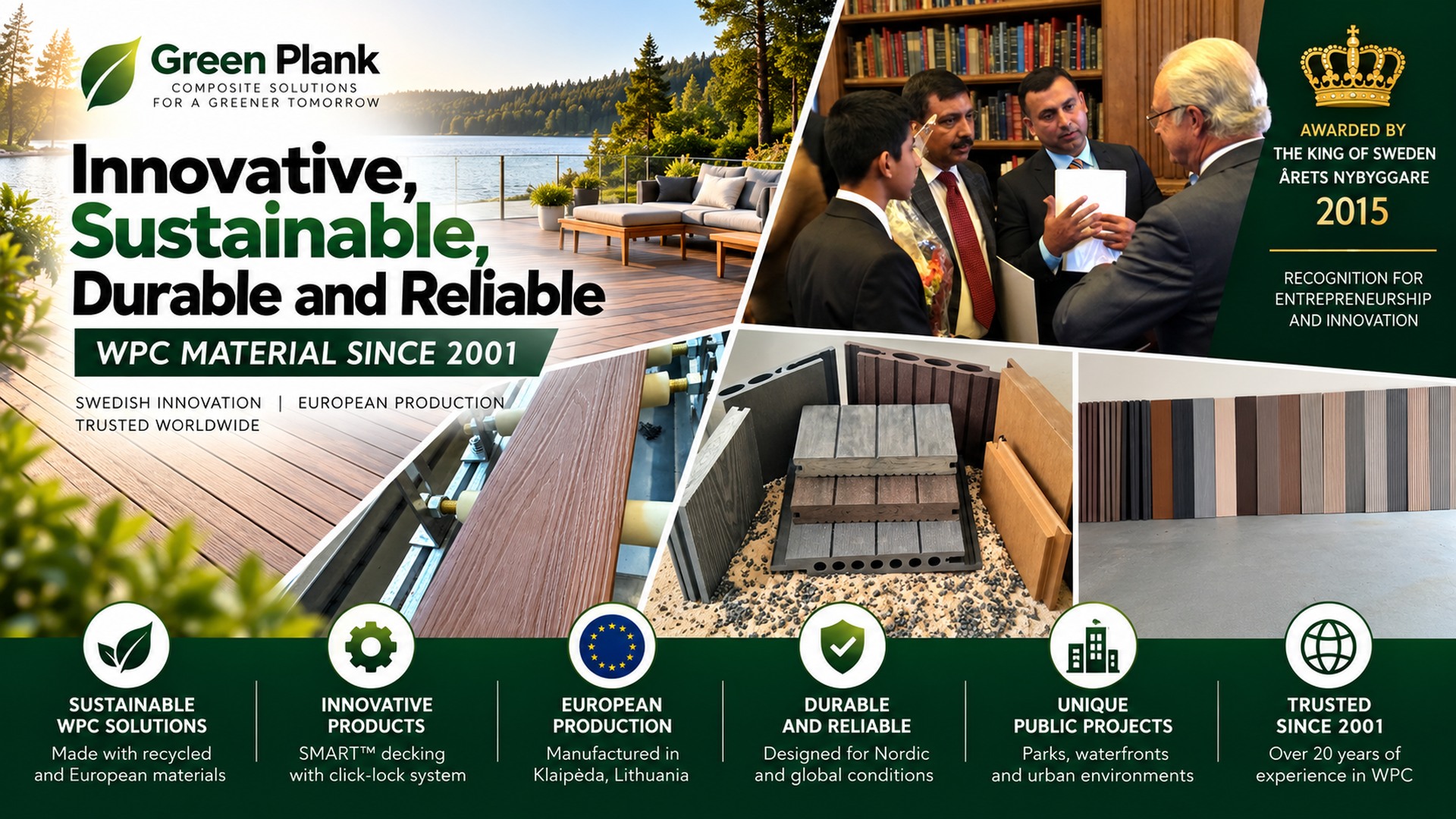
Green Plank: innovation, recognition and WPC development since 2001
Green Plank's story is about more than composite decking. It is a story of Swedish entrepreneurship, product development and a long-term ambition to rethink how wood-plastic and natural-fibre composite materials can be used in outdoor environments.
Since its early years, the brand has developed solutions for terraces, public spaces, waterfront environments, street furniture, fencing and façades. Today, Green Plank combines Swedish design thinking with European manufacturing and a growing portfolio of natural-fibre composite systems.
The Green Plank philosophy: innovation should solve practical problems. Material efficiency, concealed fixing, simplified installation, traceability and application-specific design are more meaningful than innovation for its own sake.
More than two decades of WPC development
Green Plank's development reflects the wider evolution of the European composite market. Early WPC products were often evaluated mainly as alternatives to timber. Modern buyers expect considerably more: defined profiles, technical documentation, installation systems, material traceability, surface choices and solutions for different applications.
Green Plank's published company history documents milestones including the introduction of hollow-core decking profiles, multicoloured composite boards, façade products and later a clip-free decking concept. These developments illustrate how the brand has repeatedly approached WPC as an engineered system rather than simply a board.
| Development | Purpose | Customer relevance |
|---|---|---|
| Hollow-core profiles | Optimise profile construction and material use | More product choices for different applications |
| Multicolour surfaces | Create greater visual variation | More natural-looking design options |
| Composite cladding | Extend WPC beyond decking | Coordinated exterior applications |
| Clip-free decking concept | Rethink board connection and visible fixings | Cleaner deck surfaces and simplified system design |
| European production | Bring manufacturing closer to European markets | Greater supply-chain visibility and traceability |
Recognition from Swedish entrepreneurship
A notable milestone came in 2015, when Green Plank states that it received the Årets Nybyggare recognition, presented by King Carl XVI Gustaf at the Royal Palace in Stockholm. Green Plank describes this event in its published company history as an important recognition of the entrepreneurial direction behind the business.
The distinction is particularly meaningful in the company's story because it reflects the entrepreneurial journey behind the technology: building a Swedish brand, introducing new composite concepts and expanding into European markets.
A milestone, not an endpoint
The 2015 recognition sits within a longer development timeline. Green Plank continued to develop new product concepts after the award, including a Swedish patent application in 2019 for a clip-free tongue-and-groove decking system.
SMART™ decking: rethinking the traditional deck surface
Traditional composite decking commonly uses clips between boards. Green Plank has also developed an alternative approach through its SMART™ decking concept. The current Green Plank portfolio describes SMART™ as a gap-free composite decking system using patented tongue-and-groove technology and a clip-free surface concept.
The principle is simple: instead of treating each board as an isolated component, the connection between neighbouring boards becomes part of the product design. This can create a visually continuous surface while reducing dependence on conventional intermediate deck clips.
Why connection technology matters
- It influences the visual appearance of the completed deck.
- It determines how boards interact with the supporting structure.
- It can affect installation sequence and fixing requirements.
- It allows designers to create different surface concepts from conventional open-gap decking.
SMART™ should still be installed according to its product-specific technical documentation. A specialised connection system does not eliminate the need to consider drainage, ventilation, substructure, temperature movement and the intended application.
Innovation also happens beneath the surface
A successful WPC system depends on more than the visible face of a board. Polymer characteristics, natural fibre, additives, profile geometry, processing conditions, fixings and installation details all contribute to the final construction.
Green Plank's current European strategy emphasises European raw materials and traceability. Selected products use a high proportion of European hardwood fibre combined with polymer and functional additives. Exact formulations vary by product and should be confirmed from the relevant technical documentation.
| Area | What professional buyers should evaluate |
|---|---|
| Raw materials | Origin, polymer type, natural fibre and consistency |
| Profile | Solid, hollow, capped or tongue-and-groove construction |
| Surface | Texture, colour technology and surface construction |
| Fixing system | Clips, concealed fixing or profile-specific connection |
| Installation | Support spacing, drainage, ventilation and thermal movement |
| Documentation | Datasheets, installation guidance, warranty and intended use |
From private terraces to distinctive public projects
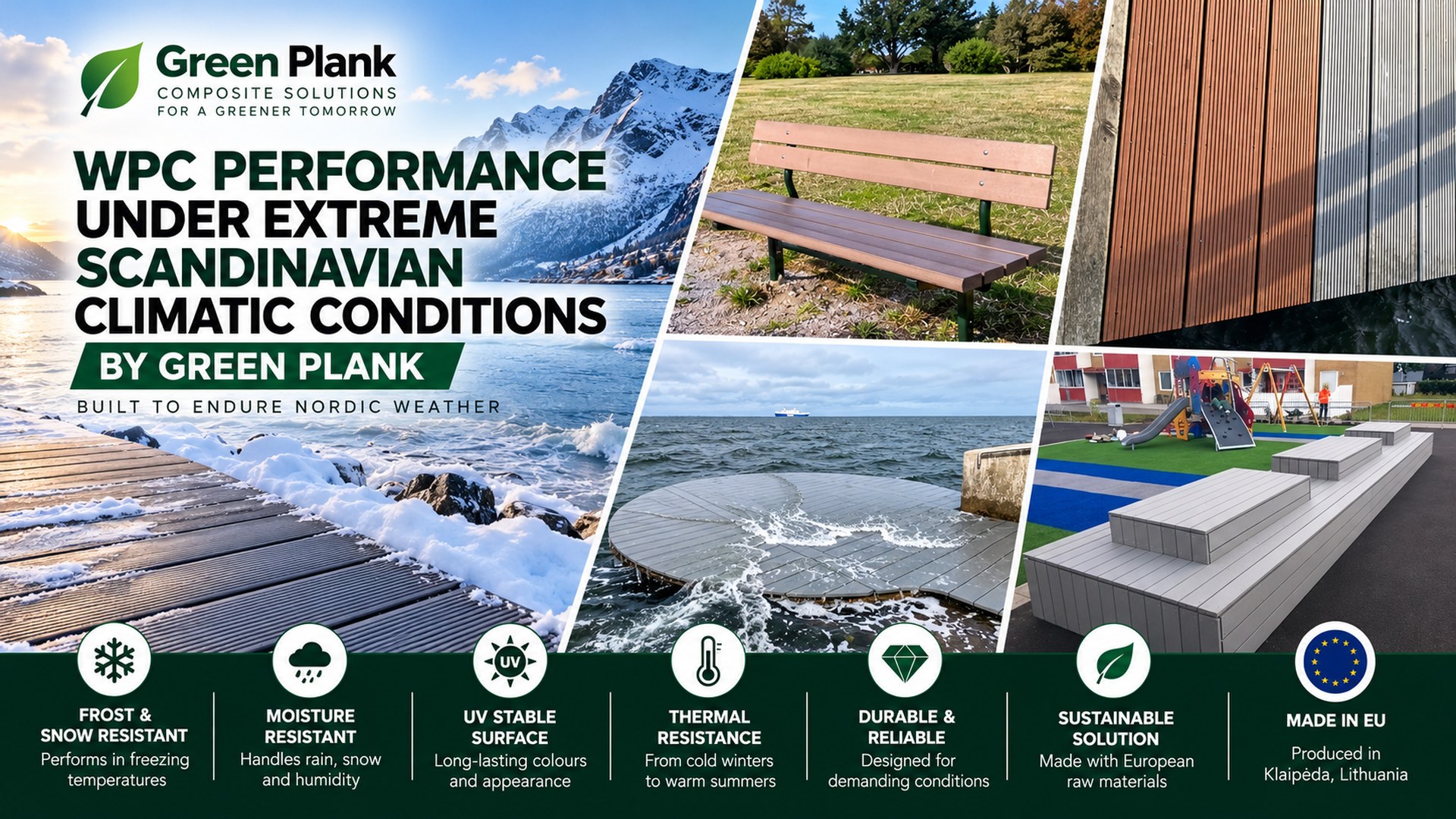
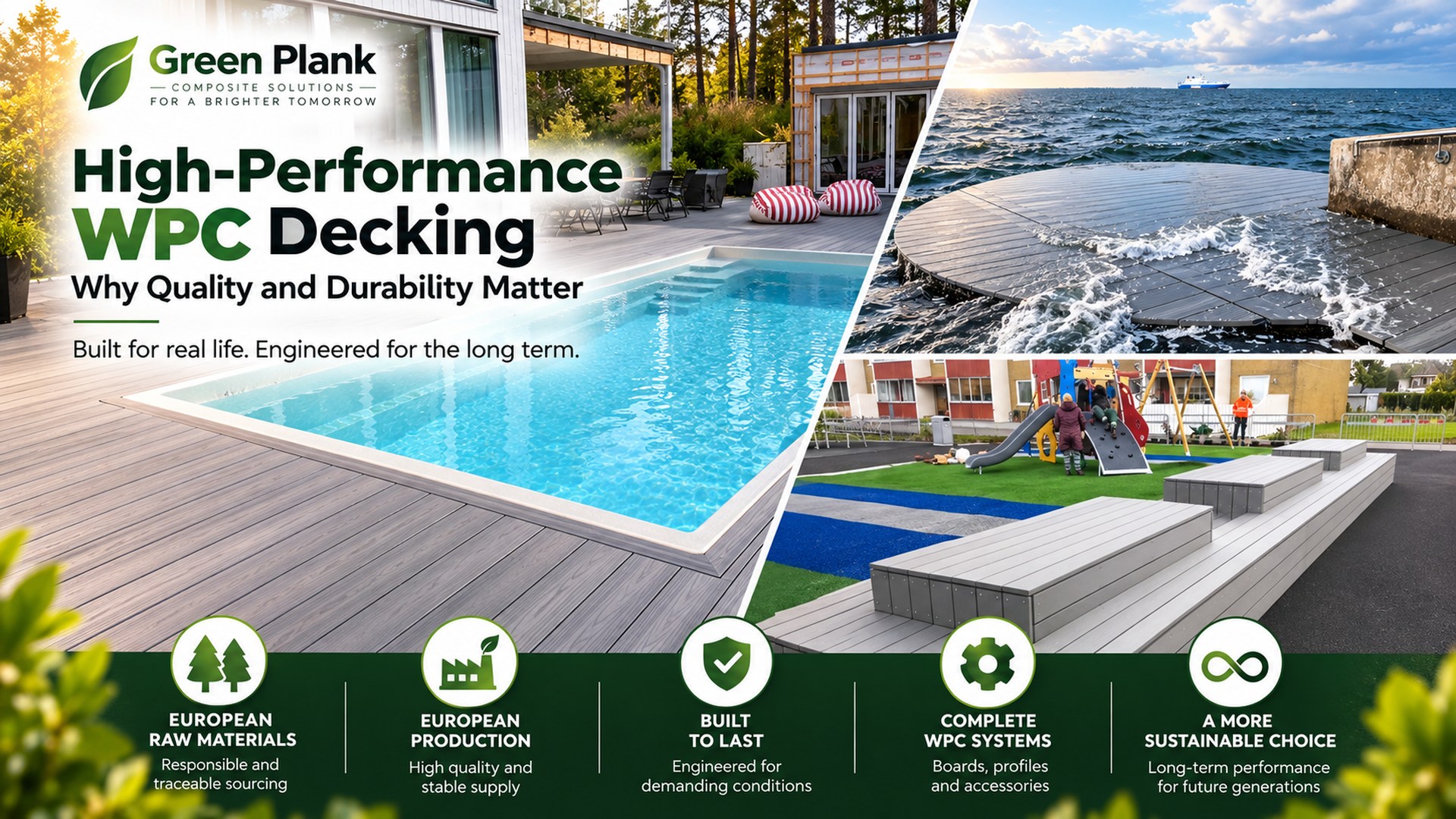
One of the most interesting parts of the Green Plank story is the variety of environments in which composite profiles have been used. The company's published case studies include urban furniture, bathing infrastructure, waterfront decking and public promenades in and around Malmö.
Kockum Bench Renewal
Green Plank documents the renewal of public seating in Malmö using natural-fibre composite profiles. The project illustrates a different role for WPC: rather than building a conventional terrace, composite boards become part of urban street furniture where appearance, cleaning and everyday public use are important considerations.
Sibbarp bathing bridges
Waterfront projects create demanding design conditions involving regular moisture exposure and Nordic seasonal changes. Green Plank lists the Sibbarp bathing bridges among its public and marine references, demonstrating the use of composite systems beyond residential gardens.
Sundspromenaden, Malmö
Sundspromenaden is another published Green Plank reference. The waterfront promenade represents the type of project where material selection must be considered as part of a complete public-space system, including construction, accessibility, maintenance planning and exposure conditions.
Public references matter because they show applications, not universal guarantees. A successful reference project does not mean every WPC profile is automatically suitable for every public or marine environment. Current technical documentation and project-specific requirements should always determine product selection.
Why public-sector projects require a different approach
A residential terrace and a municipal promenade may use materials from the same broad WPC category, but the design criteria can be very different. Public projects can involve higher pedestrian loads, accessibility requirements, maintenance schedules, safety considerations and more demanding procurement documentation.
Professional specifications should therefore evaluate the complete system:
- Define the intended use and expected loading.
- Select the appropriate profile construction.
- Verify support spacing and substructure requirements.
- Plan drainage and ventilation.
- Account for product-specific thermal movement.
- Review fixing and edge-detail requirements.
- Check technical documentation and warranty conditions.
- Establish inspection and maintenance routines.
European production and a more visible supply chain
Green Plank's current manufacturing strategy is centred on European production in Klaipėda, Lithuania, with European-sourced raw materials and an emphasis on traceability. This gives distributors, architects and project customers clearer information about the origin and manufacturing chain behind the products.
Traceability is valuable, but it should not be presented as automatic proof of superior environmental performance. Similarly, a shorter transport route does not by itself establish a lower total carbon footprint. Comparative environmental claims require appropriate life-cycle evidence.
From conventional WPC to complete outdoor systems
Green Plank today covers considerably more than conventional decking. Its portfolio includes capped decking such as TerraTuff™, solid profiles including Nordeka™, traditional composite decking ranges, SMART™ decking, fencing, cladding, composite profiles and accessories.
The broader lesson from more than two decades of product development is that WPC should be specified as a system. A board with an attractive surface cannot compensate for an unsuitable substructure or incorrect installation.
Digital tools are becoming part of product innovation
Innovation is also moving beyond the physical board. Green Plank currently offers an online Deck Designer that allows users to configure deck dimensions, choose decking ranges, explore colours, define shapes and consider elements such as joist spacing and accessories during the planning process.
For contractors, retailers and homeowners, tools of this kind can help move purchasing decisions away from simply asking for a price per linear metre and toward planning the complete deck.
What does durability really mean?
Durability should not be reduced to a single marketing number. In practice, long-term performance depends on the product, its intended application, installation quality, environment and maintenance.
Warranty periods also differ across Green Plank product families. For example, selected TerraTuff™ products are currently presented with residential warranty coverage of up to 50 years, while other ranges carry different terms. A warranty is a contractual commitment subject to its conditions; it should not be interpreted as a guaranteed technical service life.
Looking forward: practical innovation over marketing claims
Green Plank's history combines entrepreneurship, product development, Swedish recognition, public-space references and a transition toward European production. Hollow profiles, multicolour surfaces, façade systems, clip-free decking concepts and digital planning tools show how innovation can happen at several levels.
The strongest way to evaluate that innovation is through documented products and real applications. For architects, merchants, contractors and homeowners, the essential questions remain practical: What is the product made from? Where is it produced? Is it appropriate for the intended application? How is it installed? What documentation supports it? And what does the complete system cost over time?
Those questions connect Green Plank's history since the early 2000s with its present direction: developing European composite systems where material technology, design, installation and traceability work together.
Sources
- Green Plank – official European website
- Green Plank – company history and innovation timeline
- Green Plank – Projects & Case Studies
- Green Plank – composite decking portfolio and SMART™ system
- Green Plank – technical data and installation documentation
Specify the product
Use this guide with a Green Plank specification
Technical articles support the commercial catalogue — category, product, evidence, then samples or quotes.