


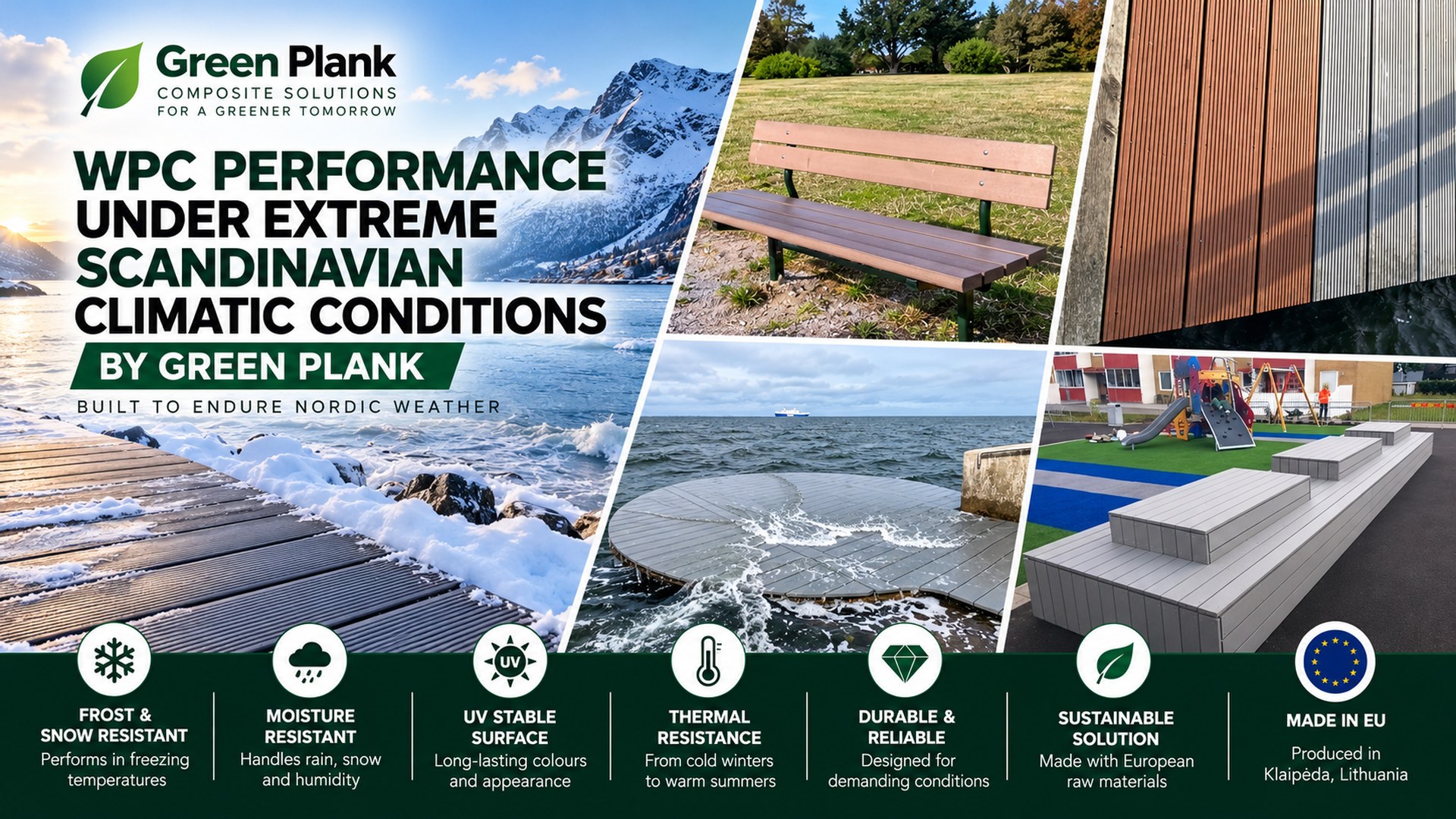
WPC performance under extreme Scandinavian climatic conditions
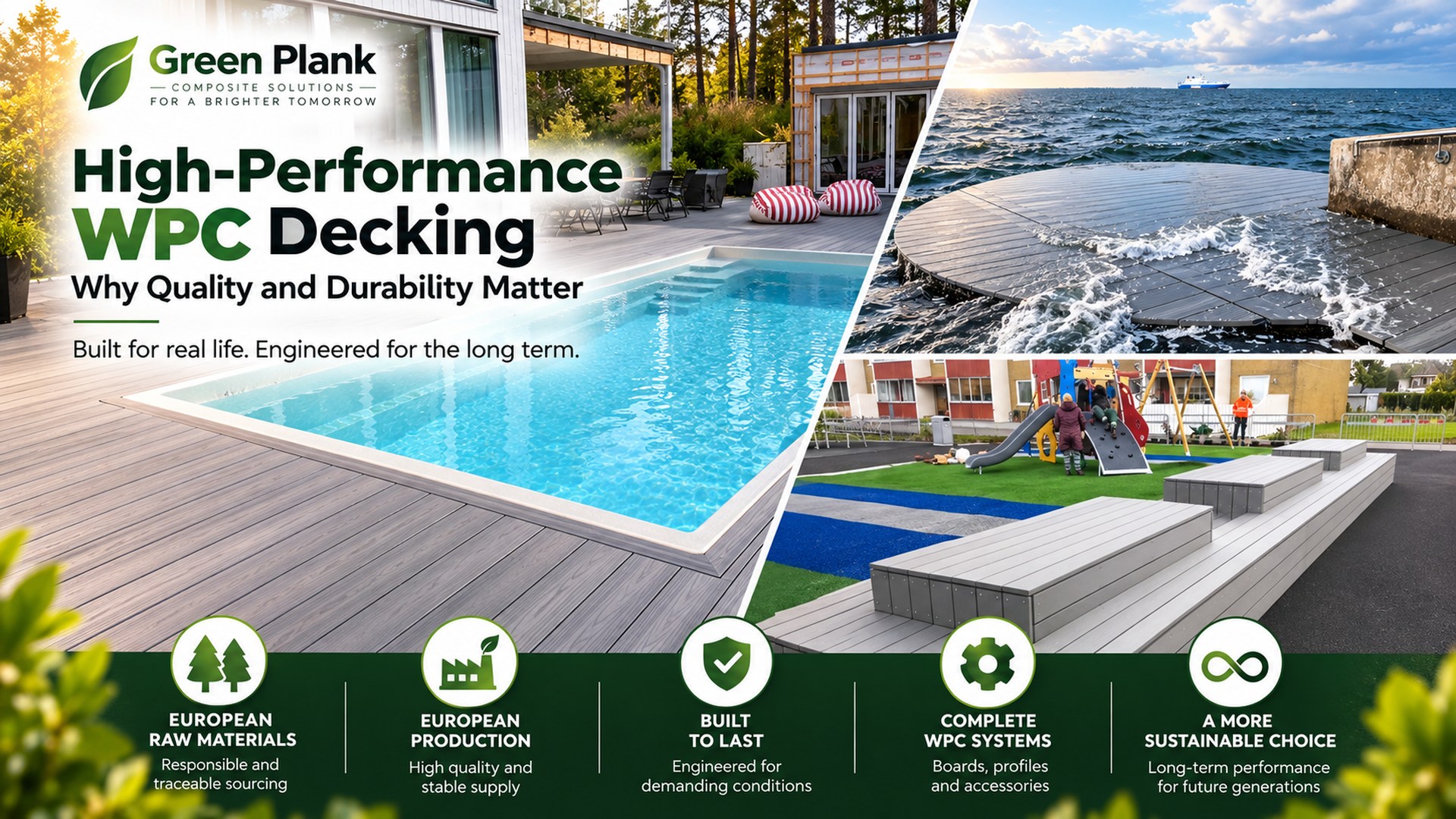
Scandinavian outdoor environments can place demanding and rapidly changing conditions on decking materials. A terrace may experience freezing winter temperatures, snow, prolonged moisture, repeated freeze-thaw cycles and, only months later, strong summer sunshine and significantly higher surface temperatures.
For WPC decking, successful performance in these conditions is not determined by one property alone. Raw-material selection, formulation, profile geometry, moisture management, thermal movement, substructure, fastening and correct installation all contribute to how a complete decking system performs.
The Nordic principle: do not evaluate a WPC board only by its appearance. For demanding climates, evaluate the complete system: board, substructure, drainage, ventilation, fastening, expansion requirements and technical documentation.
Why Scandinavian conditions are demanding
The Scandinavian climate is not simply cold. The greater challenge for exterior materials is the combination of temperature variation, water, snow, ice, sunlight and repeated seasonal changes.
| Climate factor | What happens outdoors? | What should be considered? |
|---|---|---|
| Low temperatures | Materials contract as temperature falls | Product-specific movement and fastening |
| Summer heat | Deck surfaces can become warmer in direct sun | Expansion allowance, colour and ventilation |
| Rain and melting snow | Water reaches the deck and substructure | Drainage, slope and ventilation |
| Freeze-thaw conditions | Water repeatedly freezes and melts | Avoid trapped water and poor drainage details |
| Snow and ice | Seasonal loads and slippery surfaces may occur | Correct construction and winter maintenance |
| UV exposure | Exterior surfaces receive solar radiation | Surface technology, pigmentation and formulation |
What determines WPC performance?
WPC, or wood-plastic composite, combines wood or natural fibres with a thermoplastic polymer and functional additives. There is no single universal WPC formulation. Products that look similar can therefore behave differently outdoors.
Selected Green Plank products use a high proportion of European hardwood fibres, including beech and oak, together with HDPE and functional additives. Exact formulations vary by product and should always be checked against current technical documentation.
Five factors that matter in Nordic conditions
- Material formulation: fibre, polymer, coupling system, additives and processing influence the finished composite.
- Profile engineering: solid, hollow and capped profiles have different constructions and intended applications.
- Surface design: uncapped and co-extruded products use different surface concepts.
- Manufacturing control: consistent extrusion and material preparation are important for consistent product characteristics.
- Installation: even a well-engineered board requires the correct support, fastening, ventilation and drainage.
Temperature movement: one of the most important design considerations
WPC contains a thermoplastic component and responds to temperature changes. Boards can expand as temperature rises and contract as it falls. The amount of movement depends on the specific formulation, board length, profile construction, installation temperature and other system variables.
This is especially relevant in Scandinavia, where the same terrace can experience cold winter conditions and warm summer surfaces.
There is no universal expansion gap for every WPC board
A fixed rule such as a single number of millimetres for every product and every installation can be misleading. End gaps, perimeter clearances and fastening requirements should follow the current installation instructions for the specific profile, board length and installation conditions.
Long boards deserve particular attention because dimensional movement accumulates over their length. Installers should also consider the board temperature during installation rather than relying only on the ambient air temperature.
Moisture, snow and freeze-thaw cycles
Nordic decking must be designed so that water can leave the structure. Rainwater, melting snow and moisture should not be unnecessarily trapped beneath or around the boards.
Good moisture management therefore starts below the visible decking surface. A well-planned construction should consider:
- appropriate foundation and drainage;
- adequate ventilation beneath the deck;
- correct positioning of joists and supports;
- water movement around walls, edges and fixed structures;
- product-specific board spacing and fastening;
- access for inspection and cleaning where appropriate.
WPC should consequently be described as low-maintenance rather than maintenance-free. Leaves, dirt and organic debris should be removed periodically, particularly where they can restrict drainage.
Solid, hollow or capped WPC in demanding climates?
No profile type is automatically best for every Scandinavian project. The correct choice depends on application, structural requirements, exposure, installation system and manufacturer documentation.
| WPC construction | Characteristics | Selection consideration |
|---|---|---|
| Hollow profile | Engineered internal chambers | Profile geometry and support requirements are important |
| Solid profile | Continuous composite cross-section | Weight, dimensions and intended application should be checked |
| Capped/co-extruded | Composite core with an additional surface layer | Evaluate both cap construction and core specification |
Green Plank offers different profile concepts, including TerraTuff™, Nordeka™, Classic™ and Sapphire™. TerraTuff™ uses a capped/co-extruded construction, while other ranges provide different profile and surface solutions for different project requirements.
Substructure: the hidden part of deck performance
The visible board receives most of the attention, but the substructure determines how the decking is supported. Incorrect joist spacing, insufficient support or inadequate drainage can compromise an otherwise correctly specified system.
Joist spacing should never be assumed to be universal. It can vary according to profile, loading, installation angle and application. Diagonal installation, for example, can require closer support than boards installed perpendicular to the joists.
A practical Nordic installation checklist
- Confirm the exact Green Plank profile and its current installation guide.
- Store boards correctly and allow appropriate acclimatisation before installation.
- Prepare a stable, adequately drained foundation.
- Use the specified maximum joist spacing for the application.
- Provide ventilation beneath the deck.
- Follow product-specific expansion and perimeter clearances.
- Use compatible clips, screws and system accessories.
- Avoid details that can trap standing water.
- Inspect the finished deck before handover.
- Establish a simple seasonal cleaning and inspection routine.
What about Scandinavian winters?
Snow itself does not automatically make WPC unsuitable for Nordic use. The relevant questions concern the complete construction: expected loads, drainage when snow melts, surface condition, fastening and the particular product specification.
When removing snow, follow the manufacturer's care instructions and avoid tools or methods that could unnecessarily damage the board surface. Ice-control products should likewise only be used where permitted by the applicable maintenance guidance.
Summer conditions matter too
Cold weather receives much attention in Scandinavia, but summer design should not be overlooked. Direct sunlight can increase deck-surface temperatures, while dark colours generally absorb more solar energy than lighter surfaces.
Thermal movement, ventilation and board temperature at installation therefore remain important even in northern Europe. A terrace should be designed for the annual climate cycle, not just its coldest month.
European production and traceability
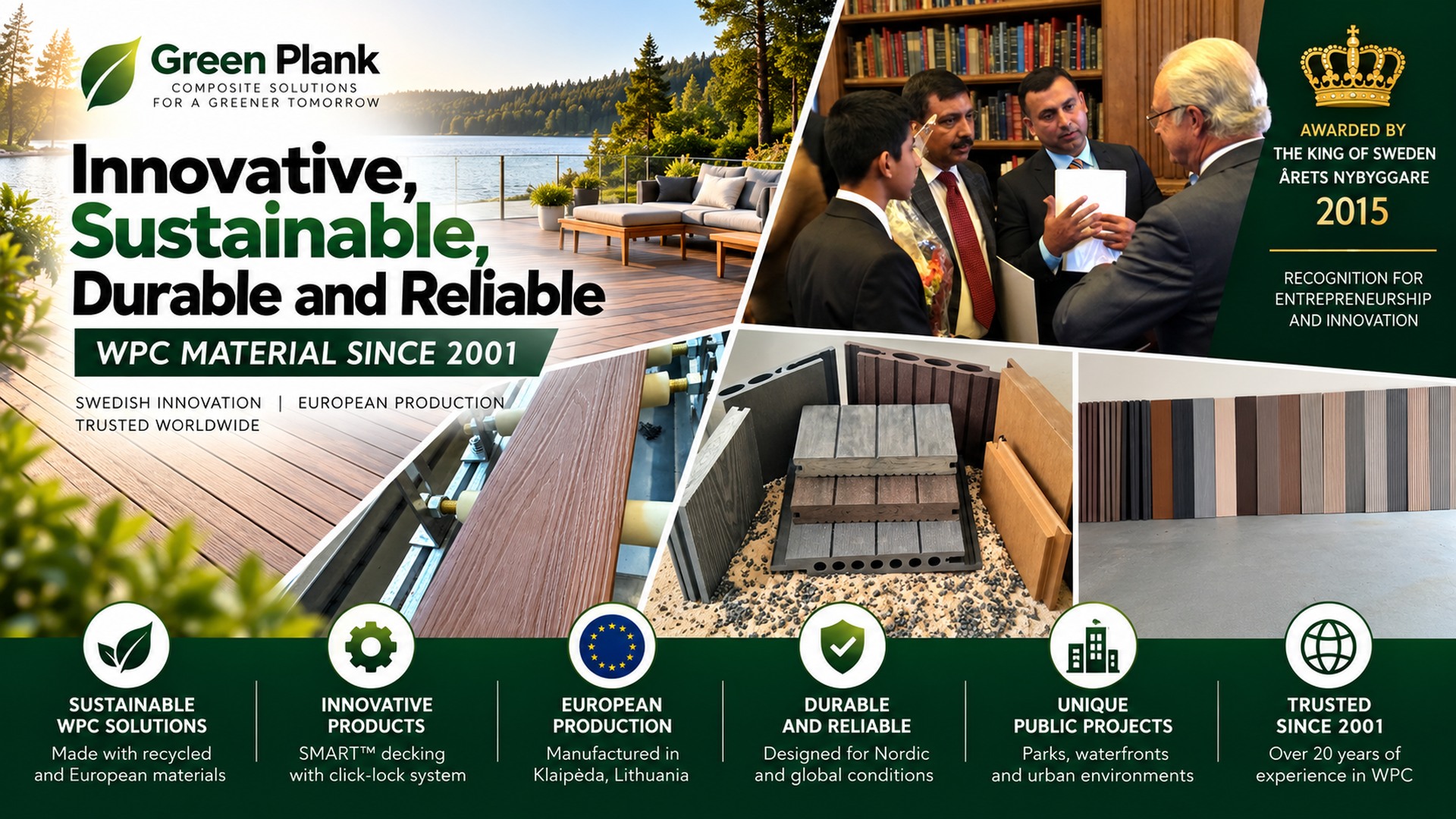
Green Plank is a Swedish brand with European production in Klaipėda, Lithuania. The current manufacturing strategy uses European raw materials with an emphasis on traceability. For professional buyers, traceability can support identification of material origin, production information and product documentation.
European origin alone, however, does not prove superior technical performance or a lower environmental footprint. Those conclusions require product-specific technical evidence and, for comparative environmental claims, appropriate lifecycle information.
Performance should be documented, not assumed
For demanding Scandinavian projects, buyers should move beyond broad terms such as durable, weather-resistant or Nordic-ready. The more useful approach is to request the information behind those claims.
- What is the exact product and profile?
- What installation conditions apply?
- What are the permitted joist distances?
- How should thermal movement be accommodated?
- What drainage and ventilation requirements apply?
- Which technical documents are available?
- What does the warranty cover for the intended application?
Selected TerraTuff™ products are offered with residential warranty coverage of up to 50 years, depending on product and applicable warranty terms. Other Green Plank ranges have different warranty periods, and professional or commercial applications may have separate conditions. A warranty period should not be interpreted as a guaranteed technical service life.
Designed as a system for real Scandinavian conditions
Successful WPC decking in Scandinavia is ultimately about combining material technology with good construction practice. Temperature movement must be allowed for, water must be able to drain, the substructure must provide the correct support, and the installation method must match the specific product.
Green Plank's approach combines more than two decades of WPC development with European production, traceable European raw materials and several decking technologies. For homeowners and professional projects alike, the strongest specification is one based on the actual product, documented requirements and the conditions of the individual site.
Sources
- Green Plank Europe – official product and company information
- Green Plank – composite decking systems
- Green Plank – technical data and installation information
- ISO 15686-5 – Buildings and constructed assets: life-cycle costing
- USDA Forest Products Laboratory – Wood Handbook
Specify the product
Use this guide with a Green Plank specification
Technical articles support the commercial catalogue — category, product, evidence, then samples or quotes.