



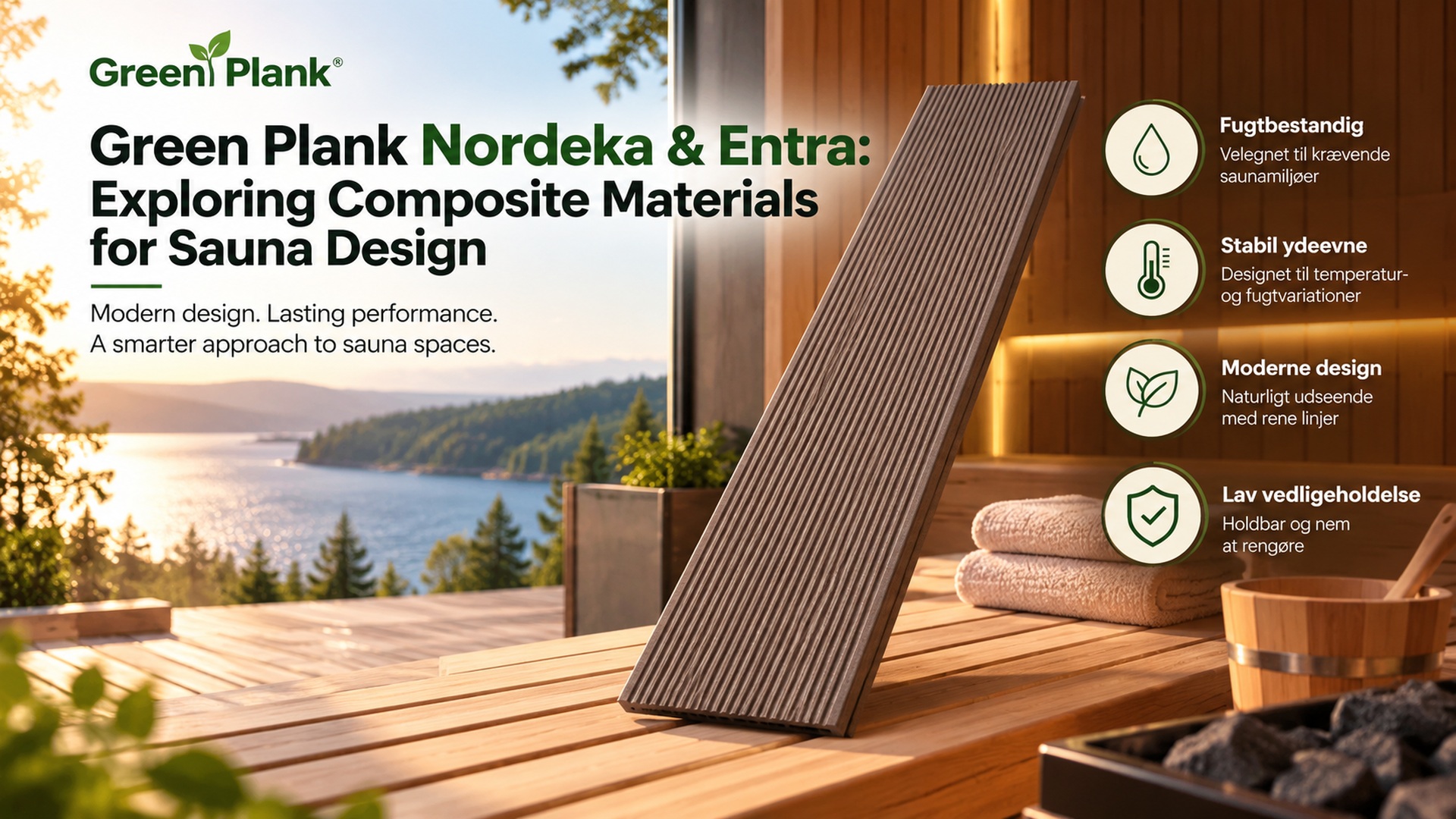
Green Plank Nordeka & Entra: Exploring Composite Materials for Sauna Design
Sauna design combines demanding environmental conditions with an equally demanding architectural brief. Surfaces may experience repeated heating and cooling, high humidity, splashing water and frequent cleaning, while users expect a warm, natural and comfortable environment.
These conditions make material selection especially important. Traditional timber remains fundamental to sauna culture, but architects and manufacturers are increasingly interested in where engineered composite materials could complement wood in carefully selected areas.
Green Plank is therefore exploring the potential of Nordeka and Entra composite profiles for sauna-related design applications. The objective is not to suggest that conventional outdoor WPC can automatically replace traditional sauna timber. Instead, it is to examine where specially evaluated composite profiles may offer advantages in moisture management, dimensional consistency, design freedom and maintenance.
Important: A material suitable for outdoor decking or cladding should not automatically be considered suitable for direct use inside a hot sauna. Temperature, surface-temperature behaviour, emissions, fire performance, fastening and long-term heat exposure must be validated for the intended sauna location before specification.
Why sauna environments require a different material strategy
A sauna is not simply another humid room. Materials can be exposed to repeated temperature and moisture cycles, and conditions vary dramatically depending on where a component is installed. A bench close to the heater experiences a different environment from a decorative wall element, lower-level panel, changing-area surface or exterior sauna façade.
The Finnish Sauna Society notes that sauna benches and surfaces should support effective washing, drying and ventilation, while water must be able to drain efficiently. These practical hygiene requirements make surface design and detailing important alongside appearance.
| Sauna design factor | Why it matters | Composite design consideration |
|---|---|---|
| Heat | Surfaces may become uncomfortable or materials may change with temperature | Validate service temperature and surface temperature |
| Humidity | Repeated moisture cycles challenge materials | Assess moisture uptake and dimensional response |
| Cleaning | Commercial environments require regular hygiene routines | Evaluate surface cleanability and chemical compatibility |
| Expansion | Temperature changes cause dimensional movement | Provide correct gaps and fastening systems |
| Fire safety | Saunas contain a powerful heat source | Verify classification and required clearances |
Where Nordeka and Entra could fit into sauna architecture
Nordeka and Entra offer Green Plank an opportunity to investigate composite profiles from a design-system perspective rather than treating every sauna surface in the same way. Potential applications should be separated according to their actual thermal exposure.
Lower-temperature and transitional areas
The most straightforward opportunities may exist outside the hottest occupied zone. Depending on testing and project requirements, composite profiles could be investigated for areas such as:
- sauna exterior façades and architectural cladding,
- changing and relaxation areas,
- spa corridors and wet-zone transitions,
- decorative screens and privacy elements,
- selected lower-temperature wall applications,
- surrounding terraces and outdoor sauna environments.
These applications can benefit from the visual continuity of using related material families across the building while avoiding the assumption that every profile is appropriate next to the heater or for direct body contact.
Heat is the critical engineering question
Wood-polymer composites combine lignocellulosic material with a thermoplastic matrix. Scientific reviews show that WPC performance depends on polymer type, wood content, interfacial compatibility, additives and processing conditions. Thermal behaviour is therefore formulation-specific rather than universal.
This distinction is especially important for sauna design. An HDPE-based WPC that performs exceptionally well as outdoor decking may still require separate evaluation before being approved for a hot sauna interior.
Surface temperature matters as much as structural stability
For components touched by bare skin, the question is not simply whether a profile remains dimensionally intact. Thermal conductivity, heat capacity, colour, surface structure and exposure can influence how hot a surface feels. Bench and backrest applications therefore require dedicated testing rather than assumptions based on outdoor performance.
Nordeka: exploring structural and architectural possibilities
Nordeka profiles can be considered as part of a broader investigation into durable composite elements for modern sauna architecture. Their potential value lies in combining a wood-inspired appearance with engineered profile geometry and controlled production.
For sauna projects, Nordeka could be particularly interesting where designers need robust profiles in adjacent wet or transitional areas, exterior surfaces or architectural elements where conventional timber may require more frequent surface maintenance.
Any proposed use within the actual hot room should be validated according to the expected maximum temperature, distance from the heater, ventilation conditions and whether users will touch the surface.
Entra: design flexibility for contemporary wellness spaces
Entra can similarly be explored as an architectural material for modern wellness environments where clean lines, repeatable dimensions and coordinated finishes are important. Contemporary spas increasingly combine sauna rooms with showers, relaxation zones, terraces and exterior architecture, creating opportunities for a consistent material language.
A composite profile system can potentially help designers coordinate:
- vertical and horizontal surface patterns,
- natural wood-inspired colours,
- modern Scandinavian detailing,
- wet-area transitions,
- interior and exterior visual continuity.
Composite versus traditional sauna timber
Composite materials and natural timber should not be viewed as automatic competitors. They have different strengths, and hybrid design may often be the more technically appropriate approach.
| Design criterion | Traditional sauna timber | Engineered composite |
|---|---|---|
| Traditional sauna character | Excellent | Wood-inspired alternative |
| Direct body-contact surfaces | Established solution with suitable species | Requires application-specific validation |
| Moisture management | Requires correct detailing and drying | Potential advantage depending on formulation |
| Dimensional consistency | Naturally variable | Controlled manufactured geometry |
| Maintenance | Depends on species and use | Potentially reduced in suitable applications |
| Design repeatability | Natural variation | Consistent profile and finish options |
A hybrid sauna may offer the best solution
One promising design direction is not an all-wood or all-composite sauna, but a carefully engineered combination. Traditional low-thermal-conductivity sauna woods can remain where direct skin contact and authentic sauna feel are priorities, while appropriately tested composite profiles can be considered for surrounding architectural surfaces.
For example, a designer could use traditional timber for benches and backrests while exploring Nordeka or Entra for selected wall details, wet-area transitions, decorative elements, exterior façades or the terrace surrounding an outdoor sauna.
This approach allows each material to be used where its characteristics make the most sense.
Moisture, hygiene and maintenance
Sauna hygiene depends not only on the material but also on construction details. The Finnish Sauna Society recommends surfaces and benches that are easy to wash, dry efficiently and allow adequate ventilation. Gaps, drainage and access for cleaning therefore remain important regardless of the chosen material.
For a composite sauna application, development testing should examine:
- Water absorption and dimensional change after repeated wetting and drying.
- Thermal cycling under realistic sauna temperatures.
- Surface temperature under relevant exposure conditions.
- VOC and odour behaviour at elevated service temperatures.
- Cleaning resistance against suitable sauna cleaning agents.
- Fastener performance during repeated thermal expansion and contraction.
- Fire performance according to the intended construction and market requirements.
Why formulation matters
WPC is not one standardized material. Scientific literature shows that properties depend strongly on polymer matrix, wood-fibre content, fibre quality, compatibilization and processing. HDPE is widely used as a WPC matrix, while coupling agents such as MAPE can improve adhesion between hydrophilic wood fibres and the hydrophobic polymer.
Green Plank's broader material philosophy uses a high proportion of European wood fibres in HDPE-based, PVC-free composites. For any dedicated sauna version of Nordeka or Entra, however, the formulation and finished profile should be evaluated specifically for the intended thermal environment rather than relying solely on conventional outdoor-product data.
From outdoor living to wellness architecture
The development potential for Nordeka and Entra reflects a wider opportunity for composite technology. Modern wellness architecture increasingly connects indoor and outdoor spaces: a sauna may open directly onto a composite terrace, pool deck, garden or waterfront environment.
For architects, this creates an opportunity to coordinate colour, texture and geometry across several zones while selecting the technically appropriate material for each location.
Green Plank design principle: The objective should not be to replace wood everywhere. It should be to use natural timber and engineered composite materials intelligently, based on temperature, moisture, human contact, maintenance and architectural requirements.
Conclusion: a promising area for material development
Nordeka and Entra open an interesting design conversation around the future of composite materials in sauna and wellness architecture. Moisture resistance, controlled profile geometry, consistent finishes and design flexibility can make WPC attractive for selected applications, particularly in transitional, wet and exterior areas.
At the same time, the extreme conditions of the sauna room require careful engineering. A profile developed for decking or conventional cladding should never be assumed suitable for benches, heater-adjacent walls or other high-temperature surfaces without appropriate testing.
For Green Plank, the opportunity is therefore larger than simply introducing WPC into a sauna. It is about developing a tested material system for modern Scandinavian wellness environments, combining European wood-fibre composite technology with thoughtful architecture and application-specific performance.
Sources
- https://greenplank.eu/" target="_blank" rel="noopener">Green Plank – composite materials and product information
- https://sauna.fi/en/sauna-knowledge/about-the-hygiene-of-sauna/" target="_blank" rel="noopener">Finnish Sauna Society – sauna hygiene, cleaning and drying guidance
- https://www.sciencedirect.com/science/article/pii/S221450952600642X" target="_blank" rel="noopener">Case Studies in Construction Materials – systematic review of WPC physical, mechanical and durability properties
- https://www.sciencedirect.com/science/article/pii/S2214993724001635" target="_blank" rel="noopener">Sustainable Materials and Technologies – WPC formulation, technology and interphase modification
- https://www.sciencedirect.com/science/article/pii/S2307187725004754" target="_blank" rel="noopener">Journal of Engineering Research – thermal properties of wood-plastic composites
Specify the product
Use this guide with a Green Plank specification
Technical articles support the commercial catalogue — category, product, evidence, then samples or quotes.