



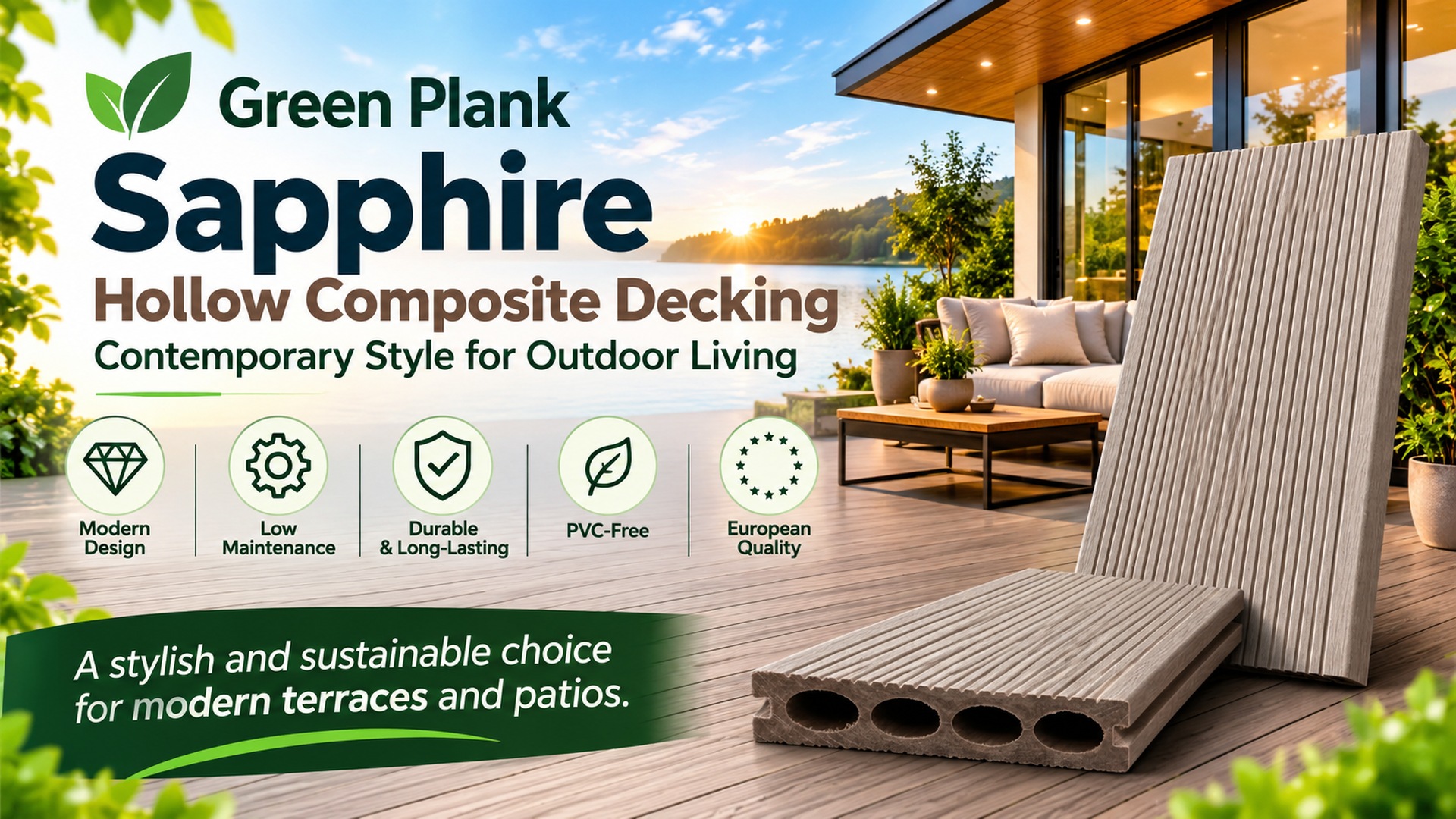
Sapphire Hollow Composite Decking: Contemporary Style for Outdoor Living
Outdoor spaces have become an extension of modern living. Terraces, balconies, roof terraces and garden areas are increasingly designed with the same attention to appearance, comfort and practicality as interior spaces. Green Plank Sapphire Hollow Composite Decking is developed for projects where contemporary aesthetics, efficient construction and reduced routine maintenance are important.
With its hollow-profile construction and modern surface character, Sapphire offers an attractive alternative to traditional timber decking. It combines wood fibre and HDPE in a wood-plastic composite designed to provide a consistent appearance while reducing the need for recurring painting, staining or oiling normally associated with many timber terraces.
Green Plank Sapphire: contemporary composite decking for homeowners, architects, developers and professional installers looking for an elegant outdoor surface with practical long-term advantages.
What Is Sapphire Hollow Composite Decking?
Sapphire is part of the Green Plank composite decking range. Its hollow profile uses strategically designed internal cavities instead of making the entire cross-section solid. This creates a practical balance between material use, handling and structural performance for suitable decking applications.
The Sapphire profile is approximately 146 × 23 mm. Green Plank offers decking in project-friendly lengths, helping designers and installers plan layouts with fewer unnecessary joints and offcuts. Final dimensions, available lengths, colours and installation requirements should always be confirmed against the current product documentation.
| Feature | Sapphire Hollow Composite Decking |
|---|---|
| Product type | Hollow WPC decking board |
| Nominal profile | Approx. 146 × 23 mm |
| Material concept | Wood fibre and HDPE composite |
| PVC | PVC-free material concept |
| Design | Contemporary European outdoor style |
| Maintenance | Lower routine surface maintenance than traditional untreated timber |
| Applications | Terraces, patios, balconies and selected outdoor projects |
Contemporary Design for Modern Outdoor Architecture
A successful terrace should complement the architecture around it. Sapphire is designed to work naturally with contemporary homes, Scandinavian-inspired gardens, glass façades, modern extensions and clean landscape architecture.
The consistent board geometry helps create strong visual lines across a terrace. Depending on the chosen colour and orientation, the decking can provide either a calm neutral foundation or a stronger architectural contrast against façades, furniture and planting.
Suitable for different outdoor environments
- Residential terraces and patios
- Balconies and rooftop outdoor areas where the system is suitable
- Garden seating and dining areas
- Pool surroundings subject to project-specific requirements
- Hospitality and selected commercial outdoor environments
- Renovation projects replacing maintenance-intensive decking
Why Choose a Hollow Composite Profile?
Hollow composite boards use internal chambers to optimise the profile. Compared with a comparable solid profile, this approach can reduce material usage and board weight while retaining the geometry needed for its intended application.
A lighter profile can also make transportation and on-site handling more convenient. However, hollow and solid decking should not be judged simply by weight. Profile geometry, raw-material formulation, wall thickness, span, support spacing, fastening and installation quality all influence performance.
Important project principle
A premium terrace is a complete system. The decking board, substructure, fasteners, ventilation, drainage, expansion allowances and installation details must work together. Always use the installation instructions specified for the selected Green Plank profile.
Composite Decking with Wood Fibre and HDPE
Wood-plastic composites combine lignocellulosic material with a thermoplastic polymer. Research literature describes how formulation, fibre characteristics, coupling agents, processing conditions and profile design influence the properties of WPC products.
Green Plank focuses on a high wood-fibre approach using European raw materials and HDPE-based technology. Functional additives and coupling technology help create an effective interface between the wood component and polymer matrix.
This engineering approach is important because wood fibres and polyethylene naturally have different surface characteristics. A well-designed formulation and controlled production process are therefore central to achieving consistent composite performance.
Less Routine Maintenance for Everyday Outdoor Living
Traditional timber can create beautiful terraces, but maintaining its original appearance commonly involves periodic cleaning and, depending on the wood and desired finish, oiling, staining or painting. Composite decking is attractive to many owners because routine care is generally simpler.
Sapphire does not require the same recurring painting or oiling cycle associated with many conventional timber decks. Normal maintenance instead focuses on keeping the surface clean and removing leaves, dirt and other deposits according to the product care instructions.
Practical benefits for property owners
- No regular painting required
- No traditional wood-staining cycle
- Consistent contemporary appearance
- Easy integration with modern outdoor furniture and landscaping
- Reduced routine surface-maintenance requirements
Sapphire Composite Decking vs. Traditional Timber
| Consideration | Sapphire WPC | Traditional timber |
|---|---|---|
| Routine painting | Generally not required | May be required depending on finish |
| Oiling/staining | Generally not required | Often used to maintain appearance |
| Profile consistency | Manufactured profile | Natural variation |
| Material character | Wood-polymer composite | Natural wood |
| Moisture behaviour | Engineered composite system | Wood naturally absorbs/releases moisture |
| Design character | Contemporary and consistent | Natural and traditional |
Neither material is universally ideal for every project. Natural timber remains attractive where authentic wood character is the main priority. Sapphire is particularly relevant where owners want a contemporary appearance together with predictable geometry and reduced routine maintenance.
Installation Matters as Much as the Board
Even high-quality composite decking requires correct installation. WPC responds to temperature changes, and outdoor structures must also manage rainwater, airflow and loads. Adequate ventilation and drainage beneath the deck are therefore essential.
- Prepare a stable, properly drained supporting structure.
- Install joists at the spacing specified for the Sapphire profile and intended use.
- Provide the required slope and drainage route away from buildings.
- Maintain adequate ventilation beneath and around the decking.
- Use compatible clips, screws and fastening components.
- Allow appropriate expansion clearances at board ends and fixed boundaries.
- Follow the latest Green Plank installation guide rather than applying timber-decking rules automatically.
Commercial projects, elevated balconies and public environments may have additional requirements relating to structural loading, fire performance, slip resistance, accessibility, waterproofing and local building regulations. These should be assessed at project level.
Designed for European Projects and Supply Chains
Green Plank positions its composite products around European production and traceable European raw-material sourcing. Regional production can offer practical advantages for European customers, including closer supply chains, communication with the manufacturer and potentially shorter replenishment routes compared with long-distance imports.
Traceability also supports better product documentation. For architects, distributors and professional buyers, knowing where materials originate and where products are manufactured is becoming increasingly important when evaluating building products.
Green Plank perspective: premium composite decking should be evaluated as more than a percentage formula. Raw-material quality, profile engineering, processing consistency, installation design, documentation and long-term support all contribute to the finished terrace.
Planning a Sapphire Terrace
Before ordering decking, consider the complete outdoor space rather than simply calculating square metres of boards.
- Architecture: coordinate decking colour with façades, doors and surrounding materials.
- Board direction: use orientation to visually lengthen or widen the terrace.
- Drainage: ensure water can move freely away from the structure.
- Ventilation: maintain airflow around the decking and substructure.
- Expansion: provide the clearances required by the installation guide.
- Usage: identify residential, commercial or higher-traffic requirements before specifying the system.
- Accessories: plan clips, screws, edge details and substructure together with the decking.
Contemporary Outdoor Living with Green Plank Sapphire
Sapphire Hollow Composite Decking brings together contemporary aesthetics, efficient hollow-profile engineering and the practical benefits of modern WPC technology. It is designed for outdoor spaces where appearance matters but owners also want to spend less time on recurring surface treatments.
For terraces, patios and modern outdoor living areas, Sapphire provides a clean architectural foundation that can complement everything from minimalist Scandinavian homes to larger residential and hospitality projects. Correct specification and installation remain essential, but when the complete system is planned carefully, composite decking can provide an attractive and practical alternative to traditional timber.
Sources
- https://greenplank.eu/">Green Plank – Composite Decking and Outdoor Products
- https://www.sciencedirect.com/topics/materials-science/wood-plastic-composite">ScienceDirect – Wood-Plastic Composite overview
- https://www.fpl.fs.usda.gov/">USDA Forest Products Laboratory – Wood and composite materials research
- https://environment.ec.europa.eu/topics/circular-economy_en">European Commission – Circular Economy
- https://single-market-economy.ec.europa.eu/sectors/construction/construction-products-regulation-cpr/cpr-overview_en">European Commission – Construction Products Regulation
Specify the product
Use this guide with a Green Plank specification
Technical articles support the commercial catalogue — category, product, evidence, then samples or quotes.