



Not all composite decking begins with the same raw materials
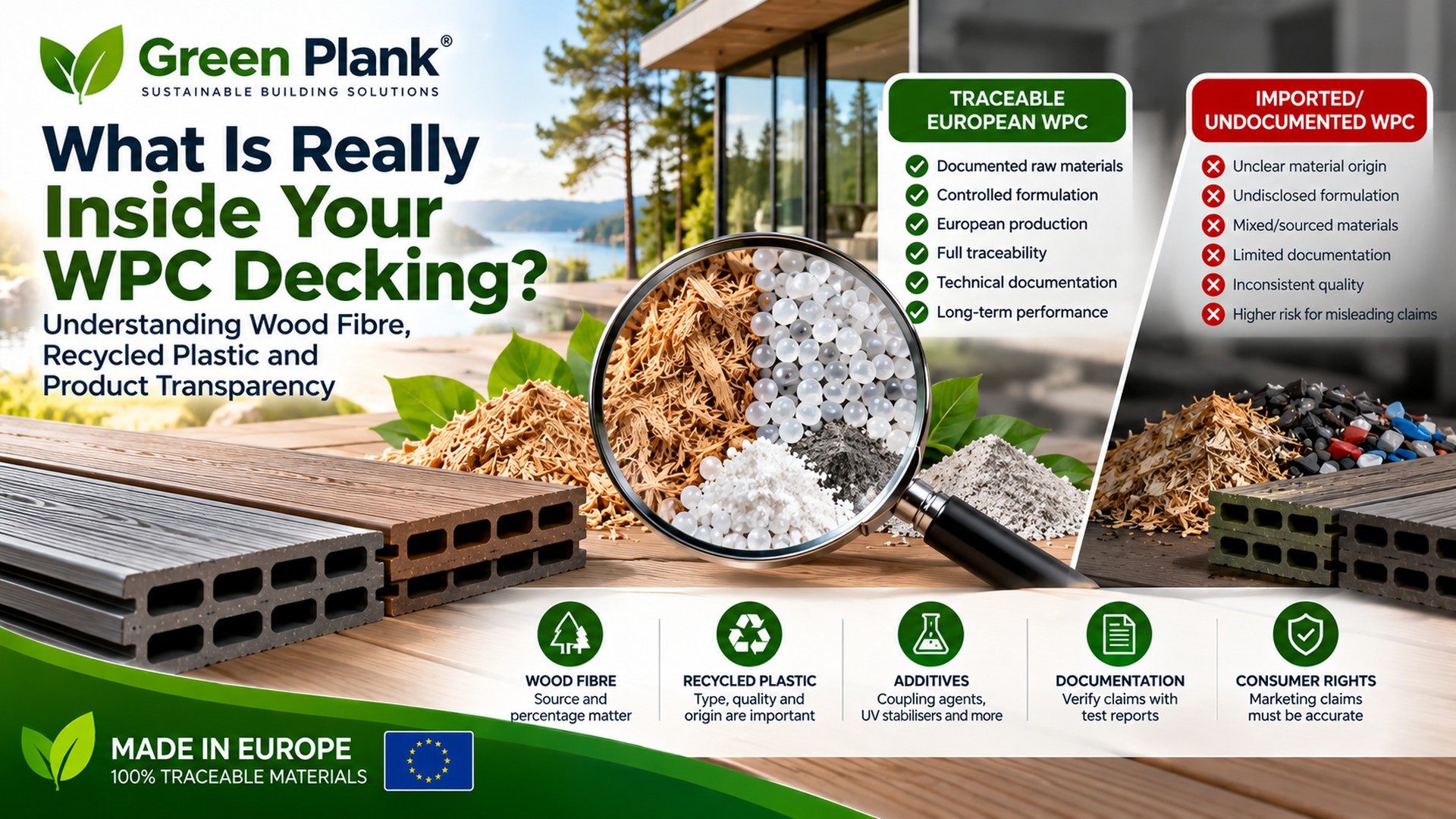
Two composite decking boards may look similar in a showroom yet differ considerably in formulation, raw-material control and manufacturing consistency. For professional buyers, distributors, architects and homeowners, the important question is therefore not simply "Is this WPC?" but "What exactly is inside it, where did those materials come from, and how consistently are they controlled?"
Wood-plastic composite performance depends on the complete material system: natural fibre, polymer matrix, coupling agents, stabilisers, lubricants, pigments, processing conditions and the quality of the interface between wood and polymer. Research on WPC durability also shows that polymer composition, moisture behaviour and compatibility between components can materially influence weathering performance. See the peer-reviewed study https://pmc.ncbi.nlm.nih.gov/articles/PMC5857712/" target="_blank" rel="noopener noreferrer">Durability of wood plastic composites manufactured from recycled plastic.
The key buying principle: Country of origin alone does not determine WPC quality. A well-engineered recycled formulation can perform successfully, while a poorly controlled virgin-material formulation can fail. What matters is documented raw-material identity, formulation, compatibility, processing, testing and quality control.
Traceability: knowing what you are actually buying
Traceability allows a manufacturer and buyer to identify the origin and specification of important raw materials rather than relying only on a generic description such as "wood fibre and recycled plastic." For project specifications, this can make technical evaluation clearer and help reduce uncertainty between production batches.
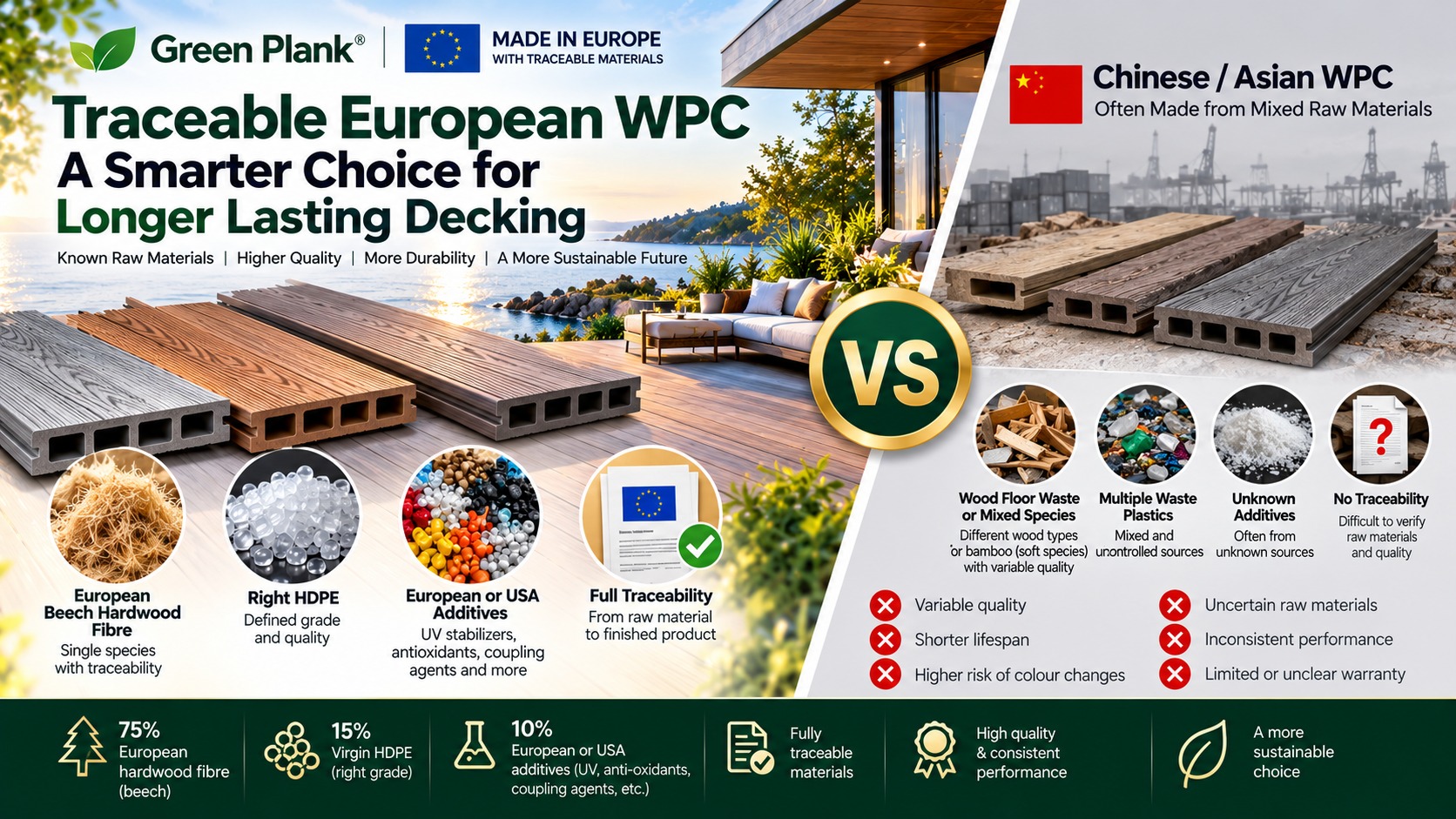
Green Plank states that its current European natural-fibre composite formulation uses 75% European wood fibre, 15% virgin HDPE and 10% additives, and that its products are manufactured in the EU using European raw materials with full traceability. These are manufacturer-specific claims documented on the https://greenplank.eu/" target="_blank" rel="noopener noreferrer">Green Plank European composite products website.
| Buyer question | Controlled, documented approach | Potential concern when information is unavailable |
|---|---|---|
| Wood fibre | Known source, specification and controlled preparation | Variable species, particle size or moisture |
| Polymer | Defined polymer type and grade | Unknown or changing polymer blend |
| Additives | Specified coupling, UV and processing package | Composition and dosage not documented |
| Production | Controlled formulation and processing window | Greater batch-to-batch uncertainty |
| Documentation | Technical data and material origin available | Difficult to verify what is being supplied |
1. Wood fibre is an engineering component, not just filler
The natural-fibre fraction contributes stiffness, appearance and other physical characteristics to WPC, but simply increasing wood content does not automatically create a better board. Fibre species, particle geometry, moisture level, preparation and interaction with the polymer all matter.
Green Plank describes its decking formulation as containing European hardwood fibre. For example, its Classic™, Entra™ and Nordeka™ decking pages specify 75% European wood fibre with HDPE and performance additives. This high natural-fibre approach is part of Green Plank's documented formulation rather than a general rule that every WPC should contain 75% wood.
Scientific evidence supports this more nuanced view. Research on outdoor WPC shows that lignocellulosic fibres absorb moisture and that moisture can weaken the fibre-polymer interface. The same research notes that improved interfacial interaction through compatibilisation can improve material stability. Therefore, fibre percentage must always be considered together with polymer selection, coupling technology and processing. See the https://pmc.ncbi.nlm.nih.gov/articles/PMC5857712/" target="_blank" rel="noopener noreferrer">peer-reviewed WPC durability research.
2. Known HDPE versus an uncontrolled mixed-plastic stream
The polymer forms the continuous matrix surrounding the wood particles. HDPE is widely used for wood-polymer composites, but "plastic" is not a sufficiently precise specification for professional procurement.
Recycled polymer is not inherently inferior. Properly sorted and characterised recycled HDPE can be a valuable circular raw material. The challenge arises when the feedstock contains an inadequately controlled mixture of different polymers, contaminants or changing grades.
A study by Turku, Kärki and Puurtinen examined WPC made with different recycled-plastic streams. Their experiments found substantial differences in water absorption and weathering behaviour between formulations. The household mixed-plastic sample had the highest water absorption in the reported group, while the researchers also noted that incompatibility between polymer grades can negatively affect composite behaviour. Importantly, the authors also discuss research where some recycled formulations performed competitively, demonstrating why recycled content itself should not be treated as evidence of poor quality. https://pmc.ncbi.nlm.nih.gov/articles/PMC5857712/" target="_blank" rel="noopener noreferrer">Read the full open-access durability study.
Better question for suppliers: Do not ask only "virgin or recycled?" Ask for the polymer type, source control, composition, contamination limits, melt-flow consistency and evidence that the formulation has been validated for outdoor WPC.
3. Why coupling agents matter
Wood is naturally hydrophilic, while polyethylene is comparatively hydrophobic. Creating an effective interface between these dissimilar materials is therefore one of the central challenges in WPC engineering.
Coupling agents are used to improve this interface. A peer-reviewed investigation of polyethylene/wood composites found that maleated and silane coupling treatments improved wood-particle dispersion, wettability and compatibility between the composite constituents. The researchers attributed the improved interface to several bonding mechanisms. See https://pmc.ncbi.nlm.nih.gov/articles/PMC6414935/" target="_blank" rel="noopener noreferrer">Revealing the Interface Structure and Bonding Mechanism of Coupling Agent Treated WPC.
This is why buyers should look beyond the percentages printed on a brochure. Two boards containing similar amounts of wood and polyethylene can behave differently if fibre preparation, coupling chemistry, additive dosage or extrusion conditions differ.
4. Additives are a small percentage with a major job
A WPC formulation typically requires more than wood and polymer. Depending on the system, the additive package can include coupling agents, UV stabilisers, antioxidants, pigments, lubricants and processing aids. Each performs a different function, and compatibility between additives matters.
Green Plank's current formulation is published as 75% European wood fibre, 15% virgin HDPE and 10% additives. Its SMART™ decking specification further describes its additive fraction as including UV stabilisers, pigments and processing aids. Green Plank also states that its composite products use European raw materials and are manufactured in Europe. These details can be reviewed through the https://greenplank.eu/" target="_blank" rel="noopener noreferrer">Green Plank material and manufacturing information.
5. Mixed raw materials are not automatically bad – uncertainty is the issue
Wood residues, recycled polymers and industrial by-products can contribute to circular construction when they are properly characterised and processed. Buyers should therefore avoid simplistic comparisons such as "recycled equals poor" or "virgin equals premium."
The technical risk is uncontrolled variability. If wood species, particle distribution, moisture, polymer chemistry or contamination change significantly between batches, maintaining a predictable formulation becomes more difficult. Research into recycled-plastic WPC demonstrates that different waste-plastic compositions can produce substantially different moisture and weathering responses.
| Material factor | Why buyers should care |
|---|---|
| Fibre identity | Species and fibre characteristics influence composite behaviour |
| Fibre moisture | Moisture affects processing and the fibre-polymer interface |
| Polymer identity | Different polymers have different processing and physical properties |
| Coupling system | Supports adhesion between hydrophilic wood and polymer matrix |
| UV package | Relevant to long-term outdoor surface exposure |
| Process control | Influences dispersion, encapsulation and consistency |
| Traceability | Helps verify whether specified materials remain consistent |
6. European origin should not replace technical evaluation
European manufacturing can offer advantages for European buyers, including shorter supply chains, easier supplier communication and access to product documentation. Green Plank states that its products are manufactured entirely in the EU from European raw materials with full traceability. https://greenplank.eu/" target="_blank" rel="noopener noreferrer">Green Plank's current company information also describes the brand's approach to controlled European production.
However, buyers should not conclude that every European WPC is superior to every Asian product. Manufacturing geography alone is not a technical performance metric. High-quality WPC can be produced in different regions when the raw materials, formulation, manufacturing controls and testing are appropriate.
A technically credible comparison should therefore be documented formulation versus undocumented formulation, not simply Europe versus Asia.
7. Warranty should be connected to a specific product
Warranty periods can differ substantially even within one manufacturer's portfolio. Green Plank's published specifications, for example, vary according to decking technology. Classic™ lists up to 20 years residential warranty, while selected premium capped systems such as TerraTuff™ publish longer residential coverage.
TerraTuff™ is currently specified by Green Plank as a capped composite system with 75% European hardwood fibre, 15% virgin HDPE and 10% additives, with up to 50 years residential and up to 15 years commercial warranty. Buyers should always read the applicable warranty conditions rather than treating the maximum headline period as universal across all products.
8. Ten questions buyers should ask before choosing WPC decking
- What type and percentage of natural fibre is used?
- Can the supplier document the fibre source?
- What polymer type and grade form the matrix?
- If recycled polymer is used, how is the feedstock sorted and controlled?
- Are coupling agents included to improve fibre-polymer compatibility?
- What UV stabilisation and antioxidant system is used?
- How is fibre moisture controlled before extrusion?
- Are formulation and raw-material batches traceable?
- What technical testing supports the intended outdoor application?
- What exactly does the product-specific warranty cover?
Professional procurement principle: A transparent supplier should be able to explain the material system, not merely provide a colour sample and a warranty headline.
Green Plank's approach: traceability before assumptions
Green Plank positions its European composite decking around controlled raw materials, European manufacturing and documented formulation. Its current material system is published as 75% European wood fibre, 15% virgin HDPE and 10% additives, while specific dimensions, installation requirements and warranty periods are provided by product family.
This approach does not mean that recycled or Asian-manufactured WPC is automatically inferior. Rather, it illustrates why buyers should demand the same fundamental information from every supplier: What is the fibre? What is the polymer? What additives are used? Are the inputs controlled? Can they be traced? And has the finished board been engineered and documented for its intended application?
Conclusion
The most meaningful comparison in composite decking is not a flag on the packaging. It is the difference between known and unknown inputs, controlled and variable formulations, documented and undocumented performance.
Traceable European WPC can give buyers greater visibility into raw-material origin and formulation, but performance still depends on engineering. Wood fibre, HDPE, coupling agents, stabilisers, manufacturing conditions and quality control work as one system. For buyers choosing composite decking in 2026, asking for evidence behind that system is far more valuable than choosing on appearance or price alone.
Sources
- https://greenplank.eu/" target="_blank" rel="noopener noreferrer">Green Plank – European Composite Decking, Fencing & Cladding – manufacturer information on European production, traceability and current 75/15/10 formulation.
- https://pmc.ncbi.nlm.nih.gov/articles/PMC5857712/" target="_blank" rel="noopener noreferrer">Durability of wood plastic composites manufactured from recycled plastic – peer-reviewed research on recycled polymer composition, water absorption and WPC weathering.
- https://pmc.ncbi.nlm.nih.gov/articles/PMC6414935/" target="_blank" rel="noopener noreferrer">Revealing the Interface Structure and Bonding Mechanism of Coupling Agent Treated WPC – research on coupling agents and wood-polyethylene interfacial compatibility.
Specify the product
Use this guide with a Green Plank specification
Technical articles support the commercial catalogue — category, product, evidence, then samples or quotes.