



Green Plank Classic Hollow Composite Decking: Timeless Design with Less Maintenance
A successful outdoor space should feel welcoming today and remain practical for years to come. Whether designing a private terrace, apartment development, hotel courtyard or garden lounge, the decking surface plays an important role in both appearance and everyday usability.
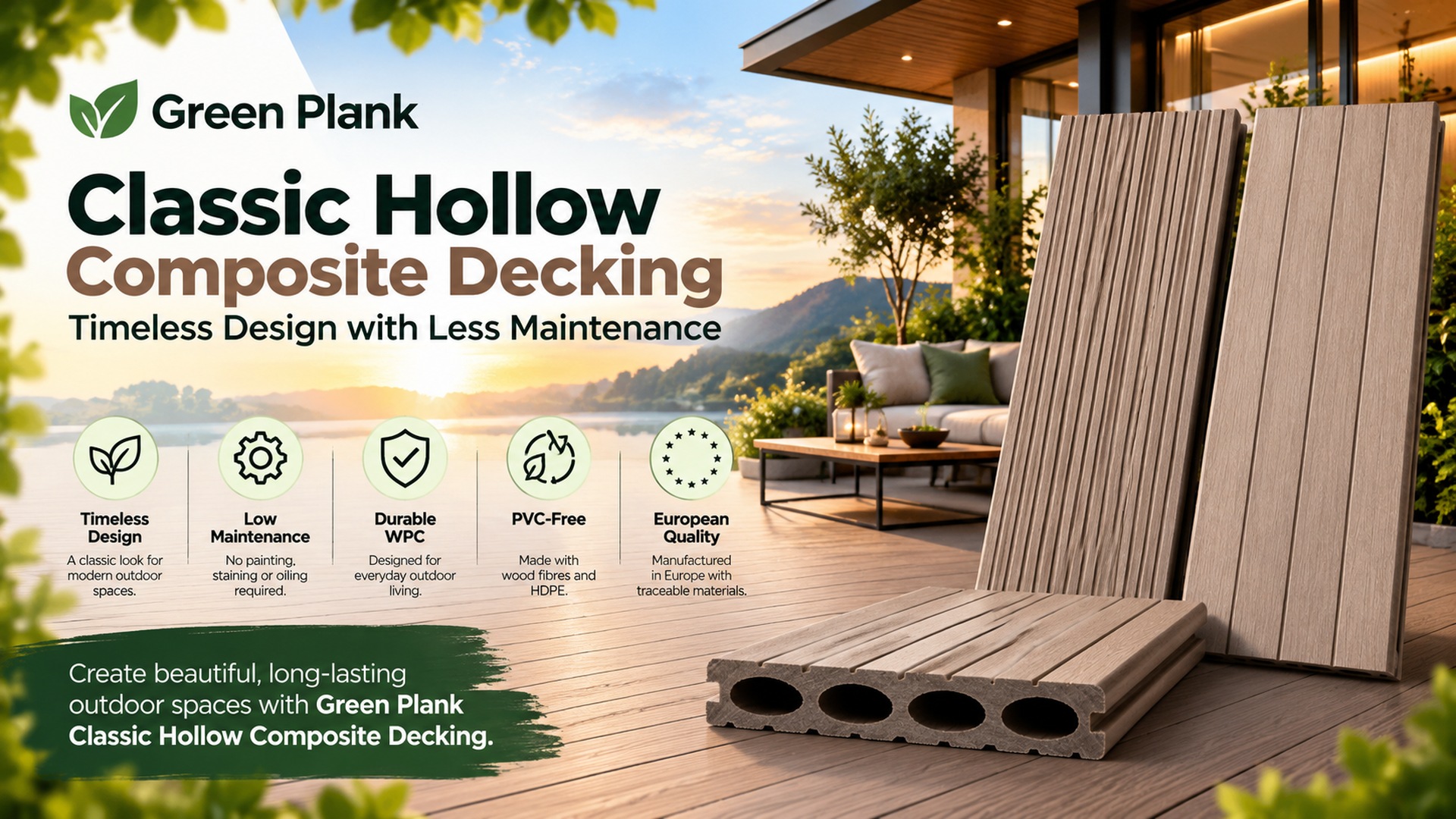
Green Plank Classic Hollow Composite Decking combines a timeless visual character with modern wood-plastic composite technology. Designed as a hollow WPC profile, Classic offers an efficient alternative for projects seeking the appearance of contemporary decking together with less routine surface maintenance than many traditional timber solutions.
With Green Plank's focus on European production, European raw materials and traceability, Classic is designed for customers who value aesthetics, practicality and a transparent supply chain.
Classic by name, contemporary by performance. Green Plank Classic brings together a familiar decking aesthetic, engineered hollow-profile construction and the everyday convenience of modern WPC.
1. What is Classic Hollow Composite Decking?
WPC, or Wood Plastic Composite, combines wood-based fibres with a thermoplastic polymer and functional additives. Instead of being a solid piece of timber, the material is engineered through extrusion to create a controlled decking profile.
Green Plank Classic uses a hollow-profile construction. Internal chambers reduce the amount of material required compared with an equivalent fully solid profile while maintaining a geometry designed specifically for decking applications.
| Classic feature | Practical value |
|---|---|
| Hollow WPC profile | Material-efficient engineered construction |
| Approx. 150 x 23 mm profile | Practical format for modern terrace design |
| HDPE-based composite | PVC-free thermoplastic WPC technology |
| Wood-fibre-rich composition | Combines wood-based material character with polymer technology |
| European production | Production closer to Green Plank's core European markets |
| Hidden fastening concept | Helps create a clean, uninterrupted deck surface |
2. Timeless design for different architectural styles
Decking trends change, but simple lines and natural-looking surfaces remain relevant across many architectural styles. Classic has been developed around this principle: a versatile appearance that can complement contemporary villas, Scandinavian homes, traditional properties and professional outdoor environments.
The visual character of a terrace is influenced by more than colour. Board direction, joint spacing, surrounding materials, furniture and landscaping all contribute to the finished result.
A practical design principle
For a calm architectural expression, coordinate the decking colour with one or two major elements such as the façade, window frames or outdoor furniture. Long, consistent board lines can visually enlarge a terrace and create a stronger connection between indoor and outdoor spaces.
3. Why choose a hollow WPC profile?
Hollow and solid composite boards are not simply better or worse versions of the same product. They are different engineering approaches. A hollow profile uses carefully designed internal chambers to place material where it contributes to the intended profile geometry while reducing unnecessary mass.
Potential advantages of a well-designed hollow profile include:
- lower material use than an equivalent fully solid profile;
- reduced board weight for easier handling;
- efficient transport and site logistics;
- clean profile geometry created through controlled extrusion;
- an attractive balance between material efficiency and decking performance.
Performance depends on the complete design, including wall thickness, internal geometry, raw materials, formulation, extrusion quality, support spacing and installation. Buyers should therefore compare technical documentation rather than judging a decking board only by whether it is hollow or solid.
4. Less routine maintenance than traditional timber
Natural timber can provide a beautiful outdoor surface, but maintaining a particular appearance may require periodic cleaning, oiling, staining or refinishing depending on the timber species, exposure and desired finish.
Green Plank Classic composite decking does not require routine painting, staining or oiling. Normal care focuses primarily on cleaning the surface and periodically checking the deck, substructure, drainage and fixings according to Green Plank's product guidance.
This can be especially attractive for homeowners who want to spend more time enjoying their terrace and for commercial projects where repeated surface-treatment programmes can add operational work.
5. Wood fibre and HDPE working as a composite system
The performance of WPC depends on how effectively its components work together. Wood fibres contribute stiffness and wood-based character, while the polymer matrix binds the composite and supports processing into a consistent profile.
Coupling agents and other functional additives are used to support the interaction between hydrophilic wood fibres and the more hydrophobic polymer phase. Manufacturing control is also important because fibre moisture, particle size, temperature and extrusion conditions can influence the finished material.
This is why WPC quality should not be evaluated using a single percentage. Raw-material consistency, formulation, profile design and manufacturing process all matter.
6. Designed for outdoor exposure
Outdoor decking experiences rain, sunlight, dirt, seasonal temperature changes and repeated foot traffic. Composite decking responds differently to these conditions than solid timber, so correct design and installation are essential.
Because WPC contains thermoplastic polymer, boards expand and contract as temperatures change. Actual movement depends on factors including formulation, board length, colour, profile geometry, installation temperature and solar exposure.
Appropriate expansion gaps must therefore be provided at board ends, walls and other fixed structures according to the installation instructions for the specific product.
Remember: Premium decking is a complete system. The board, substructure, clips, ventilation, drainage and expansion allowances must all work together.
7. Good installation starts below the surface
A beautiful deck depends heavily on what cannot be seen once installation is complete. The substructure must provide adequate support while allowing water to drain and air to circulate.
- Start with a stable and suitable base.
- Create effective drainage away from the building.
- Maintain sufficient ventilation below the decking.
- Follow the specified joist spacing for Classic.
- Provide required perimeter and expansion clearances.
- Use compatible clips, screws and fastening components.
- Keep drains and necessary inspection areas accessible.
Installation requirements can vary according to application, board orientation and project conditions. The current Green Plank installation guide should always take priority over general rules of thumb.
8. Classic Hollow WPC versus traditional timber decking
| Consideration | Traditional timber | Classic Hollow WPC |
|---|---|---|
| Construction | Solid natural wood | Engineered hollow composite profile |
| Appearance | Naturally variable | Controlled, consistent design |
| Routine oiling | May be required for desired finish | Not routinely required |
| Painting or staining | May form part of maintenance | Not part of normal maintenance |
| Dimensional movement | Strongly influenced by moisture | Temperature movement must be accommodated |
| Cleaning | Required | Required |
| Profile engineering | Determined by timber section | Designed internal chamber geometry |
9. Suitable for many modern outdoor spaces
The understated design of Classic makes it suitable for a wide range of residential and professional applications, subject to project-specific requirements:
- private terraces and patios;
- villa and townhouse gardens;
- residential developments;
- balconies where the complete construction is suitable;
- hotel and hospitality terraces;
- restaurant outdoor seating areas;
- garden rooms and outdoor-living spaces;
- other professionally designed deck areas.
For commercial or public projects, requirements relating to structural loads, fire performance, slip resistance, accessibility, waterproofing, drainage and applicable building regulations should always be assessed for the specific installation.
10. European production and traceable materials
Material origin is becoming increasingly relevant to architects, contractors, merchants and developers. Professional buyers increasingly want to understand where products are manufactured, where their principal raw materials originate and what documentation is available.
Green Plank focuses on European manufacturing and traceable European raw materials. A shorter geographical connection between sourcing, manufacturing and core European markets can also simplify communication, quality control and supply planning compared with very long international supply chains.
Origin alone, however, does not determine environmental performance. A meaningful sustainability assessment should consider raw materials, production, transport, installation, maintenance, service life and end-of-use options together.
11. Hollow versus solid decking: choose by application
A common mistake is assuming that the heaviest board is automatically the best. In engineered products, profile design and material efficiency matter. A well-designed hollow board can be appropriate for many residential decking applications, while a solid profile may be preferred where project requirements call for a different construction.
| Project priority | Hollow profile | Solid profile |
|---|---|---|
| Material efficiency | High priority | Uses more material |
| Handling weight | Typically lower | Typically higher |
| Internal geometry | Engineered chambers | Continuous material section |
| Best selection method | Check application and technical data | Check application and technical data |
12. Checklist before selecting composite decking
- Is the board hollow, solid or capped?
- What are the principal raw materials?
- Where is the decking manufactured?
- Can material origin be documented?
- What board dimensions and lengths are available?
- What joist spacing is specified?
- What expansion clearances are required?
- Which clips and screws should be used?
- How should drainage and ventilation be designed?
- Are installation, care and warranty documents available?
Conclusion: classic appearance, modern composite thinking
Green Plank Classic Hollow Composite Decking combines timeless terrace design with the practical advantages of engineered WPC. Its hollow-profile construction supports material efficiency and manageable weight, while the composite surface eliminates the routine need for painting, staining or oiling associated with maintaining many timber decks.
For the best long-term result, product quality must be matched by correct installation. Joist spacing, ventilation, drainage, expansion allowances and fastening details are fundamental parts of a successful composite terrace.
For homeowners, architects, merchants and professional project buyers looking for European composite decking with a clean appearance and lower routine maintenance requirements, Green Plank Classic provides a versatile foundation for attractive modern outdoor spaces.
Sources
- https://greenplank.eu/">Green Plank – European composite decking and outdoor products
- https://www.sciencedirect.com/topics/materials-science/wood-plastic-composite">ScienceDirect Topics – Wood-Plastic Composite
- https://www.fpl.fs.usda.gov/">USDA Forest Products Laboratory – wood and wood-composite research
- https://environment.ec.europa.eu/topics/circular-economy_en">European Commission – Circular Economy
- https://single-market-economy.ec.europa.eu/sectors/construction/construction-products-regulation-cpr/cpr-overview_en">European Commission – Construction Products Regulation
Specify the product
Use this guide with a Green Plank specification
Technical articles support the commercial catalogue — category, product, evidence, then samples or quotes.