



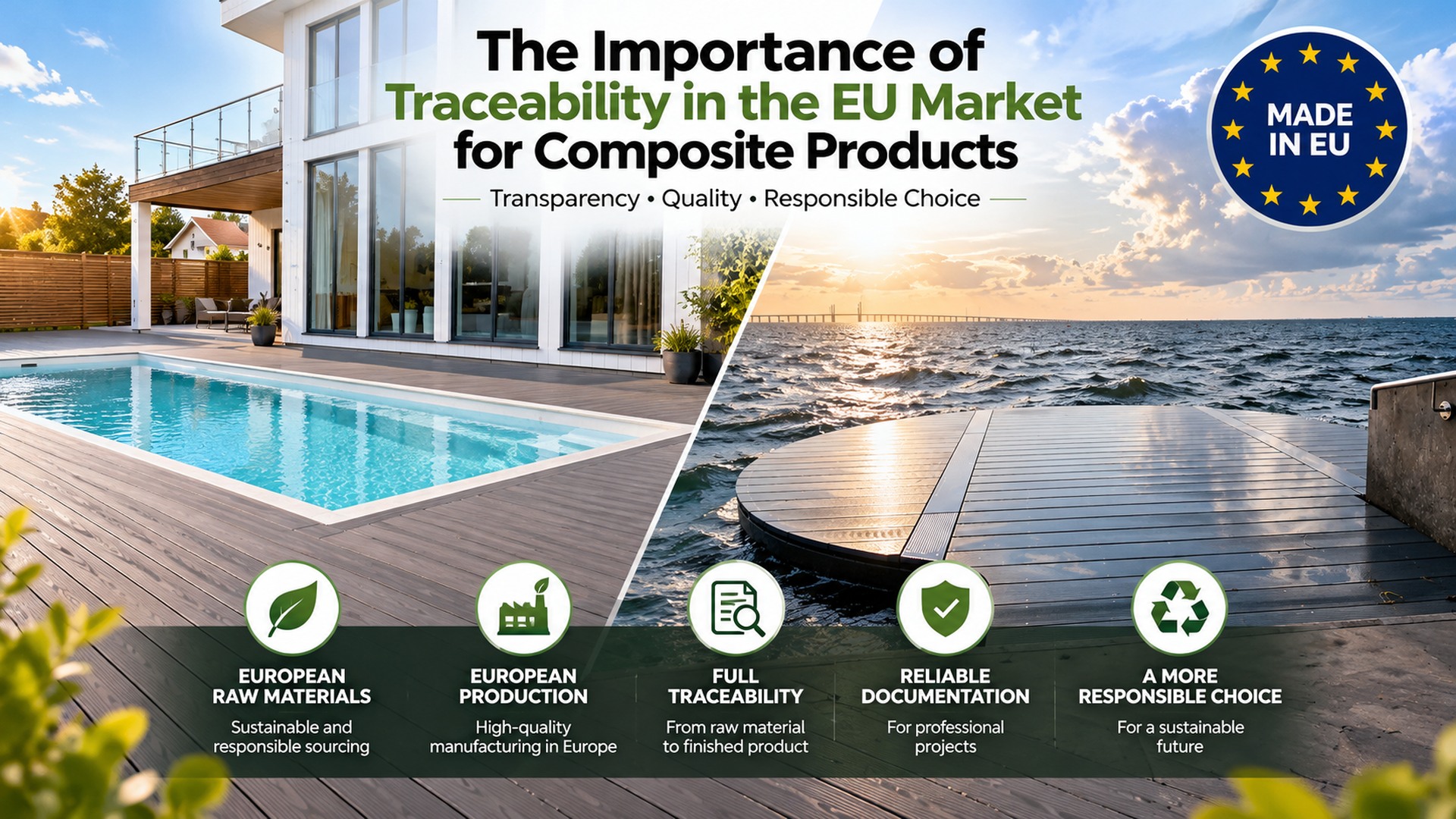
The Importance of Traceability in the EU Market for Composite Products
For professional buyers, architects, distributors and construction companies, choosing a composite product is increasingly about more than colour, profile and purchase price. Understanding where materials originate, how products are identified and what documentation follows them through the supply chain can be important for specification, procurement and future product management.
This makes traceability particularly relevant for WPC decking, composite cladding, fencing and other building products sold in the European market. Green Plank is a Swedish brand with European production in Klaipėda, Lithuania, and a supply strategy focused on European raw materials and traceability.
Traceability is not simply a country-of-origin label. A useful traceability system connects raw-material information, manufacturing, product identification and relevant documentation so that buyers can better understand what they are purchasing.
What does traceability mean for composite products?
In practical terms, traceability is the ability to connect a finished product with relevant information about its materials, production and identity. The appropriate level of information depends on the product, application and regulatory context.
For WPC and other composite building products, useful traceability information may include:
- origin and type of principal raw materials;
- polymer and fibre categories used in the product;
- manufacturer and production location;
- product family, profile and identification information;
- production or batch information where applicable;
- technical and installation documentation;
- warranty information and intended application.
Why traceability matters to EU buyers
A professional buyer may need to purchase the same profile again months or years after the original project. An architect may need technical information before specifying a product. A contractor may need installation instructions for a particular profile, while a distributor needs confidence that products and accessories can be correctly identified when replenishing stock.
Traceability can support each of these activities by creating a clearer connection between the physical product and its supporting information.
| Area | How traceability can help |
|---|---|
| Procurement | Helps identify product, manufacturer and material information |
| Specification | Connects a selected product with relevant technical documentation |
| Installation | Helps installers identify the correct instructions and system components |
| Stock management | Supports identification when ordering matching products and accessories |
| After-sales | Provides clearer product information when investigating a claim or replacement |
| Future projects | Can make repeat specification and reordering more structured |
From raw material to finished WPC profile
WPC combines wood or natural fibres with a thermoplastic polymer and functional additives. However, WPC is a broad material category rather than one standard formulation. Fibre species, polymer type, additives, proportions, profile geometry and manufacturing processes can differ significantly.
This is one reason why raw-material information is valuable. Selected Green Plank products use a high proportion of European hardwood fibres, including beech and oak, together with HDPE and functional additives. Exact composition should always be verified against the specification for the individual product family.
A practical traceability chain
- Raw materials: identify the main material categories and relevant origin information.
- Manufacturing: connect the material inputs with the production location and process.
- Product identification: distinguish profile, colour, dimensions and product family.
- Documentation: link technical information, installation instructions and applicable declarations to the product.
- Distribution: maintain sufficient product identity through warehousing, delivery and reordering.
Green Plank European supply approach
Swedish brand • Production in Klaipėda, Lithuania • European raw materials • Focus on material and product traceability
For professional procurement, these characteristics should be evaluated together with current product specifications, technical documentation and the requirements of the intended application.
Traceability and quality are related – but not identical
Traceability can provide information about a product, but it does not by itself prove that the product has superior mechanical performance, durability or quality. Those characteristics require suitable technical data and product-specific evaluation.
Similarly, European origin alone should not be treated as automatic evidence of better performance. A professional comparison should examine material composition, profile design, manufacturing consistency, installation requirements, technical documentation and suitability for the intended use.
Traceability is not the same as sustainability
This distinction is especially important in environmental communication. Knowing where a material comes from improves transparency, but traceability alone does not demonstrate lower carbon emissions or a better overall environmental footprint.
Environmental comparisons should be supported by suitable product-specific information and recognised assessment methods where applicable. A shorter transport route, for example, is a relevant logistics characteristic but is not by itself sufficient to prove that one complete product has a lower environmental impact than another.
Documentation in the European construction market
The regulatory framework for construction products in the EU continues to develop. Regulation (EU) 2024/3110 establishes rules for the marketing of construction products within its scope and introduces a framework that includes increasing use of digital product information.
Which regulatory and documentation requirements apply to a particular composite product depends on factors such as its intended use and the relevant technical specifications. Buyers should therefore avoid assuming that the same documentation requirements apply to every decking, cladding or fencing product.
What should professional buyers request?
- clear product and manufacturer identification;
- current technical data for the selected profile;
- installation instructions for the intended application;
- information about material composition where available;
- applicable declarations and regulatory documentation;
- warranty terms and exclusions;
- information needed for future product identification and reordering.
The Digital Product Passport and the direction of EU policy
Digital product information is becoming increasingly important in European product policy. The Ecodesign for Sustainable Products Regulation establishes a framework for Digital Product Passports for products covered by future delegated requirements, while the revised Construction Products Regulation also strengthens the digitalisation of construction-product information.
This does not mean that every WPC product automatically requires the same Digital Product Passport today. The practical requirements depend on the applicable legislation, product category and implementation measures. Nevertheless, the direction is clear: structured, accessible product information is becoming more important across European supply chains.
Traceability for decking, cladding and fencing
| Product | Important identification points |
|---|---|
| WPC decking | Profile, dimensions, surface, colour, fastening system and installation requirements |
| Composite cladding | Profile, orientation, substructure, ventilation, fixings and finishing details |
| WPC fencing | Profiles, posts, rails, connectors, foundation requirements and accessories |
For all three applications, traceability becomes particularly useful when a project requires additional material later. Correct identification can reduce uncertainty when matching a profile, system component or installation document to the original project.
Traceability and lifecycle cost
Initial purchase price is only one part of a project's economics. ISO 15686-5 provides principles for life-cycle costing of buildings and constructed assets, encouraging evaluation over a defined analysis period rather than focusing only on acquisition cost.
Traceability does not automatically reduce lifecycle cost. However, reliable product identification can support procurement, maintenance planning, replacement decisions and future ordering – all factors that can influence the practical management of a building product over time.
10 traceability questions for composite-product suppliers
- Who manufactures the product and where?
- Can the main raw-material origin be identified?
- What fibre and polymer types are used?
- How is the product family and profile identified?
- Can batches or production information be identified where relevant?
- Which technical documents relate to this exact product?
- Are installation instructions product-specific?
- Which regulatory documents apply to the intended use?
- Can matching profiles and accessories be reordered later?
- How is product information maintained if specifications change?
Green Plank: European production with traceability in focus
For Green Plank, traceability forms part of a broader European supply approach. The company combines Swedish brand management with production in Klaipėda, Lithuania, and European raw materials for its composite product portfolio.
For distributors, architects and professional buyers, the value of this approach is not simply the words Made in EU. The more useful question is whether material origin, product identity, specifications and supporting documentation can be connected clearly enough to support informed purchasing and project decisions.
Conclusion
Traceability is becoming an increasingly relevant consideration when evaluating composite products for the EU market. It can support transparency from raw materials to finished products, improve product identification and make technical documentation, repeat purchasing and after-sales processes easier to manage.
It should not, however, be confused with proof of quality, durability or environmental performance. The strongest procurement approach combines traceability, technical documentation, correct installation requirements and product-specific performance information. For Green Plank, this creates a practical foundation for supplying European composite decking, cladding and fencing to professional markets.
Sources
- Green Plank – European composite products and company information
- EUR-Lex – Regulation (EU) 2024/3110 on construction products
- EUR-Lex – Regulation (EU) 2024/1781 on ecodesign for sustainable products
- ISO 15686-5 – Life-cycle costing
Specify the product
Use this guide with a Green Plank specification
Technical articles support the commercial catalogue — category, product, evidence, then samples or quotes.