



WPC Decking for Public Areas – Green Plank
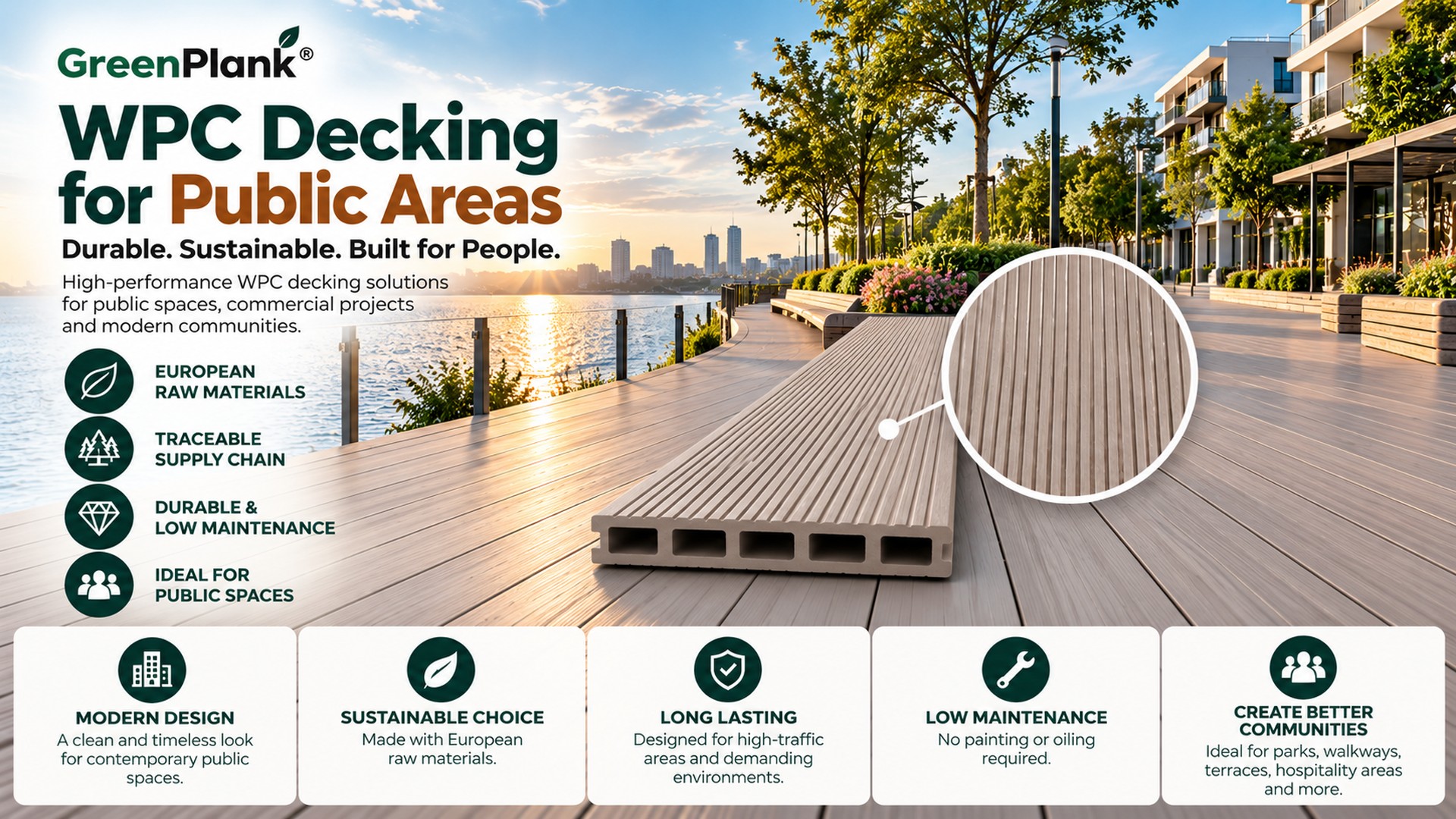
Public outdoor spaces place demanding requirements on decking systems. Promenades, hospitality terraces, courtyards, public gardens, commercial developments and other high-use environments may experience frequent pedestrian traffic, changing weather, regular cleaning and more intensive operational demands than a typical residential deck.
WPC decking can be considered for many professional outdoor projects, but selecting the right solution involves much more than choosing a board by appearance or price. The complete system – decking profile, substructure, fixings, drainage, ventilation, thermal movement, documentation and maintenance – should be evaluated for the intended application.
Professional project principle: Specify the complete decking system for the actual use of the site. Board profile, support spacing, substructure, fastening, drainage and maintenance should work together.
1. Why public decking requires careful specification
A residential terrace and a busy public deck may look similar, but their operating conditions can be very different. Public and commercial projects may face greater traffic, cleaning requirements, furniture loads and operational expectations. The specification should therefore begin with the project rather than with a generic product category.
| Project factor | What should be considered? |
|---|---|
| Usage | Expected traffic, furniture and intended function of the area |
| Board profile | Construction, dimensions, surface and intended application |
| Substructure | Support system and product-specific joist spacing |
| Drainage | Management of rainwater and avoidance of unwanted water accumulation |
| Ventilation | Air circulation beneath and around the decking system |
| Maintenance | Cleaning, inspection and access for future servicing |
2. WPC is a product category, not one specification
WPC stands for Wood Plastic Composite. It generally combines wood or other natural fibres with a thermoplastic polymer and additional functional components. However, the formulation, fibre content, polymer type, additives, profile geometry, surface construction and manufacturing process can vary between products.
For professional buyers, this means that two boards described as WPC can have different technical characteristics. Procurement should therefore be based on documented product information and suitability for the intended project.
Key information to request from a supplier
- Material composition and origin of principal raw materials
- Solid, hollow or capped/co-extruded profile construction
- Board dimensions and effective coverage width
- Product-specific support or joist requirements
- Recommended fastening system
- Thermal movement and installation requirements
- Cleaning and maintenance instructions
- Technical documentation
- Warranty terms for the intended application
3. European raw materials and traceability
Green Plank is a Swedish brand with production in Klaipėda, Lithuania. Green Plank works with European raw materials and traceability through its supply and manufacturing chain. Selected formulations combine European wood fibres, including beech and oak, with HDPE and functional components.
For architects, merchants, municipalities, contractors and professional buyers, traceability can support procurement by making the origin and identity of materials easier to follow. It can also assist with quality control, product identification and future repeat orders.
4. Choosing the right WPC profile
Profile construction is an important part of decking specification. Solid, hollow and capped or co-extruded boards use different structural concepts, and each should be assessed according to the project rather than by a simple assumption that one type is always superior.
| Profile type | General characteristic | Check for the project |
|---|---|---|
| Solid | Continuous composite cross-section | Weight, support requirements, fixing and intended use |
| Hollow | Internal chambers reduce material in the cross-section | Support spacing, edge details and application |
| Capped / co-extruded | Composite core with an additional surface layer | Cap construction, surface characteristics, care and warranty |
The correct profile should be selected together with the appropriate substructure, fixing system and installation details for the expected use.
5. Substructure is fundamental
A decking board is only the visible part of the system. The structure beneath it plays a major role in how the completed deck functions. The base should be stable, and the substructure should be designed to provide appropriate support while allowing water management and ventilation.
There is no universal joist spacing that applies to every WPC board. Profile geometry, installation direction, expected loads and manufacturer requirements all matter. Diagonal layouts or more demanding applications may require closer support than standard residential installations.
6. Plan drainage and ventilation from the beginning
Public outdoor areas need effective water management. Drainage should be incorporated into the project design rather than treated as an afterthought. Leaves, dirt or other debris should not be allowed to permanently block intended drainage paths.
Ventilation around and beneath the deck is also part of correct system design. Connections to walls, borders, stairs and other fixed structures should follow the installation requirements for the selected product.
7. Allow correctly for temperature movement
WPC materials respond to changes in temperature. The amount of movement can depend on formulation, profile, board length, installation temperature, colour, direct solar exposure and other project conditions.
For this reason, a single universal expansion gap should not be applied to every composite decking product. End gaps, perimeter clearances and board-to-board details should follow the current installation instructions for the specific board.
8. Low maintenance does not mean maintenance-free
One reason WPC is considered for public spaces is its different maintenance routine compared with many traditional timber systems. WPC decking does not normally require conventional timber painting, staining or oiling. It still requires cleaning and periodic inspection.
- Remove leaves, sand and loose debris regularly.
- Keep drainage routes and board gaps clear.
- Clean spills according to the product care instructions.
- Use cleaning products suitable for the surface.
- Inspect boards, fixings and accessible substructure periodically.
- Include cleaning and inspection in the facility maintenance plan.
9. Compare complete project cost, not only board price
For public projects, the purchase price of the decking board is only one part of the economic picture. A useful comparison includes the complete installed system and its planned operation over time.
| Cost category | Examples |
|---|---|
| Materials | Decking, substructure, clips, screws and finishing components |
| Installation | Preparation, labour, cutting and fitting |
| Operation | Cleaning and scheduled inspections |
| Maintenance | Repairs and replacement of individual components |
| Logistics | Transport, storage and future repeat orders |
ISO 15686-5 provides principles for life-cycle costing in buildings and constructed assets. For professional procurement, a defined lifecycle-cost approach can provide a more complete comparison than initial material price alone.
10. Documentation matters in professional procurement
Good documentation helps architects, municipalities, contractors and merchants compare products on a common basis. It also reduces uncertainty between specification, ordering and installation.
Before approving a WPC decking system, check:
- Exact product and profile identification
- Board dimensions and effective coverage
- Intended application
- Substructure requirements
- Product-specific support spacing
- Fixing and clip system
- Thermal movement requirements
- Drainage and ventilation details
- Cleaning and maintenance instructions
- Technical documentation and applicable warranty terms
11. Green Plank solutions for professional projects
Green Plank offers several WPC product families for different project requirements, including TerraTuff™, Nordeka™, Classic™ and Sapphire™. These ranges differ in profile construction, surface design and intended use, allowing specifiers to compare solutions according to the requirements of each project.
Selected TerraTuff™ products are offered with residential warranties of up to 50 years, depending on the specific product and applicable warranty conditions. Public and commercial applications must be assessed separately against the relevant technical requirements and warranty terms.
A residential warranty should therefore never be automatically applied to a commercial or public installation. Project use, loading, substructure, installation and maintenance conditions should all be considered during specification.
12. A practical specification approach
For public decking, a structured procurement process can reduce the risk of comparing products on price alone. Begin with the application, define technical requirements, compare complete systems and confirm installation details before ordering.
- Define the use and expected intensity of the area.
- Identify suitable profile types.
- Review material composition and traceability.
- Confirm substructure and support requirements.
- Plan drainage and ventilation.
- Calculate complete installed cost per square metre.
- Review installation instructions before construction.
- Confirm technical documentation.
- Check warranty terms for the actual application.
- Create a practical cleaning and inspection plan.
Public WPC decking should be designed as a complete system
WPC decking can provide architects, municipalities, developers and commercial property owners with useful design options for modern public outdoor areas. Successful specification, however, depends on more than the visible board.
By evaluating raw materials, traceability, profile construction, substructure, drainage, ventilation, installation, maintenance and lifecycle cost together, project teams can make more transparent and technically informed decisions. Green Plank combines European production, European raw materials and traceability with WPC product systems developed for a range of outdoor applications.
Sources
- Green Plank – official product and company information
- ISO 15686-5:2017 – Life-cycle costing
- European Commission – Construction Products Regulation
Specify the product
Use this guide with a Green Plank specification
Technical articles support the commercial catalogue — category, product, evidence, then samples or quotes.