



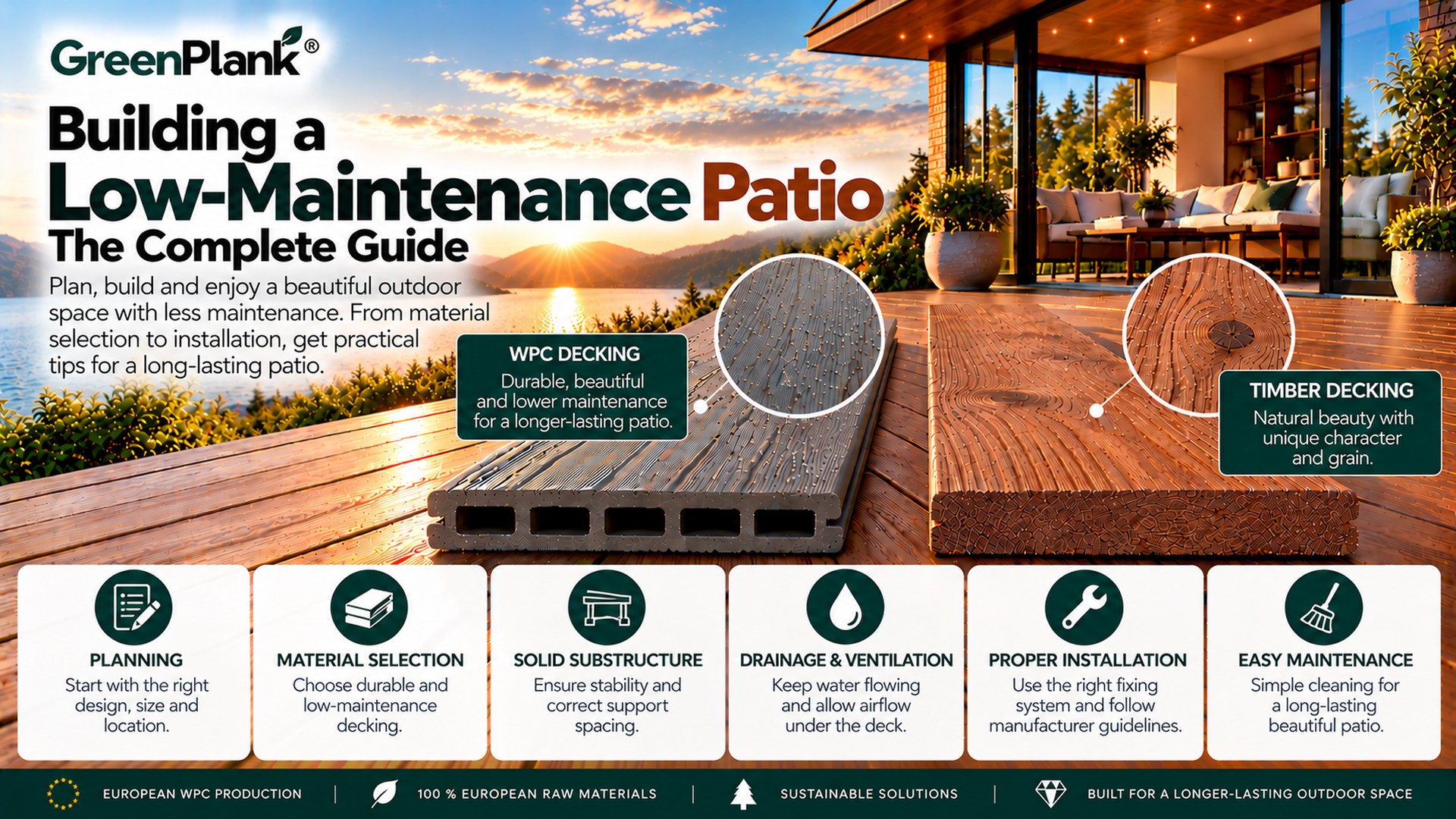
Building a Low-Maintenance Patio: The Complete Guide
A well-designed patio should give you more time for outdoor living and less time for repetitive maintenance. Achieving that result starts long before the first decking board is installed. Material selection matters, but so do the foundation, substructure, drainage, ventilation, fastening system and installation details.
WPC, or Wood Plastic Composite, is an established alternative to traditional timber decking. It combines wood or natural fibres with a thermoplastic polymer and other components. WPC typically does not require conventional painting, staining or oiling, although it still needs cleaning and appropriate care. For that reason, low maintenance is a more accurate description than maintenance-free.
Key principle: A low-maintenance patio is a complete system. Good decking installed over a poorly planned foundation or substructure cannot compensate for inadequate drainage, ventilation or support.
1. Start with How the Patio Will Be Used
Before selecting a decking board, define the project. A private garden terrace has different requirements from a restaurant terrace, hotel deck, poolside area or heavily used commercial space.
Consider the size of the area, expected traffic, exposure to sun and rain, furniture loads, access points and the amount of maintenance you are prepared to carry out. These factors help determine the appropriate decking profile and construction.
2. Choose the Right Decking Material
Both timber and WPC can create attractive outdoor spaces, but they have different characteristics and maintenance requirements.
| Factor | WPC Decking | Timber Decking |
|---|---|---|
| Routine cleaning | Required | Required |
| Painting or staining | Normally not required | May be required depending on timber and desired finish |
| Appearance | Defined colours and manufactured textures | Natural grain, knots and colour variation |
| Material movement | Temperature-related movement must be considered | Moisture-related dimensional changes are important |
| Fastening | Often a product-specific clip system | Typically screws or timber-specific fastening |
| Ongoing care | Cleaning and inspection | Cleaning plus possible surface treatment |
3. Understand Different WPC Profiles
Not all composite decking is the same. WPC products can differ considerably in formulation, profile geometry, wall thickness, surface technology, dimensions and fastening systems. Comparing products solely by colour or price per linear metre can therefore be misleading.
Solid WPC decking
Solid profiles have a continuous composite cross-section. Their suitability depends on the engineering of the individual product, board dimensions, support requirements and intended application.
Hollow WPC decking
Hollow profiles use internal chambers to achieve a different balance of material use, weight and structural design. The geometry of the profile and the manufacturer's specified support spacing are important when evaluating these boards.
Capped or co-extruded decking
Co-extruded decking combines a composite core with an additional surface layer during production. This construction provides different surface characteristics from traditional uncapped WPC. Performance should always be evaluated from the technical specifications of the actual product rather than from the word capped alone.
4. Build on a Stable Foundation
The visible decking is only the upper layer of the patio. A stable and suitable foundation is essential for a successful installation. The base should support the intended loads and allow water to drain away rather than remain trapped beneath the deck.
Before construction begins, check:
- ground and foundation stability
- finished deck height and available construction depth
- water drainage and appropriate falls
- ventilation beneath the decking
- connections to walls and fixed structures
- access to drains or areas requiring inspection
5. Plan the Substructure Carefully
The substructure transfers loads and establishes the support pattern for the decking. Joist spacing should never be assumed to be identical for every composite board.
Permitted spacing can vary according to board profile, dimensions, application and installation direction. Diagonal patterns or demanding applications may require closer support. Always follow the current installation instructions for the selected product.
| Design Area | Why It Matters |
|---|---|
| Foundation | Provides a stable base for the complete system |
| Substructure | Supports boards at the required intervals |
| Drainage | Allows rainwater to leave the construction |
| Ventilation | Allows airflow beneath the deck |
| Fastening | Secures boards according to system requirements |
| Movement gaps | Allow for product-specific dimensional movement |
6. Design for Drainage and Ventilation
Good water management is one of the most important details in patio design. Leaves, dirt and standing water should not be allowed to accumulate unnecessarily around or beneath the decking.
The foundation, substructure and board layout should work together so water can drain away and air can circulate. Keep drainage paths and board gaps clear during use. Particular attention should be given to walls, door thresholds, corners and other areas where water could become trapped.
7. Allow for Temperature-Related Movement
WPC responds to changes in temperature. Board length, installation temperature, colour, exposure to direct sunlight and product construction can all influence movement.
There is therefore no single expansion gap that should be applied universally to every WPC board. End gaps, distances from fixed structures and other movement allowances should follow the manufacturer's instructions for the specific profile and installation conditions.
This is especially important when installing long boards or working in climates with substantial seasonal temperature changes.
8. Use the Correct Fastening System
Many composite decking systems use clips and compatible screws. These components are not simply accessories: they can form an important part of the installation system and may help establish the intended spacing between boards.
Use the fasteners specified or approved for the chosen profile. Substituting components or changing support distances without technical guidance can alter how the installed system performs.
9. Make Future Cleaning Easy
Low maintenance begins with a design that is easy to keep clean. Avoid inaccessible dirt traps where possible, maintain drainage paths and consider how furniture, planters and other objects will affect access to the decking surface.
A practical maintenance routine can include:
- removing leaves and loose debris regularly
- keeping gaps and drainage points clear
- cleaning spills before they become difficult to remove
- using cleaning products suitable for the decking
- following the manufacturer's care instructions
- periodically inspecting the deck and substructure
Composite decking should not be marketed or treated as completely maintenance-free. Simple periodic cleaning remains part of responsible patio care.
10. Consider the Complete Cost, Not Just the Boards
A low-maintenance patio should also be evaluated economically as a complete project. The lowest board price does not necessarily produce the lowest installed or long-term cost.
Include decking, substructure, fasteners, edge details, transport, installation, cleaning and potential future repair or replacement when comparing alternatives. ISO 15686-5 provides a recognised framework for considering life-cycle costs over a defined analysis period.
11. Green Plank for European Patio Projects
Green Plank is a Swedish brand with production in Klaipėda, Lithuania. Its decking portfolio includes product families such as TerraTuff™, Nordeka™, Classic™ and Sapphire™, providing different profile constructions for different project requirements.
Green Plank works with European raw materials and traceability through its supply and production chain. Selected formulations combine European wood fibres, including beech and oak, with HDPE and other components. Material origin should be evaluated together with technical performance, documentation and installation requirements rather than being treated as a quality claim on its own.
Warranty periods vary by product and application. Selected TerraTuff™ products are offered with residential warranties of up to 50 years, subject to the specific product and applicable warranty conditions. Professional and commercial applications should always be checked against the relevant terms.
12. Low-Maintenance Patio Checklist
- Define the patio's size, use and expected traffic.
- Select a decking profile suitable for the application.
- Prepare a stable foundation with effective drainage.
- Design the substructure according to product requirements.
- Provide appropriate ventilation beneath the deck.
- Allow for product-specific dimensional movement.
- Use the correct clips, screws and system components.
- Follow the current installation instructions.
- Keep board gaps and drainage routes accessible.
- Plan simple periodic cleaning from the beginning.
Conclusion: Low Maintenance Starts with Good Planning
Building a low-maintenance patio is not simply a matter of choosing composite decking. The best results come from treating the patio as a complete system in which the foundation, substructure, drainage, ventilation, decking and fastening components work together.
Choose materials according to the real application, follow product-specific installation requirements and design the space so that cleaning and inspection remain straightforward. That approach creates a better foundation for an attractive outdoor space with manageable ongoing care.
Sources
- Green Plank – official website and product information
- ISO 15686-5:2017 – Life-cycle costing
- USDA Forest Products Laboratory – Wood Handbook
Specify the product
Use this guide with a Green Plank specification
Technical articles support the commercial catalogue — category, product, evidence, then samples or quotes.