



WPC vs. Wood: Which Decking Board Is Right for Your Project?
Wood has been used for outdoor decking for generations, and its natural appearance remains highly attractive. Today, however, WPC decking boards offer homeowners, architects, contractors and professional buyers another option: a manufactured composite system combining wood or natural fibres with thermoplastic polymer and other formulation components.
The question is not simply whether WPC is better than wood. Both materials have strengths. The more useful question is: which material better matches the design, maintenance expectations, installation requirements, budget and intended use of your project?
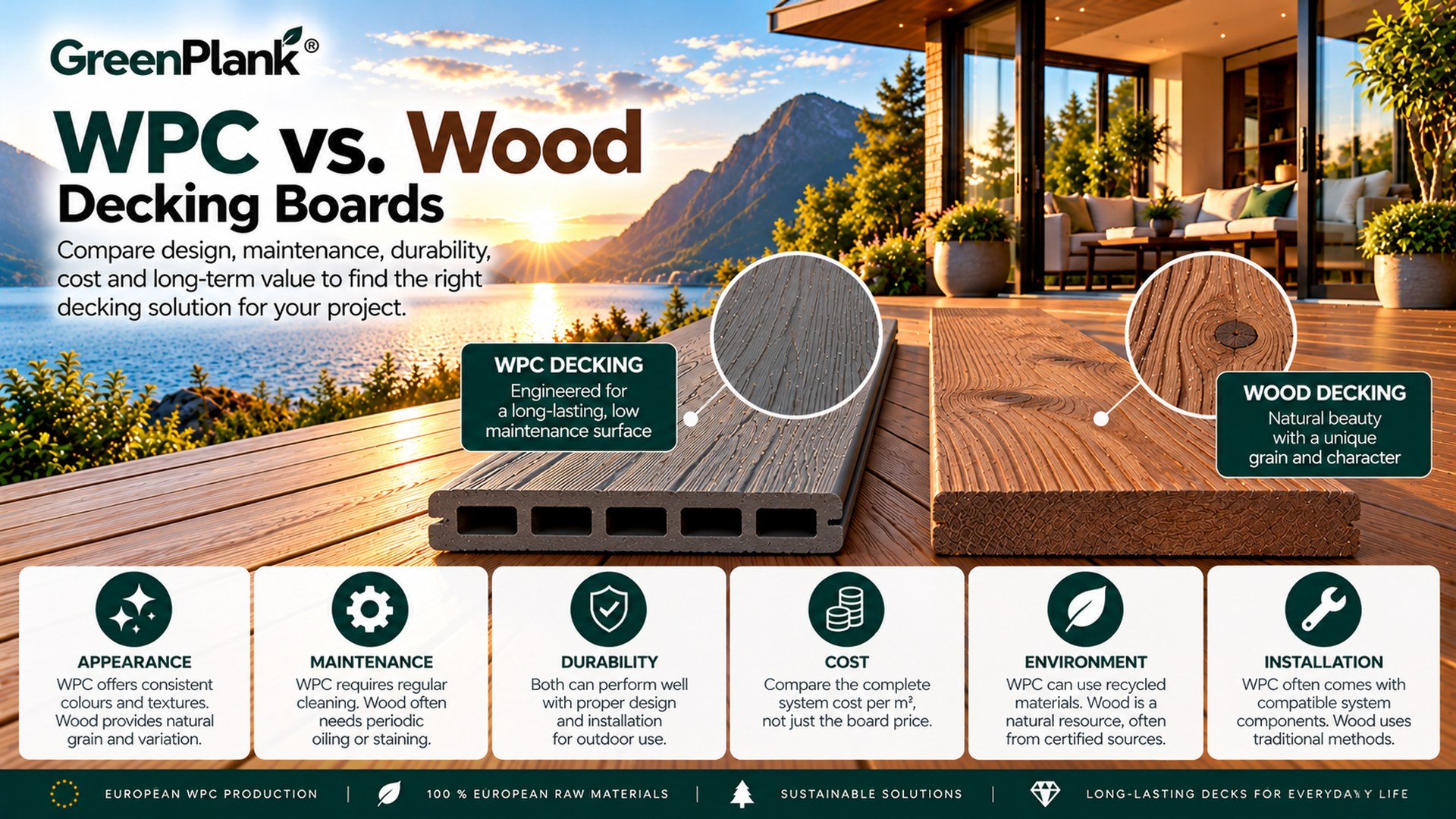
Quick comparison: Wood offers genuine natural character and variation. WPC offers engineered profiles, defined colours and compatible system components, often with less need for traditional surface treatment. Product quality and correct installation remain important with either material.
What is WPC decking?
WPC stands for Wood Polymer Composite or Wood Plastic Composite. It is produced by combining wood or natural fibres with a thermoplastic polymer and formulation components, then manufacturing the material into defined decking profiles.
Depending on the product, WPC decking can be solid or hollow and may have brushed, grooved, embossed or co-extruded surfaces. This means that two WPC boards can differ considerably in composition, profile geometry, weight, surface technology and installation requirements.
WPC vs. wood decking at a glance
| Factor | WPC decking | Wood decking |
|---|---|---|
| Material | Composite of fibres, polymer and other components | Natural solid wood |
| Appearance | Defined colours, textures and profiles | Natural grain and individual variation |
| Surface care | Regular cleaning; follow product-specific guidance | Cleaning and, depending on species and desired appearance, periodic surface treatment |
| Moisture response | Depends on formulation and construction | Wood naturally absorbs and releases moisture |
| Movement | Temperature-related movement must be considered | Moisture-related swelling and shrinkage are important |
| Installation | Often supplied as a defined system with clips and accessories | Several traditional fixing systems are available |
1. Maintenance: one of the biggest practical differences
Outdoor timber naturally changes as it is exposed to sunlight, moisture and weather. Depending on the timber species and the appearance the owner wants to maintain, cleaning, oiling or other surface treatment may be part of the maintenance plan.
WPC also requires care. Leaves, dirt, pollen and organic deposits should be removed, and cleaning should follow the manufacturer's instructions. However, WPC generally does not require the same type of recurring painting or oiling associated with maintaining a particular finish on conventional timber decking.
Low maintenance does not mean no maintenance
A well-designed WPC terrace still needs routine cleaning, free drainage and ventilation. Claims such as maintenance-free should therefore be treated carefully. Product-specific care instructions are a better basis for planning.
2. Natural character or controlled design?
One of timber's greatest strengths is authenticity. Every board can have its own grain, colour variation and natural characteristics. For projects where genuine timber appearance and natural ageing are central to the design, wood remains an attractive choice.
WPC approaches design differently. Because it is manufactured, producers can control profile dimensions, colours, surface patterns and fixing details more closely. Available options may include:
- wood-inspired embossed surfaces
- modern grey, brown and natural tones
- solid and hollow profiles
- capped and uncapped surfaces
- concealed clip systems
- matching trims and finishing profiles
3. Moisture behaves differently in wood and WPC
Wood is hygroscopic. It exchanges moisture with its surroundings, which can lead to dimensional changes. The USDA Forest Products Laboratory documents this relationship between wood, moisture and dimensional behaviour in its Wood Handbook.
WPC behaves differently because its properties are influenced by fibre content, polymer type, additives, profile construction and manufacturing. It should not, however, be treated as completely unaffected by moisture.
For both materials, good terrace construction remains essential. Drainage, ventilation, suitable support and correct fixing help the complete deck system function as intended.
4. Temperature movement matters with WPC
A key difference from traditional timber is that WPC can expand and contract as temperatures change. The amount of movement is product-specific and depends on factors such as formulation, profile geometry, board length and installation temperature.
This is why there should not be one universal expansion gap for every composite decking product. Installers should follow the technical installation guide for the specific board and system being used.
Installation principle: Compare decking as a complete engineered system. Board profile, joist spacing, fixing method, ventilation, drainage and expansion requirements all matter.
5. Capped WPC provides another surface option
Modern composite decking may be produced with a separate co-extruded polymer-based surface layer. This is commonly called capped WPC. The cap allows the manufacturer to develop the visible surface separately from much of the composite core.
Uncapped WPC uses the composite material itself as the exposed surface. Neither description alone proves quality. When comparing capped products, buyers should examine the cap material, coverage, core formulation, profile design, technical documentation and intended application.
6. Compare complete cost per square metre
Board price alone can make a WPC-versus-wood comparison misleading. A professional comparison should calculate the complete installed system per square metre.
| Cost element | What to compare |
|---|---|
| Decking boards | Effective coverage, required linear metres and waste |
| Substructure | Material, support spacing and layout |
| Fixings | Clips, screws, start/end fasteners |
| Finishing | Edge boards, trims and profiles |
| Installation | Labour and project complexity |
| Use phase | Cleaning, maintenance, repairs and possible replacement |
For longer-term decisions, lifecycle costing can provide a more complete perspective. ISO 15686-5 provides a framework for life-cycle costing of buildings and constructed assets. A lower purchase price does not automatically mean a lower total cost, while a higher initial price does not automatically guarantee better lifetime value.
7. What about splinters and natural surface changes?
Natural timber can develop checking, rough areas or splinters depending on species, exposure, age and maintenance. WPC does not have the same naturally grown grain structure and therefore behaves differently at the surface.
That does not make composite decking immune to damage. Scratching, impact, unsuitable cleaning methods or incorrect installation can affect a WPC surface. For heavily used environments, buyers should assess documented product characteristics rather than rely on general material claims.
8. Where does real wood still have an advantage?
A balanced comparison should recognise the qualities of timber. Genuine wood provides natural grain, can develop an attractive patina and, depending on the product, may be sanded or refinished. For customers who specifically want a natural material and accept its maintenance and ageing characteristics, timber can be an excellent choice.
WPC becomes particularly interesting where the priorities are defined profiles, consistent product design, compatible system components, broad colour choices and reduced dependence on traditional surface treatments.
Green Plank: European WPC decking systems
Green Plank is a Swedish brand with WPC production in Klaipėda, Lithuania. Its material strategy is based on 100% European raw materials and 100% traceability. Selected formulations use a high proportion of European hardwood fibre, including beech and oak, combined with HDPE and other formulation components.
The Green Plank range includes TerraTuff™, Nordeka™, Classic™ and Sapphire™, providing different profile constructions, surfaces and design options for residential and professional projects.
Selected TerraTuff™ products are offered with residential warranties of up to 50 years, depending on the specific product and applicable warranty conditions. Professional and commercial applications may be subject to different terms.
10 questions to ask before choosing WPC or wood
- Do you prefer genuine natural grain or a controlled surface design?
- How much ongoing surface care are you prepared to undertake?
- What type of traffic and use will the terrace receive?
- What substructure is required?
- How will the boards be fixed?
- What drainage and ventilation are required?
- What movement allowances apply to the specific product?
- What does the complete system cost per m²?
- What documentation and warranty terms are provided?
- How easily can matching boards and accessories be reordered?
Conclusion: compare the complete decking solution
There is no universal winner in the WPC vs. wood debate. Timber offers authentic natural character and remains an excellent decking material when its appearance and maintenance requirements match the project. WPC offers a different proposition: engineered profiles, controlled design, integrated system components and less reliance on traditional surface treatment.
For a sound decision, compare more than the price of an individual board. Review the complete system, installation requirements, maintenance, documentation, warranty and expected costs throughout the intended period of use. That provides a much stronger basis for choosing the right decking material.
Explore European composite decking systems at Green Plank.
Sources
- Green Plank – product and system information
- USDA Forest Products Laboratory – Wood Handbook
- ISO 15686-5 – Life-cycle costing
Specify the product
Use this guide with a Green Plank specification
Technical articles support the commercial catalogue — category, product, evidence, then samples or quotes.