



WPC Decking for Nordic Climate – What Should You Look For?
A deck in Scandinavia has to perform through much more than a warm summer season. Rain, snow, frost, moisture, strong sunlight and substantial seasonal temperature changes place demands on both the decking boards and the structure beneath them. Choosing WPC decking for a Nordic climate should therefore involve much more than colour, appearance and price.
Wood Plastic Composite, commonly known as WPC, combines wood or natural fibres with a thermoplastic polymer and functional additives. Its performance depends on several factors, including raw-material quality, formulation, profile geometry, manufacturing control and surface technology. Two composite decking products can therefore behave differently even when they look similar.
For Nordic conditions, think in systems: decking boards, substructure, ventilation, drainage, fasteners and product-specific expansion requirements must work together.
Why Is Nordic Climate Different?
Outdoor structures across Sweden, Norway, Denmark, Finland and other northern European regions experience highly variable conditions throughout the year. A deck may be exposed to prolonged rain and moisture, freezing winter temperatures and direct summer sunshine.
This makes construction details particularly important. Water must be able to drain away, air should circulate beneath the decking, and the installation must accommodate the dimensional movement specified for the chosen product.
| Nordic condition | What to consider |
|---|---|
| Rain and moisture | Drainage, ventilation and suitable deck slope |
| Snow and freezing conditions | Stable substructure and effective water drainage |
| Temperature changes | Product-specific expansion requirements |
| Summer sunshine | Surface temperature, colour and UV exposure |
| Coastal environments | Moisture exposure, wind and suitable fasteners |
| Year-round use | Cleaning, wear and maintenance requirements |
1. Start with the Raw Materials
The quality of WPC begins with the material formulation. Professional buyers should ask which type of wood fibre and polymer are used, where the principal raw materials originate and how consistency is controlled during production.
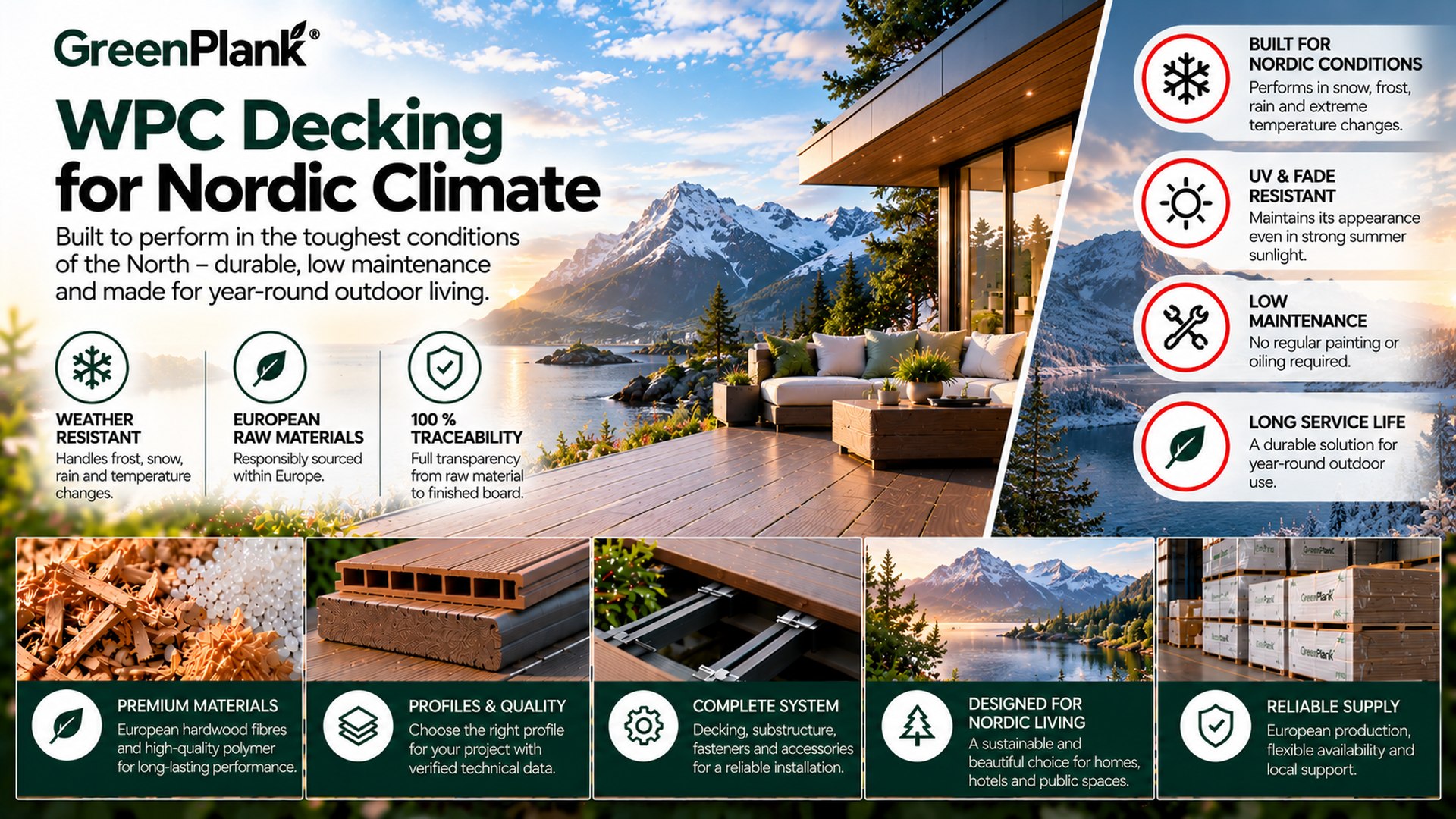
Green Plank is a Swedish brand with WPC production in Klaipėda, Lithuania, within the European Union. Its material strategy is based on 100% European raw materials and 100% traceability. Selected formulations use a high proportion of European hardwood fibre, including beech and oak, combined with HDPE and functional additives.
Questions worth asking your WPC supplier
- Where is the decking manufactured?
- What type of wood or natural fibre is used?
- Which polymer forms the composite matrix?
- Can the origin of the principal raw materials be traced?
- Are technical data and installation instructions available?
- What quality-control procedures are used during production?
2. Choose the Right Profile for the Project
Composite decking is available in solid, hollow and co-extruded constructions. No single profile design is automatically the best choice for every application. Residential terraces, hotels, apartment developments and public spaces can have very different requirements.
Green Plank offers product families including TerraTuff™, Nordeka™, Classic™ and Sapphire™, allowing the decking system to be selected according to the intended application rather than applying one profile to every project.
| Profile type | Key considerations |
|---|---|
| Solid WPC | Weight, structural characteristics and project requirements |
| Hollow WPC | Efficient material use, profile geometry and application |
| Co-extruded WPC | Protective surface layer, appearance and surface properties |
Profile type alone does not define quality. Wall thickness, geometry, raw materials, manufacturing control and documented technical properties should be assessed together.
3. Plan for Temperature Movement
Because WPC contains thermoplastic material, its dimensions change with temperature. The amount of movement depends on the particular formulation, profile geometry, board length and temperature conditions.
There is therefore no universal expansion gap that should be applied to every WPC decking product. Installers should follow the current instructions for the selected profile, particularly around board ends, walls, posts and other fixed structures.
This is especially important in Nordic regions, where the temperature of a decking surface exposed to summer sunshine can differ significantly from winter installation conditions.
4. Drainage and Ventilation Matter
High-quality decking still depends on good construction practice. A terrace should be designed so that water can drain effectively and air can circulate beneath the boards. Poor drainage can leave moisture trapped around the structure and create unnecessary maintenance issues.
- Prepare a stable and suitable foundation.
- Plan drainage and the required slope before installing the substructure.
- Maintain the specified clearance from walls and fixed objects.
- Follow the support spacing specified for the selected decking profile.
- Use the recommended clips, screws and fastening system.
- Provide the product-specific expansion spaces stated in the installation guide.
5. Compare Complete Decking Systems, Not Just Board Prices
Price per linear metre can be misleading when comparing composite decking. Board width, coverage, substructure spacing, clips, fasteners, installation time and wastage all influence the actual cost of a finished square metre.
For professional purchasing, compare quotations on an equivalent installed-area basis. Include decking, substructure, clips, screws, finishing components, expected waste, freight and installation.
Buyer tip: Give competing suppliers the same project dimensions and specification, then request the complete system requirement and cost per m². This creates a much more meaningful comparison than board price alone.
6. WPC Maintenance in Nordic Conditions
One reason WPC is attractive for outdoor applications is that it does not normally require the same routine painting, staining or oiling associated with traditional untreated timber decking. However, low maintenance should not be confused with no maintenance.
Leaves, soil, pollen and other debris should be removed, and the surface should be cleaned according to the manufacturer's recommendations. Regular cleaning is particularly relevant in shaded or damp locations where organic material can remain on the surface.
7. Read the Warranty – Not Just the Number of Years
A long warranty can be valuable, but professional buyers should examine what it actually covers. Check whether it applies to residential or commercial use, which product characteristics are covered, what installation requirements apply and what exclusions are specified.
Selected TerraTuff™ products from Green Plank are offered with residential warranties of up to 50 years, depending on the particular product and applicable warranty terms. This should not be interpreted as an automatic 50-year warranty for hotels, restaurants, commercial developments or public spaces. Commercial applications should be evaluated under the relevant product terms.
8. European Production and Traceability
For Nordic projects, European manufacturing can provide a more regional supply chain. This can be useful for communication, inventory planning and repeat orders. Green Plank combines a Swedish brand background with EU manufacturing and European raw materials.
A shorter geographical supply route should not automatically be described as proof of a lower overall carbon footprint. A credible environmental comparison requires relevant and comparable life-cycle information covering raw materials, production, transportation, service life and end-of-life assumptions.
9. Consider Life-Cycle Cost, Not Only Purchase Price
ISO 15686-5 provides principles for life-cycle costing of buildings and constructed assets. Applied to decking, this way of thinking means considering more than the initial purchase: installation, cleaning, maintenance, repairs and potential replacement can all form part of a long-term cost assessment.
This is particularly useful for hotels, housing developments, commercial properties and public outdoor environments, where maintenance activities and disruption can have financial consequences over time.
10. Nordic WPC Decking Buyer Checklist
- Are the raw materials and manufacturing location documented?
- Is the profile appropriate for the intended application?
- Are technical data and installation instructions available?
- Is the required substructure spacing clearly specified?
- Are expansion requirements provided for the actual product?
- Can the structure provide effective drainage and ventilation?
- What does the warranty cover for the intended use?
- What is the complete system cost per square metre?
- Can matching boards and accessories be supplied later?
Green Plank for Nordic Decking Projects
A successful deck in a Nordic climate depends on the relationship between material, profile design, substructure and correct installation. Product selection should therefore be based on documented specifications and the requirements of the individual project.
Green Plank offers European-produced WPC solutions using 100% European raw materials with 100% traceability. Its decking portfolio provides different profile options for residential and professional outdoor projects, supported by system components and installation guidance.
Whether the project is a private terrace, apartment development, hotel or professional outdoor environment, the final specification should always consider local conditions, expected use and the technical requirements of the selected product.
Explore European WPC decking solutions at Green Plank.
Sources
- Green Plank – WPC decking and product information
- U.S. Forest Products Laboratory – Wood/Nonwood Thermoplastic Composites
- U.S. Forest Service – research on Wood-Plastic Composites
- ISO 15686-5 – Buildings and constructed assets: Life-cycle costing
- European Commission – Construction Products Regulation
Specify the product
Use this guide with a Green Plank specification
Technical articles support the commercial catalogue — category, product, evidence, then samples or quotes.