



How Cold and Temperature Changes Affect Composite Decking
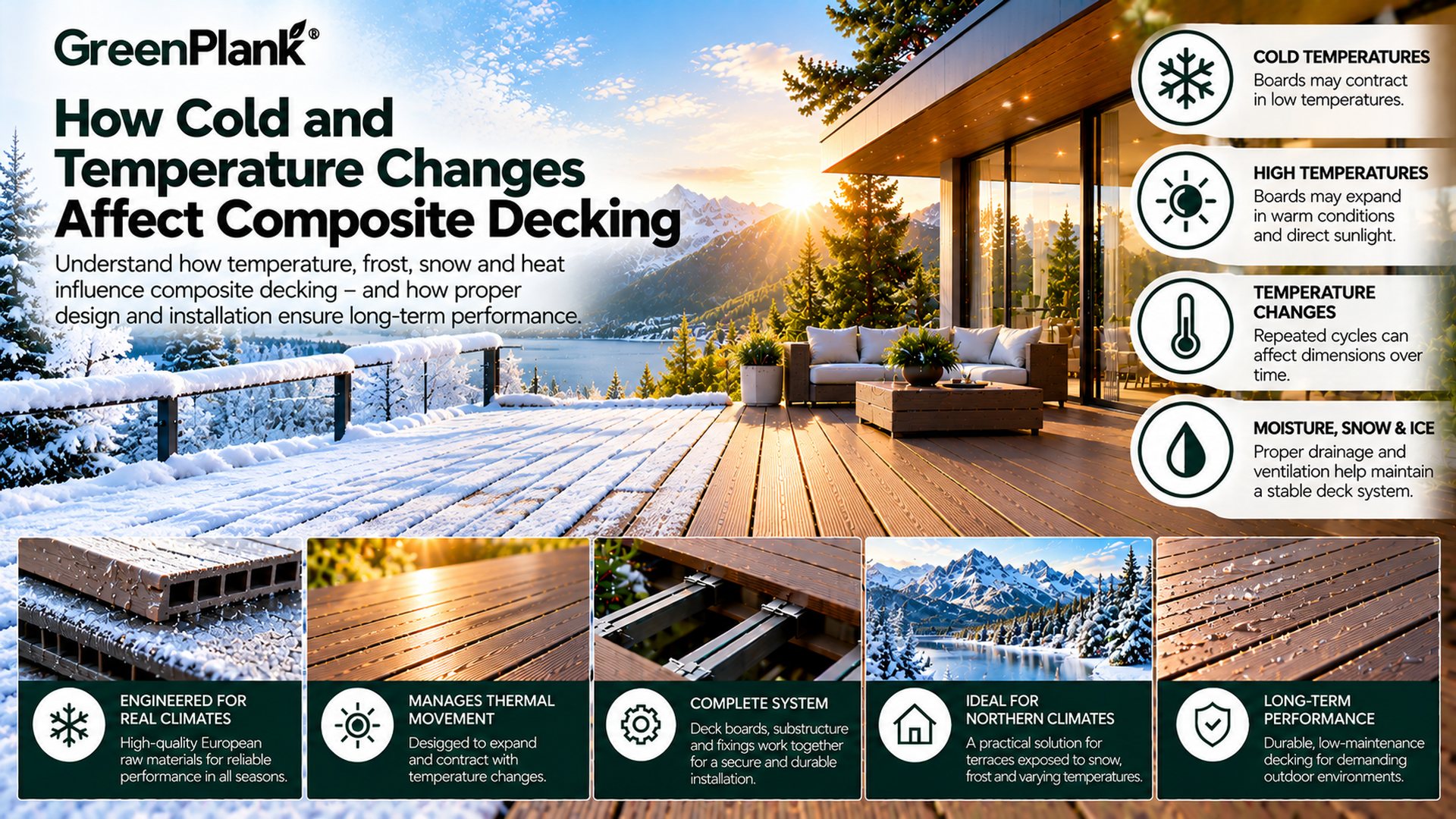
A deck in Northern Europe can experience very different conditions throughout the year: warm summer sunshine, cold nights, heavy rain, snow, frost and repeated temperature changes. For composite decking, understanding how the material responds to temperature is an important part of designing and installing a reliable outdoor system.
WPC, or Wood Plastic Composite, combines wood or natural fibres with a thermoplastic polymer and functional additives. This creates a material with different characteristics from both natural timber and pure plastic. Like other construction materials, WPC changes dimension as temperatures change, but the amount of movement depends on factors such as formulation, profile geometry, board length and temperature range.
The key principle: there is no single universal expansion gap suitable for every composite decking board. Always follow the current installation instructions for the specific product, profile, board length and installation conditions.
What Happens to WPC When Temperature Changes?
Materials expand and contract as their temperature changes. Because WPC contains a thermoplastic component, temperature-related dimensional movement needs to be considered when designing a deck. Wood fibres influence the behaviour of the composite as well, so the finished material should be assessed as a complete engineered formulation.
A board installed during a warm summer afternoon may therefore have different dimensions from the same board during a cold winter period. Longitudinal movement is particularly relevant when planning decking layouts, and the total dimensional change becomes more important as board length increases.
| Condition | Possible Effect | What to Consider |
|---|---|---|
| Cold temperatures | Boards may contract | End gaps and fixing system |
| High temperatures | Boards may expand | Space for thermal movement |
| Long boards | Greater total dimensional change | Product-specific installation requirements |
| Direct sunlight | Board surface may become warmer than ambient air | Material temperature during installation |
| Snow, ice and moisture | Additional demands on the deck system | Drainage, ventilation and substructure |
Cold Is Only Part of a Nordic Climate
The lowest winter temperature is not the only consideration for decking in a Nordic or northern European climate. The combination of cold, heat, moisture, precipitation, snow, ice and repeated temperature cycles makes correct system design particularly important.
A deck may be cold early in the morning and considerably warmer after several hours of direct sunlight. Coastal environments can add frequent rain, moisture and changing weather. For this reason, the decking boards, substructure, clips, screws, drainage and ventilation should be considered as one complete system.
Five Conditions to Consider
- Expected temperature range throughout the year
- Temperature of the boards during installation
- Board length and profile construction
- Drainage and ventilation beneath the deck
- Clearance from walls, borders and other fixed structures
How Much Does Composite Decking Expand?
Using one fixed expansion value for every WPC product can be misleading. Thermal movement depends on the material formulation and profile construction. A solid profile may behave differently from a hollow profile, while different combinations of wood fibre, HDPE and additives can also influence dimensional behaviour.
Board length matters too. Even when movement per metre is relatively small, the accumulated dimensional change becomes greater on a longer board. Professional installation should therefore combine technical product information with the manufacturer's current installation instructions rather than copying a gap from another brand or profile.
A Better Way to Plan Expansion Gaps
Instead of asking how many millimetres of expansion gap every WPC board requires, ask: Which profile is being installed? How long is the board? What is its temperature during installation? What temperature range can be expected at the site? What does the product-specific installation guide require?
Fixings Must Allow the System to Work Correctly
A composite decking system needs to accommodate normal dimensional movement without being fixed in a way that conflicts with the design of the product. Clips, start and end fixings, screws and other components should therefore be compatible with the selected decking profile.
Incorrect fixing can restrict intended movement or create unwanted stresses. At the same time, boards need secure support. This is why decking boards and their fixing components should be evaluated as a complete system rather than as separate products.
The Substructure Matters as Much as the Decking
A well-designed deck begins beneath the visible surface. Joist spacing and support requirements should match the specific profile and intended use. Requirements can differ between residential terraces, commercial areas and layouts where boards are installed diagonally.
The substructure must also support effective drainage and ventilation. Water should be able to leave the construction, while leaves, soil and debris should not be allowed to obstruct airflow beneath the boards.
Installation Checklist for Changing Temperatures
- Read the installation guide: use requirements for the exact decking profile.
- Check the base: provide a stable foundation and suitable drainage conditions.
- Plan water management: avoid areas where water can remain trapped.
- Verify joist spacing: match it to the profile and application.
- Plan for thermal movement: consider board length and installation temperature.
- Use compatible fixings: clips and screws should belong to the intended system.
- Maintain ventilation: preserve sufficient airflow beneath the decking.
Moisture, Frost and Drainage
Temperature and moisture should not be considered independently. If rainwater or melting snow cannot drain effectively, moisture can remain around the deck structure. During freezing conditions, that water can turn to ice and create additional challenges around the decking and substructure.
Appropriate slope, unobstructed drainage paths and ventilation are therefore important design principles. The area beneath and around the deck should also be kept clear of leaves and debris that could restrict drainage.
A cold-climate deck is a complete construction system. Profile design, substructure, fixings, thermal movement, drainage and ventilation all need to work together.
Solid, Hollow or Co-Extruded Composite Decking?
Profile construction influences weight, material use, structural design and suitable applications. However, profile type alone does not determine how a board will respond under every temperature condition. The complete formulation, geometry and technical specifications need to be considered together.
| Profile Type | Typical Characteristic | Important Design Consideration |
|---|---|---|
| Solid | Full material cross-section | Weight, support and board length |
| Hollow | Optimised material use and weight | Profile geometry and joist spacing |
| Co-extruded | Composite core with a separate surface layer | Complete profile construction and installation requirements |
Green Plank Decking for Northern European Projects
Green Plank is a Swedish brand with WPC production in Klaipėda, Lithuania. Its material strategy uses 100% European raw materials with 100% traceability. The decking portfolio includes TerraTuff™, Nordeka™, Classic™ and Sapphire™ profiles designed for different project requirements.
For projects exposed to significant seasonal temperature changes, the profile should be selected according to the intended application and installed according to its current technical documentation. Selected TerraTuff™ products are offered with residential warranties of up to 50 years, depending on the product and applicable warranty terms. Commercial applications should be assessed according to their specific product and warranty conditions.
Common Mistakes in Cold and Changing Temperatures
- Using the same expansion gap for every composite profile
- Ignoring board temperature during installation
- Installing long boards without checking product-specific requirements
- Restricting intended movement with unsuitable fixings
- Using excessive joist spacing
- Overlooking drainage and ventilation
- Copying installation values from another manufacturer or profile
Cold-Weather Maintenance
Seasonal maintenance is generally straightforward, but winter conditions deserve attention. Keep drainage paths clear and remove accumulated leaves or debris. When removing snow or ice, follow the manufacturer's care instructions and avoid tools or treatments that could unnecessarily damage the board surface.
Spring is also a useful time to inspect the complete terrace. Check that drainage remains open, fixings are in place and no surrounding construction has been altered in a way that prevents ventilation or natural movement.
Conclusion: Design for Temperature, Not Against It
Cold and temperature changes are normal parts of outdoor life in northern climates. The objective is not to find a material that never moves, but to choose a documented decking system and design the terrace so that normal material movement can be accommodated correctly.
With the appropriate profile, stable substructure, compatible fixings, effective drainage, good ventilation and product-specific installation clearances, WPC decking can provide a practical solution for demanding outdoor projects.
Explore composite decking systems and technical information at Green Plank.
Sources
- Green Plank – product and installation information
- USDA Forest Products Laboratory – Wood/Nonwood Thermoplastic Composites
- USDA Forest Products Laboratory – Wood-Plastic Composite Research
Specify the product
Use this guide with a Green Plank specification
Technical articles support the commercial catalogue — category, product, evidence, then samples or quotes.