



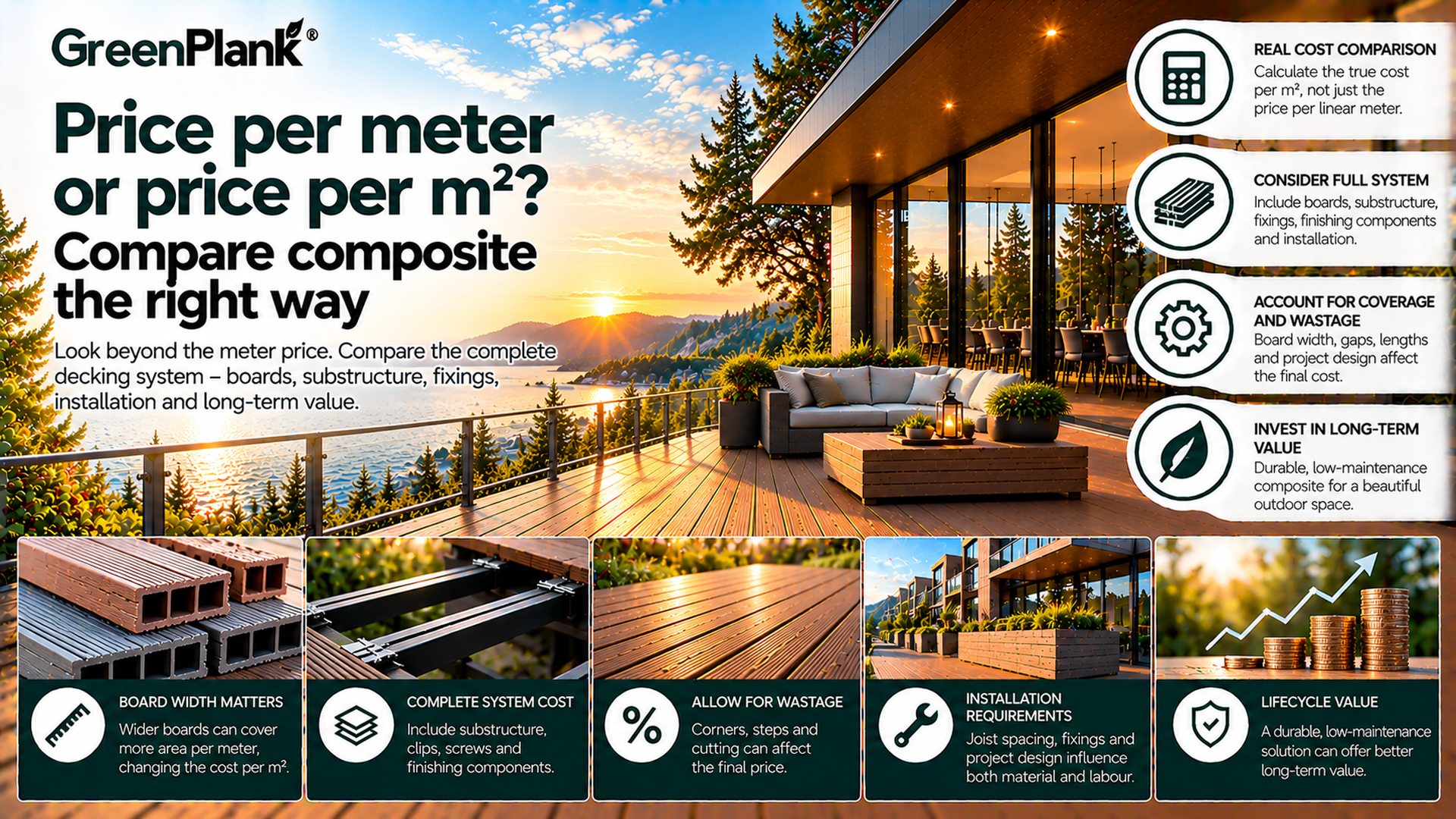
Price per meter or price per m²? Compare composite the right way
When comparing composite decking, the price per linear meter is often the first figure buyers see. It is simple and familiar, but it does not necessarily reveal which decking solution offers the lowest cost for a finished square metre.
Board width, installation gap, profile design, available lengths, wastage, substructure, clips, screws, transport and installation can all change the final project cost. Whether you are a homeowner, architect, contractor, distributor or professional buyer, the most useful comparison starts by converting competing products to the same installed area.
The key principle: Do not compare composite decking on price per linear meter alone. First calculate material consumption per m², then compare the complete decking system required for the project.
Why can price per meter be misleading?
A linear-meter price tells you the cost of one meter of a particular board. It does not tell you how much deck area that meter covers. A wider board can cover more area per linear meter than a narrower board, so two products can change position when their prices are converted to cost per m².
The effective installed coverage is therefore important. This normally considers the board width together with the relevant installation gap specified for the system.
| Price measure | What it tells you | What is still missing? |
|---|---|---|
| Price per linear meter | Cost of one meter of decking board | Area coverage and system components |
| Board price per m² | Approximate board cost for one square metre | Substructure, fixings and installation |
| System price per m² | Material cost of the complete decking build-up | Labour and project-specific conditions |
| Finished project cost | Total cost for the actual installation | Long-term costs over the chosen period |
How to convert price per meter into price per m²
A useful first calculation is based on effective coverage width. Suppose a decking board is 150 mm wide and, purely for this example, the installed system uses a 5 mm gap. Each board then occupies approximately 155 mm of deck width.
The theoretical board requirement is:
1 ÷ 0.155 m = approximately 6.45 linear meters per m².
If the board costs €10 per linear meter, the theoretical board cost becomes:
6.45 LM × €10 = approximately €64.50 per m².
This is an illustrative calculation, not a quotation or installation instruction. Actual requirements depend on the specific board, prescribed spacing, deck geometry and installation conditions.
A simple calculation
Linear meters per m² = 1 ÷ effective coverage width in meters.
Board cost per m² = linear meters per m² × price per linear meter.
Then add realistic wastage, substructure, fixings, finishing components, transport and installation where applicable.
Board width can change the comparison
Composite decking profiles are available in different widths. This means direct comparisons of linear-meter prices can be misleading unless each offer is first converted to the same installed area.
| Example board width | Example with 5 mm gap | Approx. LM per m² |
|---|---|---|
| 140 mm | 145 mm effective width | 6.90 LM |
| 146 mm | 151 mm effective width | 6.62 LM |
| 150 mm | 155 mm effective width | 6.45 LM |
The figures illustrate the calculation principle only. The correct spacing must always follow the installation instructions for the specific product and the relevant installation conditions.
Profile construction matters too
Cost per m² should not be separated from product construction. WPC decking is available in different profile types, and each may be designed for different applications, installation systems and project requirements.
- Hollow profiles: use an internal chamber structure and can provide an efficient solution for many residential applications.
- Solid profiles: use a different construction and may be selected where the application or system specification calls for this profile type.
- Co-extruded profiles: incorporate an additional outer layer around the core and should be evaluated as a distinct product construction.
A meaningful price comparison should therefore compare products capable of meeting the same project requirements rather than simply selecting the lowest advertised price.
Compare the complete decking system
The boards are only one part of a composite deck. Substructure, clips, screws, starter and finishing components, trims and other accessories can materially affect the final system cost.
| Cost element | What to include |
|---|---|
| Decking boards | Required linear meters plus realistic wastage |
| Substructure | Joists, supports and required spacing |
| Fixings | Clips, screws and start/end components |
| Finishing | Edge profiles and relevant finishing details |
| Logistics | Transport, packaging and handling |
| Installation | Labour and project complexity |
Board lengths and wastage affect the final cost
A theoretical square-meter calculation assumes efficient use of material. Real projects include corners, steps, posts, edges and other details that can create offcuts.
Available board lengths can therefore influence material efficiency. Matching board lengths to the dimensions and layout of the deck may reduce unnecessary cutting in some projects, while diagonal or more complex laying patterns can increase material consumption.
When comparing quotations, ask how much wastage has been included and why. A slightly higher board price with a more efficient cutting plan may produce a different final result from a lower-priced board with greater wastage.
Installation requirements also influence price
Two decking boards with similar purchase prices may require different substructure arrangements or quantities of fixing components. This affects both material consumption and installation time.
Before comparing the final price, check:
- maximum joist spacing for the intended application
- support requirements at board ends and joints
- number and type of clips and screws required
- drainage and ventilation requirements
- product-specific allowance for thermal movement
- clearances around walls and other fixed structures
There is no single universal expansion gap or joist spacing suitable for every WPC profile. Always follow the current installation instructions for the specific decking system.
How to compare two composite decking quotations
The fairest approach is to give each supplier the same project information and request comparable quantities and system components.
- Define the total deck area and dimensions.
- State whether the project is residential, commercial or another application.
- Request the board quantity and board cost per m².
- Request the required substructure quantity separately.
- Include clips, screws and finishing components.
- Check assumed wastage and proposed board lengths.
- Add freight, packaging and handling where applicable.
- Compare installation requirements, documentation and warranty terms.
Example: Quote A may offer the lowest price per linear meter, while Quote B requires fewer linear meters per m² or uses a different complete system. Only after both quotations are converted to the same finished area can the price comparison become meaningful.
Price per m² versus lifecycle cost
For professional projects, the analysis can go beyond the initial purchase price. ISO 15686-5 describes principles for life-cycle costing in the built environment. Depending on the purpose of the assessment, this can include acquisition, installation, planned maintenance, repair, replacement and other relevant costs over a defined analysis period.
Lifecycle costing does not mean that one material will automatically be the least expensive. The result depends on the project assumptions, analysis period, maintenance requirements and costs included in the calculation.
Green Plank: compare the product and the complete system
Green Plank is a Swedish brand with WPC production in Klaipėda, Lithuania. The material strategy is based on 100% European raw materials and 100% traceability. The portfolio includes composite solutions for decking, cladding and fencing.
Decking families include TerraTuff™, Nordeka™, Classic™ and Sapphire™, with different profile constructions and product characteristics. When comparing these or competing products, buyers should consider profile type, dimensions, effective coverage, accessories, installation requirements and warranty conditions together with price.
Selected TerraTuff™ products are offered with residential warranties of up to 50 years, depending on the specific product and applicable warranty terms. Warranty conditions for professional and commercial applications should be checked separately.
A practical checklist before choosing
- What is the effective installed coverage of the board?
- How many linear meters are required per m²?
- How much wastage is included?
- What substructure is required?
- How many clips and screws are needed?
- Are edge and finishing components included?
- What are the freight and handling costs?
- What installation requirements apply?
- What documentation and warranty are provided?
- What is the final system cost per m²?
Conclusion: Calculate the cost of the finished deck
Price per linear meter is useful product information, but it rarely tells the complete financial story. Start by converting the board price to cost per m², then add the components required to create the complete decking system.
Board width, wastage, lengths, substructure, fixings, installation and logistics can all change the final calculation. For larger or professional projects, lifecycle costing can provide an additional perspective beyond the initial purchase price.
Explore composite decking and complete European WPC systems at Green Plank.
Sources
- Green Plank – product information
- ISO 15686-5 – Buildings and constructed assets – Life-cycle costing
- USDA Forest Products Laboratory – Wood/Nonwood Thermoplastic Composites
Specify the product
Use this guide with a Green Plank specification
Technical articles support the commercial catalogue — category, product, evidence, then samples or quotes.