



How to compare prices for WPC decking – price and quality
Comparing WPC decking prices is not as simple as checking which board has the lowest price per metre. One supplier may quote per linear metre, another per square metre, while another offer may include clips, substructure components or accessories. Boards that look similar can also differ in width, profile construction, materials and installation requirements.
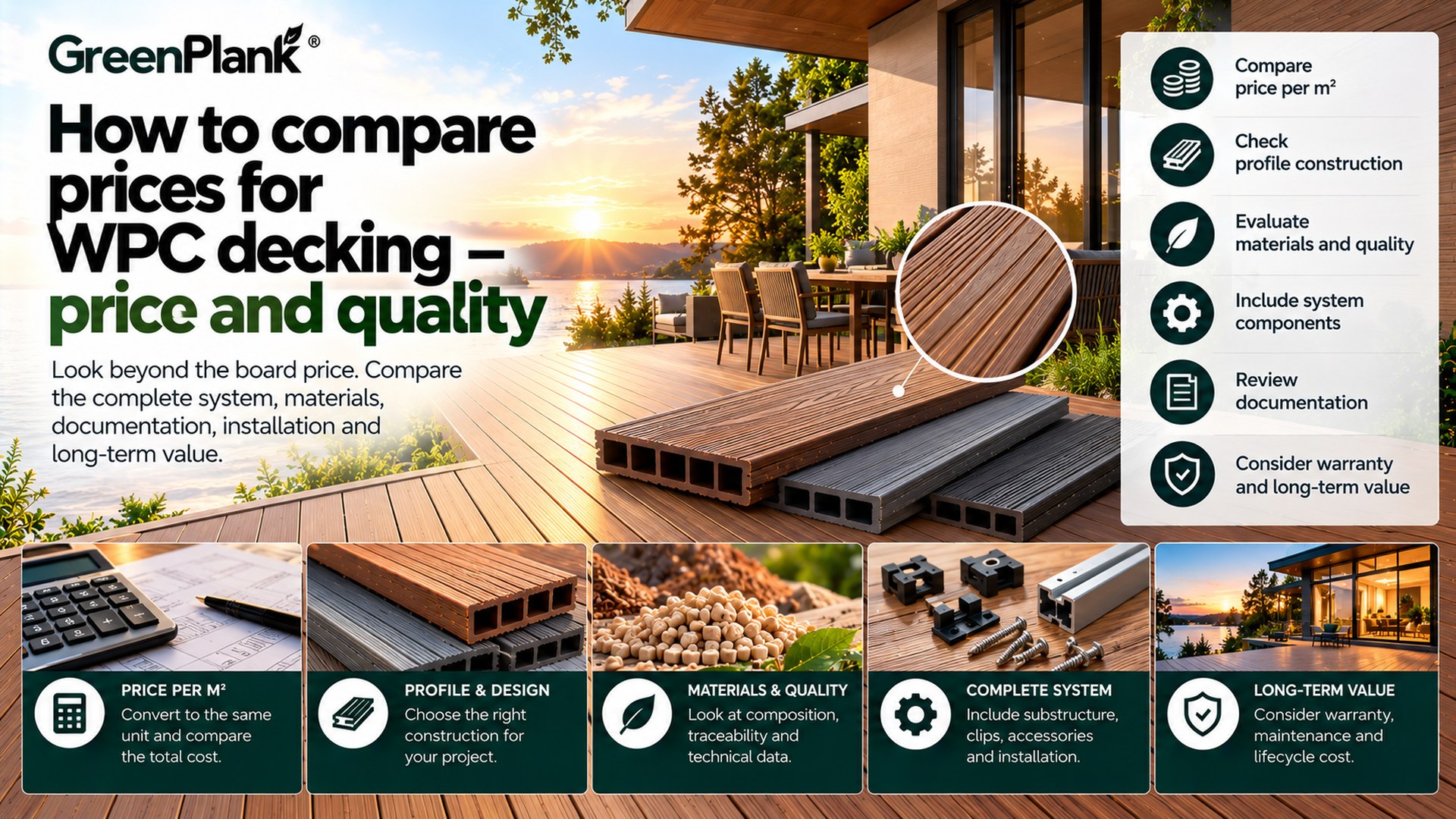
A useful comparison therefore starts by converting quotations to the same unit and then looking beyond the board price. Profile design, material composition, complete system cost, installation requirements, documentation and warranty conditions can all influence the value of a decking system.
The key principle: Do not compare only the price of the decking board. Compare the cost and specification of the complete system per finished square metre.
1. Convert the price to cost per m²
Price per linear metre is easy to understand, but it does not show how many metres of decking are required to cover one square metre. The effective coverage width of the board is therefore important.
A simple calculation is:
Linear metres per m² = 1 ÷ effective coverage width in metres.
For example, consider a 150 mm board installed with an illustrative 5 mm gap. The effective module width becomes 155 mm, or 0.155 m. One square metre would therefore require approximately 6.45 linear metres. At an illustrative board price of €10 per linear metre, the board-only cost would be approximately €64.50 per m².
This is a calculation example only, not a Green Plank price or universal installation specification. Required gaps and installation dimensions should always follow the instructions for the specific product.
| Board width | Example gap | Effective width | Approx. LM per m² |
|---|---|---|---|
| 140 mm | 5 mm | 145 mm | 6.90 LM |
| 146 mm | 5 mm | 151 mm | 6.62 LM |
| 150 mm | 5 mm | 155 mm | 6.45 LM |
2. Compare the profile construction
Two WPC decking boards with similar dimensions and colours can have very different constructions. Profile design can influence material use, weight, fastening, support requirements and suitability for different applications.
| Profile type | What should you evaluate? |
|---|---|
| Solid profile | Weight, construction, intended use and substructure requirements |
| Hollow profile | Chamber design, wall construction, support and end finishing |
| Co-extruded profile | Core material, surface layer, technical data and warranty terms |
No profile type should automatically be considered superior in every application. The better choice is the system that is technically suitable for the project and installed according to the manufacturer's requirements.
3. Look beneath the surface: compare the materials
WPC combines wood-based material with a thermoplastic polymer and other formulation components. The exact composition varies between manufacturers and product ranges. As a result, two boards with similar colours and wood-grain surfaces may not have the same material structure.
Professional buyers can ask suppliers about:
- the type and origin of wood or natural fibres
- the polymer used in the formulation
- raw-material traceability
- profile and surface construction
- relevant technical product data
- product and batch identification
Geographic origin alone does not prove technical quality. Clear specifications and traceability are more useful because they give buyers information that can be reviewed and compared.
4. Calculate the complete decking system price
Decking boards are only one component of a finished terrace. A meaningful WPC price comparison should include the materials required by the complete system.
- decking boards
- substructure or joists
- clips and screws
- starter and finishing components
- edge or fascia profiles where required
- realistic cutting waste
- transport and handling
- installation when included in the quotation
Why price per metre can be misleading
A wider board may require fewer linear metres per m² than a narrower board. At the same time, waste, accessories and installation requirements can change the final cost. Compare each quotation using the same finished deck area and equivalent scope.
5. Check substructure and installation requirements
Joist spacing, ventilation, drainage, fixing systems and expansion allowances affect both material requirements and installation. WPC responds to temperature changes, while the degree of movement depends on factors such as formulation, profile construction, board length and temperature conditions.
There is therefore no single expansion gap or installation spacing that should be applied to every WPC product. The product-specific installation instructions should determine the correct design.
6. Documentation belongs in the quality comparison
A professional quotation should clearly identify the product being supplied. Technical data, installation instructions, warranty information and relevant product documentation make competing systems easier to assess on a consistent basis.
For construction products placed on the EU market, specific regulatory requirements depend on the product category and intended use. The EU Construction Products Regulation forms part of the regulatory framework for construction products.
Useful documentation to request can include:
- product identification and dimensions
- technical data relevant to the intended application
- installation and maintenance instructions
- information about compatible system components
- warranty terms and exclusions
- applicable product documentation for the target market
7. Compare warranties on the same basis
A large warranty number does not tell the complete story. Buyers should check which product, application and conditions the warranty actually covers. Residential and professional or commercial applications may have different terms.
Check the warranty duration for the exact product, installation requirements, exclusions, permitted applications and the procedure for making a claim. A warranty should be evaluated together with technical suitability rather than used as the only measure of quality.
8. Consider price today and cost over time
For larger projects, lifecycle costing can provide a broader financial perspective than initial purchase price alone. ISO 15686-5 sets out principles for life-cycle costing in the built environment. Depending on the scope of the analysis, acquisition, installation, planned maintenance, repair and replacement can be considered over a defined period.
A higher purchase price does not automatically mean better lifecycle value, just as the lowest initial price does not automatically mean the lowest long-term cost. The calculation needs realistic assumptions for the actual project.
A useful comparison formula: Boards + substructure + fixings + accessories + waste + logistics + installation + relevant lifecycle costs provide a stronger basis for comparison than board price alone.
How to compare two WPC decking quotations
- Use exactly the same deck area for both quotations.
- Convert the board price into cost per m².
- Check board width, profile type and construction.
- Add realistic cutting and installation waste.
- Include substructure, clips, screws and finishing components.
- Compare installation requirements and material quantities.
- Review technical data and product documentation.
- Read the warranty terms for the intended application.
- Add transport and relevant logistics costs.
- Compare the complete system cost per finished m².
Green Plank: European WPC with traceable materials
Green Plank is a Swedish brand with WPC production in Klaipėda, Lithuania. Its material strategy is based on 100% European raw materials and 100% traceability, giving professional buyers a clear basis for evaluating material origin and the supply chain.
The decking portfolio includes TerraTuff™, Nordeka™, Classic™ and Sapphire™, alongside composite solutions for cladding and fencing. Because the ranges use different profile constructions, products should be selected according to the intended application, complete system design and technical requirements rather than price alone.
Selected TerraTuff™ products are offered with residential warranties of up to 50 years, depending on the specific product and applicable warranty conditions. Warranty terms for professional and commercial applications should be reviewed separately.
Price and quality: what should matter most?
Quality is not determined by one specification. A useful WPC comparison considers materials, profile construction, technical information, installation system, documentation, warranty and suitability for the project together.
Likewise, price becomes meaningful only when the scope is clear. Two quotations that show the same price per metre may result in different costs per m², while two boards with different initial prices may become much closer once complete system requirements are included.
Conclusion: Compare value, not just the price tag
The best way to compare WPC decking prices is to establish a common technical and financial basis. Start with the cost per finished square metre, then examine profile construction, materials, system components, installation, documentation, warranty and relevant long-term costs.
Once quotations are compared on the same basis, it becomes much easier to distinguish between a low board price and a competitive complete decking solution.
Explore WPC decking systems and European composite solutions at Green Plank.
Sources
- Green Plank – product and system information
- ISO 15686-5 – Buildings and constructed assets – Life-cycle costing
- European Commission – Construction Products Regulation
Specify the product
Use this guide with a Green Plank specification
Technical articles support the commercial catalogue — category, product, evidence, then samples or quotes.