



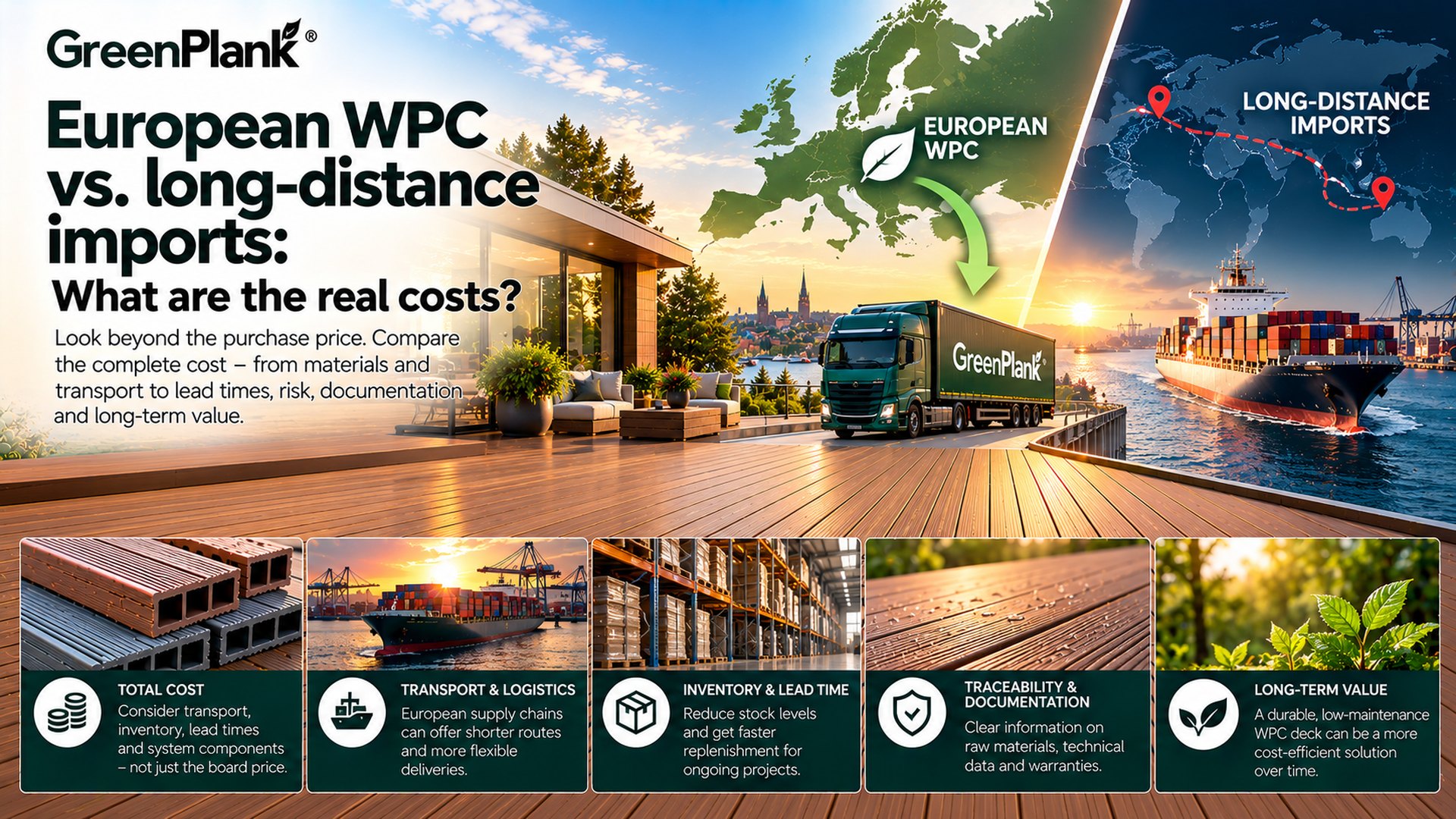
European WPC vs. long-distance imports: What are the real costs?
When sourcing WPC decking for distribution, retail or a professional project, the factory price is only one part of the commercial equation. An attractive price per linear meter can look very different once freight, inventory, minimum order quantities, lead times, documentation, replacement deliveries and supply-chain risk are considered.
This does not mean that European WPC is automatically better than a product manufactured elsewhere. Quality should be assessed through raw materials, profile construction, technical data, documentation, installation requirements and suitability for the intended application. Geography matters mainly because the structure and distance of the supply chain can influence cost, flexibility and risk.
The better question is not simply: What does the board cost? Ask what it costs to obtain the correct product, in the required quantity, with the necessary documentation, at the right place and time.
Purchase price is not the same as total cost
Professional buyers should compare European WPC and long-distance imports on an equivalent basis. For distributors, building merchants, contractors and developers, working capital, inventory and replenishment can be as relevant as the initial board price.
| Cost factor | What should be evaluated? |
|---|---|
| Product price | Price per LM or m² for genuinely comparable profiles |
| Freight | International transport, terminals, local delivery and handling |
| Inventory | Capital tied up, storage space and safety stock |
| Lead time | Time between ordering and usable stock arriving |
| Minimum order | Quantity required per profile, colour or shipment |
| Documentation | Product data, traceability and relevant technical information |
| Replenishment | Ability to obtain additional material for an existing project |
| Claims | Communication, response time and replacement procedure |
Look beyond freight distance
Transport distance alone does not establish the environmental footprint of a product. A credible carbon comparison requires defined boundaries, relevant data and an appropriate assessment methodology. It is therefore more useful for buyers to focus first on logistics factors that can be directly evaluated.
Long-distance sourcing may require earlier purchasing decisions, larger consolidated shipments or higher inventory. A European supply chain may, depending on the supplier and destination, provide a shorter physical supply route and greater flexibility for replenishment. These advantages should be verified for the actual supplier rather than assumed from geography alone.
Think in terms of the complete supply chain
Evaluate freight together with production lead time, order quantity, inventory requirement, local distribution and replenishment. This produces a more useful commercial picture than comparing factory prices or kilometres alone.
Inventory and working capital are real costs
For a distributor or building-material retailer, stock represents capital. If a sourcing model requires container-scale purchases across multiple colours, profiles and lengths, substantial working capital can remain tied up before those products are sold.
Useful questions include:
- What is the minimum order quantity per colour and profile?
- Can different products or lengths be combined in an order?
- How many colours need to be held locally?
- What quantities are required to maintain safety stock?
- How quickly can popular products be replenished?
- What happens to slow-moving colours or profiles?
- How much warehouse space does the range require?
A lower factory price should therefore be considered together with the capital and storage capacity required to support the purchasing model.
Lead time can affect project economics
For project business, delivery reliability is important because a relatively small shortage can prevent completion. Missing boards, clips or finishing components may require an additional delivery and affect the installation schedule.
Buyers should therefore evaluate not only the initial shipment but also the ability to obtain the same profile, colour, length and compatible accessories later.
| Supply question | Why it matters |
|---|---|
| Is the product stocked? | Can influence when the project can start |
| Can smaller quantities be reordered? | Helps manage shortages and additional work |
| Will the same profile remain available? | Important for extensions and replacement orders |
| Are accessories available with the boards? | Simplifies system purchasing and installation planning |
Traceability and documentation have commercial value
For professional procurement, traceability helps buyers understand where materials and products originate and how they relate to technical documentation. Traceability alone is neither proof of environmental performance nor a guarantee of product quality, but it can improve supply-chain transparency and product identification.
A structured WPC assessment can include:
- manufacturer and product identification
- raw-material information where relevant
- technical product data
- installation instructions
- maintenance information
- warranty scope and exclusions
- documentation relevant to the intended application and market
For construction products marketed in the EU, applicable documentation requirements depend on the product category, intended use and regulatory framework. The EU Construction Products Regulation provides an important framework for construction products placed on the European market.
Country of origin does not determine quality
A professional comparison should avoid assuming that European origin automatically means higher quality or that imported WPC is inherently inferior. Products from any region should be evaluated using measurable and verifiable criteria.
Compare raw materials, profile construction, dimensions, relevant technical properties, fastening system, substructure requirements, thermal movement, documentation and warranty terms. For substantial orders, physical samples can also help buyers assess surface appearance, colour and profile design before committing.
Compare complete systems, not individual boards
A WPC deck consists of more than decking boards. Substructure, clips, screws, starter components, finishing profiles and installation requirements all contribute to the final cost.
An inexpensive linear-meter price can therefore produce a different result when converted into the cost of a finished square metre. Board width, installation spacing, waste and the quantity of system components all matter.
- Calculate the board requirement per m².
- Add realistic waste for the project geometry.
- Calculate the required substructure.
- Include clips, screws and finishing components.
- Add freight, handling and relevant inventory costs.
- Consider lead time and safety-stock requirements.
- Review technical documentation and warranty conditions.
- Compare the resulting complete system cost.
A useful sourcing comparison: Factory price + logistics + inventory + complete system components + project risk provides a more meaningful commercial picture than board price alone.
What about lifecycle cost?
For professional projects, lifecycle costing can broaden the financial analysis beyond initial acquisition. ISO 15686-5 provides principles for life-cycle costing within the built environment. Depending on the scope, an assessment may consider acquisition, installation, planned maintenance, repair, replacement and other relevant costs over a defined analysis period.
Lifecycle costing should use realistic project assumptions. Neither European production nor long-distance sourcing automatically determines which product has the lowest lifecycle cost.
Green Plank and a European WPC supply chain
Green Plank is a Swedish brand with WPC production in Klaipėda, Lithuania. Its material strategy is based on 100% European raw materials and 100% traceability, providing professional buyers with a clear basis for reviewing raw-material origin and the supply chain.
The decking portfolio includes TerraTuff™, Nordeka™, Classic™ and Sapphire™ product families, alongside composite solutions for cladding and fencing. Different profile constructions serve different requirements, so selection should be based on application, complete system design and technical suitability rather than price alone.
Selected TerraTuff™ products are offered with residential warranties of up to 50 years, depending on the specific product and applicable warranty conditions. Warranty terms for professional and commercial applications should be reviewed separately.
A 10-point checklist for WPC buyers
- Where is the product manufactured?
- Can the origin of the raw materials be traced?
- What is the complete system cost per finished m²?
- What substructure and fastening system are required?
- What minimum order quantities apply?
- What are the normal lead and replenishment times?
- How much inventory must the buyer hold?
- Which technical documents are supplied?
- Which warranty applies to the intended use?
- How are additional orders and claims handled?
Conclusion: Compare the total commercial cost
European WPC and long-distance imports should be compared on more than factory price. Freight, minimum orders, working capital, inventory, lead times, replenishment, documentation, complete system requirements and long-term project economics can all influence the real cost.
The strongest purchasing decision is therefore based on documented technical, logistical and commercial requirements. For professional buyers, a structured total-cost comparison provides a more useful basis for sourcing than the price of the decking board alone.
Explore European WPC systems and product information at Green Plank.
Sources
- Green Plank – product and system information
- European Commission – Construction Products Regulation
- ISO 15686-5 – Buildings and constructed assets – Life-cycle costing
Specify the product
Use this guide with a Green Plank specification
Technical articles support the commercial catalogue — category, product, evidence, then samples or quotes.