



Traceable WPC: Why Documentation Is Important for Global Buyers
For distributors, building-material merchants, architects, contractors and international procurement teams, selecting WPC is about much more than colour, surface texture and price. Professional buyers increasingly need to understand what they are purchasing, where the materials originate, where the product is manufactured and what technical information supports its use.
WPC, or Wood Plastic Composite, combines wood or other natural fibres with a thermoplastic polymer and functional additives. Because formulations, profile designs and manufacturing processes can differ considerably, two products that look similar may not represent the same technical or commercial proposition.
This is where traceability and documentation become valuable. They create a clearer connection between raw materials, manufacturing, product identification, installation requirements and the finished WPC system.
For professional procurement, the key question is not simply “Where was this product made?” Buyers should also ask what it is made from, whether its materials can be traced, how the product is identified and what documentation supports its intended application.
What Does Traceable WPC Mean?
Traceability is the ability to follow relevant information through a product’s supply and manufacturing chain. For WPC products, this can include the origin and type of wood fibre, polymer and additives, together with manufacturing and product identification information.
A practical traceability framework may cover:
- origin and type of wood or natural fibre
- type and source of polymer materials
- manufacturing location and product identification
- technical information for the specific profile
- installation instructions and compatible components
- warranty terms for the intended application
Traceability should not be confused with technical performance. Knowing where a material originates improves supply-chain visibility, but product performance must still be evaluated through appropriate specifications, testing, quality control and project requirements.
Why Documentation Matters to Global Buyers
International buyers often compare products manufactured in different regions and offered through different distribution structures. Clear documentation helps create a common basis for evaluation and reduces reliance on marketing descriptions alone.
| Information | What it explains | Why buyers need it |
|---|---|---|
| Material information | Composition and raw-material origin | Supports sourcing and product evaluation |
| Product data | Profile, dimensions and specifications | Helps compare equivalent products |
| Installation guide | Substructure, fixing and spacing requirements | Supports correct project planning |
| System information | Compatible clips, screws and accessories | Clarifies the complete solution |
| Warranty | Coverage, duration and exclusions | Shows what applies to the intended use |
| Supply information | Lengths, packaging and availability | Supports purchasing and logistics planning |
From Raw Material to Finished Composite Product
A WPC specification should ideally provide more information than a generic percentage of wood and polymer. Professional buyers benefit from understanding the type and origin of key materials, the manufacturing location and how individual product ranges are identified.
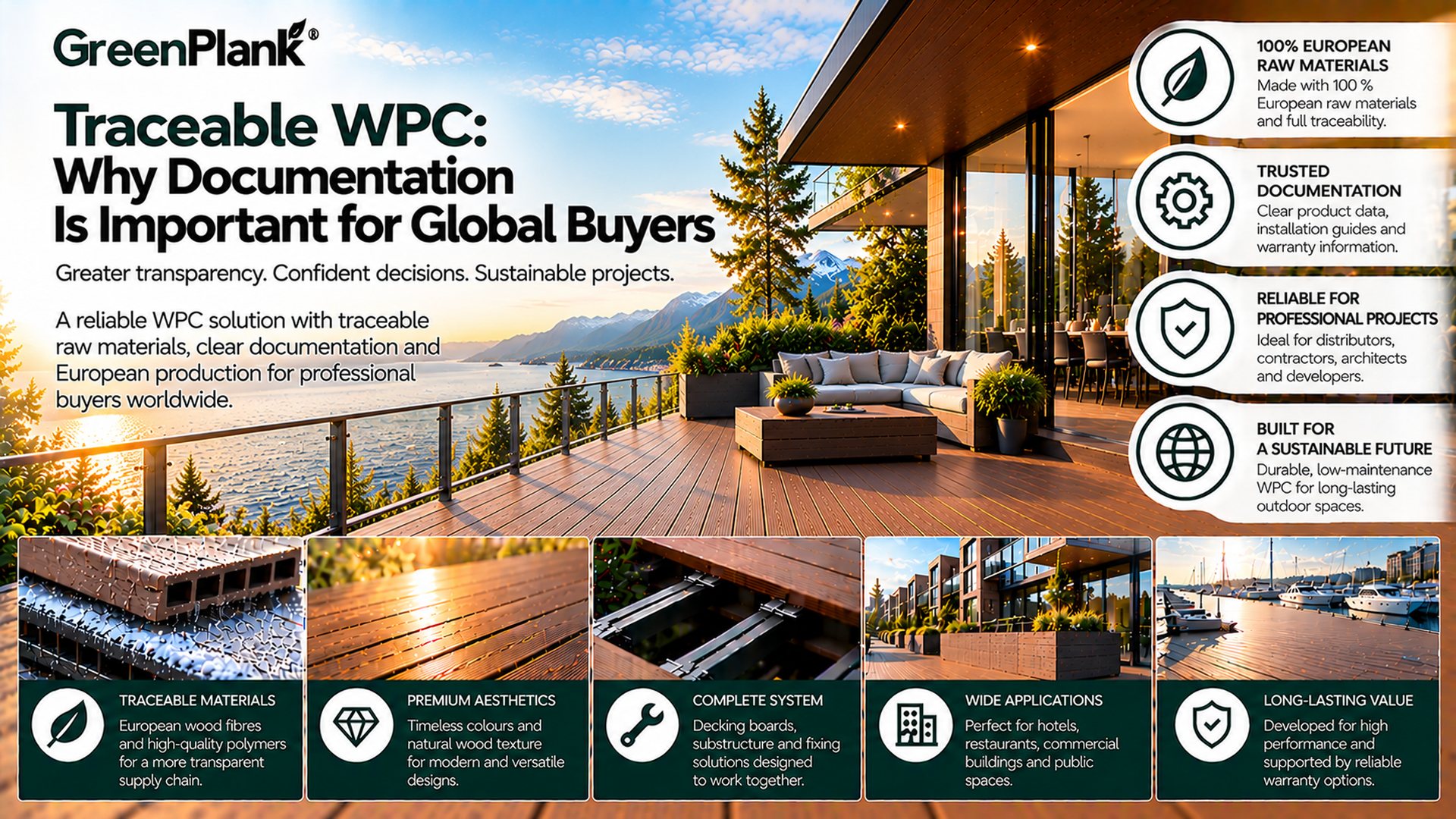
Green Plank is a Swedish brand with WPC production in Klaipėda, Lithuania. Its material strategy is based on 100% European raw materials and 100% traceability. Selected formulations use a high proportion of European wood fibre, including beech and oak, combined with HDPE and functional additives.
European origin alone, however, should not be presented as proof of superior technical quality. Origin, traceability, product specifications, manufacturing controls, installation requirements and suitability for the intended application should be considered together.
Traceability Is Not the Same as a Sustainability Claim
A traceable supply chain provides greater visibility into where materials originate and how a product moves through production. Environmental comparisons require appropriate evidence and should not be inferred from geographic origin alone.
Documentation Supports Better Project Specification
Composite decking is a system rather than simply a board. The decking profile, substructure, supports, clips, screws, drainage and ventilation must work together. Documentation helps architects, contractors and installers understand how those elements should be combined.
This is particularly important for thermal movement. WPC materials can expand and contract as temperatures change. The amount of movement depends on factors including formulation, profile geometry, board length and temperature range. A single universal expansion gap should therefore not be applied to every WPC product.
Professional teams should follow the current installation instructions for the exact profile being supplied, including requirements for joist spacing, board-end clearances, fixing systems and ventilation.
What Should Global WPC Buyers Request?
A structured procurement process makes supplier comparisons more meaningful. Before placing a significant order, buyers should request enough information to understand both the product and the complete system.
- Confirm the exact product range and profile.
- Request information about material composition and origin.
- Ask how raw materials and finished products are traced.
- Obtain relevant technical product information.
- Review the current installation instructions.
- Check substructure and support-spacing requirements.
- Confirm compatible clips, screws and accessories.
- Review available board lengths, packaging and lead times.
- Read warranty conditions for the intended application.
- Compare total installed system cost rather than board price alone.
Documentation and Regulatory Requirements
Documentation requirements vary according to market, product and intended use. For products placed on the European market, the EU Construction Products Regulation provides the regulatory framework where products fall within applicable harmonised technical specifications.
Buyers should therefore avoid assuming that every WPC product requires exactly the same declarations, marking or documentation. The appropriate requirements should be assessed for the specific product and intended application.
For buyers outside Europe, local building codes, import requirements and project specifications may introduce additional requirements. European documentation can be useful, but it does not automatically replace compliance obligations in the destination market.
Traceability Can Strengthen Supplier Evaluation
Global sourcing often involves more than comparing samples and FOB prices. Buyers may also need to assess consistency of supply, production location, packaging, lead times, replacement availability and the ability to identify products after delivery.
| Procurement area | Questions to ask |
|---|---|
| Raw materials | What materials are used and where do they originate? |
| Manufacturing | Where is the product manufactured? |
| Product identity | Can the exact profile and production information be identified? |
| Installation | Are product-specific instructions available? |
| Logistics | What lengths, quantities and lead times are available? |
| After-sales | How are warranty and replacement requirements handled? |
Compare Total System Cost, Not Just Board Price
Price per linear metre can be misleading when comparing WPC suppliers. Board width, effective coverage, wastage, substructure, clips, screws, transport and installation all contribute to the finished cost per square metre.
For long-term projects, buyers may also consider life-cycle costs. ISO 15686-5 provides principles for life-cycle costing in the built environment, allowing initial expenditure to be considered alongside planned maintenance, repair, replacement and other relevant costs.
A useful procurement comparison puts competing products on the same basis: equivalent area, complete installation system, relevant accessories, logistics, warranty conditions and expected project requirements.
Green Plank: European Production and Traceable Materials
Green Plank offers WPC systems for decking, cladding and fencing, with different profiles designed for different project requirements. Product families include TerraTuff™, Nordeka™, Classic™ and Sapphire™ decking solutions.
With production in Lithuania and European raw-material sourcing, Green Plank provides global buyers with a European WPC supply option focused on traceability and clearly identifiable product systems.
Selected TerraTuff™ products are offered with residential warranties of up to 50 years, depending on the product and applicable warranty conditions. Professional and commercial applications should always be checked separately against the relevant warranty terms.
European production may also provide a geographically different sourcing option for buyers seeking to diversify supply chains. However, shorter transport distance should not automatically be described as lower carbon impact without an appropriate transport or life-cycle assessment.
A Practical Documentation Checklist
- Product name, profile and dimensions
- Material composition and raw-material origin
- Manufacturing location and traceability information
- Relevant technical product data
- Installation and substructure requirements
- Compatible fixing system and accessories
- Packaging, lengths and logistics information
- Warranty terms for the intended application
- Applicable regulatory or project documentation
- Contact point for technical and after-sales support
Conclusion
For global buyers, traceable WPC is ultimately about making purchasing decisions with better information. Raw-material origin, manufacturing location, technical data, installation requirements, product identification and warranty conditions together create a clearer picture of what is actually being purchased.
Rather than choosing a composite product solely by appearance or unit price, professional buyers can use documentation to compare complete WPC systems on a more consistent basis. This is particularly valuable for distributors, importers, architects, contractors and developers managing repeat orders or multi-market projects.
Learn more about European WPC decking and professional composite solutions at Green Plank.
Sources
- Green Plank – product and company information
- European Commission – Construction Products Regulation
- ISO 15686-5 – Life-Cycle Costing
- USDA Forest Products Laboratory – Wood/Nonwood Thermoplastic Composites
Specify the product
Use this guide with a Green Plank specification
Technical articles support the commercial catalogue — category, product, evidence, then samples or quotes.