



Composite Decking Boards for Professional Projects
Professional decking projects demand more than an attractive surface. Architects, contractors, developers, building merchants and procurement teams need to consider structural design, profile construction, installation requirements, documentation, supply reliability, maintenance and total project cost before specifying a composite decking system.
Wood Plastic Composite, commonly known as WPC, combines wood or natural fibres with a thermoplastic polymer and functional additives. The performance of the finished decking board depends on the complete formulation, manufacturing process and profile geometry. For professional projects, products should therefore be compared using relevant technical information rather than appearance or price per linear metre alone.
Professional specification starts with the complete system. Decking boards, substructure, fixings, installation requirements, drainage, documentation, supply and warranty should be evaluated together.
Where Is Composite Decking Used Professionally?
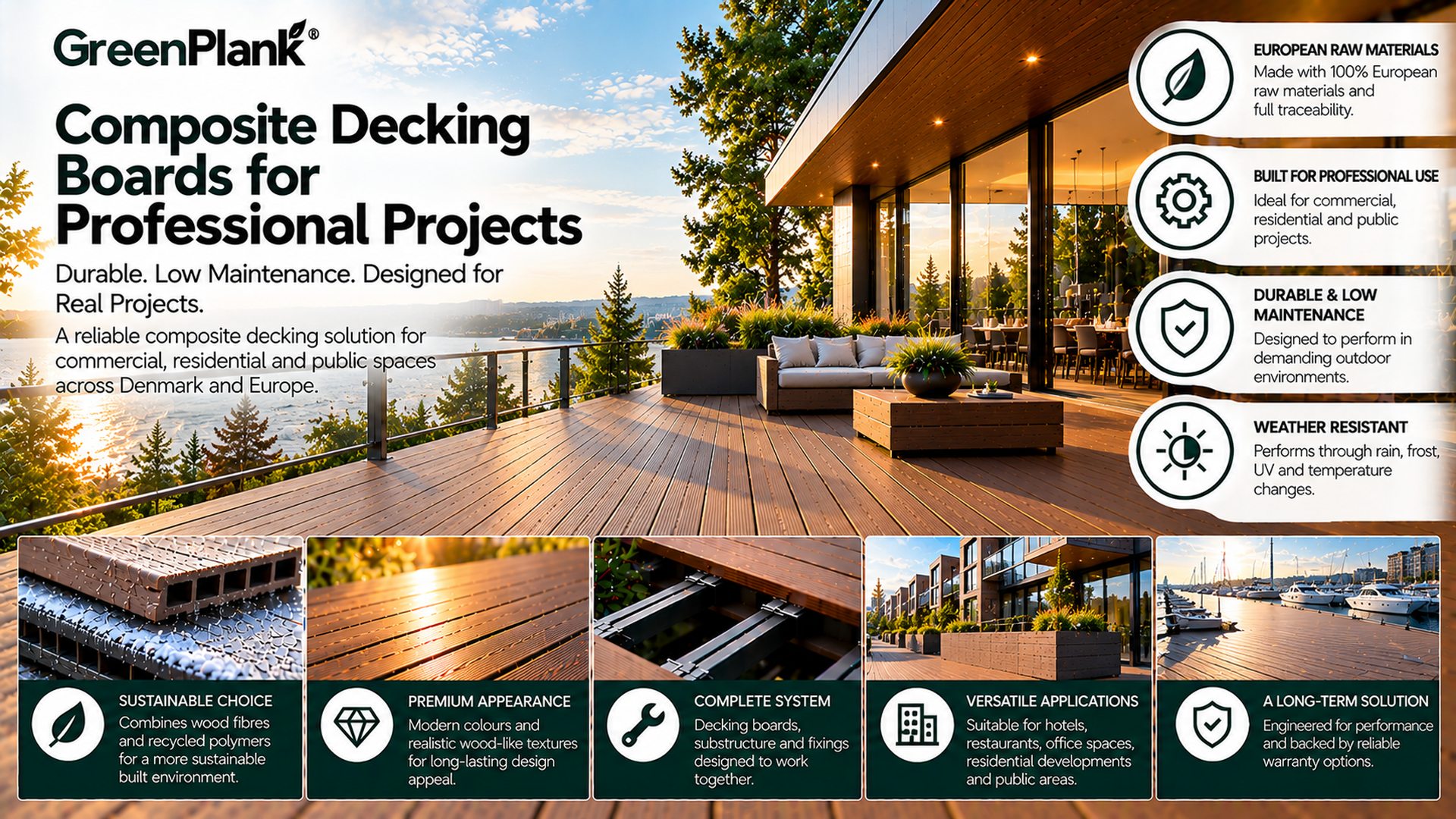
Composite decking can be considered for a wide variety of outdoor environments where design consistency, planned maintenance and an integrated installation system are important. The appropriate product should always be selected according to the project's intended use, loading and construction requirements.
- Hotels, restaurants and hospitality terraces
- Residential developments and communal outdoor areas
- Commercial buildings and office terraces
- Public spaces and landscaped developments
- Marinas and waterside projects
- Schools and institutional outdoor areas
- Renovation and property development projects
What Should Professional Buyers Evaluate?
Two composite decking boards may look similar in a sample or photograph while differing considerably in construction, material composition, weight, fixing method and technical requirements. A professional comparison should therefore look beyond colour and surface texture.
| Evaluation Area | Why It Matters | What to Check |
|---|---|---|
| Raw materials | Part of the overall product specification | Material type, origin and traceability |
| Profile design | Affects construction and application | Solid, hollow or co-extruded profile |
| Substructure | Supports the complete decking system | Joist spacing, support and intended loading |
| Fixings | Must work with the selected profile | Clips, screws and start/end components |
| Documentation | Supports specification and installation | Technical data and installation instructions |
| Warranty | Terms differ by product and application | Coverage, period and exclusions |
| Supply | Can influence the construction programme | Lengths, stock, volume and lead time |
Raw Materials and Traceability
For professional procurement, understanding where materials come from and where a product is manufactured can support better supply-chain visibility. Traceability can help buyers connect raw-material information with production, product identification and technical documentation.
Green Plank is a Swedish brand with WPC production in Klaipėda, Lithuania. Its material strategy is based on 100% European raw materials and 100% traceability. Selected formulations use a high proportion of European hardwood fibres, including beech and oak, combined with HDPE and functional additives.
European origin alone should not be treated as proof of technical quality. Professional buyers should assess origin together with product specifications, manufacturing control, profile design, installation requirements and supporting documentation.
Solid, Hollow or Co-Extruded Composite Decking?
No single profile construction is automatically the best solution for every professional project. The correct choice depends on application, loading, substructure, design objectives and the technical requirements of the specific product.
| Profile Type | Typical Characteristic | Professional Consideration |
|---|---|---|
| Solid composite | Continuous material cross-section | Consider weight, support and board length |
| Hollow composite | Engineered internal chamber structure | Check profile geometry and installation requirements |
| Co-extruded composite | Composite core with a separate outer layer | Evaluate the complete profile specification |
The Substructure Is Part of the System
A professional deck should not be designed around the visible board alone. The substructure determines support conditions and joist spacing while also influencing ventilation and drainage beneath the finished surface.
Joist spacing must follow the requirements for the selected profile and intended application. A private residential terrace and a commercial area with different traffic or loading conditions may require different design considerations. Diagonal layouts and special installation patterns can also affect support requirements.
Specification Tip
Always work from the current installation documentation for the exact decking profile being supplied. Generic WPC installation rules should not replace product-specific requirements.
Temperature Movement, Drainage and Outdoor Conditions
Professional decking systems must function through changing outdoor conditions. Composite decking can expand and contract as temperature changes, and the amount of movement can vary according to formulation, profile geometry, board length and temperature range.
This is why there should not be one universal expansion-gap value applied to every composite decking product. Designers and installers should follow the specific installation guidance for the selected board and consider conditions at the time of installation.
Drainage and ventilation are equally important. The construction should allow water to move away from the deck and avoid unnecessary obstruction beneath the boards. Leaves, soil and debris should not be allowed to block drainage or ventilation zones.
Compare System Cost, Not Only Board Price
Price per linear metre can be useful for an initial comparison, but it does not represent the complete installed cost. Board width, effective coverage, wastage, substructure, clips, screws, transport and installation can significantly influence the project budget.
Consider the Complete Cost per m²
- Decking boards and expected material waste
- Substructure and required supports
- Clips, screws and finishing accessories
- Freight, storage and site handling
- Installation labour
- Planned cleaning and maintenance
- Potential repairs and future replacement
For projects with a long planning horizon, life-cycle costing can provide a broader comparison than initial purchase price alone. ISO 15686-5 provides principles for life-cycle costing within the built environment and can support structured long-term cost analysis.
Documentation Matters in Professional Projects
Technical documentation should be reviewed before a product is specified or ordered. Requirements depend on the product, its intended use and applicable regulations. Buyers should therefore avoid assuming that every WPC product requires exactly the same declarations or documentation.
Where relevant, European construction-product requirements should be considered in relation to the specific application. Installation instructions, technical product data, warranty conditions and product identification should also be available to the project team.
10-Point Professional Procurement Checklist
- Identify the exact product range and profile.
- Review material composition and traceability.
- Request relevant technical product information.
- Check substructure and joist-spacing requirements.
- Review thermal movement and installation clearances.
- Confirm compatible clips, screws and accessories.
- Calculate the complete installed system cost per m².
- Check available lengths, quantities and lead times.
- Read warranty conditions for the intended application.
- Evaluate physical samples before large-volume specification.
Green Plank for Professional European Projects
Green Plank offers several composite decking families for different project requirements, including TerraTuff™, Nordeka™, Classic™ and Sapphire™. This allows professional customers to evaluate different profile constructions, surfaces and system options according to the needs of each development.
Selected TerraTuff™ products are offered with residential warranties of up to 50 years, depending on the specific product and applicable warranty terms. Professional and commercial applications should always be checked against the conditions applying to the intended use.
European manufacturing and European raw-material sourcing can also be relevant for buyers seeking supply-chain traceability and geographical proximity to production. A shorter transport route, however, should not automatically be presented as having a lower carbon footprint unless supported by an appropriate lifecycle or transport assessment.
Questions to Ask Before Approving a Product
- Who manufactures the decking and where?
- Can the raw materials and product batches be traced?
- Which profile is appropriate for the intended application?
- What substructure and joist spacing are required?
- How should thermal movement be accommodated?
- Which fixing system is specified?
- What technical documentation is available?
- What exactly does the warranty cover?
- What is the complete system cost per square metre?
- Can the supplier support future project phases and repeat orders?
Conclusion
Selecting composite decking boards for professional projects requires more than choosing an attractive colour or comparing individual board prices. Raw materials, profile construction, substructure, fixings, thermal movement, drainage, documentation, logistics and warranty should be assessed as one complete decking system.
For architects, contractors, developers, merchants and professional buyers, this structured approach creates a stronger basis for comparing WPC solutions and selecting the most appropriate system for each project.
Explore composite decking products and professional solutions at Green Plank.
Sources
- Green Plank – composite decking and product information
- European Commission – Construction Products Regulation
- ISO 15686-5 – Life-cycle costing
- USDA Forest Products Laboratory – Wood/Nonwood Thermoplastic Composites
Specify the product
Use this guide with a Green Plank specification
Technical articles support the commercial catalogue — category, product, evidence, then samples or quotes.