



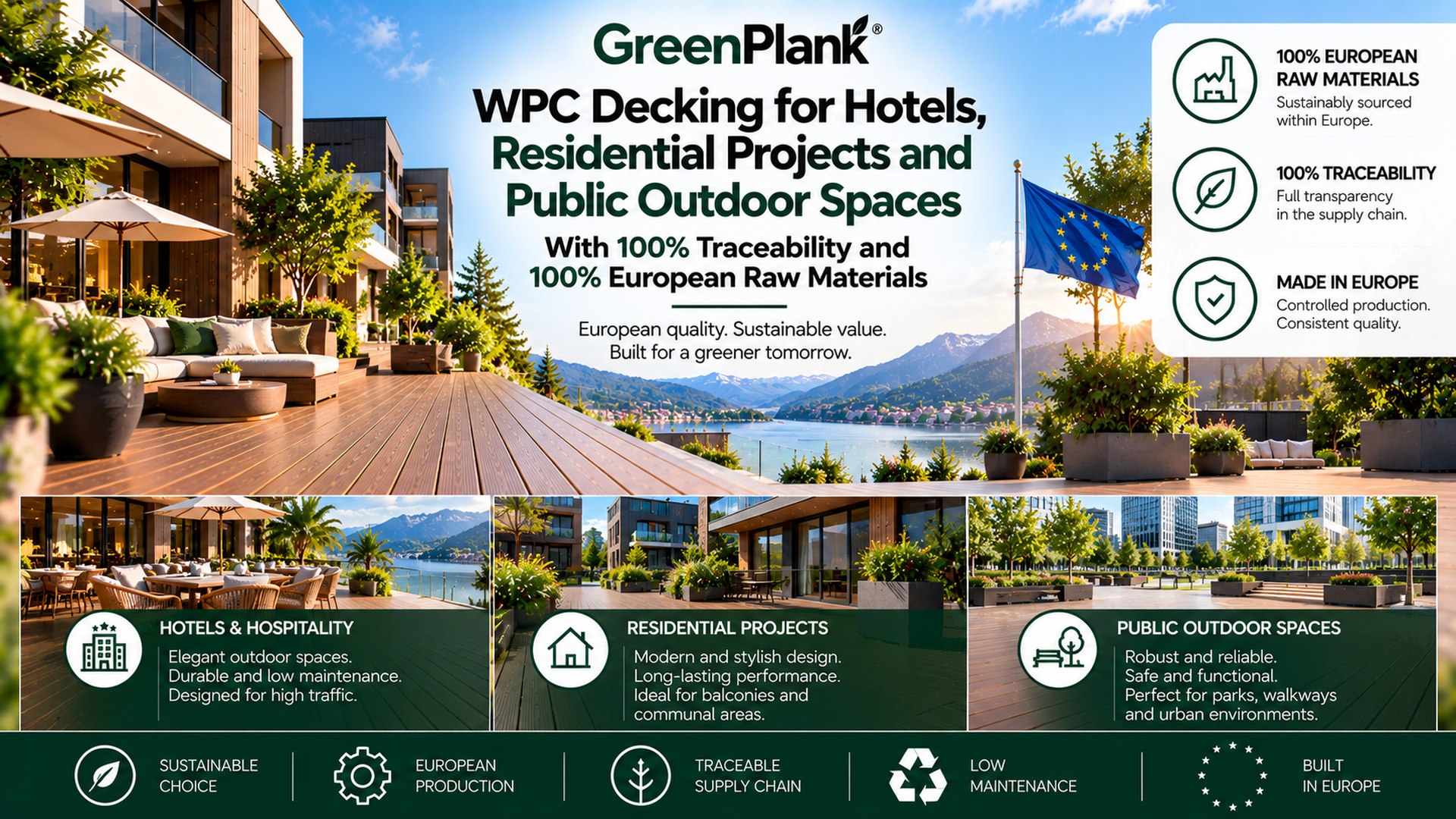
Outdoor spaces have become an important part of modern architecture. Hotels use terraces to extend restaurants, lounges and guest areas; residential developments increasingly include balconies, roof terraces and shared courtyards; and public projects need attractive outdoor surfaces designed for regular use.
Green Plank provides WPC decking manufactured in Europe using 100% European raw materials with 100% traceability. For architects, contractors, property developers, distributors and professional buyers, this creates a European sourcing option where product design, material origin, documentation and supply can be evaluated together.
Professional decking is a complete system: the board, substructure, support spacing, fixings, ventilation, drainage, thermal movement and maintenance strategy should all be considered during specification.
Why consider WPC decking for professional projects?
WPC stands for Wood Plastic Composite. It typically combines wood or natural fibre with a thermoplastic polymer and functional additives, which are processed and extruded into profiles designed for specific applications.
For commercial and shared outdoor spaces, WPC can combine a timber-inspired appearance with reduced requirements for routine surface treatments compared with many traditional untreated timber solutions. However, WPC is not a single material specification. Fibre type, polymer, additives, profile geometry and manufacturing process can all influence performance.
Different projects require different decking solutions
| Project type | Typical applications | Key considerations |
|---|---|---|
| Hotels & hospitality | Restaurant terraces, lounges, balconies and outdoor guest areas | Traffic, appearance, cleaning, service access and maintenance |
| Residential developments | Balconies, roof terraces, courtyards and communal areas | System cost, installation, consistency and future replacement |
| Public outdoor spaces | Walkways, meeting areas and recreational spaces | Loading, construction, safety, drainage and documentation |
WPC decking for hotels and hospitality
For a hotel, the terrace is part of the guest experience. A restaurant terrace, rooftop lounge or outdoor seating area can become an architectural extension of the interior. The decking therefore needs to support both design ambitions and practical operational requirements.
Specification should consider expected traffic, furniture loads, cleaning routines, local weather conditions and access for future maintenance. Choosing the correct profile and substructure is just as important as choosing the colour or surface finish.
- Select the profile according to the intended application and expected use.
- Design the substructure according to product-specific requirements.
- Provide effective drainage and ventilation beneath the deck.
- Plan access where individual boards may need future replacement.
- Consider cleaning and operational requirements before installation.
Composite decking for residential developments
Large residential developments often require the same material concept across multiple balconies, terraces and communal areas. This makes consistency, installation efficiency, documentation and future availability important parts of the purchasing decision.
Standardised profiles and installation principles can simplify planning across larger developments. Buyers should nevertheless compare the complete installed system rather than focusing only on the price per linear metre of decking.
Compare cost per completed system
A professional comparison should include boards per m², substructure, clips, screws, trims, labour, logistics and anticipated maintenance. This provides a more useful basis for evaluating competing decking proposals.
Decking for public outdoor spaces
Public environments may experience high and variable levels of use. A product suitable for a private residential terrace is therefore not automatically appropriate for a busy public walkway, hospitality venue or communal development.
Architects, engineers and contractors should assess the intended loading, profile construction, support spacing, fastening system, drainage and applicable project requirements before specifying a product. Technical documentation should form part of the decision process.
100% European raw materials and 100% traceability
Green Plank manufactures its composite products in Klaipėda, Lithuania, within the European Union. Its material strategy is based on 100% European raw materials and 100% traceability across the material supply chain.
Selected Green Plank formulations use a high proportion of European hardwood fibre, including beech and oak, combined with HDPE and functional additives. Exact formulations and technical characteristics can vary between product families, so specifications should always be confirmed against the documentation for the selected product.
Why does traceability matter?
- The origin of key raw materials can be followed through the supply chain.
- Material specifications can be connected to defined purchasing requirements.
- Professional buyers gain a clearer basis for supplier assessment.
- Architects and developers can better understand where key materials originate.
- Raw-material changes can be managed through controlled quality procedures.
Origin alone does not guarantee product quality. Traceability must work together with material formulation, manufacturing control, profile engineering, quality assurance and correct installation.
TerraTuff™ for demanding decking projects
TerraTuff™ is Green Plank's premium co-extruded decking range. During co-extrusion, the WPC core and an additional outer layer are produced together, creating a different surface construction from conventional uncapped composite profiles.
Green Plank also offers product families including Nordeka™, Classic™ and Sapphire™. The appropriate choice between solid or hollow construction and traditional or co-extruded surfaces should depend on the application, structural design and project requirements.
Selected TerraTuff™ products carry residential warranties of up to 50 years, depending on the specific product and applicable warranty conditions. Hotels, commercial developments and public projects should always verify the warranty applicable to their particular use category.
Designing for changing European climates
Outdoor decking experiences changes in temperature, moisture and weather throughout the year. Like other composite materials, WPC undergoes dimensional movement as temperature changes. The installation therefore needs sufficient room for expansion and contraction according to the selected product and site conditions.
Ventilation and drainage are equally important. The substructure should allow water to drain effectively while maintaining appropriate airflow beneath the decking. Product-specific installation instructions should always take priority over generic rules.
Professional installation checklist
- Review the current technical data sheet.
- Use the latest installation instructions for the selected profile.
- Confirm support spacing for the intended application.
- Plan drainage, ventilation and substructure carefully.
- Allow for temperature-related dimensional movement.
- Use compatible clips, screws and system accessories.
- Confirm warranty conditions for commercial or public use.
Compare the complete decking system
| Basic comparison | Professional evaluation |
|---|---|
| Price per linear metre | Complete installed system cost per m² |
| Colour | Colour, surface, profile and application |
| Country of manufacture | Manufacturing location plus raw-material traceability |
| Warranty period | Coverage, exclusions and application category |
| Decking board only | Boards, substructure, fixings and accessories |
| Current stock | Supply continuity and future replenishment |
From purchase price to life-cycle cost
For a hotel, housing development or public project, the lowest initial purchase price does not necessarily represent the lowest long-term cost. ISO 15686-5 provides a framework for life-cycle costing of buildings and constructed assets.
A project-level assessment can therefore consider initial materials, installation, maintenance, repairs, replacement requirements and the chosen analysis period. This approach is particularly relevant when comparing products with different maintenance strategies and expected service characteristics.
A more transparent approach to sustainability
Sustainability claims should be based on measurable and documented information. A complete environmental comparison may consider raw materials, manufacturing, transport, maintenance, replacement and end-of-life scenarios. Robust comparisons of environmental impact require product-specific life-cycle data rather than assumptions based only on manufacturing location.
Green Plank therefore focuses on concrete sourcing and product attributes: European manufacturing, 100% European raw materials, traceable material supply and products designed for long-term use with limited routine surface treatment. These factors can contribute to a broader sustainability assessment without replacing a product-specific life-cycle analysis.
For architects and professional buyers: Do not specify WPC decking by appearance and price alone. Evaluate material origin, profile design, installation system, documentation, warranty conditions, supply reliability and technical support together.
Green Plank for hotels, residential and public projects
Green Plank combines a Swedish brand heritage with European manufacturing in Klaipėda and a supply strategy centred on European raw materials and traceability. The product portfolio provides options for private, residential and professional outdoor environments.
For larger projects, the strongest specification is one that connects architecture with engineering and procurement. Profile construction, material origin, documentation, substructure, installation, maintenance, warranty and supply continuity should all form part of the final decision.
Explore Green Plank composite decking and other European-made WPC solutions at Green Plank.
Sources
- Green Plank – product and technical information
- U.S. Forest Products Laboratory – Wood/Nonwood Thermoplastic Composites
- U.S. Forest Service – Research on Wood-Plastic Composites
- ISO 15686-5 – Buildings and constructed assets, life-cycle costing
- European Commission – Construction Products Regulation
Specify the product
Use this guide with a Green Plank specification
Technical articles support the commercial catalogue — category, product, evidence, then samples or quotes.