



What Should Professional Buyers Look for in WPC?
For professional buyers, selecting WPC should involve much more than comparing colour and price per linear metre. Two composite decking boards may look similar in a catalogue but differ considerably in raw materials, profile construction, weight, surface technology, production control, technical documentation and intended application.
Building-material distributors, architects, contractors, developers and procurement teams should therefore evaluate WPC as a complete system. The decking profile, substructure, fastening system, installation requirements, project environment and expected use all need to work together.
A better procurement question is not simply “What does the board cost?” but “What complete, documented system are we receiving for the project?”
1. Start with the raw materials
WPC stands for Wood Plastic Composite. It typically combines wood or other natural fibres with a thermoplastic polymer and functional additives. However, there is no single formulation that represents every WPC product on the market.
Professional buyers should understand what the product contains, where its main raw materials originate and how those materials are controlled. A high wood-fibre percentage alone does not prove quality, just as a high polymer content does not automatically deliver better performance. Formulation, raw-material consistency, profile engineering and production control need to be considered together.
Questions worth asking the supplier
- What type of wood or natural fibre is used?
- Which polymer is used, for example HDPE?
- Is the polymer virgin, recycled or a controlled combination?
- How are moisture, contamination and batch variation controlled?
- Where do the principal raw materials originate?
- Can the supply chain be traced and documented?
2. Look beyond “Made in” – ask about traceability
Manufacturing origin is useful information, but professional procurement should go deeper. A product may be manufactured in one country while its principal raw materials originate elsewhere. Traceability provides greater transparency over the material supply chain and can support supplier assessment and project documentation.
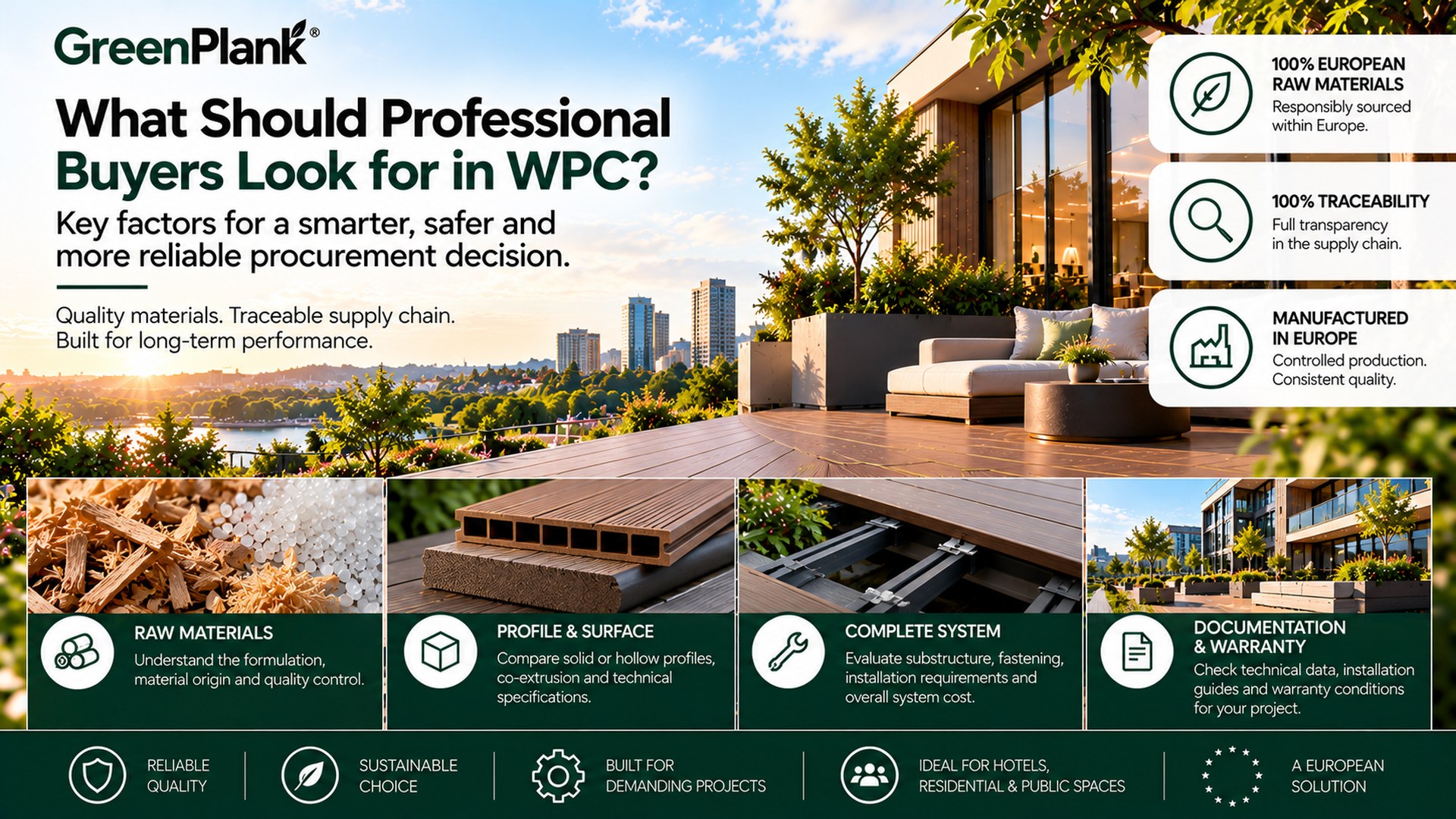
Green Plank manufactures its WPC products in Klaipėda, Lithuania, within the European Union, with a material strategy based on 100% European raw materials and 100% traceability. Selected formulations use a high proportion of European hardwood fibre, including beech and oak, combined with HDPE and functional additives.
European origin alone should not be treated as proof of technical quality or lower environmental impact. Origin and traceability are most useful when evaluated together with product specifications, quality control, documentation and manufacturing consistency.
3. Examine the profile, not just the surface
Composite decking is available in solid and hollow profiles with different dimensions, wall structures and internal geometries. Products may also use traditional uncapped surfaces or co-extruded constructions with a separate outer layer.
| Factor | What professional buyers should check |
|---|---|
| Profile design | Solid or hollow construction, dimensions and geometry |
| Surface | Traditional WPC or co-extruded construction |
| Weight | Weight per linear metre and installed m² |
| Support spacing | Permitted spacing for the intended application |
| Fastening | Clips, screws, starter clips and system compatibility |
| Application | Residential, commercial or project-specific use |
Weight alone should not be used as a quality ranking. A heavier board is not automatically stronger or better, and a lighter engineered profile is not automatically weaker. Mechanical properties, formulation and profile geometry should be assessed together.
4. Request technical documentation before specifying
For substantial projects or recurring B2B purchases, technical documentation should be reviewed before orders are placed. The exact requirements depend on the product, market and intended application, but buyers should have enough information to understand how the system is designed, installed and maintained.
Documentation checklist
- Current technical data sheet and product specifications.
- Current installation instructions.
- Warranty document and applicable conditions.
- Relevant product and performance documentation.
- Permitted joist or support spacing.
- Requirements for expansion, ventilation and drainage.
- Information about compatible clips and accessories.
The EU Construction Products Regulation provides an important regulatory framework for construction products covered by its scope. The specific documentation required should always be determined for the individual product, intended use and market.
5. Understand thermal movement and moisture management
Wood-plastic composites respond to temperature changes, and their behaviour depends on factors including polymer type, fibre content, formulation and profile design. This makes installation requirements particularly important in climates with significant seasonal temperature variation.
Professional buyers should check how the manufacturer addresses expansion and contraction, end gaps, distances from fixed structures, ventilation and water drainage. The substructure must also be suitable for the application and installation environment.
There is no universal expansion gap that is correct for every WPC board. Required spacing depends on the specific product, board length, installation temperature and manufacturer instructions.
6. Compare warranties carefully
A large warranty number can be attractive in a sales presentation, but professional buyers should examine what the warranty actually covers. Residential, commercial and public applications may have different terms and periods.
Selected Green Plank TerraTuff™ products offer a residential warranty of up to 50 years, depending on the product and applicable warranty terms. This should not be interpreted as an automatic 50-year warranty for hotels, restaurants, commercial developments or public spaces. The relevant warranty must be confirmed for the intended application.
Check these five points
- Which exact product is covered?
- Is the project residential or commercial?
- What defects or performance issues are covered?
- Which installation conditions must be followed?
- What exclusions and maintenance requirements apply?
7. Compare system cost per m², not only board price
Price per linear metre can be misleading when comparing different decking systems. Board width, installation gap, joist spacing, clips, substructure and labour can change the actual cost of one finished square metre.
| Procurement factor | Basic comparison | Professional comparison |
|---|---|---|
| Price | Price per linear metre | Complete installed system cost per m² |
| Material | “WPC” | Formulation, origin and traceability |
| Installation | Decking board only | Boards, joists, clips, screws and labour |
| Warranty | Number of years | Period, coverage, application and conditions |
| Supply | Current lead time | Stock, continuity and future availability |
8. Consider life-cycle cost
For commercial developments, housing projects and public environments, initial purchase price is only one part of the financial picture. ISO 15686-5 provides principles for life-cycle costing of buildings and constructed assets.
A useful project comparison can therefore include material purchase, installation, cleaning, maintenance, repairs, potential replacement and the selected analysis period. This creates a more meaningful commercial comparison than focusing only on the initial price of the decking board.
9. Evaluate supply reliability
Availability is part of product performance from a procurement perspective. A delayed delivery can affect installation teams, project sequencing and other trades. Buyers should therefore assess manufacturing location, standard lengths, stock strategy, production capacity, lead times and the possibility of obtaining matching material later.
A regional European supply chain can offer practical advantages in communication and logistics, but buyers should still verify actual availability and delivery capacity for each project rather than relying on general assumptions.
10. Consider maintenance and long-term appearance
Professional buyers should understand what maintenance the product requires and what changes in appearance can reasonably be expected during service. Cleaning recommendations, staining behaviour, colour development and procedures for replacing individual boards are all relevant for property owners and facility managers.
For hotels, residential developments and public projects, maintenance planning should ideally be considered during procurement rather than after installation.
10 questions every professional WPC buyer should ask
- Where is the product manufactured?
- Where do the principal raw materials originate?
- Can the material supply chain be traced?
- Which polymer and fibre types are used?
- Is the profile solid, hollow or co-extruded?
- What support spacing applies to our intended use?
- Which technical documentation is available?
- What are the requirements for thermal movement, drainage and ventilation?
- What warranty applies specifically to our project?
- What is the complete system cost per installed m²?
Procurement tip: Send the same technical questionnaire to every shortlisted supplier. Comparable answers make it much easier to distinguish a low board price from a well-engineered and properly documented decking system.
Green Plank as a European WPC option
Green Plank combines Swedish brand heritage with manufacturing in Klaipėda, Lithuania, and a focus on European raw materials and traceable sourcing. The decking portfolio includes product families such as TerraTuff™, Nordeka™, Classic™ and Sapphire™ for different project requirements.
For professional buyers, the conclusion is straightforward: do not select WPC on appearance or lowest price alone. Compare raw materials, traceability, profile engineering, documentation, installation requirements, warranty, supply capability and total system cost. That creates a stronger basis for specification, procurement and long-term project performance.
Learn more about Green Plank composite decking and European-made WPC solutions at Green Plank.
Sources
- Green Plank – products and technical information
- U.S. Forest Products Laboratory – Wood/Nonwood Thermoplastic Composites
- U.S. Forest Service – research on Wood-Plastic Composites
- ISO 15686-5 – Buildings and constructed assets: life-cycle costing
- European Commission – Construction Products Regulation
Specify the product
Use this guide with a Green Plank specification
Technical articles support the commercial catalogue — category, product, evidence, then samples or quotes.