



European WPC vs Long-Distance Imports: What Should Buyers Compare?
The composite decking market is global. Distributors, builders, architects and property developers can source WPC from European manufacturers or choose products transported over long distances from other regions. Both routes can deliver suitable products, which means origin alone should never be treated as proof of quality.
A professional comparison goes deeper. Raw-material transparency, profile engineering, technical documentation, production consistency, delivery flexibility, warranty conditions and total installed cost can matter just as much as the initial price of the decking board.
The key question is not simply European or imported. It is: which supplier offers the right combination of documented performance, traceability, reliable supply and total project value?
What Does European-Made WPC Actually Mean?
WPC, or Wood Plastic Composite, typically combines wood or natural fibres with a thermoplastic polymer and functional additives. Its properties depend on several factors, including fibre type, polymer, formulation, profile geometry and manufacturing process.
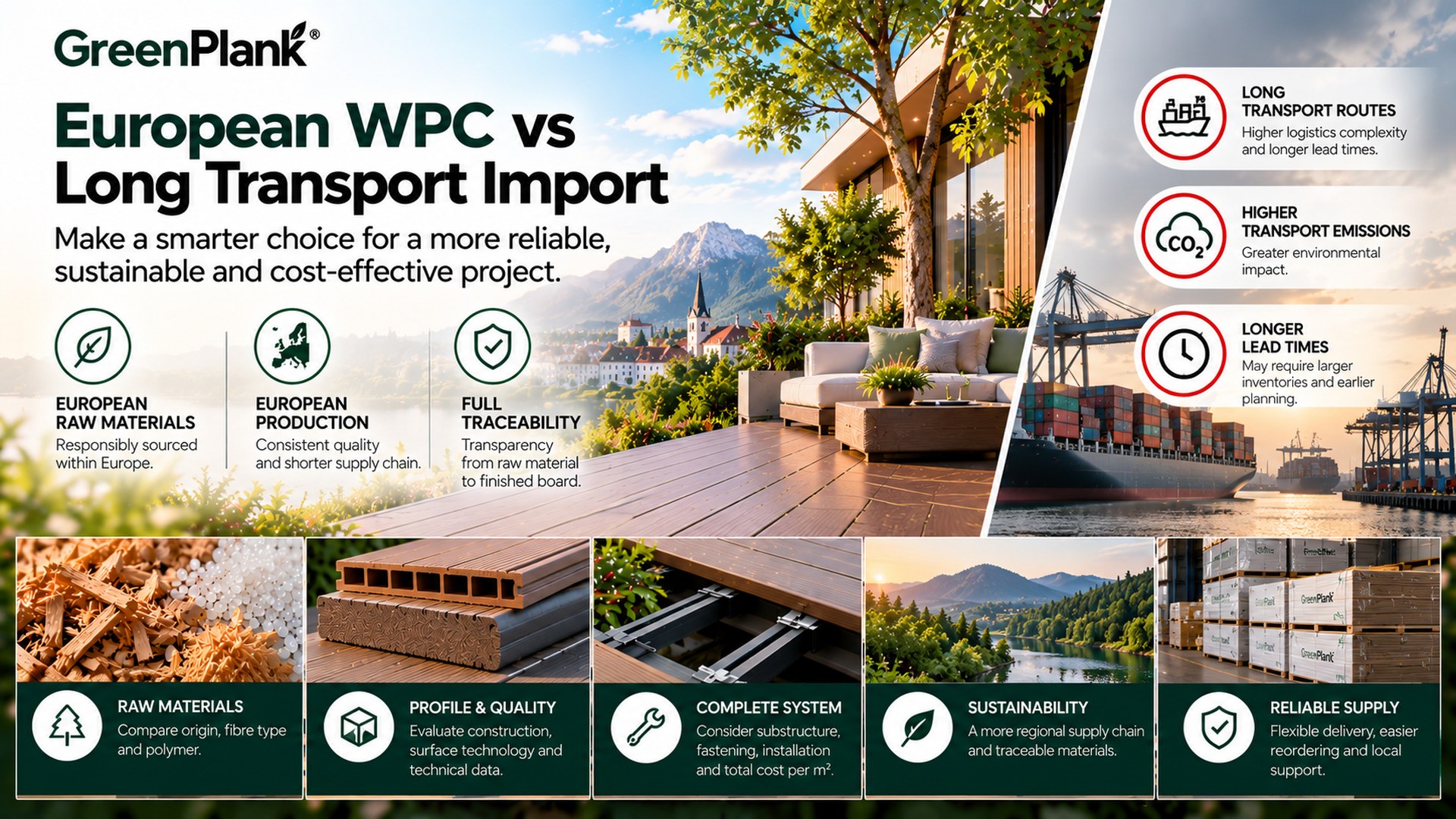
Green Plank is a Swedish brand with WPC production in Klaipėda, Lithuania, within the European Union. Its material strategy is based on 100% European raw materials and 100% traceability. Selected formulations use a high proportion of European hardwood fibre, including beech and oak, combined with HDPE and functional additives.
This gives professional buyers visibility not only into where the finished product is manufactured, but also into the origin of the main materials used in production.
European WPC vs Long-Distance Imports at a Glance
| Buying Factor | Regional European Supply | Long-Distance Import |
|---|---|---|
| Supply route | Shorter regional route to European markets | May involve long sea and inland transport |
| Lead time | Can support shorter replenishment cycles | May require longer planning horizons |
| Communication | Regional proximity can simplify coordination | Often depends on the local importer structure |
| Reordering | Can offer greater flexibility for repeat orders | May depend on shipping schedules and volumes |
| Traceability | Must be verified with the manufacturer | Must be verified with manufacturer or importer |
| Technical quality | Must be assessed product by product | Must be assessed product by product |
The important point is balance. European production can offer practical supply-chain advantages for European projects, but geography does not automatically guarantee superior technical performance. Likewise, a product manufactured further away can be well engineered and properly documented. Buyers should ask for evidence rather than relying on assumptions.
1. Traceability Should Be Part of the Specification
Professional procurement increasingly requires visibility into the supply chain. Buyers should understand where the main raw materials originate, which polymer is used, where extrusion takes place and how production consistency is controlled.
Ask suppliers to document:
- Manufacturing location and responsible producer.
- Origin of the principal raw materials.
- Type of wood or natural fibre and polymer.
- Relevant technical product information.
- Installation instructions and warranty conditions.
- Quality-control procedures and batch consistency.
Traceability is particularly useful for distributors and project buyers who need consistent specifications across repeated orders. It can also make technical discussions with architects, contractors and clients more transparent.
2. Shorter Transport Does Not Automatically Mean a Lower Footprint
Transport distance is relevant when considering a product's supply chain, but it should not be used alone to make environmental comparisons. Overall environmental impact can also depend on raw-material production, energy sources, manufacturing, material quantity, transport mode, service life, maintenance and end-of-life scenarios.
For this reason, it is more accurate to say that European manufacturing for European customers can provide a shorter, more regional supply route than long-distance overseas sourcing. A robust claim that one specific product has a lower environmental footprint than another requires comparable product-specific life-cycle data.
3. Lead Time and Inventory Can Change the Real Cost
For distributors and construction projects, logistics is part of the commercial calculation. Long supply routes may require earlier purchasing decisions, larger inventories and additional forecasting. Unexpected delays can affect installation teams, project schedules and working capital.
Regional production may allow different replenishment strategies, but buyers should still request concrete information. Production capacity, seasonal demand, stock levels and transport arrangements can influence lead times regardless of where a factory is located.
Before placing a major order, ask:
- Which profiles, colours and lengths are normally stocked?
- What are the typical production and delivery times?
- Can matching material be reordered later?
- How are seasonal volume peaks handled?
- Are clips, fasteners and accessories available with the decking?
4. Compare Complete Systems, Not Individual Boards
A low price per linear metre does not necessarily mean a lower project cost. Board width, coverage, joist spacing, fastening requirements, accessories and installation time all influence the cost of a completed square metre.
| Compare | Why It Matters |
|---|---|
| Installed cost per m² | More useful than comparing linear-metre prices alone |
| Substructure | Joist spacing and material requirements affect total cost |
| Clips and screws | Quantity and system design affect materials and labour |
| Installation | Profile and fastening design can influence labour time |
| Maintenance | Should be considered across the chosen analysis period |
| Logistics | Freight, inventory and replenishment affect project economics |
For merchants and professional buyers, comparing complete systems also makes quotations easier to evaluate fairly. One supplier may include accessories and technical support while another quotation covers only the boards.
5. Technical Documentation Matters More Than Geography
A professional buyer should not select a product simply because it is made in Europe. Technical data, installation guidance, relevant product documentation and clear warranty conditions should all form part of the evaluation.
For construction products falling within its scope, the European Construction Products Regulation provides an important regulatory framework. The documentation required for a particular WPC product depends on its intended use and applicable requirements.
Buyers should also review joist spacing, drainage, ventilation, fastening and thermal-movement instructions. Research into wood-plastic composites shows that material composition and processing influence their properties, reinforcing the importance of product-specific technical information.
6. Climate and Installation Must Be Considered Together
Outdoor decking can experience heat, cold, rain, moisture and substantial seasonal temperature changes. The complete construction must therefore be designed for the local environment rather than assuming that every WPC board behaves in the same way.
WPC experiences dimensional movement with temperature changes. Installation must allow for this movement while providing appropriate drainage and ventilation. There is no single expansion gap suitable for every WPC product; installers should follow the current instructions for the selected profile and installation conditions.
7. Compare Warranty Terms, Not Just Warranty Years
Warranty length is easy to advertise, but the number of years is only one part of the comparison. Buyers should determine which application is covered, what performance aspects are included, which installation requirements apply and what exclusions exist.
Selected Green Plank TerraTuff™ products offer residential warranties of up to 50 years, depending on the product and applicable warranty terms. This should not be interpreted as an automatic 50-year warranty for hotels, restaurants, commercial developments or public spaces; the applicable commercial warranty should be verified separately.
8. Consider Life-Cycle Cost Alongside Purchase Price
ISO 15686-5 provides principles for life-cycle costing of buildings and constructed assets. For decking, a professional assessment can consider initial materials, installation, cleaning, maintenance, repairs, potential replacement and other relevant costs over a defined analysis period.
This approach can be particularly useful for hotels, residential developments, commercial terraces and public spaces where ongoing maintenance and operational disruption may have financial consequences.
Procurement tip: Send the same specification sheet to European and long-distance suppliers. Request comparable information on raw materials, traceability, profile design, technical documentation, warranty, lead time and complete system cost per m².
9. Where Can European Supply Add Practical Value?
For a European distributor or construction project, regional manufacturing can simplify communication, replenishment and supply planning. It may also reduce dependence on long international shipping cycles. These are practical procurement advantages rather than automatic claims about product quality or environmental performance.
The strongest purchasing decision combines supply-chain considerations with measurable product characteristics. A technically suitable profile, documented installation system and dependable supplier relationship are more valuable than a country-of-origin label on its own.
Green Plank: A European WPC Alternative
Green Plank combines a Swedish brand background with WPC manufacturing in Klaipėda, Lithuania. Its decking portfolio includes TerraTuff™, Nordeka™, Classic™ and Sapphire™ for different project requirements, alongside complementary outdoor composite solutions.
For professional buyers, the conclusion is straightforward: compare evidence, systems and supply chains rather than geography alone. European production can provide valuable advantages through 100% European raw materials, 100% traceability and a regional European supply chain, while technical quality should always be assessed through product-specific data and correct installation requirements.
Explore Green Plank's European WPC solutions at Green Plank.
Sources
- Green Plank – WPC products and product information
- U.S. Forest Products Laboratory – Wood/Nonwood Thermoplastic Composites
- U.S. Forest Service – Wood-Plastic Composite research
- ISO 15686-5 – Buildings and constructed assets: Life-cycle costing
- European Commission – Construction Products Regulation
Specify the product
Use this guide with a Green Plank specification
Technical articles support the commercial catalogue — category, product, evidence, then samples or quotes.