



Why do we continue to wrap our most valuable assets in materials that are destined to degrade under the harsh Nordic sun and snow? You likely appreciate the organic beauty of a timber facade but understand that traditional wood often fails to meet the performance demands of a modern, sustainable lifestyle. It's a common frustration to see a significant investment begin to fade or warp within the first 60 months of its lifespan. You deserve a home that reflects your values without demanding your constant labor.
We're here to show you that a stunning, high-end aesthetic doesn't have to come at the cost of the environment or your free time. By exploring the latest exterior wall cladding ideas for 2026, you'll discover how European-engineered sustainability and professional-grade durability work in harmony. Our natural-fiber composites are designed in Scandinavia and produced in Europe to ensure they're built to last and designed for life. This article provides a clear roadmap for selecting materials that offer a 30 year warranty and minimal maintenance. We'll detail the technical innovations, traceable raw materials, and circular design principles that are currently defining the next generation of sustainable Swedish architecture.
Key Takeaways
- Understand how 2026 architectural trends prioritize earth-toned textures and natural finishes to balance thermal regulation with high-end visual impact.
- Discover innovative exterior wall cladding ideas that leverage HidLoc™ hidden fastening systems to achieve a seamless, professional-grade facade.
- Analyze why European-engineered WPC has become the sustainable standard, offering superior moisture resistance and an industry-leading 50-year warranty.
- Learn to manipulate building perception through strategic vertical and horizontal orientations using Terra Tuff and Smart System technologies.
- Explore the benefits of a unified design language by transitioning high-performance composite panels from interior walls to exterior envelopes.
Transformative Exterior Wall Cladding Ideas for Modern Architecture
The modern facade acts as a sophisticated protective envelope. It balances thermal regulation with immediate visual impact. In Sweden, where temperatures fluctuate from -20°C to +30°C, the choice of material determines both energy efficiency and long-term maintenance costs. These exterior wall cladding ideas focus on a "Designed for life" philosophy. This approach ensures materials withstand environmental stress while enhancing the home's aesthetic profile. Understanding What is Wall Cladding is essential for homeowners who want to protect their investment from harsh weather and potential fire risks.
Trends for 2026 show a decisive shift toward natural textures and earth-toned palettes. Homeowners are moving away from artificial gloss; they prefer the tactile depth of timber-look composites and stone-inspired finishes. This evolution reflects a growing commitment to circularity and traceable raw materials. High-quality cladding protects the building's skeleton from moisture. It prevents rot. It secures the property value for the next 30 years. Engineered with 100% traceable raw materials, modern facades provide stability, strength, and a refined Nordic character. Built to last. Designed for life.
The Nordic Aesthetic: Minimalism and Natural Character
Scandinavian design relies on functional minimalism. It uses clean lines and muted tones to create a timeless, calm exterior. Using natural-fiber composites allows architects to achieve this look without the constant upkeep of traditional wood. Texture plays a critical role here. It breaks up large architectural volumes. A ribbed surface creates shadows that change throughout the day, adding life to a static wall. This style remains the gold standard for sustainable luxury in Northern Europe.
Selecting a Facade Style: From Rustic to Ultra-Modern
Choosing the right style requires matching the cladding to the existing architecture. Biophilic design is rising in Swedish residential projects. This style integrates natural elements to improve occupant well-being. Deep grooves offer a rugged, rustic feel; flat surfaces provide a sleek, ultra-modern finish. Every choice impacts the building's silhouette and its relationship with the surrounding landscape. Architects often mix these exterior wall cladding ideas to define different zones of a property, such as using vertical slats for entryways and flat panels for main living areas.
- Thermal Efficiency: Modern cladding reduces heat loss in winter and heat gain in summer.
- Property Value: High-quality facades can increase resale value by up to 15% in premium markets.
- Low Maintenance: Natural-fiber composites eliminate the need for annual oiling or painting.
- Swedish Standards: Materials are tested to withstand extreme Nordic frost-thaw cycles.
The transition toward sustainable materials is not just a trend; it's a requirement for future-proofing homes. Designed in Scandinavia. Produced in Europe. This geographical commitment ensures that every plank meets strict environmental and quality regulations, providing peace of mind for the conscious homeowner.
Material Comparison: Stone, Metal, and Timber Facades
Selecting the right exterior wall cladding ideas requires balancing aesthetic vision with long-term performance. Stone and masonry offer unmatched protection against harsh Nordic winters. These materials are heavy-duty and fire-resistant. However, they demand specialized labor and significant structural reinforcement. Installation costs for natural stone in Sweden often exceed 3,000 kr per square meter, making it a premium investment with high complexity.
Metal cladding provides an industrial, sleek finish favored in contemporary urban architecture. It resists rot and insects effectively. Despite this durability, metal faces challenges with heat absorption during summer months and remains susceptible to denting from hail or accidental impact. It lacks the organic warmth many homeowners desire for residential spaces. It is efficient but often feels cold and clinical.
Natural timber remains a traditional favorite for its tactile beauty. It connects the home to the landscape. It is the gold standard for aesthetic warmth. Yet, timber is the most demanding material regarding upkeep. Without constant attention, wood loses its structural integrity and visual appeal within a few seasons.
The High Cost of Traditional Wood Maintenance
Real wood is vulnerable to the elements. UV rays break down lignin while moisture invites rot. Homeowners must commit to annual staining, sealing, and chemical treatments to prevent degradation. Many of the common wood decking problems, such as splintering, warping, and fungal growth, are equally prevalent in timber facades. Beyond the labor, the environmental cost is high. Harvesting old-growth forests for short-lived cladding contradicts the principles of modern circular construction. Maintenance-heavy wood often requires total replacement within 15 to 20 years.
Engineered Alternatives: The Rise of Natural Fiber Composites
High-performance composites differ fundamentally from standard PVC or plastic-heavy products. They utilize a precise blend of 75 percent hardwood fiber and 25 percent high-density polyethylene (HDPE). This ratio ensures the material retains the look and feel of wood while gaining the weather-resistance of polymers. Wood Plastic Composite (WPC) cladding serves as a high-performance, sustainable alternative to traditional timber that eliminates the need for toxic preservatives.
These materials are engineered for stability. They don't crack or fade under intense sun. Designed in Scandinavia and produced in Europe, these solutions provide a traceable path to sustainability. If you're planning a renovation, exploring a sustainable cladding solution can reduce your home's lifetime maintenance costs by over 60 percent compared to softwood alternatives. Built to last. Designed for life.
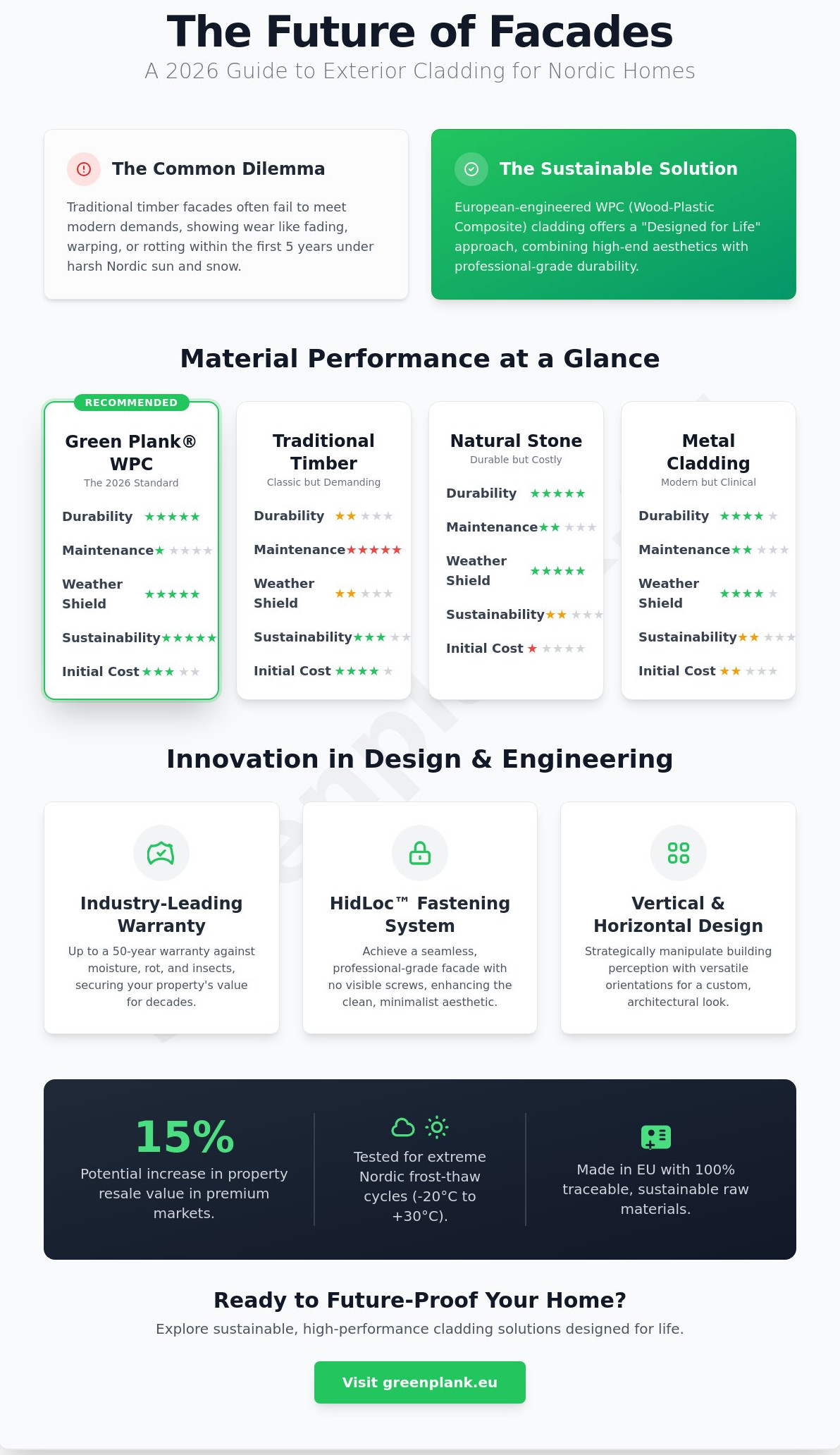
The Evolution of Cladding: Why WPC is the 2026 Standard
Modern architecture demands more than just aesthetics; it requires a commitment to longevity. Homeowners in Sweden are increasingly looking for exterior wall cladding ideas that combine visual appeal with long-term ecological responsibility. Traditional timber requires repainting every five to seven years, which can cost homeowners thousands of SEK in maintenance over the building's life. PVC alternatives often fail to meet the structural integrity required for 2026 building standards. Green Plank natural fiber composite (WPC) solves these issues by offering a 50-year warranty against rot, moisture, and UV degradation. It's a professional-grade solution built to last.
The shift toward sustainable building materials is now a core requirement for projects seeking LEED or BREEAM certification. Green Plank reduces CO2 footprints by utilizing 100% EU-sourced raw materials. This regional focus minimizes transportation emissions and ensures every profile meets strict European environmental regulations. By choosing engineered composites over imported tropical hardwoods, architects can achieve high-end results without contributing to deforestation.
- Maintenance-free: No staining, oiling, or painting required for the duration of the product life.
- UV Stability: Advanced pigments ensure colors remain vibrant despite intense summer sun.
- Moisture Resistance: Engineered to prevent swelling and fungal growth in damp environments.
Circular Construction and Cradle to Cradle Ownership
Traceability defines the Green Plank supply chain. We prioritize circular construction where every board is tracked from production to installation. This cradle-to-cradle approach ensures that cladding doesn't end up in a landfill. Instead, the material is engineered for repurposing at the end of its life cycle. We've moved past the era of disposable building components; we now manufacture infrastructure profiles that serve as long-term assets. This shift from "disposable" to "durable" is essential for modern green building strategies.
Engineered for Extreme Climates
Swedish weather is unforgiving, and exterior wall cladding ideas must account for heavy snow and coastal salt air. We use high-density polyethylene (HDPE) rather than the lower-grade recycled plastics found in budget alternatives. This choice provides superior stability during extreme temperature fluctuations. Our low-density composites are specifically engineered to prevent warping and expansion. Tested against harsh Nordic winters, these profiles provide a stable, secure facade that protects the building envelope for decades. Professional installers prefer this stability because it ensures clean lines and tight joints that stay flush year after year.
Design Execution: Vertical, Horizontal, and Mixed-Material Facades
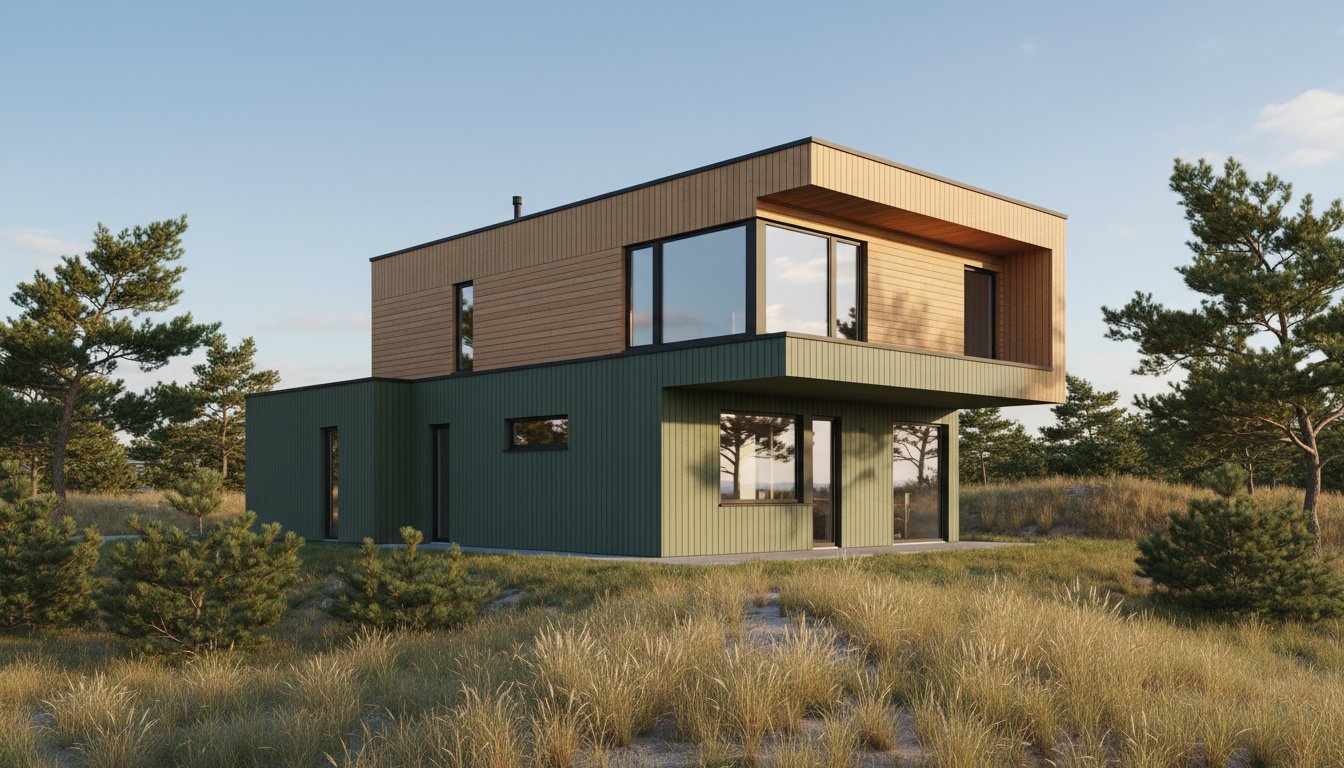
The orientation of your boards dictates the architectural character of your home. Horizontal lines create a grounded, traditional feel that roots a building to its site. Vertical lines draw the eye upward, creating a sense of volume and height. This simple shift in orientation changes how we perceive the entire structure. When exploring exterior wall cladding ideas, consider how shadow lines and profile depth impact curb appeal. Deep grooves create shifting patterns throughout the day as the sun moves across the Swedish sky.
Achieving a professional finish requires precision engineering. We utilize HidLoc™ hidden fastening systems to ensure a seamless facade. These clips eliminate visible screws and hardware. It's a refined approach that preserves the integrity of the board surface. The result is a clean, uninterrupted aesthetic that reflects Nordic reliability and high-end craftsmanship.
Vertical Cladding: Height, Modernity, and Drama
Vertical cladding is the preferred choice for Scandinavian architects in 2026. It offers a bold, contemporary look that feels both disciplined and dramatic. Using vertical WPC boards helps elongate small structures, making them appear more significant. This is a strategic choice for urban builds in cities like Stockholm or Gothenburg where space is at a premium.
Beyond the visual appeal, vertical installation is practical for the Swedish climate. It facilitates rapid water drainage. Gravity pulls moisture down the grooves, preventing the pooling that can occur on horizontal surfaces. This aligns with EKS (Europeiska konstruktionsstandarder) principles for moisture management in northern climates. It's a solution that is built to last and designed for life.
Mixed-Material Textures: Composite and Stone
Contrast creates depth. Pairing wood-look WPC with natural stone or recycled brick is a top choice for modern exterior wall cladding ideas. Use composite boards as a feature wall to highlight an entrance or a balcony. This technique breaks up monolithic walls and adds architectural interest by creating distinct visual zones.
The warmth of our natural-fiber composite balances the cold, industrial texture of masonry. To avoid a cluttered look, limit your palette to two primary materials. Focus on the interplay of textures rather than a variety of colors. Our European-made boards are engineered to maintain their color stability, ensuring your mixed-material facade looks cohesive for decades. We back this engineering confidence with warranties of up to 30 years, providing peace of mind for the sustainable homeowner.
Transform your facade with our professional-grade solutions. Browse the Green Plank cladding collection today to find the perfect profile for your project.
Implementing Your Vision with Green Plank Sustainable Solutions
Selecting the right materials is the final bridge between a conceptual design and a lasting architectural legacy. Green Plank offers a sophisticated range of exterior wall cladding ideas that prioritize both environmental ethics and engineering precision. Our Terra Tuff and Smart System technologies represent the pinnacle of natural-fiber composite evolution. These systems provide a circular solution for modern facades, utilizing 100% traceable raw materials to ensure every plank contributes to a lower carbon footprint without compromising on the refined Nordic character your project demands.
Achieving a seamless transition from indoor to outdoor spaces is a hallmark of contemporary Swedish architecture. By integrating interior WPC wall panels with our high-performance exterior cladding, you create a unified aesthetic that expands the perceived volume of the home. This visual continuity isn't just about style; it's about using engineered materials that resist rot, decay, and the harsh Nordic climate. Our products are built to last and designed for life, ensuring your investment remains as striking in decades to come as it is on the day of installation.
For residential homeowners and commercial specifiers in Sweden, the 50-year limited warranty serves as a definitive statement of confidence. This industry-leading protection reflects our commitment to durability and professional-grade quality. It eliminates the anxiety of frequent maintenance or premature replacement, allowing you to focus on the long-term value of your property. Whether you're designing a private villa or a large-scale commercial infrastructure project, our composite solutions provide the stability and strength required for the most demanding environments.
Scandinavian Design Meets European Manufacturing
Green Plank is an independent, family-owned company rooted in the values of Nordic reliability and ethical craftsmanship. Designed in Scandinavia and produced in Europe, every board is manufactured within the European Union to adhere to the strictest safety and labor standards. This "Made in EU" hallmark ensures that your exterior wall cladding ideas are supported by a transparent supply chain and superior quality control. Green Plank products are specifically engineered for 600 cc private spans, providing the structural rigidity necessary to withstand heavy snow loads and fluctuating temperatures common in Northern Europe.
From Concept to Completion: Working with Project Partners
We don't just supply materials; we act as a dedicated partner for architects and contractors across Sweden. Our team provides comprehensive technical specifications and installation guidance to ensure every project meets local building regulations and performance benchmarks. High-performance cladding is essential for modern commercial infrastructure where longevity and low maintenance are non-negotiable. Take the next step in your design journey by choosing sustainable innovation. Contact us today to transform your vision into a reality that respects both nature and the built environment.
Future-Proofing the Modern Swedish Facade
Selecting the right exterior wall cladding ideas requires a balance between bold aesthetics and environmental durability. As we approach 2026, the Swedish construction landscape is shifting toward circular materials that reduce lifecycle costs and environmental impact. Green Plank leads this transition by offering professional-grade composite systems with a warranty of up to 50 years. These facades are engineered for the demanding Nordic climate, utilizing 100 percent EU-sourced raw materials that adhere to Cradle to Cradle circular ownership principles. The innovative HidLoc™ hidden fastening system ensures a clean, architectural finish without visible screws, preserving the elegant profile of your home. It's a system designed to withstand time while respecting the natural world. By choosing engineered solutions, you don't just build a house; you create a sustainable legacy. Explore our range of high-performance facades to see how Scandinavian design meets European engineering excellence.
Discover Green Plank’s Sustainable Cladding Systems
Take the next step toward a home that is built to last and designed for life.
Frequently Asked Questions about Exterior Wall Cladding
What is the best material for exterior wall cladding in 2026?
Natural-fiber composites represent the premier choice for exterior wall cladding ideas in 2026 because they offer a circular lifecycle and extreme durability. These engineered materials combine the warm aesthetic of Scandinavian timber with advanced polymer technology. They're designed to resist the harsh Nordic climate, effectively preventing the rot and moisture absorption that typically affects traditional softwoods.
How long does composite wall cladding last compared to wood?
High-quality composite cladding typically lasts 25 to 30 years, whereas traditional timber often requires significant repair or replacement after 10 to 15 years. This longevity stems from the material's resistance to UV degradation and fungal growth. Green Plank products come with a 25-year warranty, ensuring your home's exterior remains structurally sound without the frequent replacement cycles of natural wood.
Is WPC wall cladding more expensive than traditional timber?
While the initial purchase price of WPC is often higher than pressure-treated pine, it's a more cost-effective investment over its 30-year lifespan. In Sweden, homeowners can save approximately 15,000 kr to 25,000 kr in maintenance costs over a decade by eliminating the need for annual staining or oiling. The total cost of ownership remains lower because you don't buy expensive paints or hire professional cleaners every few seasons.
Can I install exterior wall cladding myself or do I need a professional?
You can install exterior wall cladding yourself if you've got intermediate carpentry skills and follow the specific technical guidelines provided. However, hiring a certified professional ensures the installation meets Swedish building regulations and maintains the product warranty. Professional installers use specialized hidden fastening systems that allow for natural thermal expansion, which prevents warping during extreme temperature shifts.
How does exterior cladding help with home insulation and energy efficiency?
Exterior cladding creates a rainscreen system that provides a vital thermal break between the outdoor environment and your home's structure. This ventilated air gap reduces heat transfer, which can lower heating demands in Swedish winters by up to 10 percent. It protects the primary insulation layer from moisture, ensuring the building envelope remains dry and thermally efficient throughout the year.
Are Green Plank cladding materials truly eco-friendly and recyclable?
Yes, Green Plank materials are engineered using 100 percent traceable raw materials including recycled wood fibers and polymers. These products are fully recyclable at the end of their service life, supporting a circular economy model. By utilizing reclaimed industrial waste, the manufacturing process reduces the carbon footprint compared to harvesting virgin timber or producing cement-based alternatives.
What maintenance is required for WPC exterior wall cladding?
WPC cladding requires only a simple wash with mild soap and water once or twice a year to remove surface dust. You'll never need to sand, paint, or seal the boards to maintain their structural integrity or appearance. This low-maintenance profile is a core benefit for busy homeowners who want a premium Scandinavian look without the labor-intensive upkeep of traditional wood.
Does composite cladding fade in direct sunlight?
Engineered composite cladding undergoes a minor, controlled color stabilization process during the first 12 to 16 weeks of UV exposure. After this initial period, the color remains consistent and won't fade to the dull grey typical of untreated timber. The pigments are integrated deep into the fiber matrix, ensuring the vibrant Nordic tones last for decades without the need for chemical stains.
Specify the product
Use this guide with a Green Plank specification
Technical articles support the commercial catalogue — category, product, evidence, then samples or quotes.