



Solid or Hollow Composite Decking – What Is the Difference?
When choosing composite decking, colour and surface finish are only part of the decision. One of the most important differences is hidden inside the board itself: should you choose solid or hollow composite decking?
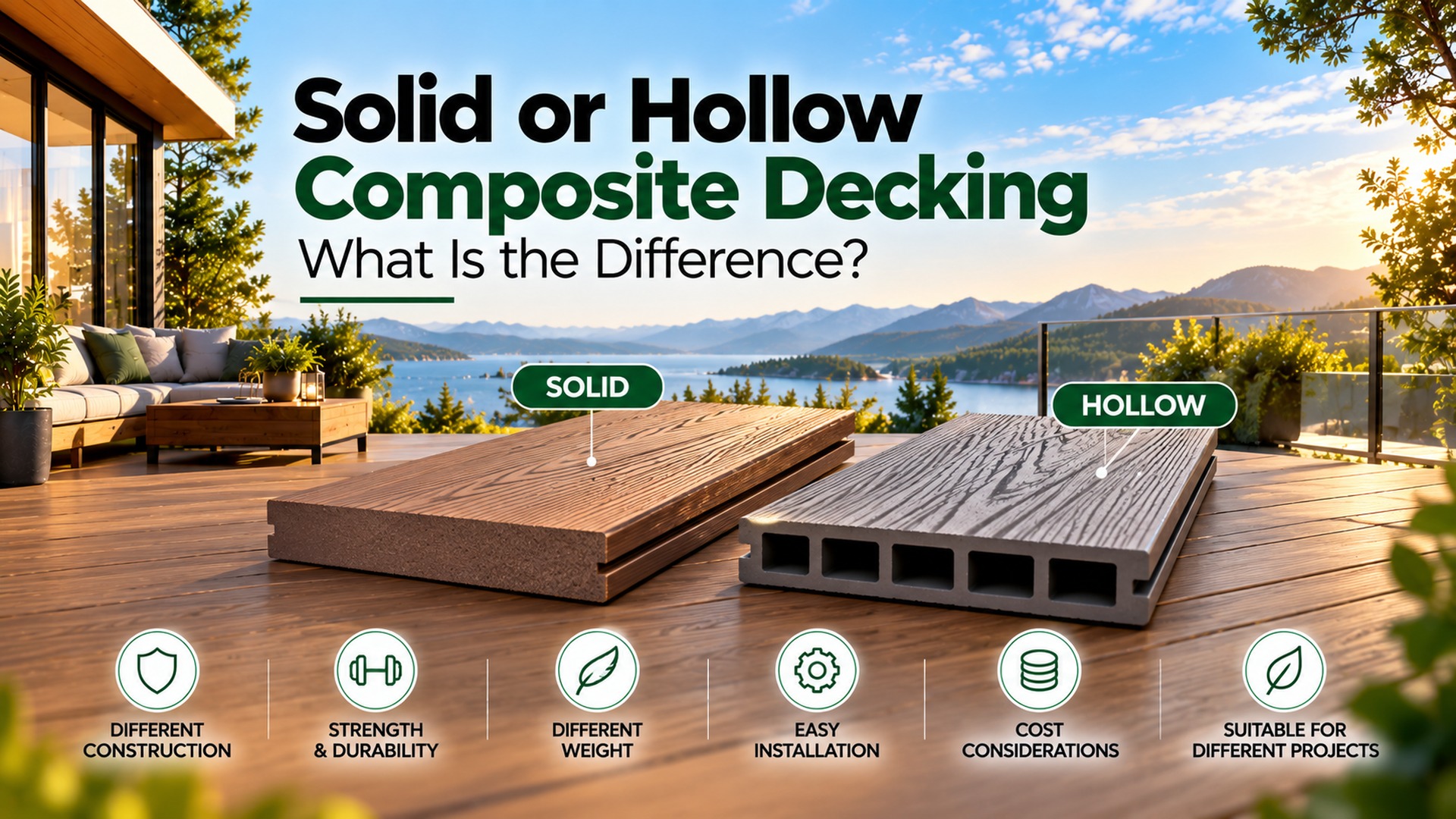
Both designs can create attractive, durable and low-maintenance outdoor spaces, but they achieve their performance through different profile constructions. Solid boards contain more material throughout the cross-section, while hollow boards use engineered internal chambers to optimise material use, weight and handling.
That does not mean solid is automatically better or hollow is simply a budget alternative. Profile geometry, raw materials, manufacturing quality, board dimensions, joist spacing and correct installation all influence how a decking system performs.
Key buying principle: Do not judge composite decking by solid or hollow construction alone. Compare the complete system – board specification, profile geometry, weight, substructure requirements, fixings, technical documentation, warranty and intended application.
1. What Is Solid Composite Decking?
A solid composite decking board has a substantially continuous cross-section rather than the large longitudinal cavities found in hollow profiles. As a result, a solid board will generally contain more material per linear metre than a hollow board of comparable dimensions.
Solid profiles can be attractive for projects where a substantial construction, particular mechanical characteristics or a specific board geometry is required. Within the Green Plank range, Nordeka™ is an example of a solid-profile decking family.
Typical characteristics of solid profiles
- Substantially continuous material through the cross-section.
- Generally heavier than a comparable hollow profile.
- Robust, substantial construction.
- Can suit projects where specific structural characteristics are prioritised.
- Higher board weight may influence transport and site handling.
2. What Is Hollow Composite Decking?
Hollow composite decking contains longitudinal cavities within the profile. These cavities are surrounded by engineered walls and internal ribs designed as part of the board's overall geometry.
The principle is material efficiency: instead of filling the entire cross-section, material is positioned where the profile design requires it. This can reduce board weight and make longer boards easier to transport and handle.
Green Plank Classic™ and Sapphire™ are examples of product families using hollow-profile construction. A hollow board, however, should never be evaluated simply by counting its chambers. Wall thickness, chamber geometry, material formulation and overall board design are all relevant.
3. Solid vs Hollow Composite Decking at a Glance
| Feature | Solid Composite | Hollow Composite |
|---|---|---|
| Construction | Substantially solid cross-section | Engineered internal chambers |
| Material use | Generally higher | Optimised through hollow geometry |
| Weight | Generally heavier | Generally lighter |
| Handling | Weight can be noticeable on long boards | Lower weight can simplify handling |
| Material efficiency | More material across the profile | Internal cavities reduce material use |
| Applications | Depends on product specification | Depends on product specification |
| Cost | Higher material content can influence cost | Can provide efficient material utilisation |
4. Is Solid Composite Decking Stronger?
It is tempting to assume that a solid board must always be stronger than a hollow one. In practice, that comparison is too simple. Mechanical behaviour depends on multiple factors, including board dimensions, profile geometry, wall thickness, material properties, manufacturing consistency and the spacing of the supporting joists.
A properly engineered hollow profile can therefore be designed for demanding applications within its specified installation conditions. Equally, a solid board still needs the correct substructure and installation method to achieve its intended performance.
Look at joist spacing, not only the cross-section
Two boards of similar width can have different installation requirements. Always check the manufacturer's current technical documentation for the recommended support spacing and distinguish between residential and higher-load applications where relevant.
5. How Does Board Weight Affect a Project?
Weight becomes increasingly important as project size grows. It influences transport, unloading, storage and the amount of material installers must physically move around the site.
A lighter hollow profile can offer practical handling advantages, particularly with longer board lengths. A solid profile, on the other hand, may be preferred where the project specification calls for its particular construction and material content.
For an accurate comparison, ask suppliers for both weight per linear metre and installed board weight per square metre. This provides a much more useful basis than simply describing one product as heavy or light.
6. Solid vs Hollow Is Only Part of the Story
Another important distinction is whether the decking has a traditional composite surface or an additional co-extruded protective layer. Co-extrusion applies a separate outer layer around the composite core during manufacturing, creating a different surface construction from conventional uncapped WPC.
Green Plank TerraTuff™ is positioned as a premium co-extruded decking solution. This illustrates why buyers should examine both the internal profile and the surface technology rather than treating all composite boards as equivalent.
Four questions worth asking together
- Is the board solid or hollow?
- Is it traditional composite or co-extruded?
- What joist spacing is specified for the intended application?
- What installation and warranty conditions apply?
7. Which Is Better for a Residential Deck?
For a typical residential terrace, both solid and hollow composite decking can be suitable when the selected product is designed and correctly installed for that application.
Hollow decking can be attractive when lower board weight, easier handling and efficient material use are priorities. Solid decking may appeal when a substantial profile construction or particular technical specification is preferred.
The best choice therefore depends on the project rather than one universal rule. Consider the deck size, expected use, substructure, installation conditions, desired appearance, budget and long-term requirements.
8. The Substructure Matters Just as Much
Even a high-quality composite board depends on correct installation. Joist spacing, ventilation, drainage, fastening and allowance for thermal movement can all influence the finished deck.
- Follow the product-specific joist-spacing requirements.
- Provide adequate ventilation beneath the decking.
- Design the structure so water can drain effectively.
- Use the recommended clips, screws and accessories.
- Maintain the specified expansion clearances around fixed structures.
- Follow the current installation instructions for the selected product.
This is particularly important when comparing products because a board price alone does not reveal how much substructure or how many fixings will be required per square metre.
9. What About Price?
Solid profiles generally use more composite material, but the retail or project price is influenced by much more than board weight. Raw materials, surface technology, manufacturing process, dimensions, logistics, warranty and product positioning can all affect the final cost.
| Cost Factor | What to Check |
|---|---|
| Decking per m² | Compare equivalent installed coverage |
| Substructure | Check the required joist spacing |
| Clips and screws | Include the complete fastening system |
| Waste | Consider board lengths and deck geometry |
| Transport | Board weight and length can affect logistics |
| Warranty | Compare coverage and conditions, not only years |
10. Material Formulation Matters Too
The words solid and hollow describe profile geometry, not material quality. WPC typically combines wood or natural fibre with a thermoplastic polymer and functional additives, but formulations vary between manufacturers and product families.
Selected Green Plank products use a high proportion of European wood fibre combined with HDPE and functional additives. Buyers comparing decking should therefore examine the material specification alongside profile design, rather than assuming that all boards labelled WPC have the same composition or performance.
11. Green Plank Options for Different Projects
Green Plank offers different decking constructions for different project requirements. Nordeka™ provides a solid-profile option, while Classic™ and Sapphire™ include hollow-profile solutions. TerraTuff™ provides a premium co-extruded alternative for buyers looking for a different surface and performance concept.
The right product should be selected by considering profile construction, dimensions, surface finish, installation requirements, intended application and current warranty terms together.
Before choosing your decking, check:
- Solid or hollow profile construction.
- Traditional or co-extruded surface technology.
- Board dimensions and weight per metre.
- Specified joist spacing for your application.
- Required clips, screws and accessories.
- Ventilation, drainage and expansion requirements.
- Complete installed cost per square metre.
- Technical documentation and warranty conditions.
- Physical product samples before final selection.
Solid or Hollow Composite Decking – Which Should You Choose?
There is no single winner for every terrace. Solid composite decking provides a substantial profile with more material through the cross-section, while hollow decking can combine lower weight with efficient material utilisation. Both can be effective solutions when properly engineered and installed for their intended application.
Instead of choosing by profile type alone, compare the complete decking system. Technical specifications, substructure, installation, surface technology, material formulation, warranty and total project cost provide a much stronger basis for making the right decision.
Explore Green Plank composite decking and find the right profile for your project: www.greenplank.eu
Sources
- Green Plank – official product and company information
- ISO 15686-5 – Buildings and constructed assets: Life-cycle costing
- European Commission – Construction Products Regulation
Specify the product
Use this guide with a Green Plank specification
Technical articles support the commercial catalogue — category, product, evidence, then samples or quotes.