



How Do Temperature Changes Affect Composite Decking?
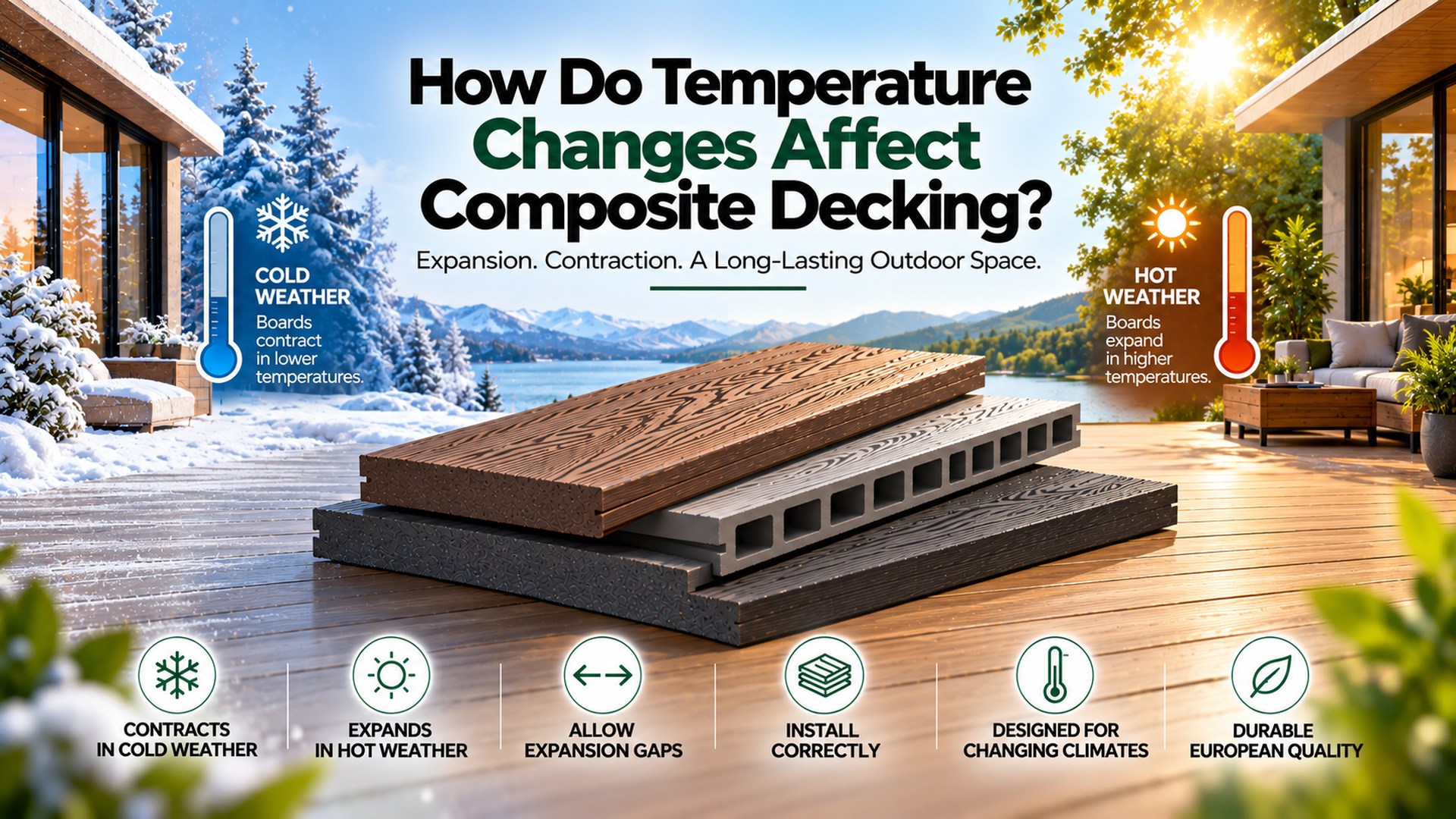
A deck can experience substantial temperature changes throughout the year. Cold winter conditions, rapid spring temperature swings and strong summer sunshine all affect outdoor building materials. Composite decking is no exception: as temperatures change, boards can expand and contract.
Composite decking, often described as WPC or wood-plastic composite, combines wood or natural fibres with a thermoplastic polymer and functional additives. Because the polymer component responds to temperature, composite boards generally expand as they become warmer and contract as they become colder. The amount of movement depends on the formulation, profile design, board length, temperature range and installation method.
Key principle: Thermal movement is a normal material characteristic, not automatically a product defect. A correctly designed deck allows the boards enough space to move without creating unnecessary stress in the system.
1. Why Does Composite Decking Expand and Contract?
Wood-plastic composites combine materials with different physical properties. Research into WPC materials shows that thermal behaviour is influenced by both the polymer matrix and the wood-fibre content. This is why one universal expansion value should not be applied to every composite decking product.
As a board warms, its dimensions can increase slightly. When it cools, the opposite occurs. The effect becomes particularly relevant along the length of longer boards because even a relatively small dimensional change per metre accumulates across the total board length.
| Condition | Typical response | Installation consideration |
|---|---|---|
| Rising temperature | Board expands | Provide the specified movement space |
| Falling temperature | Board contracts | Avoid incorrectly restricting board movement |
| Longer board | Greater total length movement | Plan joints and end clearances carefully |
| Frequent temperature changes | Repeated expansion and contraction | Follow product-specific installation instructions |
2. Air Temperature Is Not the Same as Deck Surface Temperature
One important consideration is the difference between ambient air temperature and the actual temperature of the decking surface. A deck exposed to direct sunlight can become considerably warmer than the surrounding air. Colour, solar exposure, ventilation and the characteristics of the surface all influence heat build-up.
This means the same board can experience different conditions on a south-facing terrace exposed to strong sunlight compared with a shaded deck. It is one reason installers should follow instructions for the specific decking system rather than copying expansion gaps or installation details from an unrelated composite product.
Factors that can influence temperature exposure
- Board colour and surface finish.
- Direct versus indirect sunlight.
- Ventilation beneath the deck.
- Board length and profile geometry.
- Material formulation.
- Material temperature during installation.
- Local climate and site orientation.
3. Why Expansion Gaps Matter
Composite boards should not be installed in a way that prevents their intended movement. Appropriate clearances at walls, fixed structures, board ends and joints help the decking system accommodate changes caused by temperature.
If a long board expands but is constrained by a fixed object, stresses can develop. With an incorrectly installed system, boards may press against neighbouring components, joints may change or fasteners may be subjected to unnecessary forces.
Use product-specific installation guidance
The correct expansion clearance can depend on the product, board length, profile and installation temperature. Always use the current Green Plank installation instructions for the specific decking range rather than relying on one generic gap for every WPC product.
4. Installation Temperature Makes a Difference
The conditions on installation day are relevant. A board installed while cold has greater potential to expand when exposed to warmer summer conditions. A board installed while already warm may subsequently contract as temperatures fall.
Installers should therefore consider the material temperature and follow the manufacturer's requirements for end gaps, joints, fixed boundaries and fastening arrangements.
A practical installation sequence
- Store boards flat and according to the supplier's recommendations before installation.
- Read the current installation guide for the selected profile.
- Plan board direction, lengths and joints before fixing begins.
- Consider temperature conditions at the time of installation.
- Maintain the specified clearances from walls and fixed structures.
- Use the recommended clips, screws and fastening components.
- Provide appropriate ventilation and drainage beneath the deck.
5. What Happens to Composite Decking in Winter?
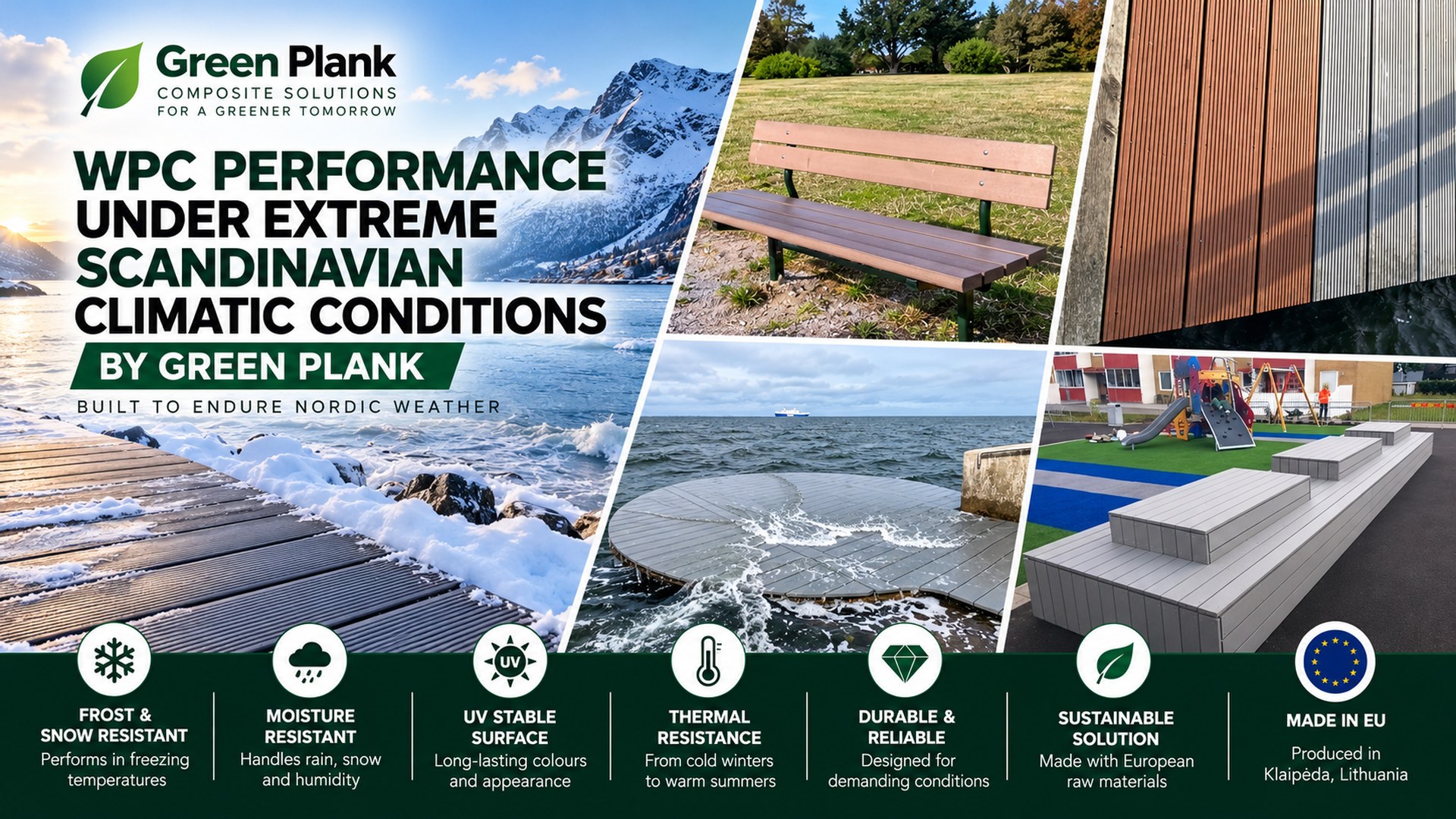
Cold climates expose outdoor structures to more than low temperatures. Moisture, snow, ice and repeated freeze-thaw conditions can all form part of the service environment. Green Plank positions its European-made decking systems for demanding European and Nordic outdoor conditions.
Temperature is only one consideration. Research by the U.S. Forest Products Laboratory has also examined moisture behaviour and durability in wood-plastic composites. Good drainage, ventilation and correct construction should therefore form part of the complete deck design.
During colder conditions, composite boards normally contract. The installation system needs to accommodate this movement while continuing to provide appropriate support along the length of each board.
6. What Happens During Hot Summer Weather?
In summer, solar radiation becomes particularly important. As the surface temperature rises, composite boards can expand. Darker surfaces can absorb more solar energy than lighter surfaces, making colour and exposure relevant considerations for decks receiving intense direct sunshine.
Green Plank offers different decking constructions through ranges including TerraTuff™, Nordeka™, Classic™ and Sapphire™. Because these products use different profile designs and constructions, installation requirements should always be checked against the current technical information for the chosen range.
7. Why Board Length Matters
Thermal expansion is related to both temperature change and material length. A longer continuous board therefore has a greater potential total dimensional change than a shorter board made from the same material under the same temperature variation.
The general engineering relationship can be expressed as:
Dimensional change = coefficient of thermal expansion × board length × temperature change.
This formula illustrates why length matters, but the coefficient should be relevant to the specific material. A generic value from another composite product should not be assumed to apply to every WPC decking board.
| Design consideration | Why it matters |
|---|---|
| Board length | Influences total longitudinal movement |
| End-to-end joints | Need to accommodate specified movement |
| Fixed boundaries | Require suitable clearance from the boards |
| Fastening system | Must be installed according to system instructions |
| Substructure | Provides the required support for the decking system |
8. Common Installation Mistakes
Some issues attributed to composite decking can be related to installation rather than the material itself. Problems are more likely when normal movement has not been considered during design and installation.
- Insufficient clearance from a wall or other fixed structure.
- Incorrect gaps at board-end joints.
- Using fasteners in a way that restricts intended movement.
- Excessive spacing between supporting joists.
- Insufficient ventilation beneath the decking.
- Poor drainage that allows water to remain around the structure.
- Installing without considering board temperature.
9. Material Formulation and Profile Design Work Together
Thermal performance cannot be judged simply by asking how much wood fibre or polymer a composite board contains. Polymer characteristics, fibre type, additives, profile geometry and manufacturing conditions all contribute to the behaviour of the finished product.
Research on wood-plastic composites has shown that the addition of wood fibre can alter thermal expansion characteristics compared with the polymer alone. This reinforces the importance of using product-specific technical information instead of making assumptions based on the general term "composite decking".
10. Installation Checklist for Changing Temperatures
- Select decking suitable for the intended outdoor environment.
- Read the latest product-specific installation instructions.
- Plan board lengths and joints before installation.
- Consider material temperature during installation.
- Maintain specified expansion and perimeter clearances.
- Use compatible clips and fastening components.
- Follow the specified joist or support spacing.
- Provide adequate ventilation and drainage.
- Do not restrict the board's intended thermal movement.
- Ask the supplier for technical guidance when the construction is unusual.
Temperature Changes Are Normal – Correct Installation Matters
Composite decking is designed for outdoor use, but like other construction materials it responds to its environment. Expansion during warmer conditions and contraction during colder periods are normal physical responses.
A successful deck therefore combines the right product with careful design and installation. Appropriate expansion space, correct substructure spacing, suitable fastening, ventilation and drainage allow the decking system to accommodate seasonal temperature changes more effectively.
For homeowners, architects, installers and professional buyers, the most important rule is simple: follow the technical requirements of the specific decking product rather than relying on a universal installation gap.
Explore Green Plank composite decking, product ranges and current technical information at Green Plank Europe.
Sources
- Green Plank – Composite decking and product information
- U.S. Forest Products Laboratory – Wood/Nonwood Thermoplastic Composites
- U.S. Forest Products Laboratory – Fungal and Moisture Durability of Wood-Plastic Composites
Specify the product
Use this guide with a Green Plank specification
Technical articles support the commercial catalogue — category, product, evidence, then samples or quotes.