



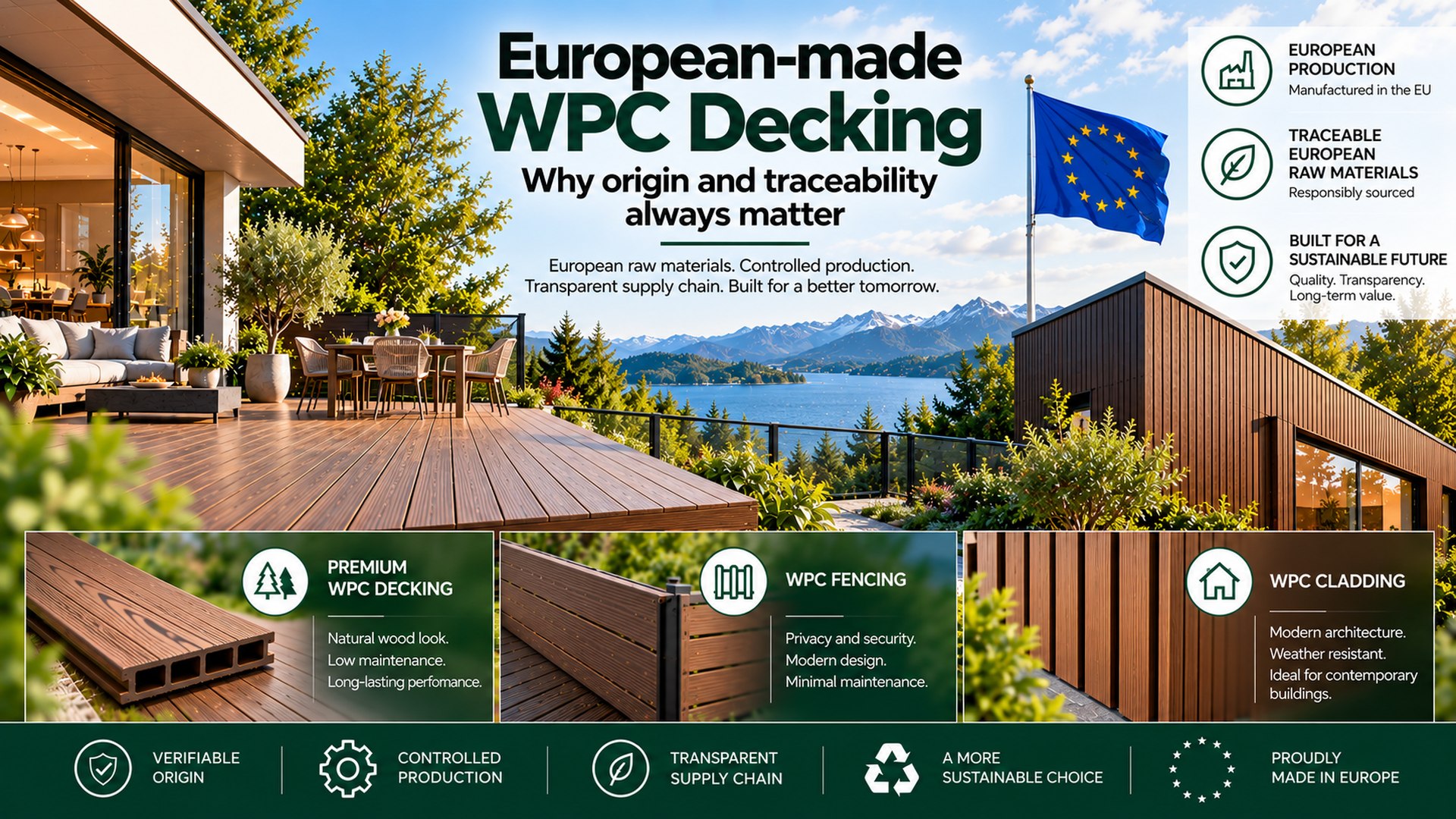
European-made WPC decking: Why origin and traceability always matter
When comparing WPC decking, buyers naturally look at colour, surface texture, profile design and price. Yet two questions deserve equal attention: Where was the decking actually manufactured, and can the origin of its key raw materials be traced?
For a product expected to remain outdoors for many years, origin is more than a label on the packaging. Material selection, manufacturing control, technical documentation, installation guidance and supply-chain transparency all contribute to an informed purchasing decision.
Green Plank is a Swedish brand with European production in Klaipėda, Lithuania. Its approach focuses on European manufacturing, European-sourced raw materials and traceability, creating a closer connection between material sourcing, production and the European market.
Traceability matters: A meaningful Made in Europe strategy is not simply about where the final board leaves the production line. Buyers should also ask where the principal materials come from, how the product is manufactured and what technical information supports it.
What is WPC decking?
WPC stands for Wood Plastic Composite. The material typically combines wood or other natural fibres with a thermoplastic polymer and functional additives. These ingredients are processed and extruded into profiles designed for decking and other exterior applications.
However, WPC is a broad material category rather than a single quality standard. Products that look similar can have different formulations, polymer systems, fibre content, profile geometries and manufacturing processes. These differences can influence mechanical behaviour, dimensional movement, weight, installation requirements and long-term performance.
Why does the origin of composite decking matter?
Country of origin alone does not prove that one decking board is technically superior to another. High-quality products can be manufactured in many regions. What matters is the level of transparency and control behind the finished product.
For European retailers, architects, contractors and project buyers, regional production can provide practical advantages when it is supported by documented sourcing and professional technical support.
| What to check | Why it matters |
|---|---|
| Manufacturing location | Identifies where the finished decking profile is actually produced. |
| Raw-material origin | Provides greater visibility into the product supply chain. |
| Material formulation | Helps buyers understand what the composite contains. |
| Technical documentation | Supports specification, installation and product comparison. |
| Quality control | Helps maintain consistency between production batches. |
| Manufacturer support | Provides a clear contact for technical and commercial questions. |
Traceability starts with raw materials
In practical terms, traceability means being able to connect a finished product with defined material sources and production processes. For WPC decking, this can include the wood or natural fibre, polymer, functional additives and manufacturing batches used to produce the profile.
This is particularly relevant for professional procurement. Rather than accepting a general statement about product origin, buyers can ask more specific questions about where the principal raw materials originate and how their consistency is controlled.
Seven questions to ask a WPC decking supplier
- Where are the decking boards manufactured?
- Where do the wood fibres and polymer originate?
- Is the material formulation controlled and documented?
- How are incoming raw materials and production batches monitored?
- Are technical data and installation instructions available?
- What warranty applies to the specific product?
- Who provides technical support if a project question arises?
European production and European raw materials
Green Plank manufactures its composite products in Klaipėda, Lithuania, within the European Union. The company's material strategy focuses on European-origin raw materials and traceability throughout its supply chain.
Selected Green Plank formulations use a high proportion of European hardwood fibre, including beech and oak, together with HDPE and functional additives. Exact formulations vary by product family, so composition and technical characteristics should always be confirmed against the documentation for the specific decking system.
For building-material retailers and project customers, this approach provides more than a country-of-origin statement. It creates a clearer link between material sourcing, manufacturing, product development and the company supplying the finished decking.
Why formulation and production control belong together
A good WPC formulation is only one part of producing a reliable decking board. Raw-material preparation, moisture management, accurate dosing, mixing, extrusion parameters, cooling and profile geometry all influence the finished product.
For this reason, a high percentage of wood fibre should not be treated as a stand-alone measure of quality. The fibre, polymer matrix, coupling system, additives and manufacturing process must work together as a complete material system. Technical literature from the U.S. Forest Products Laboratory similarly describes wood-plastic composites as materials whose properties depend on both constituents and processing.
From raw material to finished decking
- Selection and inspection of raw materials.
- Preparation of wood or natural fibres.
- Controlled dosing of polymer and functional additives.
- Mixing according to the defined formulation.
- Extrusion into the required profile geometry.
- Cooling, surface finishing and cutting.
- Quality checks before packaging and distribution.
TerraTuff™, Nordeka™, Classic™ and Sapphire™
Green Plank offers several composite decking families for different applications and design requirements, including TerraTuff™, Nordeka™, Classic™ and Sapphire™. They provide different profile constructions, surfaces and product options rather than a single universal decking solution.
TerraTuff™ is Green Plank's premium co-extruded decking range. Co-extrusion combines the composite core with an additional protective outer layer during manufacturing. Selected TerraTuff products carry a residential warranty of up to 50 years, depending on the particular product and applicable warranty conditions.
A warranty should not be confused with a guaranteed service life. Buyers should always review the warranty terms, technical data, intended application and installation requirements for the exact product being specified.
Made in Europe should not be used as a shortcut for quality
European origin should be evaluated fairly. A product is not automatically better simply because it is manufactured in Europe, just as an imported product is not automatically inferior. Technical quality needs evidence.
The value of a transparent European supply chain comes from combining known origin, controlled materials, documented manufacturing, accessible technical information and supplier support. These are stronger purchasing criteria than geography alone.
Traceability and the professional buyer
For builders' merchants, distributors, architects and contractors, product sourcing involves more than choosing an attractive board. A decking system also has to fit commercial, technical and logistical requirements.
| Basic comparison | More professional evaluation |
|---|---|
| Price per linear metre | Installed system and material requirement per m² |
| Colour | Colour, profile, surface and application |
| Brand name | Manufacturer, factory location and traceability |
| Warranty years | Warranty scope, exclusions and conditions |
| Decking board | Boards, substructure, clips and accessories |
| Current stock | Supply continuity and replenishment capability |
A European supply chain can simplify planning
Supply reliability matters when decking is sold through professional distribution or specified for larger projects. Long-distance sourcing may require longer planning cycles, larger order quantities and additional inventory management.
Manufacturing within Europe reduces the geographical distance between the production site and many European markets. Depending on stock, production schedules, order volume and destination, this can support closer communication, sampling, production planning and replenishment. It should not, however, be interpreted as a universal guarantee of a particular delivery time.
Installation is part of product performance
Even well-manufactured WPC decking requires correct installation. Substructure design, joist spacing, ventilation, drainage, fastening and expansion gaps all need to match the chosen profile and its installation instructions.
Composite decking also responds to temperature changes by expanding and contracting. The correct movement allowance depends on factors including profile design, board length and installation temperature. This is why project-specific and product-specific installation instructions are more reliable than applying one universal gap to every WPC board.
Before ordering, check the complete system
- Current technical data sheet and installation guide.
- Profile dimensions and construction.
- Permitted joist spacing for the intended application.
- Expansion and perimeter clearance requirements.
- Compatible clips, screws and finishing profiles.
- Drainage and ventilation requirements.
- Product-specific warranty conditions.
Traceability is also about accountability
When buyers know who manufactured a product, where it was made and how to reach the supplier, the relationship becomes more transparent. This can be especially valuable for retailers and professional projects where technical questions may arise before, during or after installation.
Traceability therefore has a commercial dimension as well as a material one. It creates a clearer chain of responsibility from raw-material sourcing through manufacturing to the finished decking system.
A better way to compare decking: Do not ask only how much the board costs. Ask what it is made from, where it was produced, how it should be installed, what documentation supports it and who stands behind the product.
Origin should be part of every WPC decking decision
Appearance and price will always matter when choosing composite decking, but they should not be the only criteria. Origin, raw-material traceability, manufacturing control, technical documentation, installation requirements and supplier support provide a much fuller picture of the product being purchased.
Green Plank combines Swedish brand and product development with manufacturing in Lithuania and a focus on European raw materials and traceability. The result is a European-made WPC alternative for homeowners, retailers, architects and professional buyers who want to understand not only what their decking looks like, but also where it comes from and what stands behind it.
Explore European-made composite decking and product information at Green Plank.
Sources
- Green Plank – European composite decking and product information
- U.S. Forest Products Laboratory – Wood/Nonwood Thermoplastic Composites
- U.S. Forest Service – Research on Wood-Plastic Composites
- European Commission – Construction Products Regulation
Specify the product
Use this guide with a Green Plank specification
Technical articles support the commercial catalogue — category, product, evidence, then samples or quotes.