



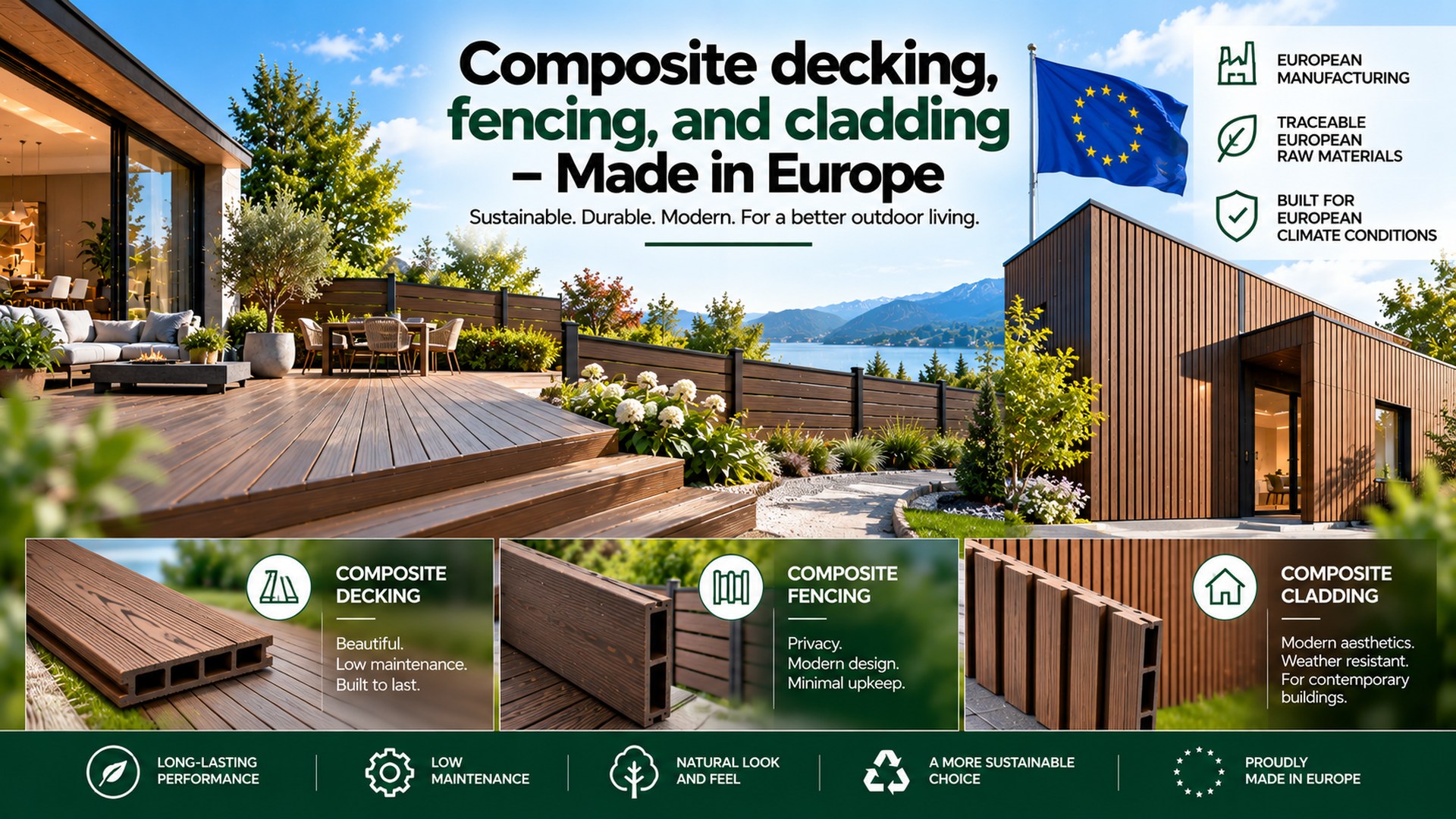
Composite Decking, Fencing and Cladding – Made in Europe
Outdoor building materials are increasingly evaluated on more than appearance and initial price. Homeowners, architects, contractors, developers and building-material retailers also want to understand where products are manufactured, where their raw materials originate, how they perform, what maintenance they require and how reliably they can be supplied.
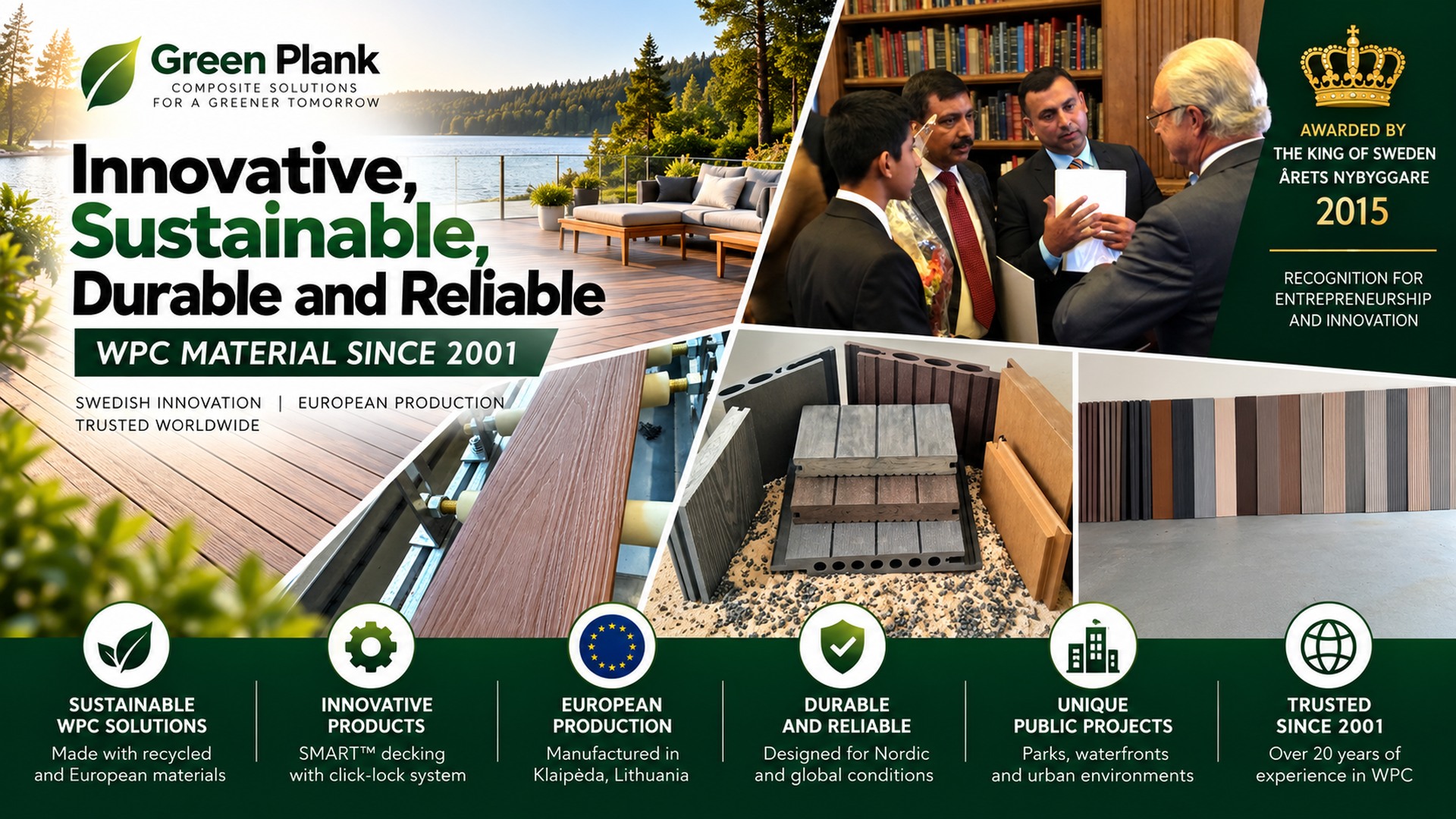
Green Plank is a Swedish brand offering European-made composite decking, fencing and cladding for residential, commercial and professional outdoor projects. With production in Klaipėda, Lithuania, the focus is on European manufacturing, European raw materials, traceability, Scandinavian-inspired design and solutions developed for European market requirements.
Made in Europe: For Green Plank, European production means a closer and more transparent supply chain – connecting raw materials, manufacturing, quality control, technical support and distribution within the European market.
Why Choose Composite Materials for Outdoor Living?
Wood Plastic Composite, commonly known as WPC, combines wood or natural fibres with a thermoplastic polymer and functional additives. The result is a versatile material that can be extruded into profiles for decking, fencing and exterior cladding.
One of the practical advantages of composite products is their relatively low maintenance requirement. Unlike conventional timber products that may require periodic painting, staining or oiling, composite profiles are designed to retain their function without the same routine surface-treatment cycle. Cleaning and normal care are still necessary, but ongoing maintenance can be significantly simplified.
Three Product Categories – One Architectural Language
| Product | Typical Applications | Key Considerations |
|---|---|---|
| Composite decking | Terraces, balconies, patios and public spaces | Profile, surface, substructure, installation and maintenance |
| Composite fencing | Gardens, patios, privacy screens and boundaries | Privacy, design, stability and low maintenance |
| Composite cladding | Homes, commercial buildings and architectural features | Ventilation, fixing, façade design and weather exposure |
European Manufacturing and Traceable Raw Materials
Green Plank manufactures composite products in Klaipėda, Lithuania, within the European Union. The company focuses on European raw materials and traceability throughout its supply chain. For professional buyers, this provides a clearer connection between material sourcing, manufacturing and the finished product.
European production can also simplify communication regarding technical specifications, colours, profiles, samples and delivery planning. A geographically closer production base can reduce dependence on very long intercontinental supply routes, although environmental performance should always be assessed using appropriate product-specific data rather than origin alone.
What Can European Production Offer?
- A production base closer to European customers and projects.
- Traceability of materials through the European supply chain.
- Shorter geographical supply routes compared with intercontinental sourcing.
- Closer communication on technical requirements and product development.
- Products developed with European applications and market expectations in mind.
Composite Decking for Residential and Professional Projects
A successful terrace needs to combine appearance, structural planning and practical performance. Green Plank offers several decking families, including TerraTuff™, Nordeka™, Classic™ and Sapphire™, providing different profile constructions, finishes and design possibilities.
When comparing composite decking, price per linear metre should not be the only criterion. Profile construction, board dimensions, substructure requirements, fixing system, surface technology, documentation, warranty and maintenance all influence the complete decking solution.
What Should You Compare Before Buying Composite Decking?
- Where the product and its principal raw materials originate.
- Whether the board is solid, hollow or co-extruded.
- The specified joist spacing for the selected profile and application.
- How thermal expansion and contraction must be accommodated.
- Which clips, screws and accessories form part of the system.
- The warranty applicable to the specific product range.
- Availability of installation instructions and technical support.
TerraTuff™ – Premium Co-Extruded Composite Decking
TerraTuff™ is Green Plank's premium co-extruded decking range. Its construction combines a composite core with a protective outer layer designed to provide a contemporary wood-inspired appearance and a low-maintenance surface for outdoor living.
TerraTuff™ is manufactured in Europe and is available in multiple colours and lengths. Selected TerraTuff products are offered with a residential warranty of up to 50 years, depending on the specific product and applicable warranty conditions. Buyers should always consult the current product documentation for exact warranty terms.
Composite Fencing – Privacy Meets Contemporary Design
Fencing has become an important architectural element of modern outdoor spaces. A well-designed fence can provide privacy, define different areas and visually connect a terrace with the surrounding landscape.
Green Plank composite fencing provides an alternative to traditional timber fencing for gardens, terraces, residential developments and selected commercial environments. The objective is a clean, coordinated appearance with reduced requirements for recurring surface treatments.
- Suitable for privacy and screening applications.
- Contemporary appearance for modern outdoor spaces.
- No routine painting or staining cycle like conventional painted timber.
- Can visually coordinate with composite decking and other exterior elements.
- Designed as part of a complete outdoor-living concept.
Composite Cladding for Modern Architecture
Composite materials are no longer limited to horizontal surfaces. Exterior WPC cladding can be used to introduce warm, wood-inspired textures and strong architectural lines to houses, entrances, offices, hospitality projects and commercial buildings.
Ribbed and linear profiles are particularly well suited to contemporary Scandinavian-inspired architecture. They can create visual depth while helping designers connect façades with terraces, fencing and landscape elements.
As with any exterior cladding system, successful performance depends on correct design and installation. Substructure, ventilation, fixing details, expansion requirements and transitions around windows, doors and corners should be planned according to the relevant product instructions and project requirements.
Designed for Changing European Conditions
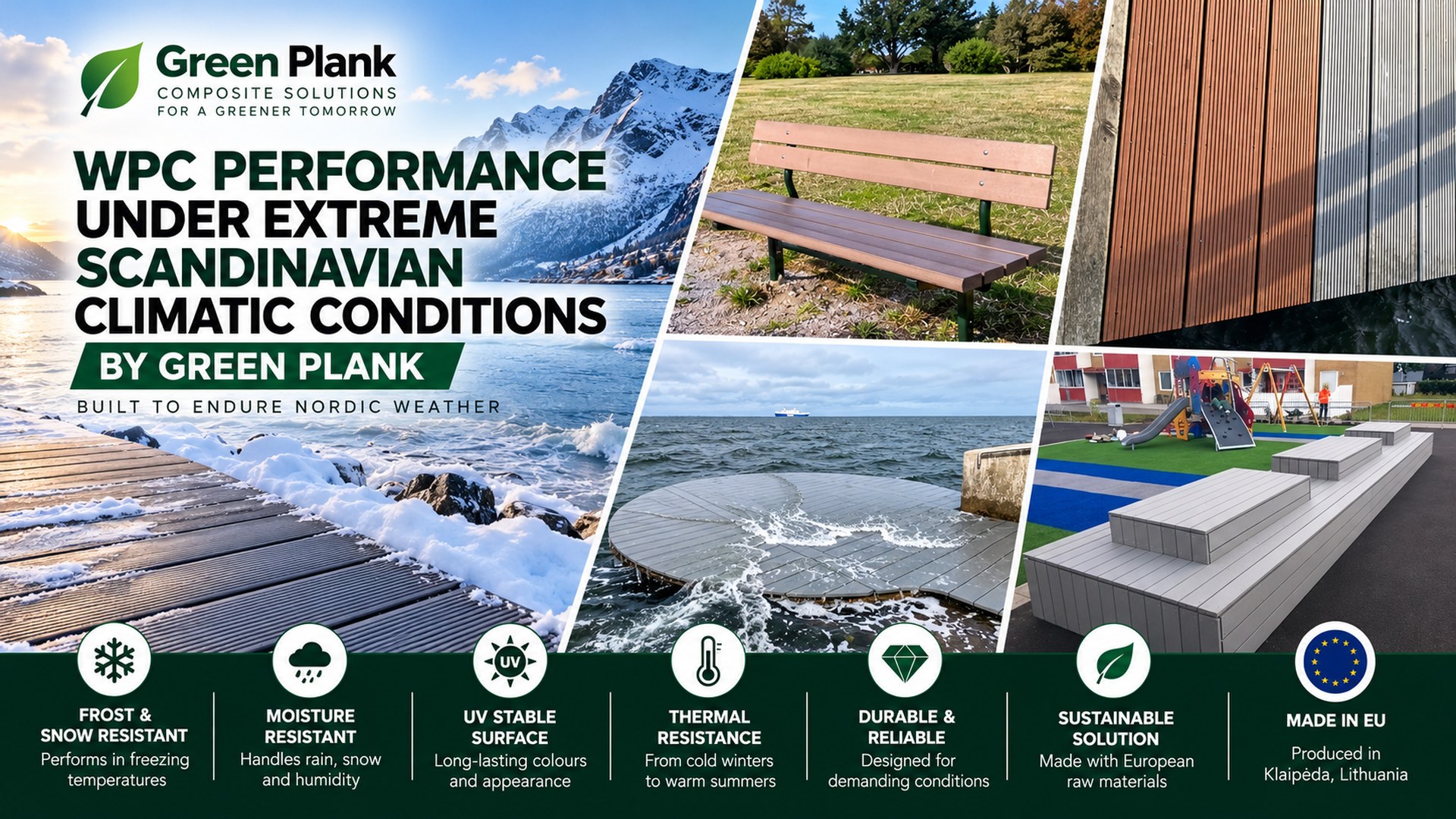
Outdoor building products across Europe encounter rain, moisture, sunlight, frost and substantial seasonal temperature variations. In Nordic markets, these changes can be particularly demanding. Product selection therefore needs to be considered together with correct construction and installation.
For decking, adequate drainage and ventilation are important, while the supporting structure must follow the specified spacing for the selected profile. Composite materials can also expand when heated and contract when cooled, making product-specific expansion clearances an important part of installation.
| Outdoor Condition | What Should Be Considered? |
|---|---|
| Rain and moisture | Drainage, ventilation and correct construction |
| Temperature changes | Product-specific expansion clearances |
| Structural loads | Correct joist spacing and substructure |
| Sun exposure | Product selection, colour and surface temperature |
| Long-term use | Correct installation, cleaning and routine inspection |
A Complete Solution for Building-Material Retailers
For distributors and building-material retailers, a composite supplier is more than a manufacturer of individual boards. A successful product category also requires accessories, technical documentation, samples, sales support, dependable supply and a range that serves different customer segments.
Green Plank's European manufacturing platform is intended to support cooperation with distributors, merchants, contractors, architects and project customers. Having production within the EU also creates opportunities for closer dialogue regarding colours, lengths, product development and market-specific requirements.
For Architects, Contractors and Developers
Professional projects require careful evaluation of the complete system. An architect may prioritise colour, profile geometry and visual continuity, while an installer will focus on substructure, fixing and installation details. A developer or purchasing manager may also consider delivery reliability, documentation, maintenance and lifecycle value.
A Practical Specification Checklist
- Confirm the exact product and intended application.
- Review technical data and installation instructions.
- Verify board dimensions, lengths and profile construction.
- Confirm substructure and fixing requirements.
- Review expansion and ventilation requirements.
- Check colour samples under realistic daylight conditions.
- Verify the warranty for the selected product.
- Plan accessories and finishing details as part of the complete system.
Look Beyond the Initial Purchase Price
Initial material cost is only one part of an outdoor project's economics. ISO 15686-5 provides principles for life-cycle costing of buildings and constructed assets. Applied practically to decking, fencing or cladding, this means considering initial materials and installation together with maintenance, repairs and potential future replacement.
Composite products can be attractive in this context because they are designed to reduce recurring surface-treatment requirements. However, actual lifecycle cost varies by project, environment, installation quality and maintenance regime. A credible comparison should therefore use real project assumptions rather than a universal cost claim.
One Material Family for a Coordinated Outdoor Environment
Using composite decking, fencing and cladding together can create visual continuity across an entire property. A terrace can flow into a privacy screen, while related façade textures can connect the building architecture with the landscape.
This system-oriented approach is relevant for private homes as well as residential developments, hospitality environments and commercial projects. Instead of selecting each exterior component in isolation, designers can consider colour, texture, profile and detailing as one coordinated concept.
Made in Europe – Built Around Traceability and Design
Composite decking, fencing and cladding provide versatile options for modern outdoor environments where design, practical maintenance and material performance all matter. European manufacturing adds another dimension by bringing sourcing, production and customers into a closer regional supply chain.
Green Plank combines European manufacturing, traceable European materials, Scandinavian-inspired design and technical product development across a growing range of outdoor composite solutions.
Explore Green Plank composite decking, fencing and cladding at Green Plank.
Sources
- Green Plank – composite decking and outdoor products
- Green Plank – composite fencing
- U.S. Forest Products Laboratory – Wood/Nonwood Thermoplastic Composites
- ISO 15686-5 – Life-cycle costing
Specify the product
Use this guide with a Green Plank specification
Technical articles support the commercial catalogue — category, product, evidence, then samples or quotes.