



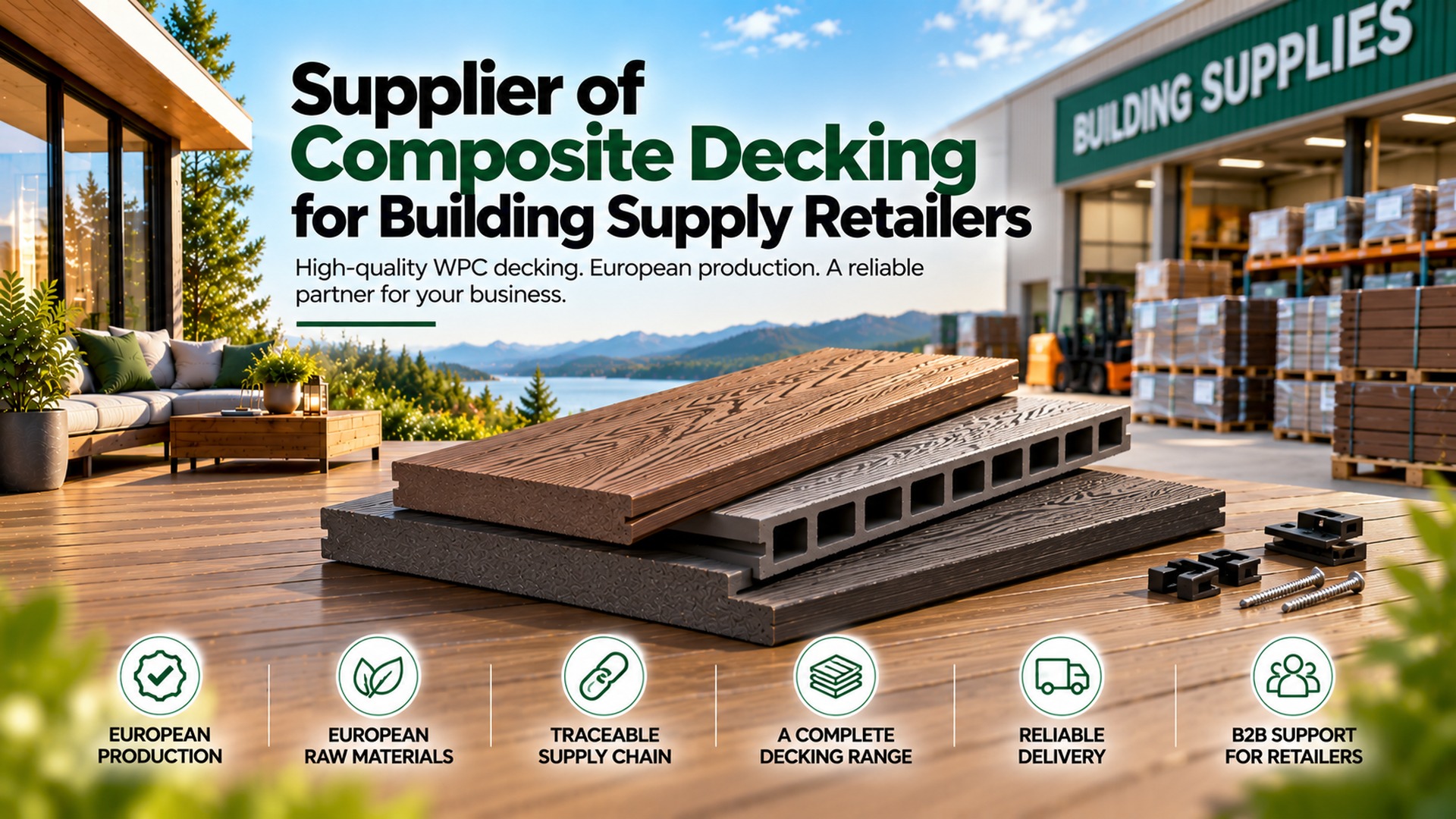
Supplier of Composite Decking for Building Supply Retailers
For building supply retailers, choosing a composite decking supplier involves much more than comparing colours and purchase prices. A successful decking range must work throughout the commercial chain – from purchasing and inventory planning to showroom presentation, installation guidance, technical support and after-sales service.
A professional composite decking supplier for building supply retailers should therefore provide more than boards. Retailers need clear information about material origin, product construction, installation requirements, accessories, warranties and availability. Samples, technical documentation and responsive support can be equally important when helping homeowners, installers and professional contractors make confident purchasing decisions.
Green Plank® is a Swedish brand with European production of composite products for outdoor living and construction. Its decking portfolio includes different profile constructions and product families designed to give retailers options for different customer groups, budgets and project requirements.
For professional buyers: The lowest price per linear metre does not necessarily represent the best commercial value. Product consistency, traceability, availability, technical documentation, installation systems and supplier support should be considered together.
1. Why composite decking is an important retail category
Wood-plastic composite, commonly known as WPC, combines wood or natural fibre with a thermoplastic polymer and functional additives. The result provides an alternative to traditional timber decking for customers looking for attractive outdoor surfaces with reduced routine maintenance requirements.
For builders merchants and building supply retailers, composite decking also creates opportunities to serve several market segments. A structured range can include traditional hollow profiles, solid boards and premium co-extruded decking rather than relying on one product for every application.
Questions customers commonly ask retailers
- How much maintenance does the decking require?
- Is the board solid or hollow?
- Where is the decking manufactured?
- Where do the raw materials come from?
- What joist spacing is required?
- Which clips and accessories are needed?
- How should expansion, ventilation and drainage be managed?
- What warranty applies to the selected product?
A supplier that provides clear answers to these questions helps sales teams explain the differences between products instead of competing solely on price.
2. European production and material traceability
Supply-chain transparency has become an increasingly relevant consideration in professional purchasing. Retailers, contractors and project customers may want to understand where a product is manufactured, where its materials originate and who is responsible for technical support.
Green Plank positions its range around EU production, European raw materials and material traceability. Production for the European market takes place in Klaipėda, Lithuania, providing a European manufacturing base for the Green Plank product portfolio.
Manufacturing location alone should never be treated as proof of product quality. Professional buyers should also examine the formulation, profile design, production controls, installation requirements, technical documentation and warranty conditions of the specific product being considered.
Why traceability matters at the sales counter
When a homeowner, architect or contractor asks where a decking product comes from, a retailer should be able to provide a clear answer. Transparent information about manufacturing and raw-material origin can therefore become a practical part of the sales conversation rather than simply a purchasing specification.
3. A decking portfolio for different customer segments
A strong retail range does not necessarily require dozens of similar boards. Clearly differentiated product families can make specification easier and help sales teams guide customers towards an appropriate solution.
| Green Plank range | Positioning | Potential application |
|---|---|---|
| TerraTuff™ | Premium co-extruded composite decking | Customers prioritising premium appearance, surface technology and long-term product value |
| Nordeka™ | Solid composite profile | Projects where a solid profile construction is preferred |
| Classic™ | Traditional composite decking | Residential and professional decking applications |
| Sapphire™ | Hollow composite profile | Projects where lower board weight and efficient profile design are attractive |
Current dimensions, colours, installation specifications and warranty terms should always be checked against the latest documentation for each product.
4. What should a building supply retailer compare?
Two composite boards may appear similar in a showroom while representing very different supplier propositions. A professional comparison should therefore extend beyond surface appearance and the initial buying price.
| Area | Questions for the supplier |
|---|---|
| Manufacturing | Where is the product manufactured and who controls production? |
| Raw materials | Is material origin documented and traceable? |
| Product range | Are different profiles, colours and performance levels available? |
| Logistics | Which lengths, packaging formats and delivery options are offered? |
| Installation | Are instructions, clips and compatible accessories available? |
| Documentation | Can the supplier provide relevant technical product information? |
| Warranty | What is covered and which conditions apply to each product? |
| Support | Is commercial and technical assistance available for the retailer? |
5. Look beyond price per linear metre
Purchase price matters, but price per linear metre can be misleading when products have different widths, installation gaps, lengths or substructure requirements. For meaningful purchasing decisions, retailers should calculate the cost of creating the same finished deck area.
The complete system may include decking boards, joists or substructure requirements, clips, screws, finishing profiles and delivery. Available board lengths can also affect cutting waste and project efficiency.
A better B2B comparison
- Calculate the required linear metres for one finished square metre.
- Add the complete fixing system, including clips and screws.
- Check the specified joist spacing for each product.
- Estimate cutting waste using available board lengths.
- Include freight, packaging and warehouse handling.
- Compare warranty conditions and technical support.
This approach gives buyers a clearer picture of the actual system cost and makes competing quotations easier to evaluate on an equivalent basis.
6. Supply reliability is part of the product
A successful retail product must be available when customers want to buy it. For seasonal categories such as decking, inventory planning and replenishment can therefore be just as important as product design.
A European supply chain can offer different planning and communication conditions compared with long-distance sourcing. Actual lead times, however, depend on product, quantity, stock position and season and should always be confirmed before orders are placed.
Retail buyers should discuss standard colours, stock products, minimum quantities, pallet configuration, available board lengths and seasonal forecasts before launching a new range. This can help reduce surprises during peak decking season.
7. Technical support makes retail selling easier
Composite decking should be considered as a complete installation system rather than simply a decorative board. Joist spacing, ventilation, drainage, fixing methods and expansion allowances can all affect the finished installation.
A professional supplier should therefore support retailers with practical sales and installation resources:
- Decking and colour samples.
- Technical product information.
- Installation instructions.
- Guidance on joist spacing and expansion.
- Compatible clips, screws and accessories.
- Product photography and marketing materials.
- Commercial and technical support for sales teams.
Good documentation can help the retailer answer technical questions before an order is placed and can support installers in following the specified installation method.
8. Material composition and profile design matter
WPC is a broad product category, and formulations can differ considerably between manufacturers and ranges. Selected Green Plank products use a high proportion of European wood fibre combined with HDPE and functional additives.
Profile design should also be considered. Solid and hollow boards use different structural concepts and have different characteristics in areas such as material use and weight. Co-extruded decking adds another dimension by combining the core profile with a separately engineered outer layer during manufacturing.
For buyers, this means that comparing products solely by colour or board dimensions can overlook important technical differences.
9. From a decking board to a complete B2B proposition
Retailers can create a stronger category when the supplier supports the complete route to market. A focused stock programme in popular colours can be complemented by additional profiles or colours for project orders, depending on availability and commercial terms.
Green Plank aims to provide building supply retailers, distributors and professional partners with a European alternative where products, traceability, documentation and support form part of the same B2B proposition.
Retailer checklist before appointing a decking supplier
- Verify manufacturing location and raw-material origin.
- Request current technical documentation.
- Compare material composition and profile construction.
- Review colours, board lengths and stock strategy.
- Calculate the complete system cost per m².
- Evaluate fixing systems and accessories.
- Read the warranty scope and conditions.
- Discuss capacity, lead times and seasonal planning.
- Evaluate commercial and technical support.
- Request physical product and colour samples.
Green Plank as a composite decking supplier
For building supply retailers, selecting a long-term decking supplier is ultimately about more than adding another board to the shelf. The supplier should help the retailer manage the category from purchasing and inventory to customer advice, installation and after-sales support.
Green Plank combines European production with European raw materials, traceability and a portfolio that includes TerraTuff™, Nordeka™, Classic™ and Sapphire™. This allows retailers and distributors to build a structured composite decking offer for different customer groups and project requirements.
Are you a builders merchant, building supply retailer, distributor or professional reseller? Contact Green Plank to discuss product samples, range planning and B2B cooperation: www.greenplank.eu
Sources
- Green Plank – official product and company information
- European Commission – Construction Products Regulation
- ISO 15686-5 – Buildings and constructed assets: Life-cycle costing
Specify the product
Use this guide with a Green Plank specification
Technical articles support the commercial catalogue — category, product, evidence, then samples or quotes.