



Your deck's fasteners aren't just hardware; they're the precision-engineered expansion joints that determine whether your investment lasts five years or fifty. While the decision to use hidden fasteners for composite decking is often driven by a desire for a clean aesthetic, the structural implications are far more critical. You've likely seen premium boards marred by "mushrooming" screw heads or felt the frustration of fasteners popping out as the Swedish seasons shift. These issues aren't just unsightly; they're symptoms of a system that fails to account for the natural thermal movement of high-performance WPC materials.
We agree that a high-end outdoor space should look as refined as an indoor floor while standing up to the harshest environmental demands. This guide helps you master the technical nuances of hidden fastening systems to ensure your deck remains aesthetically perfect and structurally sound for up to five decades. We'll preview the specific advantages of the HidLoc™ system, the importance of using 100% EU-sourced hardware, and the professional techniques required to meet 50-year service life requirements. It's time to move beyond simple DIY methods and embrace a sustainable, engineering-led approach to deck construction that respects both your home and the environment.
Key Takeaways
- Learn how to create a flawless, "indoor-floor" aesthetic by utilizing "blind" fastening systems that eliminate visible screw heads and surface mushrooming.
- Understand the engineering behind sliding joints, which allow high-hardwood WPC boards to expand and contract naturally without compromising structural integrity.
- Discover why choosing high-performance hidden fasteners for composite decking is essential for meeting 50-year service life requirements and preventing joist rot.
- Master professional installation protocols, such as the Starter Clip technique and proper 600 cc joist alignment, to ensure a perfectly level surface.
- Support regional reliability and reduce your carbon footprint by selecting hardware engineered in the EU from 100% sustainable raw materials.
What are Hidden Fasteners for Composite Decking?
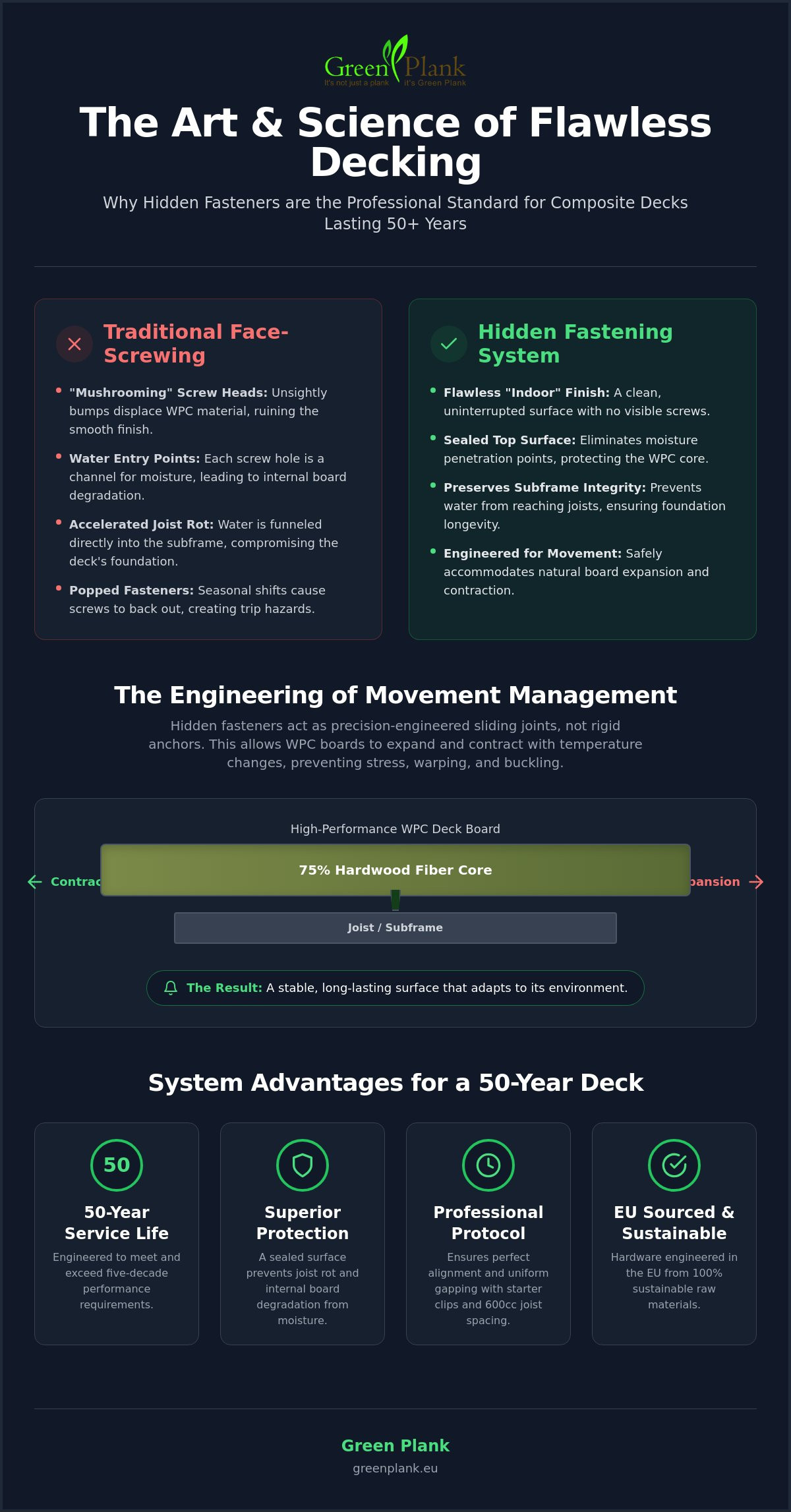
Hidden fasteners for composite decking are engineered clips and hardware designed to secure deck boards to a subframe without the use of visible screws on the walking surface. These systems typically fit into pre-milled grooves along the sides of the boards, anchoring them firmly while remaining tucked out of sight. This represents a fundamental shift from traditional face-fastening, where screws are driven directly through the top of the material. In professional circles, this "blind" fastening approach has become the benchmark for high-performance installations across Sweden and the wider EU.
Architects and professional specifiers prioritize these systems for premium residential and commercial projects because they offer a level of precision that manual screwing cannot replicate. While face-screwing is often associated with older, timber-based construction, modern composite decking materials require a more sophisticated attachment method. These hardware solutions aren't merely about looks; they're structural components that allow for the natural expansion and contraction of the boards. By utilizing hidden fasteners for composite decking, installers can ensure uniform gapping and a surface that remains safe, smooth, and free of trip hazards caused by backing-out screws.
The Aesthetic Advantage of a Screw-Free Surface
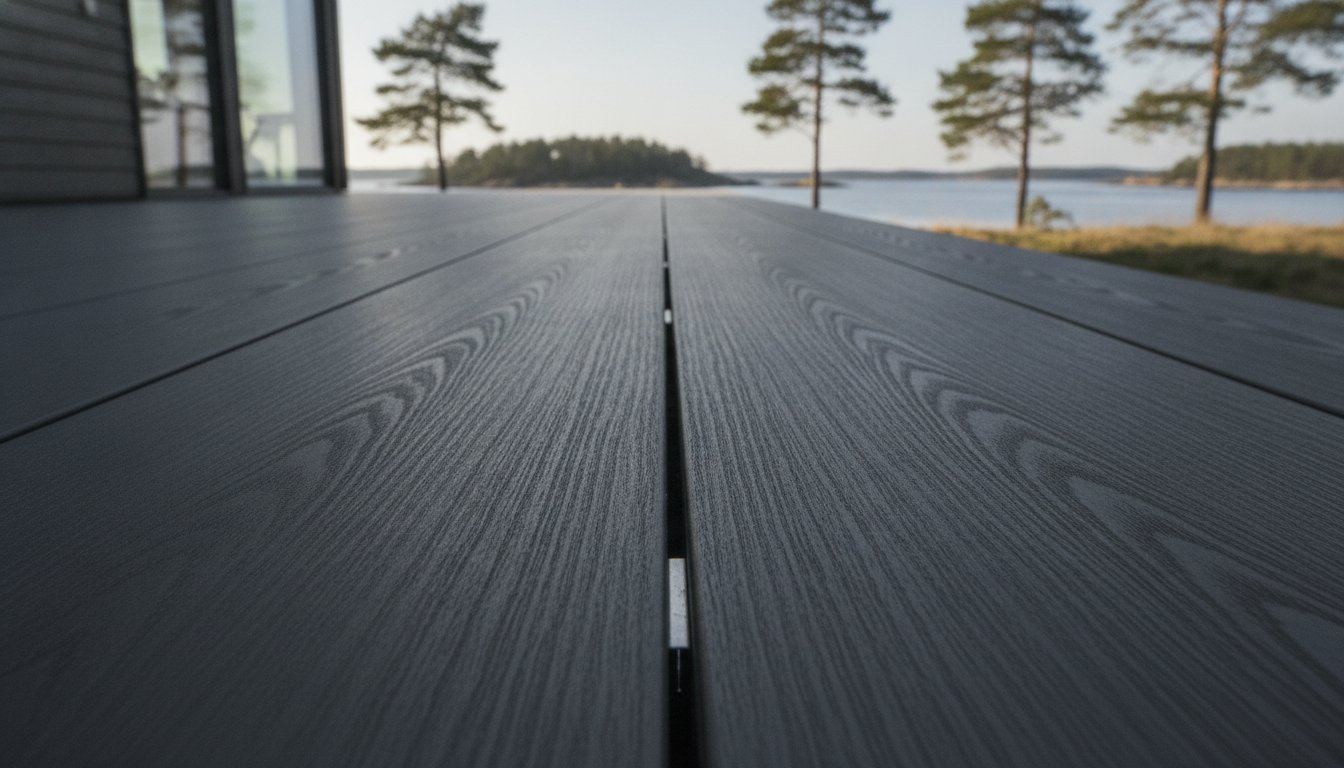
A primary benefit of a hidden system is the creation of a seamless "indoor-outdoor" flow. Without hundreds of silver or brown screw heads dotting the floor, the natural grain patterns and textures of the boards can shine without interruption. This creates a sophisticated, furniture-like finish that extends your living space into nature. Furthermore, hidden systems eliminate "mushrooming," an unsightly effect where the screw head displaces the WPC material and creates a small, jagged bump on the surface. Removing these visual distractions is the most effective way to enhance the premium feel of wpc composite decking.
Structural Integrity and Moisture Protection
Beyond aesthetics, avoiding surface penetration is a vital engineering choice. Every screw hole in a deck board is a potential entry point for water. When moisture pools inside these holes, it can reach the hardwood fiber core, leading to internal degradation over time. In the variable Swedish climate, where moisture and frost are constant factors, maintaining a sealed top surface is essential for longevity. By using hidden clips, you also protect the underlying joists. Traditional face-screwing often funnels water directly into the subframe, which accelerates joist rot. Hidden clips function as a critical protective barrier that preserves the structural integrity of the deck foundation by eliminating the entry points for moisture.
The Engineering Behind Hidden Fastening Systems
High-performance WPC boards with 75% hardwood fiber content are designed for longevity, yet their material composition requires a sophisticated mechanical approach. The engineering behind composite decking reveals that these boards aren't static; they are dynamic elements that react to environmental shifts. Unlike traditional timber, which expands primarily due to moisture, WPC is subject to thermal expansion driven by its HDPE component. To manage this, hidden fasteners for composite decking act as precision-engineered sliding joints rather than rigid anchors.
These clips allow the boards to glide longitudinally while maintaining a firm vertical grip on the joist. This is particularly critical in commercial decking projects where long spans are the norm. Lateral movement must be managed to prevent the cumulative stress that leads to warping or buckling. By allowing for this movement, the fastening system achieves three critical goals:
- Reducing internal stress during peak summer heat.
- Protecting the subframe from cumulative lateral force.
- Maintaining surface alignment across diverse climates.
This engineering approach ensures that the deck remains structurally sound without the risk of fasteners popping out or boards shearing. It's a system designed for regional reliability, especially in environments where temperature swings are a daily reality. You can explore our full range of EU-manufactured decking solutions to see how these engineering principles are applied to real-world projects.
Managing WPC Expansion and Contraction
The science of WPC involves balancing the stiffness of hardwood fiber with the flexibility of HDPE. In Sweden, where temperature fluctuations are extreme, boards can expand and contract significantly within a single 24-hour cycle. Rigid face-screwing restricts this movement, often resulting in board cracking or catastrophic fastener failure. HidLoc™ clips provide the specific "give" required for these high-performance boards, gripping the side grooves without pinning the core. This flexibility prevents the material from fighting against its own fasteners, which is the leading cause of deck failure in northern climates.
Automatic Spacing for Optimal Drainage
Precision installation depends on consistent spacing, and hidden clips provide this automatically. Each clip acts as a spacer, ensuring a uniform 5mm or 6mm gap across the entire surface. This consistency is a requirement for sustainable building materials certification, as it guarantees proper water runoff and debris management. Uniform gaps provide a reliable channel for under-deck ventilation, which is the primary defense against joist decay and mold growth. This automated precision removes the risk of human error during installation, ensuring the deck remains a safe and beautiful asset for decades.
Comparing Clip Materials: Stainless Steel vs. Plastic Fasteners
Selecting the right hardware material is as critical as the boards themselves. While generic marketplaces often offer low-grade plastic brackets without material specifications, professional installations demand hardware that matches the 50-year service life of premium WPC. High-quality plastic clips, typically manufactured from glass-filled nylon or high-density polyethylene (HDPE), provide a cost-effective and resilient solution for standard residential projects. These materials are engineered to be UV-stabilized, ensuring they don't become brittle after years of exposure to the Swedish sun. For those seeking a broader technical overview of available hardware, this comprehensive guide to hidden fasteners offers foundational industry insights.
Stainless steel remains the gold standard for high-traffic and coastal applications. Grade 304 provides excellent durability for most inland environments, while Grade 316 is essential for saltwater zones or public boardwalks. These metal options offer superior tensile strength, ensuring that hidden fasteners for composite decking don't shear under the intense lateral pressure of thermal expansion. It's also vital to consider subframe compatibility. If you're installing on an aluminium subframe, the fastener material must be chosen carefully to avoid galvanic corrosion, a chemical reaction that can compromise the structural integrity of the entire deck foundation.
When to Specify Stainless Steel
Professional specifiers choose stainless steel when a project demands maximum "bite" and long-term grip. High-density boards, such as Terra Tuff, exert significant force during expansion cycles, requiring the rigid mechanical hold that only metal can provide. In public infrastructure projects, where safety and maintenance-free operation are paramount, Grade 316 stainless steel is the professional benchmark. It resists the corrosive effects of salt spray and environmental pollutants, ensuring the deck remains secure for up to 50 years. This reliability is why steel is the preferred choice for commercial facades and high-use outdoor spaces.
The Role of Coatings and Finishes
Aesthetics and durability are often enhanced through specialized finishing processes. Many HidLoc™ systems utilize black oxide coatings to achieve a virtually "invisible" presence between board gaps. This finish serves a dual purpose: it eliminates metallic glint and adds an extra layer of protection against harsh chemical cleaners. From a sustainability perspective, stainless steel is a superior choice for a circular economy. It is highly recyclable and maintains its structural value over decades, aligning with our commitment to cradle-to-cradle ownership. Choosing high-grade metal hardware isn't just an engineering decision; it's a commitment to reducing the project's long-term environmental impact.
Installation Guide: Achieving a Flawless Screw-Free Surface
Precision in the field is what separates a professional installation from a standard DIY attempt. Before the first board is even placed, the subframe must be verified for absolute levelness. For private residential projects in Sweden, joist spacing must not exceed 600 cc to ensure the structural integrity of the boards and prevent sagging. Any deviation in the foundation will be amplified across the finished surface, potentially compromising the "sliding joint" functionality of the hidden fasteners for composite decking. A level foundation is the prerequisite for a 50-year service life.
The process begins with the "Starter Clip" technique. This specialized hardware secures the outer edge of the first board, anchoring it firmly to the joist without requiring a single face-screw. Once the first board is locked, subsequent boards are installed sequentially. You slide the next board into the previously installed clips, lock it into place with a fresh set of HidLoc™ hardware on the leading edge, and repeat the cycle. This creates a tight, consistent fit across the entire deck. To finish the project, use perimeter trim or skirting to conceal the final clip line, maintaining the seamless aesthetic from edge to edge.
Step-by-Step HidLoc™ Integration
Integrating HidLoc™ hardware requires a focus on alignment and torque. Each clip must be inserted fully into the side groove and centered directly over the joist center. When driving the screws, use a drill with adjustable torque settings. Over-tightening can deform the clip or strip the screw head, while under-tightening allows for excessive vertical play. At butt joints where two board ends meet, the "double-joist" rule is mandatory. Each board end must have its own dedicated joist and clip to ensure stability and accommodate independent thermal movement without stress.
Common Installation Mistakes to Avoid
Most failures in WPC projects stem from rushing the foundational steps. Over-driving screws is a frequent error that strips the subframe and weakens the mechanical bond. This is particularly problematic with softer timber joists. Another critical mistake is skipping starter clips in favor of face-screwing the first board; this creates a point of rigidity that leads to perimeter instability as the deck expands. For a deeper dive into subframe preparation and framing details, consult our professional deck installation guide. Ensuring your foundation meets these standards is the only way to guarantee long-term performance. You can explore our HidLoc™ range to find the specific hardware engineered for your board profile.
The HidLoc™ Advantage: Sustainable Precision for 50-Year Decks
The HidLoc™ system serves as the essential mechanical partner for Green Plank’s high-performance boards. While some competitors promote "lost head" screws as a hidden solution, those methods still involve piercing the board surface and compromising the core. HidLoc™ is engineered specifically for our 75% hardwood fiber and 25% HDPE blend, creating a system synergy that allows the hardware and decking to age at the same rate. This precision engineering ensures that your investment remains aesthetically perfect and structurally sound, fully aligning with our 50-year service life requirements. Utilizing these specific hidden fasteners for composite decking is the primary requirement for maintaining the validity of your long-term product warranty.
Regional reliability is built into every clip through 100% EU sourcing. By manufacturing our hardware within Europe using local raw materials, we significantly reduce the carbon footprint associated with long-distance shipping. This commitment to local production also guarantees that every screw and clip meets stringent European quality standards for tensile strength and corrosion resistance. It's a choice that satisfies the rational decision-maker looking for engineering excellence and the emotional buyer prioritizing ecological responsibility. This localized supply chain ensures that your project supports sustainable manufacturing practices from the foundation up.
Future-proofing your outdoor space is another critical benefit of the HidLoc™ system. In the unlikely event that a single board needs replacement, the hidden fastening design allows for much easier access compared to face-screwed decks. You can remove and replace individual boards without damaging the surrounding surface or leaving unsightly holes behind. This modularity extends the practical life of the entire installation, ensuring the deck remains a maintenance-free asset rather than a future liability. It's a sophisticated approach to construction that respects both the material science and the user's long-term needs.
Cradle to Cradle Ownership in Hardware
Our commitment to sustainability isn't limited to the boards; it encompasses the entire fastening system. Every HidLoc™ component is selected for its ability to contribute to a circular economy. High-quality stainless steel and UV-stabilized polymers ensure the hardware doesn't degrade into microplastics or leach harmful chemicals into the Swedish soil. By choosing EU-manufactured components, you are investing in hardware that supports a "long service life" promise while adhering to the highest environmental ethics. This cradle-to-cradle philosophy ensures that every element of your deck is as responsible as it is durable.
Specifying for Commercial Excellence
In public infrastructure projects, such as commercial piers and urban walkways, safety is the non-negotiable priority. HidLoc™ fasteners provide a completely smooth, screw-free surface that eliminates trip hazards and prevents injuries from protruding hardware. This makes it the professional standard for high-traffic environments where maintenance-free performance is essential for operational efficiency. The system's ability to manage lateral movement in long-span decking ensures that even the largest commercial projects remain stable under heavy use. Request a technical specification for your next project at Green Plank to ensure your design meets the highest standards of safety and sustainability.
Elevating the Standard for Sustainable Decking
Mastering the installation of hidden fasteners for composite decking is the definitive step toward achieving a professional finish that respects both architectural vision and material science. By transitioning from traditional face-screwing to engineered sliding joints, you ensure your deck can withstand the thermal shifts of the Swedish climate without compromising its structural integrity. This approach prioritizes a seamless, "indoor-floor" aesthetic while protecting the subframe from moisture ingress and the core from internal degradation.
Choosing the right hardware is a commitment to longevity and ecological responsibility. Our HidLoc™ systems are engineered for a 50-year service life and manufactured using 100% EU raw materials to ensure a lower CO2 footprint. Whether you are designing high-traffic commercial infrastructure or a private residential retreat, these specialized solutions provide the precision required for a maintenance-free future. It's time to build with quiet confidence and regional reliability.
Request a technical specification for your 2026 composite project to ensure your next build meets the highest standards of engineering and sustainability. Your journey toward a flawless, screw-free outdoor space begins with the right foundation.
Frequently Asked Questions
Are hidden fasteners better than screws for composite decking?
Yes, hidden fasteners are superior for both aesthetics and structural longevity. They eliminate visible screw heads and unsightly surface mushrooming while allowing for natural thermal movement. By avoiding surface penetration, they prevent water from entering the board core, which is essential for maintaining the 50-year service life of high-performance WPC. This approach ensures a safer, smoother walking surface for residential and commercial projects alike.
Do hidden fasteners work with all types of composite boards?
No, hidden fasteners require boards with pre-milled side grooves to function correctly. While square-edge boards typically require face-screwing or specialized plugs, grooved profiles like Terra Tuff are designed specifically for HidLoc™ integration. It's vital to verify that the clip geometry matches the board's groove depth and width to ensure a secure, mechanical bond that won't loosen over time.
How many hidden fasteners do I need per square metre?
You typically require approximately 20 to 25 fasteners per square metre for a standard installation. This calculation assumes a joist spacing of 400 mm to 600 mm, which is the professional standard for private residential projects in Sweden. Using the correct density of hidden fasteners for composite decking ensures uniform pressure across the entire surface and prevents individual boards from shifting during seasonal temperature swings.
Can I use hidden fasteners on a timber subframe?
Yes, hidden fasteners are compatible with both timber and aluminium subframes. When installing on timber, it's critical to use high-quality stainless steel screws to prevent corrosion and ensure the hardware remains anchored as the wood naturally ages. This combination provides a stable, reliable foundation while maintaining the clean, screw-free aesthetic that defines premium outdoor living spaces.
Are hidden fasteners more expensive than traditional deck screws?
The initial material cost is higher, but the long-term value far outweighs the upfront investment. Hidden systems reduce labor time through automatic spacing and eliminate the need for pre-drilling or countersinking hundreds of surface holes. When you factor in the extended 50-year warranty and the reduced risk of joist rot, these systems represent a more cost-effective choice for any high-end project.
How do hidden fasteners handle thermal expansion and contraction?
They function as precision-engineered sliding joints that allow boards to expand and contract longitudinally without internal stress. High-hardwood WPC boards move in response to temperature shifts, and rigid face-screwing can cause these boards to crack or shear the fasteners. Hidden fasteners for composite decking grip the grooves while allowing for this necessary movement, preserving structural integrity throughout the variable Swedish seasons.
Can I replace a single board if it is installed with hidden fasteners?
Yes, individual boards can be replaced with significantly less effort than face-screwed alternatives. By unscrewing the clips on either side of the damaged board, you can slide the plank out and insert a new one without marring the surrounding surface. This modularity is a key feature of the HidLoc™ system, ensuring your deck remains a maintainable, long-term asset rather than a permanent liability.
Which hidden fastener material is best for coastal environments?
Grade 316 stainless steel is the professional benchmark for all coastal and saltwater environments. This material offers maximum corrosion resistance against salt spray and harsh environmental pollutants found near the sea. For inland projects, Grade 304 or high-quality glass-filled nylon clips provide excellent durability, but coastal excellence requires the engineering precision and regional reliability of 316-grade steel hardware.
Specify the product
Use this guide with a Green Plank specification
Technical articles support the commercial catalogue — category, product, evidence, then samples or quotes.