



Why Traceability and Documentation Are Important for Composite Products
When choosing composite decking, cladding or fencing, it is easy to focus on colour, appearance, profile design, price and warranty. For professional buyers, architects, contractors and building-material distributors, however, two other factors deserve equal attention: traceability and documentation.
A modern WPC product is the result of multiple raw materials, a controlled formulation and a defined manufacturing process. A professional supplier should therefore be able to explain where key materials originate, where the product is manufactured, which technical information is available and how the product should be installed.
A professional product choice should be supported by evidence. Traceability helps explain where materials originate and how the supply chain is structured, while documentation helps buyers determine whether a product is suitable for its intended application.
What Does Traceability Mean for WPC?
WPC stands for Wood Plastic Composite. It generally combines wood or other natural fibres with a thermoplastic polymer and functional additives. The final characteristics depend on factors such as fibre type, polymer, formulation, profile geometry and manufacturing conditions.
Traceability means being able to identify and follow relevant materials and products through the supply chain. For WPC, this can include information about wood fibre, polymer, additives, manufacturing location, product profile and production batch.
| Area | What Should Be Known? | Why It Matters |
|---|---|---|
| Raw materials | Type and origin | Provides greater visibility into the material base |
| Manufacturing | Producer and production location | Clarifies the supply chain |
| Product | Profile, dimensions and identification | Supports purchasing and later follow-up |
| Technical data | Relevant documented properties | Supports technical evaluation |
| Installation | Product-specific requirements | Helps reduce incorrect application |
Why Raw-Material Traceability Matters
The term WPC does not define one universal formulation. Different products can contain different fibres, polymers, additives and proportions. Two boards that appear similar may therefore have different material compositions and technical characteristics.
Professional procurement should go beyond asking whether a product is simply composite. Buyers should understand the material system behind the finished profile and whether the manufacturer has sufficient control over its key inputs.
Questions to Ask About WPC Raw Materials
- Which wood or natural fibre is used?
- Which polymer forms the plastic matrix?
- Where do the key raw materials originate?
- How are incoming materials controlled?
- How is consistency between production batches managed?
- Can the supplier provide meaningful traceability information?
Green Plank: European Materials and European Production
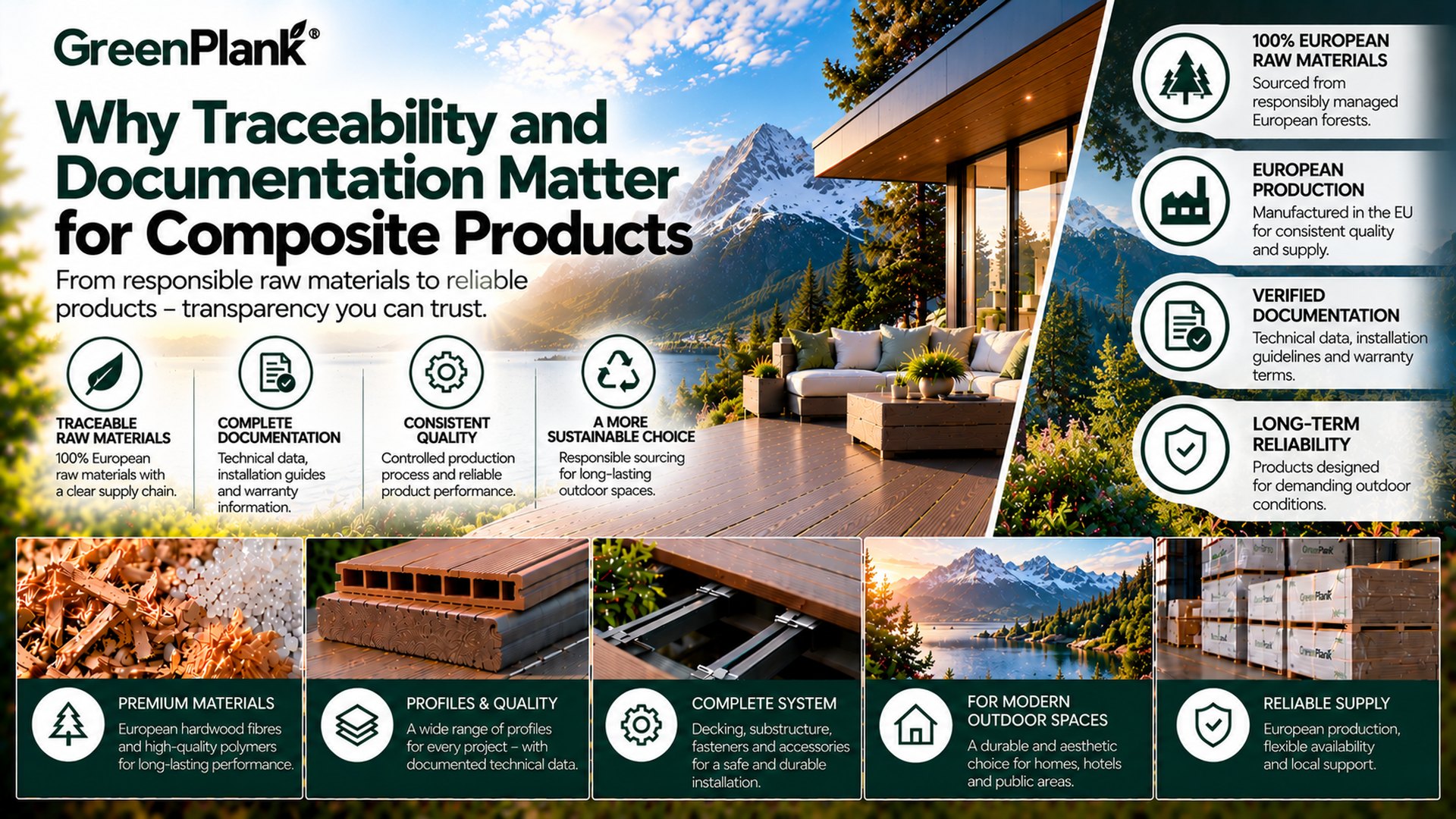
Green Plank is a Swedish brand with WPC manufacturing in Klaipėda, Lithuania, within the European Union. Its material strategy is based on 100% European raw materials and 100% traceability. Selected formulations use a high proportion of European hardwood fibre, including beech and oak, combined with HDPE and functional additives.
For distributors and project customers, a clearly defined material and manufacturing chain can simplify supplier evaluation, technical communication, quality follow-up and future replenishment.
Documentation Is More Than a Product Brochure
Marketing materials are useful for introducing a product, but they should not replace technical documentation. Professional buyers need information that allows them to evaluate how a product should be specified, installed, maintained and used.
Depending on the product and its intended application, relevant information may include technical data sheets, installation instructions, warranty conditions, product identification, maintenance information and applicable test or performance documentation.
The EU Construction Products Regulation provides the regulatory framework for construction products within its scope. The precise requirements depend on the product, its intended use and the applicable technical specifications. Buyers should therefore verify requirements for the specific product rather than assuming that every WPC profile is subject to identical documentation.
Useful Documentation to Request
- Technical product data sheet
- Current installation instructions
- Product dimensions and profile information
- Raw-material and manufacturing information
- Warranty terms and exclusions
- Relevant test or performance documentation where applicable
- Cleaning and maintenance recommendations
- Product or batch identification where available
Why Documentation Matters During Installation
Even a well-manufactured composite board depends on correct installation. Joist spacing, drainage, ventilation, fastening, distances from fixed structures and allowances for thermal movement can all affect the completed system.
There is no single universal expansion gap or joist spacing suitable for every WPC product. Requirements can vary with formulation, profile geometry, board length, temperature and intended use. Installers should therefore work from the current instructions for the exact product being installed.
Practical rule: Never copy installation dimensions from another WPC brand or profile. Use the current technical and installation documentation for the product specified in the project.
Traceability Supports Quality Follow-Up
Large developments may receive materials across several deliveries. If products, materials and production batches can be identified, manufacturers and customers have a clearer basis for investigating questions or variations that may arise.
This can also be valuable for building-material retailers. A customer may return several years later requiring additional boards, accessories or technical support. Clear product identification and organised documentation make such enquiries easier to manage.
Documentation Helps Buyers Compare Like with Like
Comparing composite products solely by price per linear metre can produce a misleading result. Board width, profile design, coverage, joist spacing, fixing requirements, accessories and installation can all influence the final system cost.
| Comparison Point | Basic Evaluation | Professional Evaluation |
|---|---|---|
| Price | Price per linear metre | Complete installed system per m² |
| Material | Labelled as WPC | Fibre, polymer, formulation and origin |
| Origin | Country statement | Raw-material and manufacturing traceability |
| Performance | Marketing claims | Relevant technical documentation |
| Warranty | Number of years | Coverage, application, conditions and exclusions |
| Installation | General advice | Profile-specific installation requirements |
Warranty and Documentation Should Be Read Together
A long warranty can be valuable, but the headline number is only part of the information. Buyers should check which application the warranty covers, which product characteristics are included, what installation conditions apply and which exclusions are specified.
Selected Green Plank TerraTuff™ products are offered with residential warranties of up to 50 years, depending on the product and applicable warranty terms. This should not be interpreted as an automatic 50-year warranty for hotels, restaurants, commercial developments or public spaces. Professional applications should be evaluated against the relevant product and warranty conditions.
European Origin Is Useful Information, Not a Substitute for Evidence
Manufacturing location and material origin are valuable elements of traceability, but European origin alone does not prove technical quality. Raw-material control, formulation, manufacturing consistency, profile engineering, relevant testing and correct installation should be considered together.
Likewise, a shorter geographical supply route does not by itself prove a lower total carbon footprint. A credible environmental comparison requires relevant and comparable life-cycle information covering factors such as raw materials, manufacturing, transport, use and end-of-life.
A Seven-Step WPC Procurement Check
- Identify the product: confirm profile, dimensions, surface and intended application.
- Check the materials: ask about fibre, polymer and key raw-material origins.
- Verify traceability: establish where the product is manufactured and how materials are controlled.
- Review technical information: compare documented information rather than marketing statements alone.
- Study installation requirements: check joist spacing, drainage, ventilation, fastening and thermal movement.
- Read the warranty: verify application, duration, conditions and exclusions.
- Calculate system cost: include boards, substructure, clips, screws, accessories, waste, transport and installation.
What Should a Professional WPC Supplier Be Able to Answer?
A reliable purchasing process starts with clear questions. Where is the product manufactured? What are the key raw materials? Can their origin be identified? Which technical documents are available? Which installation system is recommended? What exactly does the warranty cover? Can matching products or accessories be supplied later?
The quality of these answers can be just as important as the appearance of a sample board. Clear information helps architects, distributors, contractors and developers make decisions based on project requirements rather than assumptions.
Traceability Creates a Better Basis for Decision-Making
Traceability and documentation are not simply administrative details. They connect raw materials, manufacturing, technical performance, installation and long-term product support.
Green Plank combines European WPC production with 100% European raw materials and 100% traceability. For professional buyers, this provides a clearer foundation for evaluating products, planning projects and managing future requirements.
Explore European composite decking, cladding and fencing solutions at Green Plank.
Sources
- Green Plank – composite product and company information
- European Commission – Construction Products Regulation
- U.S. Forest Products Laboratory – Wood/Nonwood Thermoplastic Composites
- ISO 15686-5 – Buildings and constructed assets: Life-cycle costing
Specify the product
Use this guide with a Green Plank specification
Technical articles support the commercial catalogue — category, product, evidence, then samples or quotes.