



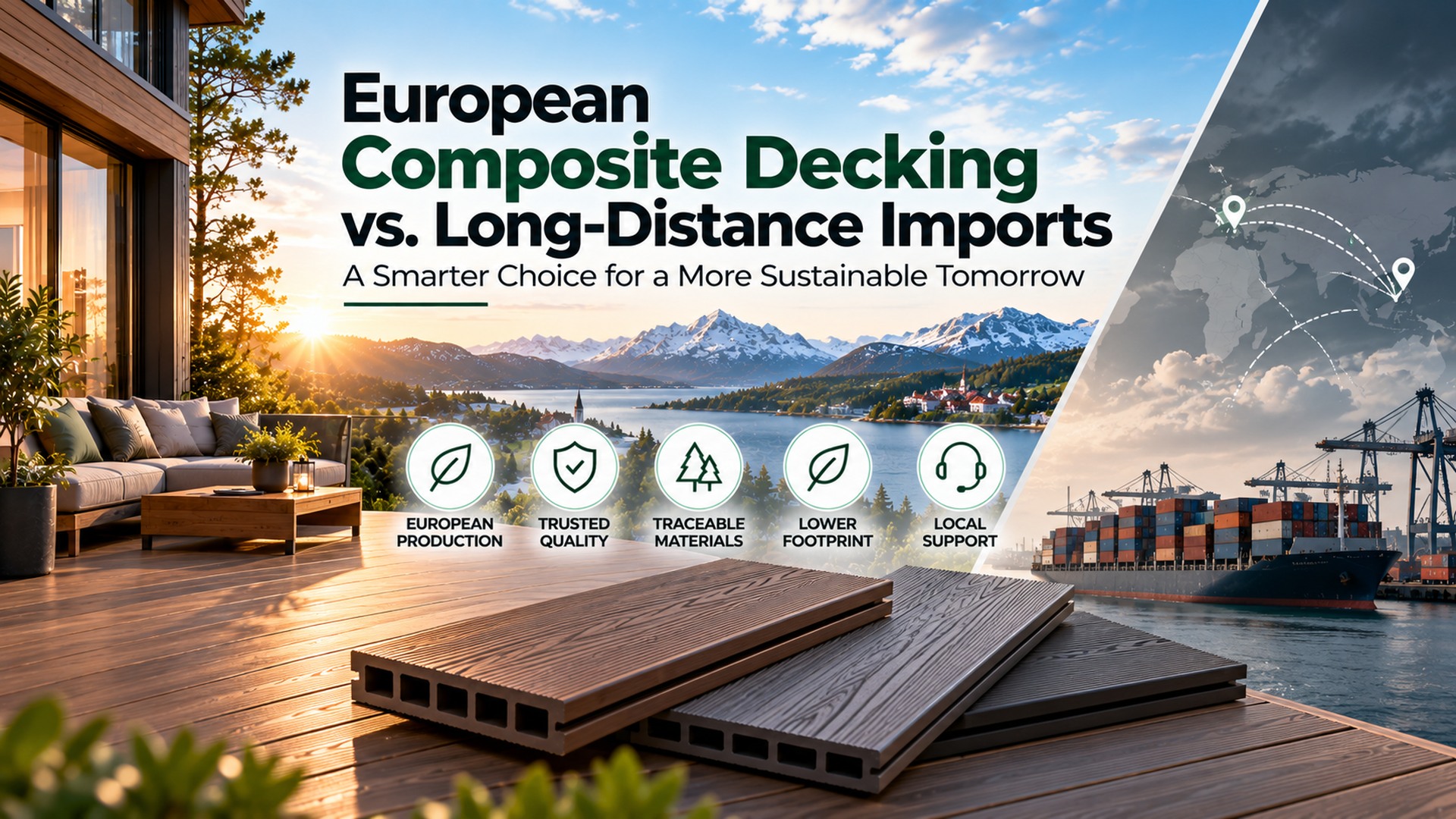
European Composite Decking vs. Long-Distance Imports: What Should Buyers Compare?
Composite decking has become an established choice for residential terraces, hospitality spaces and commercial outdoor projects. Yet two boards that look almost identical in a showroom can differ considerably in raw materials, manufacturing methods, technical documentation, supply chains and after-sales support.
That makes one question increasingly relevant: where and how is the composite decking actually manufactured? European production is not automatically superior to manufacturing elsewhere, but proximity to the market can offer practical advantages when combined with traceable materials, consistent quality control, accessible technical support and transparent documentation.
A better way to compare: Do not choose a decking product simply because of the country on the label. Compare material composition, origin, traceability, technical data, installation requirements, warranty, supply chain and long-term value.
1. What Does European Composite Decking Actually Mean?
The term European decking can be interpreted in different ways. A brand may be headquartered in Europe while its products are manufactured elsewhere. Buyers should therefore distinguish between the location of the brand, the manufacturing location and the origin of the principal raw materials.
Green Plank focuses on EU manufacturing, European-origin raw materials and supply-chain traceability. For homeowners, merchants, architects and contractors, this approach can make it easier to understand where a product comes from and who is responsible for manufacturing it.
Three useful questions for every supplier
- Where is the actual composite decking manufactured?
- Where do the wood fibre, polymer and principal raw materials originate?
- Can the supplier provide credible information about material traceability?
2. European Production vs. Long-Distance Imports
Long-distance imports can provide competitive products, broad ranges and substantial manufacturing capacity. European production can offer a different set of advantages, particularly geographical proximity, shorter communication routes and closer interaction between the market and manufacturing operation.
The right choice depends on the priorities of the project rather than geography alone.
| Factor | European Production | Long-Distance Import |
|---|---|---|
| Distance to European market | Generally shorter | Generally longer |
| Replenishment | May allow shorter planning cycles | May require longer forward planning |
| Factory communication | Proximity can simplify direct contact | Depends on supplier structure |
| Traceability | Depends on documented systems | Depends on documented systems |
| Product adaptation | Can provide a shorter route between customer and factory | May involve longer lead times or larger quantities |
| Quality | Must be verified technically | Must be verified technically |
| Cost | Compare complete system and lifecycle value | Purchase price may be attractive; total cost still matters |
3. Traceability Is Becoming More Important
Traceability means being able to understand a product and its materials through the supply chain. For merchants, architects and professional projects, better product information can support procurement, specification, documentation and future product identification.
The European regulatory environment is also moving toward more structured product information. Regulation (EU) 2024/3110, the new Construction Products Regulation, establishes a framework that includes digital product passports for construction products. This reflects a broader move toward accessible product information and improved transparency across value chains.
Transparency goes beyond a Made in Europe statement
A professional supplier should be able to explain where the product is manufactured, what its main materials are, how it should be installed, what technical information is available and what the warranty actually covers.
4. Raw Materials and Formulation Matter
WPC, or Wood Plastic Composite, combines wood or natural fibre with a polymer and functional additives. The proportions, fibre source, polymer type, additives, profile geometry and manufacturing process can vary substantially between products.
Selected Green Plank products use a high proportion of European wood fibre combined with HDPE and functional additives. Buyers should always request the current technical data for the specific product rather than assuming that all composite decking has the same formulation or performance characteristics.
Before comparing prices, compare the specification
- Wood or natural-fibre content and source
- Polymer type and specification
- Solid, hollow or co-extruded construction
- Board dimensions, weight and profile geometry
- Recommended joist spacing
- Clips, fixings and installation system
- Technical documentation and warranty conditions
5. Manufacturing Location Alone Does Not Determine Quality
High-quality and lower-specification products can be manufactured in many regions of the world. A credible comparison should therefore avoid assuming that every European product is superior or that imported products are automatically lower quality.
Instead, compare measurable and documented characteristics. Ask for technical data sheets, installation instructions, relevant test information and clear warranty conditions. Buyers should also understand who takes responsibility if technical questions or product issues arise after installation.
For Green Plank, European manufacturing is part of a wider proposition combining European-origin materials, traceability, production control and proximity to customers in European markets.
6. Supply-Chain Distance Can Affect Planning
For a homeowner, delayed decking can postpone an installation. For a merchant, distributor or contractor, supply reliability can influence inventory levels, working capital, project schedules and customer service.
Long-distance supply chains may require greater forward planning, particularly when goods travel internationally by sea. Production closer to the destination market can, depending on stock and manufacturing capacity, make replenishment and supplementary orders easier to manage.
Actual lead times should always be confirmed with the supplier rather than assumed from geographical distance alone.
7. Technical Support Is Part of the Product
A composite deck is a complete construction system. Decking boards, joists, clips, screws, drainage, ventilation and expansion allowances all need to work together. Accessible technical support can therefore be valuable before, during and after installation.
For professional buyers, the ability to communicate efficiently with a supplier and obtain product-specific installation information may be just as important as a small difference in the initial board price.
Think beyond the board: The real product includes the decking, substructure, fixing system, installation guidance, documentation, warranty and technical support behind it.
8. Environmental Comparisons Need Evidence
It can be tempting to assume that a product travelling a shorter distance automatically has a lower total environmental impact. Transport is relevant, but a complete assessment can also involve raw-material production, energy use, manufacturing, product lifespan, maintenance, transport and end-of-life scenarios.
For meaningful environmental comparisons, buyers should look for verifiable lifecycle information, such as relevant LCA or environmental product data where available, rather than making conclusions solely from manufacturing distance.
9. Purchase Price Is Only One Part of the Cost
A lower board price may be appropriate for a particular project, but quotes should be compared on an equivalent basis. The real project cost can include much more than the decking itself.
| Cost or Value Factor | Question to Ask |
|---|---|
| Decking | What exact profile and specification am I buying? |
| Substructure | What joist spacing is required? |
| Fixings | Are clips, screws and start/end components included? |
| Transport | What are delivery and supplementary-order costs? |
| Maintenance | What routine care is recommended? |
| Warranty | What is covered and under which conditions? |
| Support | Who assists the installer or customer when questions arise? |
10. Consider Lifecycle Value, Not Just Price per Metre
A useful purchasing decision considers the cost of acquiring, installing, maintaining and potentially replacing an outdoor system over time. This is consistent with the general lifecycle-costing principles described in ISO 15686-5.
For composite decking, this means comparing the complete installed system and anticipated maintenance requirements rather than simply comparing the price of one linear metre of decking.
11. Green Plank as a European Alternative
Green Plank offers composite products for European markets with an emphasis on European manufacturing, European-origin raw materials, traceability, Scandinavian design and technically considered decking systems.
The decking portfolio includes TerraTuff™, Nordeka™, Classic and Sapphire™, providing different profile constructions, aesthetics and positioning for residential and professional projects. Current technical specifications and warranty conditions should always be checked for the individual product family.
A practical buyer checklist
- Confirm the actual country of manufacture.
- Ask where the principal raw materials originate.
- Request the technical data sheet.
- Compare profile construction and recommended joist spacing.
- Calculate the complete installed cost per square metre.
- Review installation instructions and expansion requirements.
- Read the full warranty rather than comparing years alone.
- Evaluate availability, replenishment and technical support.
- Request physical samples before making the final decision.
European or Long-Distance Import: Which Should You Choose?
There is no universal answer. The strongest purchasing decision is based on documented product characteristics and the priorities of the project. Long-distance imports may be competitive for some applications, while European composite decking can be particularly attractive when buyers value manufacturing proximity, European material sourcing, traceability and accessible support.
Compare products on equal terms and ask suppliers for samples, technical documentation and complete quotations. When material specification, installation, logistics, warranty, support and long-term cost are considered together, the differences between apparently similar decking products become much clearer.
Explore Green Plank composite decking manufactured in Europe: www.greenplank.eu
Sources
- Green Plank – official product and company information
- ISO 15686-5 – Buildings and constructed assets: Life-cycle costing
- EUR-Lex – Regulation (EU) 2024/3110 on construction products
- European Commission – Construction Products Regulation
Specify the product
Use this guide with a Green Plank specification
Technical articles support the commercial catalogue — category, product, evidence, then samples or quotes.