



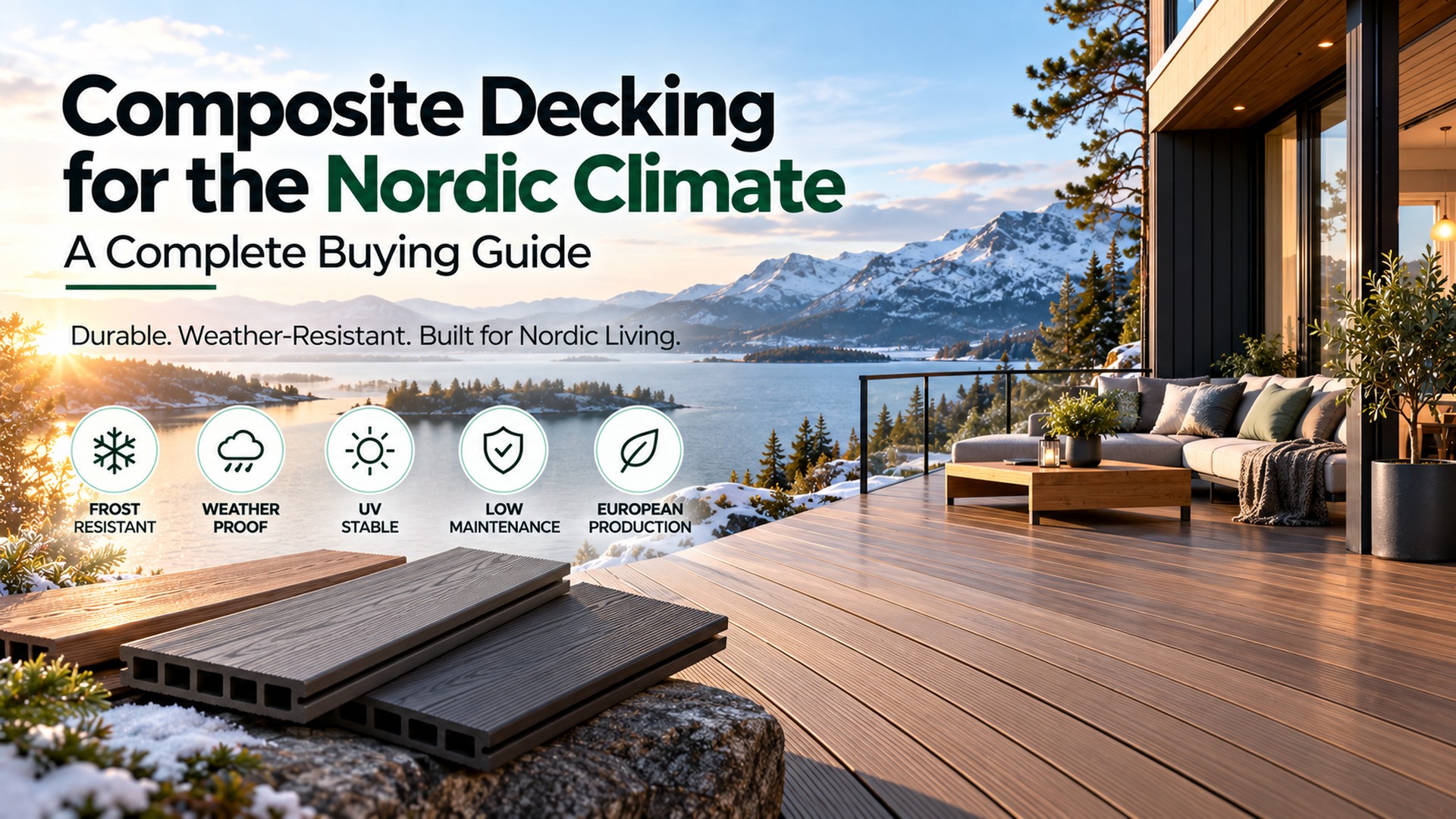
Composite Decking for the Nordic Climate – What Should You Consider Before Buying?
A deck in Northern Europe must perform through very different seasons. Summer sunshine can be followed by prolonged rain, moisture, freezing temperatures, snow, ice and repeated freeze-thaw cycles. Choosing composite decking for a Nordic climate therefore involves much more than selecting an attractive colour and comparing the price per square metre.
Material composition, board construction, drainage, ventilation, substructure, expansion allowances and installation requirements all contribute to the performance of a completed deck. A good buying decision considers the entire decking system, not simply the visible board.
Buyer's key principle: do not compare composite decking on price alone. Compare construction, technical documentation, installation requirements, warranty conditions, maintenance and total long-term value.
1. Why Is the Nordic Climate Demanding for Decking?
Nordic outdoor environments experience substantial seasonal changes. A terrace can become warm in direct summer sun and later face persistent moisture, freezing temperatures and snow. The decking system must therefore be designed and installed with changing environmental conditions in mind.
| Nordic condition | What should the buyer check? |
|---|---|
| Rain and moisture | Drainage, ventilation and moisture-related product guidance |
| Freezing and thawing | Correct construction, drainage and expansion allowances |
| Sun and UV exposure | Surface technology, colour behaviour and technical specifications |
| Temperature changes | Expansion guidance, board lengths and required gaps |
| Snow and ice | Cleaning guidance, surface characteristics and structural design |
2. Understand What the Composite Board Is Made From
Wood-plastic composite, commonly known as WPC, combines wood or natural fibres with a polymer and functional additives. However, not every composite board uses the same formulation. Fibre content, polymer type, additives, manufacturing control and profile design can all vary.
Selected Green Plank products use a high proportion of European hardwood fibre combined with HDPE and functional additives. Buyers should always check the current technical information for the specific product rather than assuming that all composite decking has the same composition.
Questions worth asking your supplier
- Which polymer is used in the composite?
- What proportion of wood or natural fibre does the board contain?
- Can the origin of the raw materials be traced?
- Where is the decking manufactured?
- Is a technical data sheet available?
- Is the profile solid, hollow or co-extruded?
- What applications has the profile been designed for?
3. Traditional or Co-Extruded Composite Decking?
Composite decking is available in several constructions. A traditional composite profile and a premium co-extruded board should not be compared solely by initial purchase price.
| Feature | Traditional composite | Co-extruded composite |
|---|---|---|
| Construction | Composite material throughout the profile | Composite core with an additional outer surface layer |
| Positioning | Standard to premium depending on product | Often positioned as a premium solution |
| Surface | Varies according to product | Outer layer engineered for additional surface protection |
| Initial cost | May provide a lower entry price | May require a higher initial investment |
Green Plank TerraTuff™ is an example of a premium co-extruded decking family. Other Green Plank ranges, including Nordeka™, Classic and Sapphire™, provide alternative profile constructions for different project requirements and budgets.
4. Moisture Management Starts Below the Deck
Good decking material still requires good construction. Water must be able to drain away, while sufficient airflow beneath the deck helps the system remain ventilated. Standing water and constructions that unnecessarily restrict ventilation should be avoided.
The foundation should provide appropriate drainage for the site, and the deck should be installed according to the product-specific installation instructions. Composite boards should not simply be placed directly on soil or installed in a way that prevents necessary drainage and airflow.
A premium board still needs a correct installation
Even high-performance composite decking cannot compensate for a poorly designed substructure. Always follow the manufacturer's requirements for joist spacing, ventilation, drainage, fastening and expansion gaps.
5. Allow for Thermal Movement
Composite materials expand and contract as temperatures change. This is especially relevant in climates with substantial seasonal temperature variations. Correct installation therefore needs sufficient room for movement.
The required gaps depend on the product, board length, installation temperature and overall deck design. Check the manufacturer's current instructions for distances between board ends and fixed structures such as walls, posts and borders rather than relying on one universal rule.
6. Joist Spacing Can Change the Real Project Cost
Joist spacing is one of the most important specifications to check when comparing decking systems. Two products with similar board prices can produce different total project costs if one requires substantially more substructure material.
Always verify the permitted centre-to-centre spacing for the exact profile and intended application. Residential terraces, commercial environments and diagonal installations may have different requirements.
For a meaningful comparison, calculate the complete system cost per m²: boards, substructure, clips, screws, edge details, foundations, delivery and installation.
7. Surface Performance Matters in Wet Conditions
Nordic terraces are frequently exposed to rain, morning moisture, snow and ice. Surface characteristics can therefore be particularly important around entrances, stairs, pool areas and other frequently wet locations.
Ask for relevant technical information for the specific decking product and intended application. No outdoor surface should be assumed to be slip-free under every condition, particularly when covered by frost or ice.
8. UV Exposure, Colour and Appearance
Outdoor materials are continuously exposed to sunlight and weather. Buyers should therefore investigate how a particular decking product is designed for exterior use and what the manufacturer states about colour and surface changes after installation.
Physical samples are especially useful. View samples outdoors in direct sunlight, shade and, if possible, when wet. A small colour difference can become visually significant once repeated across an entire terrace.
9. European Manufacturing and Traceability
For homeowners, architects, contractors and professional buyers, product origin and supply-chain transparency can be important purchasing criteria. Green Plank focuses on European production, European-origin raw materials and traceability, together with products developed for European markets.
Manufacturing location alone does not prove product quality. Buyers should combine origin information with technical specifications, quality control, documentation, warranty conditions and access to supplier support.
10. Read the Warranty, Not Just the Number of Years
A warranty can be an important part of a decking purchase, but the headline duration should never be considered in isolation. Coverage can vary by product family, application and warranty terms.
- Check whether the warranty applies to residential or commercial use.
- Identify which product characteristics or defects are covered.
- Check whether coverage changes during the warranty period.
- Review all installation and substructure requirements.
- Check exclusions and limitations.
- Keep invoices, product details and installation documentation.
Green Plank warranty periods vary between product families. Buyers should therefore consult the current warranty applicable to the exact decking profile being considered.
11. Low Maintenance Does Not Mean No Maintenance
One reason homeowners choose composite decking is to reduce the recurring surface treatments often associated with maintaining the appearance of traditional timber decking. Composite decking generally does not require the same routine oiling or staining regime.
It still requires care. Leaves, pollen, dirt and organic debris should be removed, and the surface should be cleaned according to the manufacturer's instructions. Drainage routes and ventilation beneath the deck should also remain unobstructed.
12. Compare Lifetime Value, Not Only Purchase Price
The lowest material price is not necessarily the lowest long-term cost. A useful comparison considers initial materials, substructure, installation, maintenance, repairs and potential replacement over an appropriate analysis period.
This approach is consistent with the broader principles of life-cycle costing described in ISO 15686-5. For decking buyers, it provides a practical way to compare alternatives beyond the initial price per square metre.
| Buyer's checkpoint | Why it matters |
|---|---|
| Material and profile | Influences performance and suitable applications |
| Technical documentation | Supports specification and correct installation |
| Joist spacing | Affects substructure and project cost |
| Expansion requirements | Important with changing temperatures |
| Drainage and ventilation | Essential elements of good deck construction |
| Surface characteristics | Important for exposed and wet locations |
| Warranty | Compare coverage and conditions, not only years |
| Origin and traceability | Provides greater supply-chain transparency |
| Total system cost | Provides a better comparison than board price alone |
Buy a decking system, not simply a board. In Nordic conditions, decking, substructure, fasteners, drainage, ventilation and installation instructions should work together as one complete solution.
Choosing Composite Decking with Confidence
The right composite decking for a Nordic climate is the product that matches the real requirements of the project. Climate exposure, intended use, profile construction, raw materials, installation, technical documentation, warranty, design and long-term cost should all form part of the decision.
Compare competing products using the same criteria and request technical information before purchasing. This provides a stronger basis for choosing a terrace that is not only attractive when newly installed, but thoughtfully specified for many seasons of outdoor living.
Explore Green Plank composite decking for European and Nordic projects: www.greenplank.eu
Sources
- Green Plank – official product information
- ISO 15686-5 – Buildings and constructed assets: Life-cycle costing
- European Commission – Construction Products Regulation
Specify the product
Use this guide with a Green Plank specification
Technical articles support the commercial catalogue — category, product, evidence, then samples or quotes.