


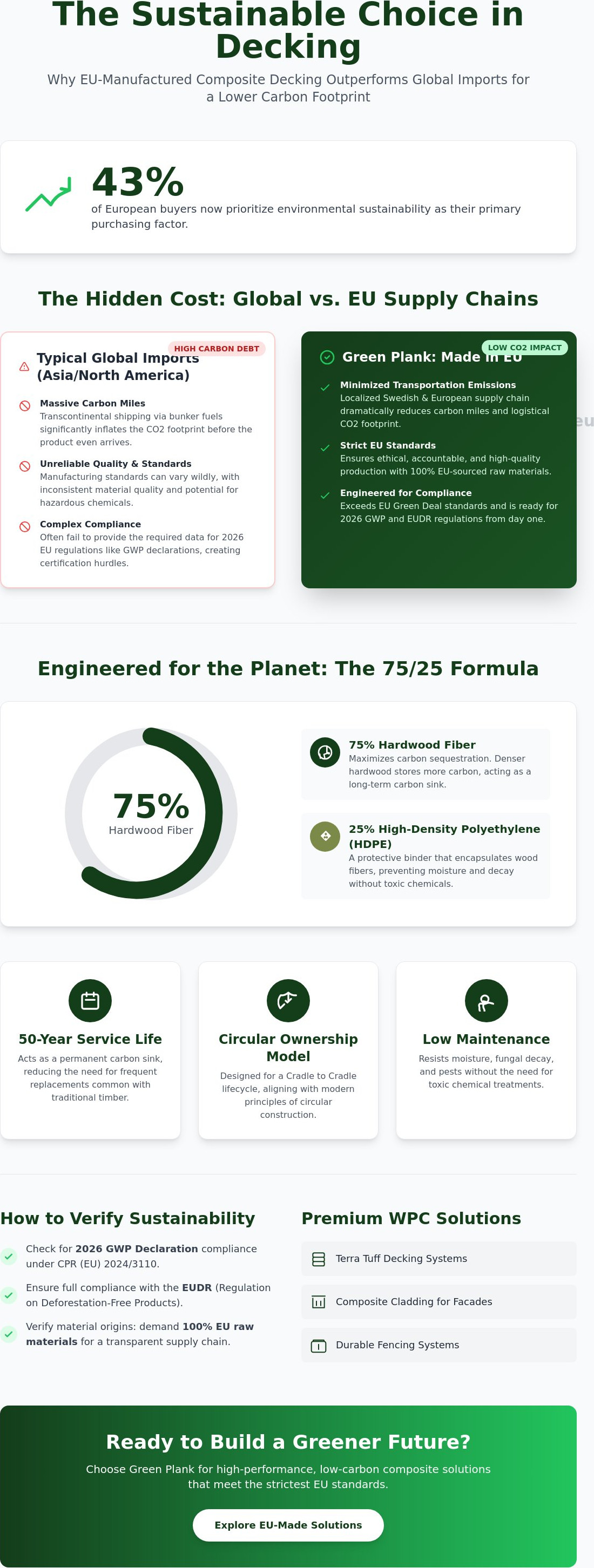
Over 43% of European decking buyers now prioritize environmental sustainability as their primary purchasing factor. However, many professionals and homeowners still struggle with the hidden carbon debt of transcontinental shipping and the unreliable quality of non-EU materials. You shouldn't have to compromise your design vision to meet your ecological responsibilities.
Choosing Green Plank Made in eu lower Co2 impact is achieved through localized manufacturing and advanced material science. This article explores how our proprietary blend of 75% hardwood fiber and 25% HDPE meets the strict 2026 Global Warming Potential declaration requirements while delivering a 50-year service life. You'll learn how our EU-sourced composite decking provides a high-performance, low-maintenance solution that aligns with the latest European Green Deal regulations and a circular Cradle to Cradle ownership model.
Key Takeaways
- Understand how regional manufacturing eliminates the significant carbon debt associated with transcontinental shipping from Asia or North America.
- Examine the technical composition of Green Plank Made in eu lower Co2, which utilizes 75% hardwood fiber to maximize carbon sequestration.
- Discover why a 50-year service life acts as a permanent carbon sink, reducing the need for the frequent replacements required by traditional timber.
- Learn how to verify material origins and navigate the latest 2026 sustainability certifications for high-end construction projects.
- Identify specialized WPC solutions for commercial and residential use, including Terra Tuff decking, composite cladding, and fencing systems.
Table of Contents
- The Hidden Carbon Cost of Global Composite Decking Supply Chains
- Engineered for the Planet: The Science of Low-CO2 WPC Production
- Performance Meets Responsibility: Durability as a Carbon Sink
- How to Verify Sustainability in Your Next Construction Project
- Green Plank Solutions: Premium WPC for Low-Carbon Infrastructure
The Hidden Carbon Cost of Global Composite Decking Supply Chains
Embedded carbon represents the total greenhouse gas emissions generated during the extraction, production, and distribution of building materials. For many outdoor construction projects, this figure is often overlooked in favor of surface-level aesthetics. Selecting Wood-plastic composites (WPCs) manufactured in Asia or North America adds a massive carbon debt before the product even arrives at the site. Transcontinental shipping relies heavily on bunker fuels, which significantly inflates the CO2 footprint of the material. The reality of choosing Green Plank Made in eu lower Co2 impact products is that the environmental benefit begins long before the first board is installed.
Regional reliability is becoming the cornerstone of the 2026 construction market. While global manufacturing standards vary wildly, European production follows a strict ethical and environmental trajectory. This disparity is not just about quality; it's about the accountability of the entire supply chain. By sourcing materials locally, we ensure that every component of our composite decking meets the rigorous expectations of modern, eco-conscious developers.
Transportation Emissions: The Invisible Project Cost
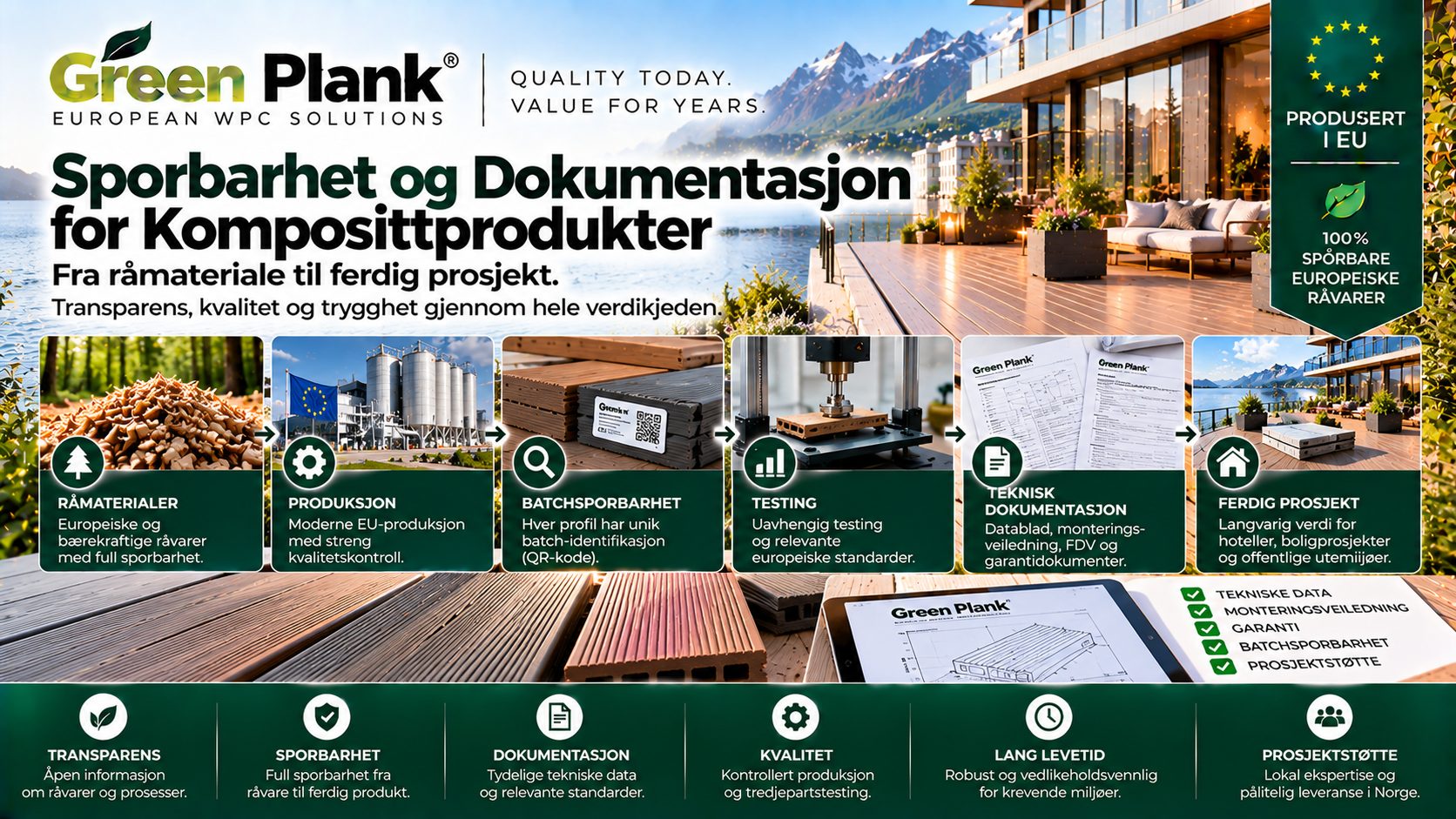
Carbon miles measure the distance a product travels from factory to consumer. Importing materials from distant markets often doubles the embedded carbon of the final installation. Green Plank utilizes a localized Swedish and European supply chain to minimize these logistical footprints. Our products feature a low-density profile, which allows for more efficient transport. Lighter materials require less fuel for road and rail transit; this directly lowers the overall CO2 contribution of the delivery phase. This regional focus ensures that the environmental claims on our technical data sheets translate to real-world results for your project.
Regulatory Alignment and the EU Green Deal
The European Union's regulatory landscape is shifting toward total transparency. Under the Construction Products Regulation (CPR) (EU) 2024/3110, manufacturers are required to declare the Global Warming Potential (GWP) of their products starting January 8, 2026. Many non-EU manufacturers struggle to provide this level of data, leading to complex certification hurdles for contractors. Green Plank Made in eu lower Co2 solutions are engineered to exceed these standards from day one. We use 100% EU raw materials, ensuring full compliance with the Regulation on Deforestation-Free Products (EUDR).
Integrating sustainable building materials into modern architecture is essential for achieving Net Zero Energy Building (NZEB) goals. Our commitment to the EU Green Deal means we avoid the hazardous chemicals often found in unregulated imports. This alignment provides architects and contractors with the peace of mind that their projects are ethically sourced, legally compliant, and environmentally superior.
Engineered for the Planet: The Science of Low-CO2 WPC Production
The environmental performance of composite materials is defined by their chemical composition and the longevity of their raw ingredients. We utilize a specific blend of 75% hardwood fiber and 25% high-density polyethylene (HDPE) to maximize carbon sequestration. Hardwood trees are naturally denser than softwoods; they store a higher concentration of carbon per cubic meter. By incorporating these fibers into our production process, Green Plank Made in eu lower Co2 solutions act as long-term carbon sinks. The HDPE component serves as a protective binder, encapsulating the organic fibers to prevent moisture absorption and fungal decay. This synergy ensures that the material remains structurally sound for decades without requiring the toxic chemical treatments common in traditional timber.
Scientific validation is a core pillar of our manufacturing ethics. A recent life cycle assessment of wood-plastic decking highlights that the carbon footprint of WPC is heavily influenced by the source of its polymers and fibers. Sourcing 100% EU raw materials allows us to maintain a transparent, low-emission production cycle that aligns with the Carbon Removals Certification Framework (CRCF). Because our products are designed to last up to 50 years, they effectively lock away carbon for a duration that exceeds many international sustainability benchmarks.
The 75/25 Formula: Balancing Strength and Sustainability
Our high-fiber formula significantly reduces the volume of petroleum-based plastics required for manufacturing. While many competitors rely on a 50/50 split, our 75% hardwood blend prioritizes renewable content. This requires immense engineering precision to ensure the boards maintain a low-density profile while meeting the mechanical demands of professional construction. This material balance is particularly effective for wpc composite decking, where slip resistance and thermal stability are paramount. You can view our full range of technical profiles to see how this engineering translates to different architectural applications.
Circular Design and Cradle to Cradle Principles
We embrace a Cradle to Cradle ownership model that views every fencing system and wall cladding profile as a future resource. This circular design philosophy means our products are engineered for disassembly. At the end of their extensive service life, the components can be ground down and recycled into new building materials. This approach complies with the Ecodesign for Sustainable Products Regulation (ESPR) enforced in July 2024. Using 100% recyclable components ensures that your project contributes to a zero-waste future. It's a commitment to regional heritage and manufacturing quality that protects both your investment and the European landscape.
Performance Meets Responsibility: Durability as a Carbon Sink
True sustainability isn't just about how a product is made; it's about how long it stays in service. While traditional timber decking often requires replacement every 10 to 15 years, our engineered composite solutions are built for a half-century of performance. Every time a wooden deck is replaced, the carbon footprint of that outdoor space effectively doubles. You must account for the energy used in new timber extraction, the emissions from secondary transport, and the waste generated from the old structure. Choosing Green Plank Made in eu lower Co2 solutions breaks this cycle of consumption. By extending the material lifecycle to 50 years, we turn every installation into a permanent carbon sink.
The environmental cost of maintenance is another critical factor often ignored in standard life cycle assessments. Natural wood requires annual chemical treatments, including petroleum-based stains, sealers, and oils, to prevent rot. These substances release volatile organic compounds (VOCs) and require energy-intensive manufacturing. Our composite materials eliminate the need for these chemicals entirely. According to the principles of Sustainable Management of Construction and Demolition Materials, reducing the need for maintenance and replacement is a primary strategy for lowering the environmental impact of the built environment. Durability is the ultimate metric for any serious sustainability claim.
50-Year Service Life: Engineering for Generations
Our Terra Tuff and Smart System product lines serve as the gold standard for long-term reliability in both private and commercial sectors. We've engineered these profiles with advanced UV-resistance and moisture-blocking technology to ensure they don't warp, crack, or splinter over time. This engineering confidence allows us to provide a specific 50-year service life guarantee. It's the reason why professional specifiers increasingly look for trex decking alternatives that are manufactured within Europe. Regional production ensures that the quality control meets strict EU standards, providing a level of reliability that global imports can't match.
Low Density, High Impact Resistance
Engineering for the European climate requires a material that can handle extreme thermal expansion and contraction. Green Plank Made in eu lower Co2 profiles utilize a low-density design that doesn't sacrifice structural integrity. This technical advantage makes our products ideal for large-scale public infrastructure and high-performance wall cladding on modern facades. Whether it's a coastal boardwalk or a mountain retreat, our composite systems withstand harsh Northern conditions without the degradation typical of softwoods. This resilience ensures that the aesthetic and functional value of your project remains intact for decades, further solidifying its role as a responsible, long-term investment.
How to Verify Sustainability in Your Next Construction Project
Verifying the environmental credentials of building materials has transitioned from a niche preference to a regulatory necessity. As of January 8, 2026, the Construction Products Regulation (CPR) (EU) 2024/3110 mandates that manufacturers declare the Global Warming Potential (GWP) of their products. This shift ensures that every project manager has access to verified life cycle data. However, reading a Life Cycle Assessment (LCA) requires a discerning eye. You must look beyond the final score and examine the origin of raw materials. Sourcing Green Plank Made in eu lower Co2 impact materials guarantees that the data is anchored in strict European labor and environmental standards. Regional production isn't just a logistical advantage; it's a verification shortcut that reduces project risk and ensures regulatory compliance.
The "Made in EU" label serves as a proxy for high ethical standards and chemical safety. Materials produced outside the European economic area often bypass the Regulation on Deforestation-Free Products (EUDR) or utilize energy grids with significantly higher carbon intensities. When you select European-engineered composites, you're choosing a supply chain that's already aligned with the EU Green Deal's 2050 climate-neutrality goals. This alignment simplifies the auditing process for large-scale developments and public infrastructure projects.
The Specifier’s Checklist for Low-CO2 Materials
To ensure your project meets modern sustainability benchmarks, follow this structured verification process:
- Verify raw material percentage: Look for a high hardwood fiber content, such as the 75% blend used in Green Plank profiles. Higher organic content typically correlates with better carbon sequestration.
- Check for integrated fastening systems: Systems like HidLoc™ Hidden Fastening Systems improve structural integrity and allow for easier disassembly, supporting circular economy principles.
- Confirm the manufacturing location: Calculate the transport CO2 by ensuring the factory is within the European region to minimize carbon miles.
Understanding Environmental Product Declarations (EPDs)
Environmental Product Declarations (EPDs) provide the transparent, third-party verified data required for modern architecture. They offer a standardized way to communicate the environmental impact of a product throughout its life. For architects aiming for BREEAM or LEED credits, these documents are indispensable. Green Plank provides comprehensive EPDs that reflect the reduced carbon footprint of our EU-based manufacturing. This transparency supports the goals of the Energy Performance of Buildings Directive (EPBD), especially for new buildings that must disclose life-cycle GWP starting in 2028. You can access our full library of environmental declarations to support your next planning application.
Green Plank Solutions: Premium WPC for Low-Carbon Infrastructure
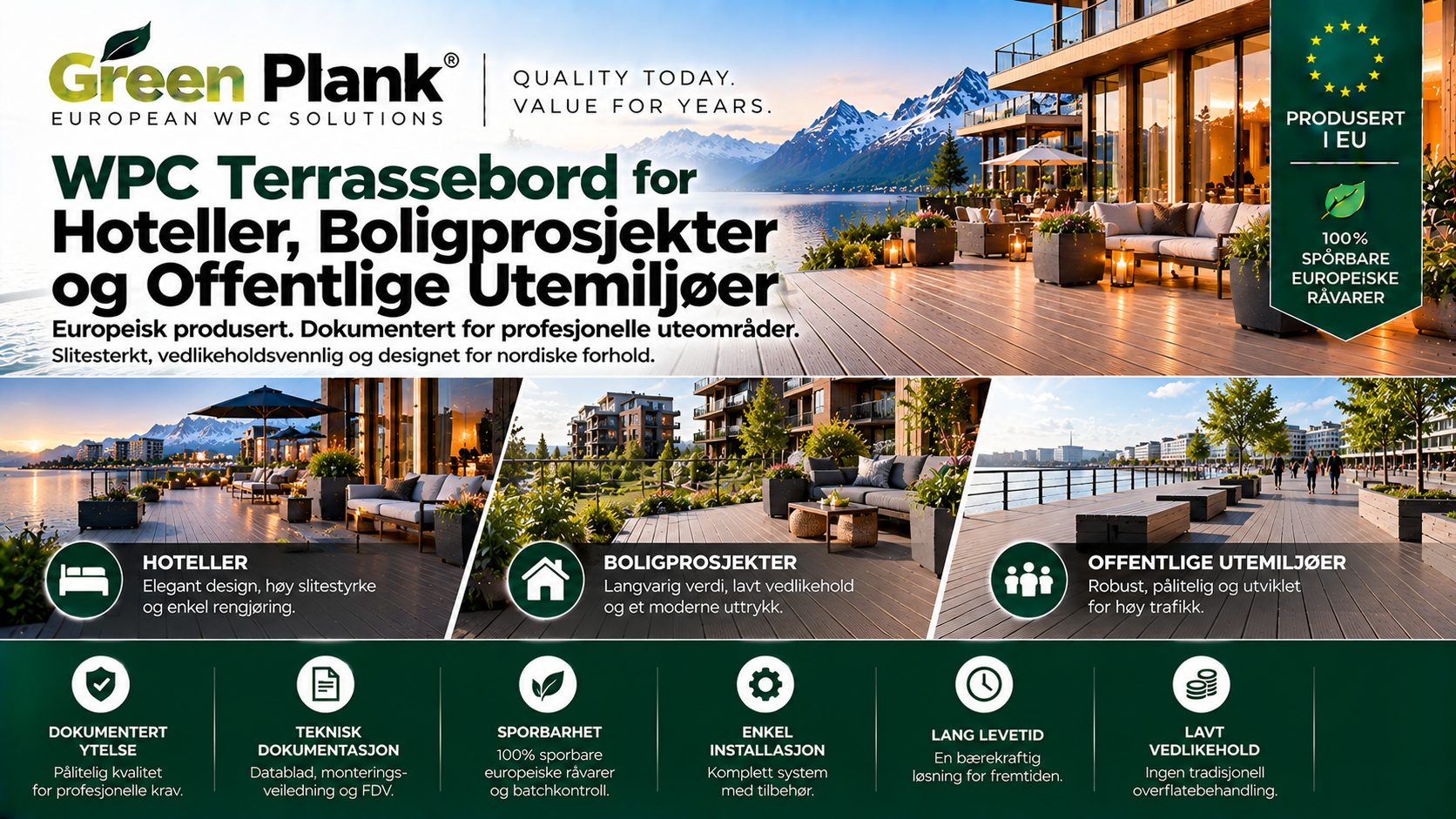
The transition toward sustainable architecture requires more than just high-level data; it demands high-performance materials that can withstand the rigors of public use. Our comprehensive product family, including decking, wall cladding, and fencing, is engineered to bridge the gap between aesthetic excellence and ecological responsibility. By choosing Green Plank Made in eu lower Co2 solutions, developers can specify materials that are as durable as they are ethical. Every profile in our catalog is the result of regional manufacturing expertise and a commitment to the circular economy. We provide the systems for municipal boardwalks, the profiles for residential facades, and the structures for commercial boundaries.
Precision is a hallmark of professional execution. Our proprietary HidLoc™ Hidden Fastening Systems offer a clean, screw-free aesthetic; they simultaneously ensure the structural integrity of the installation by allowing for natural thermal movement. This system is a critical component of any deck installation guide designed for long-term success. It minimizes the risk of surface damage and simplifies the disassembly process at the end of the product's life cycle. Partnering with Green Plank for large-scale European developments ensures access to a reliable supply of 100% EU-sourced materials that simplify the path to project completion.
Terra Tuff and Smart System: The Professional Standard
Commercial environments require materials with exceptional load-bearing capabilities and wear resistance. The Terra Tuff line is specifically designed for high-traffic areas where traditional timber would quickly degrade. These profiles support a 600 cc joist spacing for both private and commercial applications, providing a rigid foundation that reduces installation time and material costs. Beyond the floor, our composite wall cladding offers a sophisticated solution for modern facades. It combines the warm texture of natural wood with the engineering precision of high-density polyethylene, ensuring the building envelope remains maintenance-free and visually striking for decades.
Sustainable Boundaries: Fencing and Infrastructure
Public works and large-scale residential projects often require extensive boundary solutions that don't compromise environmental goals. Our composite fencing systems provide a durable alternative to treated timber, which often leaches chemicals into the surrounding soil. These systems are part of a broader portfolio of Commercial Infrastructure Profiles designed for the toughest European climates. Whether you're designing a municipal park or a high-end commercial terrace, our Green Plank Made in eu lower Co2 products deliver the regional reliability your project demands. We invite architects, contractors, and developers to contact our technical team to discuss custom specifications for your next sustainable project.
Building a Responsible Future for Outdoor Living
Selecting the right building materials is a definitive choice for both project longevity and planetary health. We've examined how regional supply chains eliminate the heavy carbon debt of global shipping while ensuring compliance with the latest EU Green Deal regulations. By combining 100% EU raw materials with advanced 75% hardwood fiber technology, Green Plank Made in eu lower Co2 solutions provide a scientifically verified path to sustainable construction. This approach transforms every terrace, facade, and boundary into a high-performance carbon sink that remains maintenance-free for decades.
Investing in durability is the most effective way to lower the environmental impact of the built environment. Our products are engineered to last, supported by an industry-leading 50-year warranty and built upon Cradle to Cradle certified principles. This ensures that your investment respects nature while delivering a premium, worry-free outdoor space. You can partner with Green Plank for your next sustainable project to access the highest standards of European engineering and ecological responsibility. Let's build a beautiful, resilient future together.
Frequently Asked Questions
Does Green Plank decking really have a lower CO2 footprint than wood?
Yes, Green Plank products offer a superior environmental profile when measured over a full 50-year life cycle. Traditional timber requires replacement every 10 to 15 years and demands regular chemical treatments. Our composite solution eliminates the need for toxic sealers and prevents the carbon expenditures associated with frequent material replacement and secondary transport. It's a long-term carbon sink for any outdoor space.
What makes EU-sourced raw materials better than international alternatives?
European raw materials guarantee compliance with the strictest environmental and chemical safety standards in the world. Sourcing 100% EU ingredients ensures that our supply chain adheres to the Regulation on Deforestation-Free Products (EUDR). This regional focus drastically reduces carbon miles compared to imports from Asia or North America, providing a transparent and ethical foundation for your construction project.
How does the 75% hardwood fiber content affect the durability of the deck?
The high concentration of hardwood fiber provides exceptional structural stability and density. Unlike softwoods, hardwood fibers are naturally resilient and offer superior carbon sequestration properties. This 75/25 blend ensures the boards resist warping and splintering even under heavy commercial use. It creates a robust material that maintains its aesthetic and functional integrity for up to 50 years.
Can Green Plank products be recycled at the end of their 50-year lifespan?
Yes, all our profiles are designed according to Cradle to Cradle ownership principles. Every component is 100% recyclable and can be processed into new building materials at the end of its service life. This circular approach prevents waste and aligns with the Ecodesign for Sustainable Products Regulation (ESPR). It ensures your project contributes to a sustainable, zero-waste future.
Is the HidLoc™ fastening system compatible with all Green Plank profiles?
The HidLoc™ system is specifically engineered for our grooved decking profiles to provide a clean, screw-free finish. It secures the boards firmly while allowing for the natural thermal expansion and contraction required in European climates. This hidden fastening technology improves the overall structural integrity of the deck and simplifies the disassembly process for future material reuse or recycling.
How does Green Plank contribute to LEED or BREEAM certifications?
Our products provide the verified Environmental Product Declarations (EPDs) required to secure high-tier green building credits. Choosing Green Plank Made in eu lower Co2 impact materials helps architects meet the life-cycle Global Warming Potential (GWP) targets mandated by the latest EU directives. This transparency is essential for achieving energy performance goals in modern, sustainable developments.
Why is low-density WPC preferred for commercial infrastructure projects?
Low-density composite profiles offer high impact resistance without the excessive weight of traditional solid materials. This makes them easier to handle and install in large-scale public works like boardwalks or bridges. The engineered density ensures the material remains strong enough for high-traffic areas while reducing the fuel consumption and emissions associated with transporting heavy construction goods to the site.
Does Green Plank offer direct-to-consumer sales for small residential projects?
Green Plank does not engage in direct-to-consumer online retail. We focus our expertise on supporting industry professionals, contractors, and large-scale developers. Our goal is to provide technical guidance and premium materials for projects that prioritize engineering quality and long-term sustainability. Residential customers should consult with their professional installers to specify Green Plank Made in eu lower Co2 solutions for their homes.
Spesifiser produktet
Bruk denne guiden i en Green Plank-spesifikasjon
Tekniske WPC-artikler skal støtte de kommersielle sidene — ikke konkurrere med dem. Fortsett til komposittdekke, TerraTuff, Nordeka eller de tekniske nedlastningene.