



Is the lighter choice for your deck actually the weaker one, or are you overpaying for material density your project doesn't require? Many specifiers feel a familiar uncertainty when weighing solid vs hollow composite decking pros and cons, especially when balancing the desire for a premium aesthetic against the reality of environmental stressors. You likely want an outdoor space that maintains its integrity against thermal expansion and heavy use without the fear of boards cracking or warping after just a few seasons.
We believe that profile selection is an engineering decision, not just a budgetary one. This guide will provide a clear technical breakdown of which profile suits your specific foot-traffic and regional climate, ensuring you choose the right engineering for a project that lasts up to 50 years. We'll explore the material science of high-density fiber profiles, compare structural load capacities, and demonstrate how a commitment to European manufacturing standards results in a superior, low-maintenance finish that respects the natural world. By understanding these structural differences, you can move forward with the confidence that your investment supports both long-term performance and ecological responsibility.
Key Takeaways
- Identify the structural differences of solid vs hollow composite decking pros and cons to select the profile that matches your project's load and foot-traffic demands.
- Evaluate the efficiency of hollow engineered profiles, like our Nordeka and Smart System ranges, which offer a lightweight solution ideal for residential decks and roof terraces.
- Discover why high-density solid boards, such as Terra Tuff, serve as the commercial benchmark for superior sound-dampening and long-term durability in high-traffic zones.
- Analyze technical specifications for installation, including the 600cc joist spacing standard and linear expansion rates, to guarantee a service life of up to 50 years.
- Understand how choosing European-manufactured materials supports a circular economy by utilizing 100% regional raw materials and reducing your total carbon footprint.
Table of Contents
- Solid vs. Hollow: Defining the Core Structural Differences
- Hollow Composite Decking: Efficiency and Residential Versatility
- Solid Composite Decking: Maximum Performance for Demanding Environments
- Technical Head-to-Head: Weight, Expansion, and Installation Requirements
- Choosing Your Profile: The Green Plank Engineering Perspective
Solid vs. Hollow: Defining the Core Structural Differences
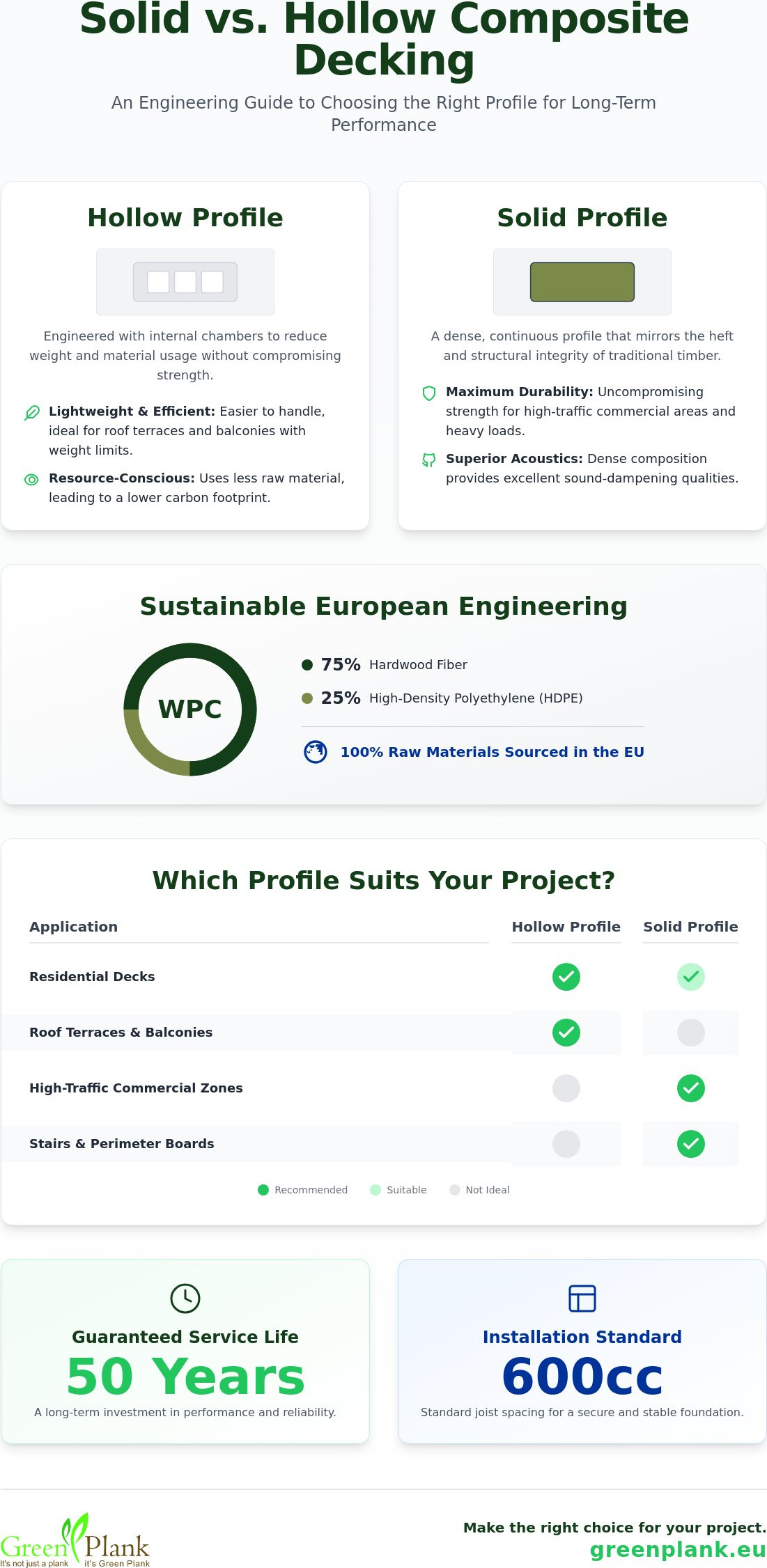
Profile selection begins with a clear understanding of the material composition. Both profiles utilize Wood-plastic composites (WPCs), which are sophisticated blends of recycled materials engineered for decades of service. Our manufacturing process uses 75% hardwood fiber and 25% high-density polyethylene (HDPE) sourced entirely within the EU. This specific ratio provides a natural wood aesthetic while the polymer component protects against moisture. It's a responsible innovation that reduces the carbon footprint of your project while ensuring regional reliability.
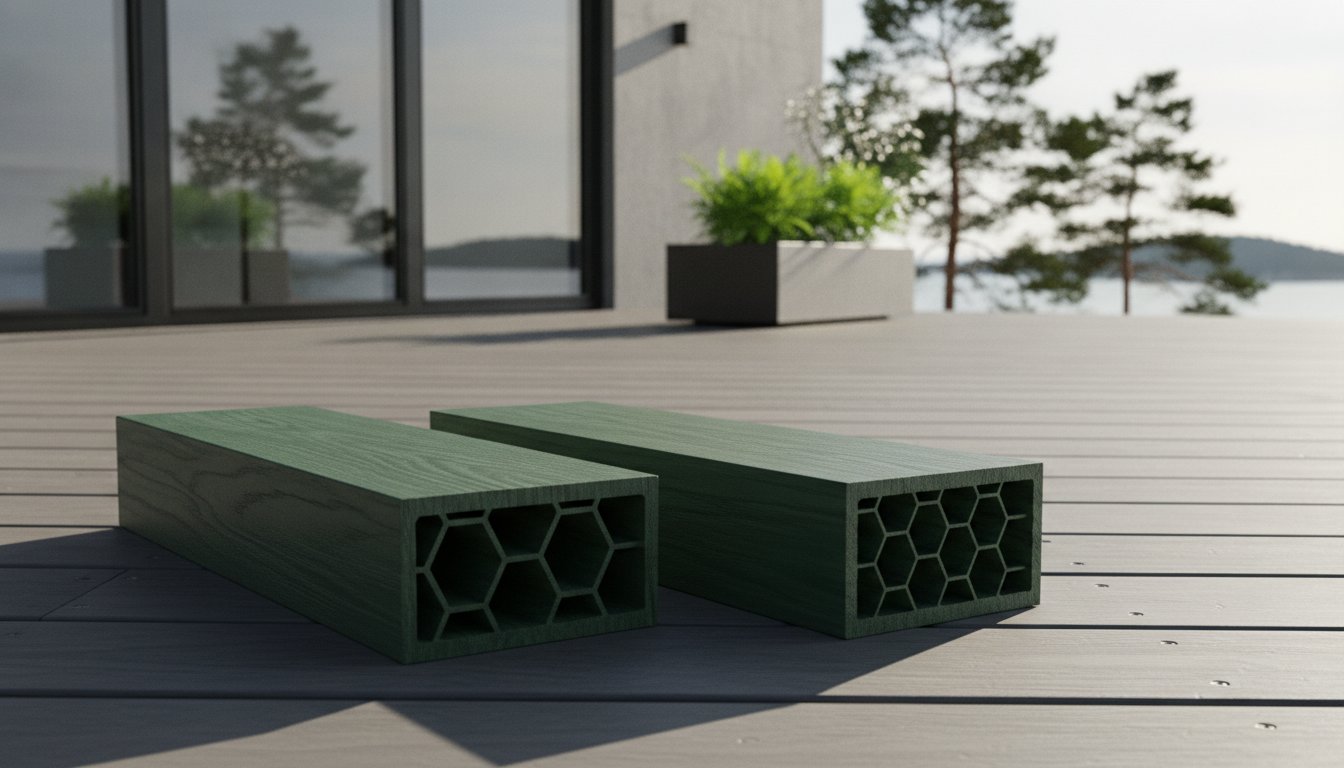
The core distinction lies in the internal architecture of the board. Solid decking is extruded as a continuous, dense mass that mirrors the heft and structural presence of traditional timber. Hollow decking is an engineered profile that incorporates internal chambers or "ribs" to optimize performance. When weighing solid vs hollow composite decking pros and cons, specifiers must consider the intended application. The primary manufacturing goal is to balance material weight with structural integrity, ensuring the profile supports the required load while remaining resource-efficient.
Anatomy of a Hollow Decking Board
High-performance hollow profiles, including our Nordeka and Smart System ranges, utilize sophisticated internal chamber designs. These rectangular or circular voids are separated by vertical "ribs" that act as structural supports. This design maintains high strength while significantly reducing the board's weight. It's a technical attribute that leads to practical advantages: easier handling during installation and lower pressure on substructures. This makes hollow profiles the preferred choice for residential decks and weight-sensitive roof terraces where precision engineering is required to meet strict weight tolerances.
Anatomy of a Solid Decking Board
Solid boards like Terra Tuff provide uniform density with no internal voids. This lack of air pockets allows for a consistent material profile from the surface to the core. Because the board is solid, the edges can be finished or routed to show a consistent texture, much like natural wood. The 75% hardwood fiber content ensures the board is heavy and rigid. This density provides excellent sound-dampening qualities and makes the board suitable for heavy-duty commercial use where durability is the priority. The solid construction eliminates the need for end caps, providing a clean, professional finish for stairs and perimeter boards.
Understanding these structural foundations is the first step in selecting the right profile for your environment. Whether you prioritize the lightweight efficiency of an engineered hollow board or the uncompromising strength of a solid core, the underlying material science ensures long-term reliability. This engineering confidence is what allows for performance guarantees that span up to 50 years.
Hollow Composite Decking: Efficiency and Residential Versatility
Hollow profiles represent a triumph of engineering efficiency. The Smart System wpc composite decking exemplifies this approach by utilizing a cellular core that prioritizes high strength and low density. For residential specifiers, the decision often centers on the balance of solid vs hollow composite decking pros and cons. While solid boards offer density, hollow profiles excel in projects where weight tolerances are critical. This is particularly evident in urban roof terraces or balcony installations where structural load limits are strictly enforced. By using less raw material to achieve a similar surface performance, these boards offer a more cost-effective solution that aligns with our commitment to reducing the CO2 footprint of every project.
The ease of handling hollow profiles makes them the preferred choice for large-scale residential developments. A lighter board translates to faster transit, easier staging, and more efficient movement across large job sites. This logistical advantage does not come at the expense of quality. Our hollow boards, including the Nordeka range, are manufactured with 100% EU raw materials, ensuring that every plank meets our rigorous standards for regional reliability and professional performance. If you are planning a residential project that requires a balance of beauty and efficiency, you can view our residential composite ranges to see these engineering principles in action.
Thermal Management and Expansion
Hollow WPC boards provide superior thermal management through their engineered architecture. The internal air pockets act as a cooling mechanism, allowing the boards to dissipate solar heat more efficiently than their solid counterparts. This technical attribute makes them ideal for poolside areas or sun-drenched garden spaces where barefoot comfort is essential. While all composite materials expand, the engineered ribs within hollow profiles help manage linear expansion and contraction rates during temperature swings. This stability ensures the deck remains aesthetically pleasing and structurally sound throughout the seasons.
Installation Advantages
Efficiency extends directly to the job site. The reduced weight of hollow boards minimizes the physical strain on installation crews, which is a significant advantage during long workdays on expansive projects. These profiles are designed for seamless integration with HidLoc™ hidden fastening systems. This system provides a clean, screw-free finish that enhances the aspirational lifestyle element of the outdoor space. To ensure a professional result, specifiers should consider these key installation benefits:
- Lightweight profiles reduce logistics and shipping costs.
- Engineered chambers improve thermal comfort for end-users.
- Precision grooves facilitate rapid, uniform fastening.
- Dedicated end caps provide a finished, high-end appearance.
Using fascia boards or specific end caps allows you to hide the hollow profile edges, maintaining the look of traditional timber while benefiting from modern material science. This combination of aesthetics and engineering makes hollow decking a versatile tool for the modern sustainable craftsman.
Solid Composite Decking: Maximum Performance for Demanding Environments
Terra Tuff represents the peak of material science in our portfolio. While residential users might prioritize the lightweight nature of hollow boards, commercial specifiers often demand the uncompromising density of solid core profiles. When evaluating solid vs hollow composite decking pros and cons for high-traffic infrastructure, the decision is usually driven by the need for extreme impact resistance. Solid boards withstand the repetitive stress of heavy patio furniture, high-heel traffic, and moving equipment without surface deformation. It's a professional choice for those who prioritize structural permanence over initial weight savings.
Public piers, boardwalks, and busy restaurant terraces require a surface that feels and sounds substantial. Solid profiles eliminate the "echo" effect sometimes associated with hollow chambers, providing a premium acoustic experience that mirrors traditional timber. This regional reliability ensures that public spaces remain inviting and quiet, even under heavy footfall. By choosing a solid core, you're investing in a material that doesn't just look like wood but performs with the same structural gravity.
Durability and Service Life
The long-term performance of solid WPC is backed by engineering confidence. Our premium solid profiles carry a service life supported by a 50-year warranty. This longevity is rooted in the material's resistance to point-loading failures. Unlike hollow profiles, which rely on internal ribs to distribute weight, a solid board's uniform density manages concentrated pressure across its entire mass. This makes it the only viable choice for supporting hot tubs or heavy planters. We operate under a Cradle to Cradle ownership model, ensuring that every plank is part of a circular economy that respects the natural world.
Aesthetics and Edge Detailing
Designers often select solid profiles for their superior aesthetic versatility. In high-end wpc composite decking projects, solid boards are essential for creating picture-frame borders and stair treads. Because the material is uniform throughout, you can sand or slightly round the edges to achieve a bespoke finish. This ability to manipulate the edge profile provides a level of visual authenticity that hollow boards cannot match. While hollow boards require end caps to hide internal chambers, solid boards offer a clean, finished look from every angle. Consider these aesthetic advantages for your next project:
- Uniform core density allows for custom routing and edge shaping.
- Solid edges eliminate the need for additional plastic end caps.
- Enhanced acoustic properties provide a premium, "solid" footfall sound.
- Natural grain patterns remain consistent across the board's entire thickness.
This combination of beauty and engineering makes solid decking a vital tool for the sustainable craftsman. It satisfies the emotional desire for a natural look while meeting the rational requirement for a deck that lasts half a century with minimal maintenance.
Technical Head-to-Head: Weight, Expansion, and Installation Requirements
Engineering a deck that remains stable for half a century requires a deep dive into material behavior. When we analyze solid vs hollow composite decking pros and cons, the technical data reveals distinct advantages for different environments. Solid boards provide a substantial foot-feel and superior acoustics. They absorb impact and sound, preventing the hollow echo that can occur with lighter profiles. Hollow boards offer a lighter alternative that simplifies logistics without compromising the walking surface. Your choice influences the entire substructure design, from joist spacing to fastener selection.
Installation protocols vary based on the intended use of the space. For private residential projects, our profiles are engineered for a 600cc joist spacing standard, which optimizes material use while maintaining safety. Commercial environments often require tighter spacing to accommodate higher point loads. Over a 25-year period, the total cost of ownership remains competitive for both profiles. While hollow boards offer a lower initial investment, solid boards provide a lower replacement risk in high-traffic zones. You can explore our technical decking specifications to match these requirements to your specific site conditions.
Span Ratings and Load Bearing
The structural integrity of each board is determined by its composition and profile geometry. Our 25% HDPE content ensures the boards remain flexible enough to resist brittle snapping while providing the stiffness needed to prevent excessive sagging. Solid profiles naturally offer higher load-bearing capacities because there are no internal voids to compress. The Modulus of Elasticity is a technical measure of a decking board's stiffness and its ability to resist bending under a specific load. This stiffness allows for consistent performance across the entire deck surface, regardless of the weight of furniture or groups of people.
Moisture Resistance and Internal Condensation
A common industry myth suggests that hollow boards are prone to internal mold. This is only a risk if the installation lacks proper drainage or if the material is of inferior quality. Our hollow profiles utilize 100% EU raw materials to ensure consistent density and structural walls that resist moisture penetration. Solid boards offer 360-degree moisture protection because their uniform mass leaves no room for internal condensation. This makes solid boards particularly effective for low-to-the-ground installations where airflow may be restricted. Both profiles benefit from our high hardwood fiber content, which provides natural resistance to the elements when combined with our eco-conscious polymer technology.
- Solid boards eliminate internal air pockets to prevent condensation.
- Hollow boards dissipate heat quickly for better thermal management.
- Precision manufacturing ensures linear expansion remains predictable.
- Regional raw materials guarantee consistent density across all batches.
Choosing between these profiles is an exercise in engineering precision. By matching the technical attributes of the board to the environmental stressors of your project, you ensure a result that respects both the user's experience and the natural world.
Choosing Your Profile: The Green Plank Engineering Perspective
Profile selection represents the final stage of technical specification. When you weigh solid vs hollow composite decking pros and cons, the decision should align with both the structural demands of your site and the ethical standards of the build. Nordeka serves as our high-performance hollow profile, delivering residential efficiency without excessive weight. Terra Tuff stands as our solid-core benchmark, providing the density required for heavy-duty commercial infrastructure. Both profiles share the same DNA: a commitment to premium quality, regional manufacturing, and a 50-year service life.
We view every deck as a long-term investment in a maintenance-free lifestyle. This perspective requires architects and project managers to move beyond initial material costs and focus on the right engineering for the specific environment. Whether you're designing a private garden retreat or a public boardwalk, the choice between solid and hollow boards determines the deck's acoustic quality, thermal comfort, and resistance to impact. Our goal is to provide the data necessary to make that choice with absolute confidence.
Sustainability and the Circular Economy
Our commitment to sustainable building materials is a core identity marker. We utilize a blend of 75% hardwood fiber and 25% HDPE to create a material that is durable and 100% recyclable. By sourcing all raw materials within the EU, we significantly reduce the CO2 footprint associated with long-distance logistics. This regional reliability ensures that every board meets professional standards for material purity and environmental safety. We operate under a Cradle to Cradle Ownership model, ensuring that our products contribute to a circular economy long after their installation. If you require project-specific carbon calculations or material life-cycle data, our specialists are available to provide technical consultations.
Final Recommendation: Residential vs. Commercial
The ideal specification often depends on the foot-traffic intensity and the complexity of the design. Hollow profiles like the Smart System or Nordeka are the intelligent choice for residential homes and roof terraces where weight and cost-efficiency are primary concerns. Solid profiles like Terra Tuff are the necessary choice for industrial and public sectors where point-loading and acoustic dampening are non-negotiable. Many sustainable craftsmen find that a hybrid approach offers the best results. You can use solid boards for stairs and "picture-frame" borders while utilizing hollow boards for the main field to optimize the project budget.
Use this final framework to guide your selection:
- Choose Nordeka (Hollow) for residential balconies, roof terraces, and garden decks.
- Choose Terra Tuff (Solid) for public piers, restaurant terraces, and high-traffic boardwalks.
- Specify solid boards for any area requiring custom edge routing or stair treads.
- Verify joist spacing at 600cc for private residential applications to ensure structural stability.
Selecting the right profile ensures your outdoor space respects nature while providing a beautiful, maintenance-free environment for decades. You can view our complete range of WPC profiles to find the perfect engineering match for your next project.
Build Your Sustainable Outdoor Legacy
Selecting the right profile is the final step in engineering an outdoor space that honors both design and durability. You now understand that the choice regarding solid vs hollow composite decking pros and cons isn't merely about cost; it's about matching material science to your project's specific load requirements. Whether you prioritize the lightweight efficiency of the Nordeka range for a private terrace or the uncompromising strength of Terra Tuff for a public boardwalk, your decision supports a circular economy. We provide the foundation for spaces that last, backed by a 50-year warranty and our Cradle to Cradle Ownership model.
Every plank we manufacture uses 100% EU-sourced raw materials, ensuring a lower carbon footprint and regional reliability for your development. You don't have to compromise between high-end aesthetics and ecological responsibility. To experience the technical precision and natural texture of our profiles firsthand, we invite you to Request a Professional Sample Kit. Take the first step toward a beautiful, maintenance-free project that respects the natural world and stands the test of time.
Frequently Asked Questions
Is solid composite decking better than hollow?
Neither profile is inherently superior; the right choice depends entirely on your project's load requirements and environment. Solid boards like Terra Tuff excel in high-traffic commercial spaces due to their uniform density. Hollow boards like Nordeka offer efficiency and thermal management for residential use. Selecting the right engineering involves balancing structural permanence against material weight and cost.
Does hollow composite decking break easily?
No, engineered hollow profiles are designed to withstand significant residential loads without breaking. The internal rib structure maintains rigidity while reducing material volume. When you follow professional installation guidelines, such as the 600cc joist spacing for private decks, the boards remain stable. This engineering precision ensures a deck that resists warping and cracking for decades.
Why is solid composite decking more expensive?
Solid composite decking carries a higher price point because it utilizes a greater volume of raw material. Each board is a dense mass of 75% hardwood fiber and 25% HDPE, providing uncompromising strength. This investment pays off in commercial settings where superior impact resistance and sound-dampening are required. It is a choice for projects where long-term performance is the primary priority.
Do hollow decking boards need end caps?
Yes, hollow profiles require end caps or fascia boards to conceal the internal engineered chambers. This provides a clean, professional finish that mirrors the look of traditional timber. Solid boards don't need these additions because their core is uniform throughout. This aesthetic difference is a practical consideration for architects who are weighing the solid vs hollow composite decking pros and cons.
Which profile is better for a pool deck?
Hollow profiles are generally better for pool decks because they dissipate heat more efficiently. The internal air pockets act as a cooling mechanism, preventing the surface from becoming uncomfortably hot in direct sunlight. Combined with our moisture-resistant polymer blend, these boards provide a safe and durable barefoot surface. They offer a maintenance-free solution that respects both nature and user comfort.
Can you use the same fasteners for solid and hollow boards?
Yes, both profiles are designed for compatibility with our HidLoc™ Hidden Fastening Systems. This system creates a seamless surface without visible screws, enhancing the aspirational lifestyle element of your outdoor space. Whether you specify a solid or hollow core, the installation process remains efficient and professional. It ensures a uniform look that maintains the integrity of the material.
How does the weight of solid decking affect my subframe?
The increased weight of solid decking requires a subframe capable of supporting a higher dead load. Because solid boards are denser and heavier than hollow ones, you must ensure your joists and support posts are engineered for this mass. This is particularly important for elevated decks or commercial boardwalks. Proper structural calculation prevents sagging and ensures the deck's 50-year warranty remains valid.
What is the lifespan difference between solid and hollow composite decking?
There is very little difference in lifespan, as both profiles are engineered for a service life of up to 50 years. Both utilize 100% EU-sourced raw materials and high-density hardwood fibers to resist decay. While solid boards offer better resistance to point-loading in industrial zones, both profiles provide the regional reliability and sustainability required for modern, circular construction.
Produkt spezifizieren
Diese Anleitung in einer Green Plank-Ausschreibung nutzen
Technische WPC-Artikel sollen die kommerziellen Seiten stärken — nicht mit ihnen konkurrieren. Weiter zu WPC-Terrasse, TerraTuff, Nordeka oder den technischen Downloads.