



With the global fencing market projected to reach $43.8 billion by the end of 2026, the traditional approach of viewing a perimeter as a simple boundary has become a costly oversight. Most facility managers are trapped in a cycle of high labor costs for repainting wood or treating corroded metal in industrial environments. You know that a fence should be a long-term infrastructure investment, not a recurring line item on your maintenance budget. Choosing low maintenance commercial fencing is no longer just about aesthetics; it's a strategic decision to protect your bottom line and your professional reputation.
This specifier's guide explores how modern WPC composite systems, such as the Haven fencing system, deliver a professional appearance for 30 years or more with zero staining requirements. You'll discover how 75% European wood fiber and engineering precision combine to create products that meet the upcoming 2026 EU Deforestation Regulation requirements. We'll detail the material science behind Cradle to Cradle sustainability and provide the technical framework you need to achieve documented CO2 reductions without sacrificing durability.
Key Takeaways
- Define low maintenance commercial fencing by its ability to eliminate structural degradation, which removes the need for recurring repair budgets.
- Learn how the 75/25 hardwood and HDPE blend provides thermal stability, ensuring your perimeter remains straight and professional for decades.
- Compare acoustic performance across materials to see how WPC fencing creates quieter commercial zones than traditional metal alternatives.
- Navigate technical compliance requirements by sourcing 100% EU raw materials to meet rigorous safety and environmental standards.
- Secure long-term infrastructure value with a Cradle to Cradle approach that supports your corporate CO2 reduction targets.
Table of Contents
- Defining Low Maintenance in Commercial Fencing Environments
- The Engineering Behind High-Performance Composite Fencing
- Comparing Commercial Fencing Materials: WPC vs. Metal vs. Vinyl
- Key Selection Criteria for Large-Scale Infrastructure Projects
- Green Plank’s Sustainable Fencing Systems: European Quality for Global Standards
Defining Low Maintenance in Commercial Fencing Environments
True low maintenance in a commercial environment is more than a marketing claim. It's a fiscal strategy. For a specifier or facility manager, low maintenance commercial fencing signifies a system that retains its structural integrity and aesthetic finish without requiring annual labor or chemical treatments. This definition encompasses three critical pillars: minimal human intervention, zero structural degradation, and total aesthetic consistency. While residential products might prioritize initial price, commercial infrastructure requires a material that remains "fit and forget" for decades.
Traditional materials frequently fail to meet these professional standards. Wood rots and splinters. Metal rusts and peels. Vinyl becomes brittle under intense UV stress. These failures are not merely cosmetic; they represent a breakdown in the security and professional image of the property. To solve these engineering challenges, many modern projects now utilize Wood-Plastic Composite (WPC). This material combines the natural appearance of timber with the resilience of high-density polymers, creating a barrier that resists the typical cycles of decay.
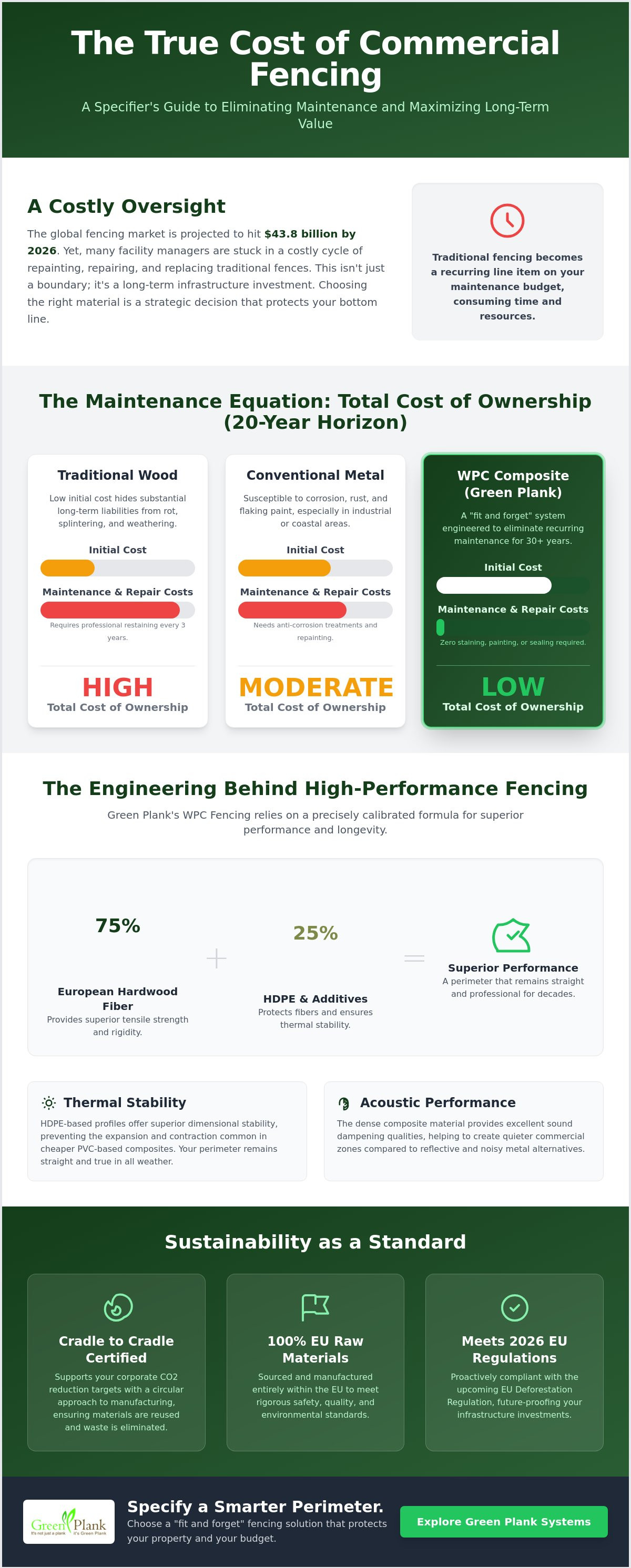
The "Maintenance Equation" is the most effective way to evaluate a perimeter investment. Professionals must calculate the total cost over a 20-year horizon. This includes the rising cost of skilled labor, the price of specialized stains or anti-corrosion coatings, and the operational downtime required for repairs. When these variables are factored in, the initial capital expenditure of a high-performance composite system becomes significantly lower than the lifecycle cost of cheaper, high-maintenance alternatives. Shifting to a "fit and forget" mindset allows organizations to reallocate maintenance budgets toward more productive facility improvements.
The Hidden Costs of Traditional Fencing
Timber fences are a common choice for their low upfront cost, yet they hide substantial long-term liabilities. A commercial timber fence typically requires professional cleaning and restaining every three years to prevent moisture ingress and rot. Over a decade, these labor hours often exceed the original cost of the fence itself. In industrial or high-salinity coastal environments, steel fencing faces similar challenges. Salt and pollutants accelerate oxidation, causing protective coatings to bubble and flake. Once the core metal is exposed, structural failure is inevitable. Choosing "cheap" materials at the procurement stage is the fastest way to ensure the highest Total Cost of Ownership (TCO).
Aesthetics That Last: Avoiding the "Weathered" Look
A property's perimeter is the first point of contact for clients and stakeholders. When a fence begins to look aged, grayed, or neglected, the perceived value of the entire commercial asset declines. Retail environments and corporate headquarters cannot afford the "weathered" look that organic materials inevitably adopt after a few seasons of rain and sun. High-quality WPC systems are engineered for color-fastness, utilizing pigments that are integrated into the material rather than applied as a surface layer. This ensures the fence looks as professional in year 25 as it did on the day of installation. Low maintenance fencing is a strategic asset that preserves property value while eliminating recurring operational expenses.
The Engineering Behind High-Performance Composite Fencing
Specifying low maintenance commercial fencing requires an understanding of material science that goes beyond surface aesthetics. The structural integrity of a perimeter depends on the precise calibration of its components. High-performance composite fencing relies on a specific 75/25 formula. This ratio consists of 75% hardwood fiber and 25% high-density polyethylene (HDPE) along with specialized additives. Hardwood provides the necessary tensile strength and rigidity, while the HDPE acts as a protective matrix that encapsulates the organic fibers. This synergy ensures the profile remains flexible enough to resist impact but strong enough to maintain its form under heavy use.
Thermal stability is a primary concern for large-scale infrastructure. Cheaper composites often utilize PVC, which is prone to significant expansion and contraction during temperature swings. In contrast, HDPE-based profiles offer superior dimensional stability. This material consistency is verified through rigorous ASTM performance standards, which evaluate how composites behave under load and environmental stress. By selecting a material with high thermal resistance, specifiers prevent the warping and bowing that frequently plague lower-quality installations in exposed commercial sites.
Structural integrity is further protected by advanced UV inhibitors. These additives are blended throughout the profile to prevent the sun from breaking down the polymer chains. While traditional materials degrade at the surface, these engineered profiles maintain their density and weight. Low-density, high-strength profiles are particularly advantageous for low maintenance commercial fencing projects. They reduce the dead load on support structures while providing the robust barrier required for industrial security. The molecular bond between hardwood fiber and HDPE creates a material that is impervious to the elements that destroy traditional wood.
Hardwood Fiber vs. Softwood Fillers
The choice of fiber is a critical differentiator in engineering quality. Many manufacturers use softwood fillers like pine, which are highly porous and susceptible to moisture absorption. We utilize hardwood fiber because its dense cellular structure naturally resists fungal decay and water ingress. This material choice is why our Commercial Infrastructure Profiles carry a service life warranty of up to 50 years. You receive the authentic texture of natural wood grain without the inherent biological weaknesses of untreated timber.
HDPE: The Superior Polymer for Commercial Use
HDPE is the preferred polymer for professional applications because it is more impact-resistant and environmentally friendly than PVC. It does not release harmful phthalates or lead, aligning with modern sustainability targets. To manage the natural physics of the material, we utilize the HidLoc™ hidden fastening system. This technology allows for controlled thermal expansion without putting stress on the fasteners or the boards. This engineering foresight ensures the fence remains secure and silent, even in environments with extreme temperature fluctuations.
Comparing Commercial Fencing Materials: WPC vs. Metal vs. Vinyl
Selecting the correct perimeter material requires balancing immediate capital expenditure with thirty years of operational reality. While metal fencing currently holds a significant global market share, its performance in commercial environments often falls short of the "fit and forget" standard. Low maintenance commercial fencing must provide more than just a physical barrier; it must offer acoustic insulation, repairability, and a low carbon footprint. WPC systems outperform traditional materials by addressing these specific infrastructure challenges through advanced material science.
Acoustic performance is a primary differentiator for commercial zones located near residential areas or busy thoroughfares. Metal fences are resonant; they reflect and even amplify ambient noise. WPC profiles are dense and solid. Their internal structure absorbs sound waves, providing a superior noise reduction barrier that enhances the environment for both the property and its neighbors. This density also plays a role in vandalism resistance. If a section is damaged by graffiti or impact, individual profiles can be replaced without the need for specialized welding equipment or full-panel removals. This modularity reduces repair downtime and keeps maintenance costs predictable.
Sustainability credentials also separate these materials in the 2026 market. Aluminum and steel production are energy-intensive processes that rely on high-heat smelting. In contrast, our manufacturing process focuses on a circular economy. By utilizing 75% hardwood fiber and 25% HDPE, we reduce the CO2 footprint of the perimeter. This aligns with corporate sustainability targets and Cradle to Cradle ownership principles, ensuring the material remains an asset rather than an environmental liability at the end of its service life.
WPC vs. Aluminum and Steel
Metal fences rely on surface treatments like powder coating or galvanization to resist the elements. These coatings eventually fail, leading to rust and unsightly peeling that compromises the professional image of a facility. WPC is naturally resistant to oxidation. It is the ideal choice for coastal environments where salt air accelerates metal corrosion. Beyond durability, WPC offers aesthetic versatility. It provides the warm, natural look of wood for upscale commercial developments while maintaining the strength of industrial-grade infrastructure.
WPC vs. Commercial Vinyl (PVC)
Commercial vinyl often fails the professional aesthetic test because of its "plastic" sheen and lightweight feel. It lacks the structural weight required for premium projects and can become brittle when exposed to intense UV radiation. Impact resistance is another critical factor. In high-traffic areas where vehicles or equipment operate, vinyl is prone to cracking upon impact. WPC, with its high hardwood content, possesses the impact strength necessary to withstand the rigors of a commercial site. It supports circular construction goals, offering a sophisticated alternative that doesn't sacrifice performance for price.
Key Selection Criteria for Large-Scale Infrastructure Projects
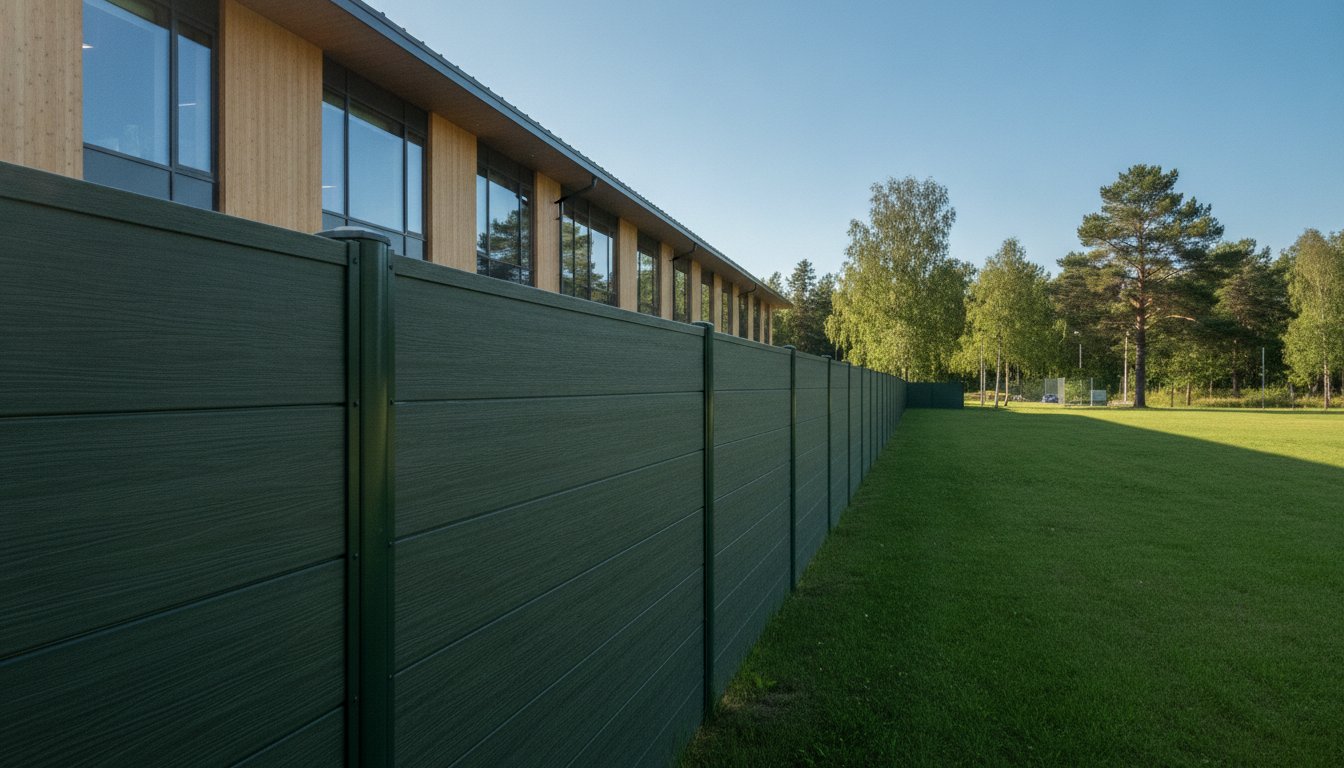
Large-scale infrastructure demands a rigorous evaluation of engineering tolerances. When specifying low maintenance commercial fencing for perimeters exceeding several hundred linear feet, wind load becomes a primary structural concern. Tall boundary fences, often reaching heights of 8 to 10 feet in industrial zones, must withstand significant lateral pressure. Our Commercial Infrastructure Profiles are engineered to maintain their vertical alignment under these stresses, ensuring the perimeter remains secure without the risk of structural fatigue. This reliability is built into the design, allowing for consistent performance across expansive commercial sites.
Compliance with evolving regulatory frameworks is equally vital. By utilizing 100% EU raw materials, specifiers ensure that their projects meet stringent safety and environmental standards from the outset. This regional sourcing provides a transparent supply chain, which is essential for meeting the December 2026 requirements of the EU Deforestation Regulation (EUDR). Installation efficiency also plays a major role in project timelines. Modular composite systems allow for rapid assembly, reducing the total labor hours required on-site. This speed doesn't compromise quality; instead, it ensures a uniform finish that integrates seamlessly with existing security features like automated gates and access control systems.
Sustainability and ESG Compliance
Modern commercial tenders now prioritize sustainable building materials as a core requirement. Reducing the CO2 footprint of a project is no longer optional; it's a mandate for ESG compliance. We minimize transport-related emissions by sourcing all components within Europe. Our commitment to Cradle to Cradle ownership ensures that the product can be repurposed or recycled at the end of its 50-year service life, supporting a truly circular construction model. You can view our full range of Composite Fencing Systems to see how these credentials translate into high-performance infrastructure.
Acoustics and Privacy for Commercial Zones
Strategic use of composite fencing provides essential sound mitigation for sensitive areas such as loading docks or external HVAC units. The density of WPC profiles creates an effective acoustic barrier, shielding neighboring properties from industrial noise. This functional benefit is paired with high privacy levels, creating a secure environment that remains welcoming and professional. Selection of commercial fencing is a balance between engineering specs, aesthetic intent, and environmental certification.
Green Plank’s Sustainable Fencing Systems: European Quality for Global Standards
Green Plank’s approach to low maintenance commercial fencing is rooted in the philosophy of the Sustainable Craftsman. We don't just manufacture barriers; we engineer long-term infrastructure assets. Our Commercial Infrastructure Profiles are the result of rigorous material science and a commitment to regional manufacturing excellence. While competitors offer standard warranties of 10 to 25 years, our 50-year service life guarantee reflects the confidence we have in our proprietary hardwood and HDPE blend. This longevity isn't accidental. It's a direct result of using 100% EU raw materials, which ensures a level of consistency and safety that global imports simply cannot match.
The European advantage extends beyond quality control. By manufacturing within the EU, we provide a transparent supply chain that simplifies compliance for modern specifiers. You won't have to worry about the variable quality of untested polymers or the ethical ambiguities of distant wood sources. Instead, you'll receive a product that meets the highest professional standards while supporting regional industry. We offer extensive customization for professionals, providing project-specific profiles and dedicated technical support to ensure your perimeter meets exact engineering requirements.
The Cradle to Cradle Commitment
Our commitment to sustainability is documented through Cradle to Cradle ownership. We implement circular design in every fencing profile, ensuring that 75% of the material is composed of hardwood fiber. This high wood content acts as a carbon-sequestering agent, effectively locking away CO2 within the structure of your fence. Partnering with a manufacturer that prioritizes the carbon footprint of your project allows you to meet corporate environmental targets with verifiable data. We view every fence as a step toward a more responsible construction industry.
Specifying Green Plank for Your Next Project
We provide the tools necessary for precise architectural planning. Professionals can access technical data sheets and BIM objects to integrate our systems into their digital workflows. Many specifiers find that using both wpc composite decking and fencing creates a unified, professional aesthetic across a commercial site. This holistic approach ensures material compatibility and simplifies procurement. If you're ready to secure your perimeter with low maintenance commercial fencing that respects both your budget and the planet, contact Green Plank for commercial supply and infrastructure partnerships.
Securing the Future of Commercial Infrastructure
Transitioning to a high-performance perimeter is a commitment to both fiscal responsibility and environmental ethics. You've seen how modern WPC engineering eliminates the structural decay inherent in wood and the corrosion common in metal systems. By prioritizing low maintenance commercial fencing, facility managers can redirect maintenance labor toward higher-value tasks while maintaining a pristine corporate image. Our systems are built on a foundation of 100% EU raw materials and manufacturing, ensuring that every profile meets rigorous safety and consistency standards.
This engineering confidence is backed by a 50-year commercial service life warranty. With Cradle to Cradle Certified circular design, your infrastructure investment aligns with the most stringent global sustainability targets, ensuring the material remains an asset throughout its lifecycle. Ready to elevate your site's performance? Request a Technical Consultation for Your Commercial Fencing Project today. Let's build a boundary that respects both your bottom line and the natural world.
Frequently Asked Questions
Is WPC fencing truly maintenance-free for commercial use?
WPC fencing is classified as a low maintenance commercial fencing solution because it eliminates the need for recurring chemical treatments. Unlike timber, it doesn't require annual staining or sealing to prevent rot. A simple periodic wash with pressurized water is sufficient to remove surface dust. This "fit and forget" performance allows facility managers to focus resources on core operations rather than perimeter repairs.
How does the cost of commercial composite fencing compare to aluminum?
While the initial capital expenditure for composite systems is often higher than budget-grade wood, it remains highly competitive with premium aluminum over a 20-year horizon. Metal systems rely on surface coatings that eventually flake or oxidize, leading to expensive repainting cycles. WPC provides a lower Total Cost of Ownership because the color and protective properties are integrated throughout the material’s core.
Can WPC fencing withstand high wind loads in open commercial sites?
Our Commercial Infrastructure Profiles are specifically engineered to manage significant wind loads in exposed sites. The internal density of the 75/25 hardwood and HDPE blend provides the necessary rigidity to prevent bowing. When installed according to our technical specifications, these systems offer a robust physical barrier that maintains its structural alignment even in high-pressure environments.
Does composite fencing fade over time in direct sunlight?
High-performance composite fencing undergoes a natural color stabilization process during its first few months of exposure. Once this initial period is complete, the integrated UV inhibitors protect the material from the significant fading seen in traditional timber. The pigments are molecularly bonded within the HDPE matrix, ensuring the professional aesthetic remains consistent for decades without the need for touch-ups.
What is the expected lifespan of a commercial WPC fence system?
A professionally specified WPC system has an expected service life of up to 50 years. We justify this longevity through our use of 100% EU raw materials and advanced manufacturing standards. This extended lifespan is a primary signature of our engineering confidence, providing a durable boundary that outlasts multiple cycles of traditional fencing materials in demanding environments.
How does WPC fencing contribute to BREEAM or LEED certifications?
WPC fencing supports green building credits by utilizing recycled HDPE and 75% hardwood fiber. Our Cradle to Cradle ownership model and regional manufacturing significantly reduce the CO2 footprint of a project. These documented sustainability credentials help specifiers meet the rigorous requirements of BREEAM and LEED certifications for circular construction and responsible sourcing.
Can damaged sections of a composite fence be easily replaced?
Damaged sections are easily addressed thanks to the modular design of our composite systems. If a single profile is compromised by impact, it can be removed and replaced without dismantling the entire fence line. This is a significant advantage over welded metal sections, which require specialized labor and heavy equipment to repair or replace once structural damage occurs.
Is WPC fencing resistant to graffiti and environmental pollutants?
The dense, non-porous surface of our composite profiles provides excellent resistance to environmental pollutants and salt air. While no material is entirely graffiti-proof, the lack of organic absorption makes it much easier to clean than traditional wood. Most surface contaminants can be removed using standard commercial cleaning agents without damaging the underlying material integrity or finish.
Produkt spezifizieren
Diese Anleitung in einer Green Plank-Ausschreibung nutzen
Technische WPC-Artikel sollen die kommerziellen Seiten stärken — nicht mit ihnen konkurrieren. Weiter zu WPC-Terrasse, TerraTuff, Nordeka oder den technischen Downloads.