



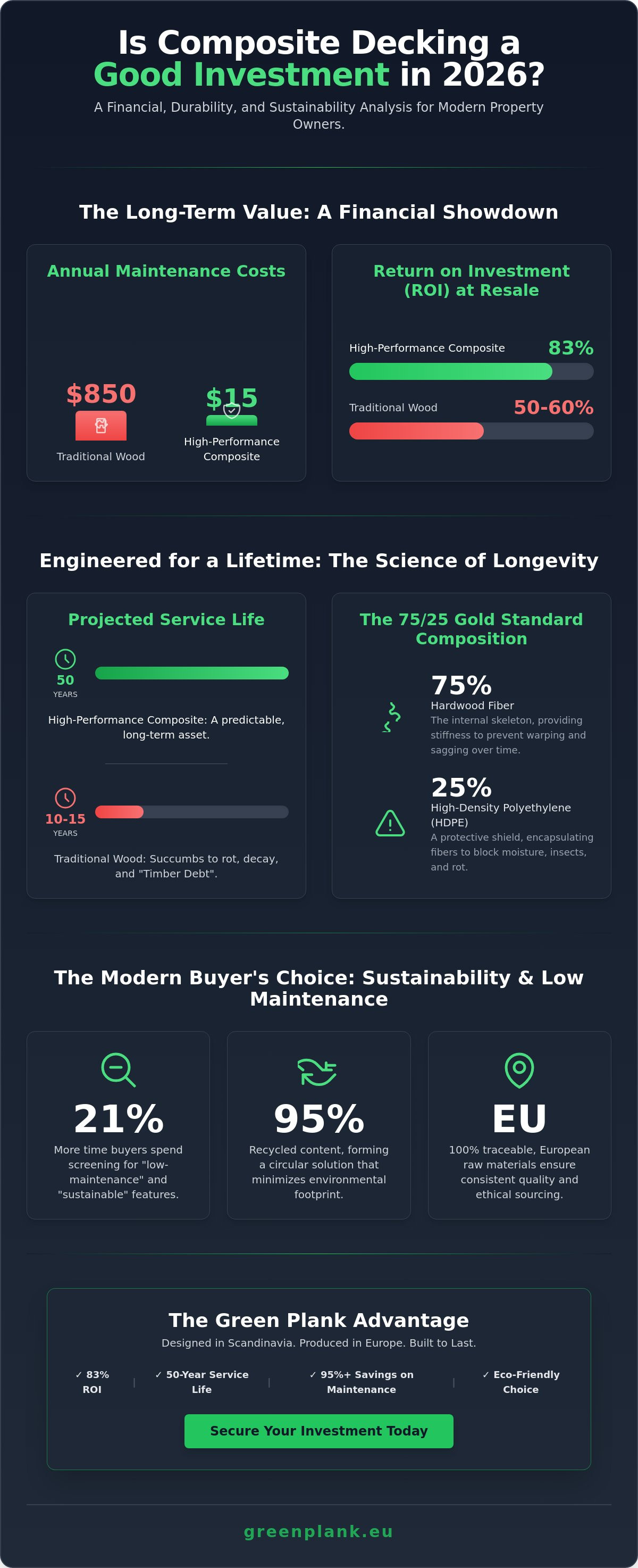
While traditional wood decking requires up to $850 in annual maintenance, high-performance composite alternatives demand as little as $15. This massive financial gap is why many property owners are asking: is composite decking a good investment 2026? With property buyers now spending 21% more time screening for "sustainable living" and "low-maintenance" features, a deck that warps or fades is no longer just an eyesore; it's a financial liability.
It's frustrating to watch a significant outdoor investment deteriorate under harsh weather or require constant staining. This guide will demonstrate why high-performance WPC decking is the most sound financial and ecological choice for your property. We'll analyze the 83% return on investment seen in 2026, the benefits of 95% recycled content, and how our traceable, engineered materials offer a circular solution for the modern home. Designed in Scandinavia. Produced in Europe. Built to last. Designed for life.
Key Takeaways
- Analyze the long-term financial security provided by an 83% ROI and how it protects your property value against rising timber costs.
- Uncover the technical engineering behind the 75% hardwood fiber composition that ensures your outdoor space remains structurally sound for up to 50 years.
- Discover why is composite decking a good investment 2026 by calculating the cumulative savings achieved through a low-maintenance, circular material choice.
- Learn how European-made, traceable raw materials help your project meet modern CO2-neutral building standards and ethical permit requirements.
- Identify the professional-grade infrastructure profiles needed to create high-traffic, durable environments that are built to last and designed for life.
Redefining the 'Best' Outdoor Investment for 2026
In 2026, the definition of a successful property investment has fundamentally changed. It no longer refers to the lowest ticket price at the point of sale. Instead, smart property owners prioritize long-term capital preservation and environmental circularity. Determining whether is composite decking a good investment 2026 depends on how you value your time and the future resale value of your home. With labor rates for maintenance climbing and timber prices fluctuating, a deck that requires zero sanding or oiling isn't a luxury; it's a strategic hedge against rising costs.
The 2026 market rewards those who eliminate recurring liabilities. While traditional wood decks recover only 50% to 60% of their cost at resale, high-performance composite decks now recoup up to 83% of their initial value. This shift reflects a broader consumer mindset that values low-density performance and traceable manufacturing. People want outdoor spaces that are sustainable and capable of lasting a lifetime without becoming a burden on the planet or the wallet. Designed in Scandinavia. Produced in Europe. This is the new global standard for outdoor living.
Beyond Aesthetics: Why Durability is the New Luxury
Durability has become the hallmark of premium architecture. High-performance Wood-plastic composites (WPCs) provide a level of stability that traditional timber cannot match in today's unpredictable weather. We define WPC as a professional-grade blend of 75% hardwood fiber and 25% high-density polyethylene (HDPE). This specific ratio creates a natural-fiber composite that resists the moisture absorption and thermal expansion that plague cheaper alternatives.
By combining the aesthetic warmth of wood with the engineering precision of high-density polymers, we deliver a product that withstands the elements while maintaining its structural integrity for decades. This is the core of our Nordic Reliability standard. Every board is engineered to minimize its environmental footprint while maximizing its service life. It's a circular approach to building that ensures your investment remains an asset rather than a maintenance project.
The Shift from Traditional Wood to High-Performance WPC
Homeowners are increasingly wary of "Timber Debt." This refers to the cycle of recurring costs associated with natural wood, which often fails within 10 to 15 years in 2026 climate conditions. In contrast, premium WPC is engineered for a 50-year service life. When you consider that buyers are now 21% more likely to screen for "low-maintenance" features, the transition to composite is a logical financial step. You can explore the technical details in our guide on What is WPC Composite Decking? to understand how these materials are built to last. Designed for life. Built to last.
The Science of Longevity: Engineering a 50-Year Service Life
Longevity isn't an accident; it's a result of precise molecular engineering. When homeowners ask is composite decking a good investment 2026, the answer lies in the material's ability to resist the biological and mechanical failures that destroy timber. While wood-only decks succumb to rot and fungal decay, our high-performance natural-fiber composite uses a specific 75/25 ratio to ensure the boards remain straight, strong, and safe for up to 50 years. This engineering approach eliminates the "Timber Debt" mentioned previously, replacing it with a predictable, long-term asset.
European raw materials provide the foundation for this durability. By sourcing 100% traceable wood fibers and high-grade polymers within the EU, we maintain a consistent board density that cheaper imports cannot match. This consistency is vital for structural integrity. It ensures that every linear meter of decking performs exactly as specified, providing a stable platform for decades of outdoor living. Designed in Scandinavia. Produced in Europe. Built to last.
Hardwood Fiber vs. HDPE: The 75/25 Gold Standard
The structural integrity of our boards depends on the synergy between 75% hardwood fiber and 25% high-density polyethylene (HDPE). The hardwood fiber acts as the internal skeleton. It provides the necessary stiffness to prevent "creep," which is the tendency of solid materials to move or deform under mechanical stress. Without this high fiber content, boards can sag or warp over time. Conversely, the HDPE acts as a protective shield. It encapsulates the wood fibers to block moisture, insects, and rot. This composition is supported by the Life Cycle Assessment of WPCs, which confirms that properly engineered composites significantly outperform traditional materials in durability and environmental impact.
Nordic Reliability: Built for Extreme Weather
Scandinavian winters and hot European summers demand materials with exceptional thermal stability. Our engineered boards are designed to handle extreme temperature fluctuations without the excessive expansion or contraction seen in lower-grade plastics. This stability is a core pillar of our Nordic reliability. We focus on high-density performance, ensuring that even in wet or icy conditions, the surface maintains professional-grade slip resistance. This safety feature is essential for both private residences and high-traffic commercial projects. Adopting a "Cradle to Cradle" ownership model means our products are designed for life. They are built to last. If you're ready to upgrade your outdoor space with this level of precision, you can explore our professional-grade decking collections to find the right fit for your project.
Lifecycle Cost Analysis: Initial Price vs. Decades of Value
Evaluating the total cost of ownership is essential when deciding is composite decking a good investment 2026. While natural timber often presents a lower entry price, it carries an invisible "maintenance tax" that accumulates every season. A wood deck requires sanding, staining, or oiling every 2 years to prevent structural failure. In contrast, our engineered WPC boards require only basic cleaning with water and mild soap. When you calculate the cumulative expenses of high-quality stains and professional labor over a 25 year or 50 year warranty period, the financial advantage shifts decisively toward composite materials.
Modern property owners increasingly prioritize assets that do not demand constant attention. The 2026 real estate market reflects this preference clearly. Properties featuring professional-grade, low-maintenance outdoor spaces now recoup up to 83% of their installation costs during resale. This high recovery rate is driven by buyers who view a wood deck as a future chore and a composite deck as a permanent lifestyle upgrade. Choosing a material that is built to last isn't just an aesthetic choice; it's a calculated financial strategy to preserve your home's equity.
Eliminating the 'Maintenance Debt' of Natural Timber
The time saved by choosing WPC is substantial. Over the typical lifespan of a deck, homeowners save more than 100 hours of intensive manual labor by avoiding the sanding and sealing cycle. This "maintenance debt" also includes the rising cost of chemical sealants. As EU regulations on VOCs (volatile organic compounds) become stricter in 2026, the price of compliant, high-performance wood treatments continues to climb. By removing these recurring costs, you transform your outdoor space from a liability into a stable, long-term asset. It's a circular approach to budgeting that pays dividends for decades.
Property Value and the HidLoc™ Aesthetic
Visual precision directly impacts property valuation. Traditional decks often suffer from visible screw heads, split boards, and uneven gaps that deteriorate the home's curb appeal. Our HidLoc™ hidden fastening system eliminates these issues by securing boards from the side. This creates a flawless, screw-free surface that mimics the refined look of high-end interior flooring. This level of finish is a primary driver for premium buyers who value Scandinavian design principles and engineering excellence. For those planning a project, following a Professional Deck Installation Guide ensures the structural integrity matches the high-end aesthetic. Designed in Scandinavia. Produced in Europe. Built to last. Designed for life.
Sustainability as a Financial and Ethical Asset
Sustainability in 2026 is no longer a voluntary "green" choice; it's a financial necessity. Municipalities across Europe now require proof of circularity for new building permits. If you're wondering is composite decking a good investment 2026, consider how sustainable materials shield you from future environmental taxes and carbon penalties being phased in for traditional construction. Choosing a material that is engineered for circularity ensures your property remains compliant with evolving environmental legislation. This protects its long-term marketability and value in a world that increasingly penalizes waste.
Unlike competitors who source materials from distant markets with opaque labor standards, our localized supply chain reduces the environmental cost of long-distance shipping. By manufacturing in Europe using 100% traceable raw materials, we minimize the CO2 footprint of every board. This localized approach isn't just about ethics. It's about supply chain stability and quality control that results in a professional-grade product. Using 75% natural fibers significantly reduces the reliance on virgin plastics, achieving a CO2 savings of up to 40% compared to traditional PVC-based alternatives. This engineering precision ensures your project respects nature while delivering high-end performance.
Cradle to Cradle: Investing in a Circular Future
A truly circular material maintains its value even at the end of its functional life. While many products are labeled "recycled," they often end up in landfills because they cannot be processed again. Our natural-fiber composite follows a "Cradle to Cradle" model. This means the boards are designed to be reclaimed and re-engineered into new products, effectively closing the loop. You can learn more about these requirements in our Sustainable Building Materials Guide. This circularity is a primary reason why professionals choose Green Plank for commercial bidding where sustainability scores are mandatory. It's a promise that your material choice today won't become the waste of tomorrow.
Reducing CO2 Footprints through European Manufacturing
Shipping building materials across oceans from Asia or America adds a massive carbon debt to a project before it even begins. By keeping our production within Europe, we ensure that every board reflects our commitment to Nordic reliability and ethical manufacturing. This proximity allows for rigorous quality control that guarantees the durability of your deck. It also ensures that the labor involved meets high European standards for safety and fairness. When you invest in our products, you're investing in a system that respects both the planet and the people who build it. If you're ready to start a project that balances luxury with responsibility, view our sustainable decking solutions today. Designed in Scandinavia. Produced in Europe. Built to last.
The Green Plank Advantage: Why Professionals Choose Us in 2026
Professionals don't just buy building materials; they invest in long-term infrastructure. Deciding if is composite decking a good investment 2026 requires looking at the technical support and product specialization behind the brand. For architects and developers, the priority is risk mitigation. They need a partner that provides traceable, European-made solutions that won't require replacement in a decade. Our position as a "Responsible Innovator" means we provide the engineering precision required for large-scale projects while maintaining the aesthetic warmth expected in high-end residential design.
The security of our 20 to 50 year warranties serves as a primary signature of our engineering confidence. In the 2026 market, where material costs are volatile, a half-century service life is a powerful financial safeguard. We've built our reputation on Nordic reliability, ensuring that every board delivered to a site meets professional-grade standards for strength and stability. This commitment to quality is why project partners trust us for everything from private balcony renovations to expansive public boardwalks. Built to last. Designed for life.
Terra Tuff and Smart System: Specialized Project Solutions
Every outdoor space has unique mechanical requirements. Our Terra Tuff line is engineered with high-density reinforcement to withstand the constant friction and heavy foot traffic of commercial plazas and public parks. It provides the durability needed for high-traffic environments without sacrificing the natural-fiber aesthetic. Conversely, our Smart System is designed for the specific needs of modern urban architecture. It features low-density boards that are essential for balcony and rooftop installations where weight restrictions are a critical factor in 2026 building codes.
Installation efficiency is another area where we provide a distinct financial advantage. The HidLoc™ hidden fastening system simplifies large-scale assembly, reducing labor hours by up to 30% compared to traditional face-screwing methods. This system ensures a flawless, uniform finish that attracts premium buyers and satisfies the most demanding architectural specifications. By combining specialized product lines with intuitive installation technology, we help our partners deliver projects on time and under budget. It's a circular approach to construction that values both the builder's time and the client's long-term satisfaction.
The European Standard of Excellence
The final justification for choosing our WPC is our geographical and ethical branding. Designed in Scandinavia. Produced in Europe. This isn't just a slogan; it's a guarantee of quality control and ethical manufacturing. We act as a dedicated partner for architects and developers, providing the technical data and sustainability certifications needed to navigate the complex regulatory environment of 2026. If you're ready to future-proof your project with a material that respects both the planet and your budget, explore our sustainable WPC decking solutions today. Our engineered boards are built to last, ensuring your outdoor space remains a beautiful, maintenance-free asset for decades to come.
Securing Your Outdoor Future with Circular Engineering
Choosing the right materials today determines the value of your property for the next five decades. The transition from high-maintenance timber to engineered natural-fiber composite is a strategic move that reflects the 2026 priority for circularity and low-density performance. With an 83% ROI at resale and the elimination of $850 in yearly maintenance fees, the financial logic is undeniable. You are not just building a deck; you are eliminating a recurring liability.
When evaluating if is composite decking a good investment 2026, it's clear that professional-grade WPC provides the only path to a CO2-neutral, maintenance-free lifestyle. Our boards are Cradle to Cradle Certified and manufactured from 100% EU raw materials to guarantee structural integrity in extreme climates. Designed in Scandinavia and produced in Europe, our systems are backed by a 50-year warranty to ensure your investment remains a permanent asset.
Discover the Green Plank Difference: Explore Sustainable WPC Decking
Build with confidence and enjoy a beautiful outdoor space that respects both your time and the planet. Your vision of a refined, sustainable retreat is within reach. Built to last. Designed for life.
Frequently Asked Questions
Is composite decking worth the extra cost in 2026?
Yes, composite decking is a financially sound choice because it eliminates the high recurring costs of timber maintenance. While wood requires an annual investment of $450 to $850 for staining and sealing, composite upkeep averages only $5 to $15. This makes people ask if is composite decking a good investment 2026; the long-term savings of over $15,000 across 20 years confirm its value. You don't just buy a deck, you eliminate a recurring liability.
How much does composite decking increase home value?
High-performance composite decks recoup between 65% and 83% of their installation cost in immediate property value as of early 2026. This is significantly higher than the 50% to 60% recovery rate seen with traditional wood. Modern buyers are 21% more likely to screen for terms like low-maintenance and sustainable living. This makes these decks a primary driver for faster, more profitable home sales in the current market.
Can composite decking really last 50 years?
Engineered natural-fiber composite is designed for a service life of 25 to 50 years. Our specific blend of 75% hardwood fiber and 25% HDPE creates a board that resists moisture, insects, and rot. Unlike wood, which often fails after 10 to 15 years, our professional-grade boards maintain their structural integrity through decades of extreme weather. It's a product built to last and designed for life.
Is composite decking better for the environment than wood?
Yes, leading composite brands utilize up to 95% recycled content and eliminate the need for toxic chemical stains and sealants. Our European-made products follow a circular Cradle to Cradle model; this ensures materials can be reclaimed at the end of their life. This reduces the CO2 footprint and prevents the deforestation associated with traditional timber harvesting. It's an ethical choice for the responsible innovator.
Does composite decking get too hot to walk on in full sun?
Modern engineering has significantly improved thermal performance through heat-reflective pigments and high-density cores. While all outdoor surfaces absorb heat, high-performance WPC remains comfortable underfoot compared to older plastic-heavy boards. Choosing lighter colors and professional-grade profiles ensures your outdoor space remains usable even during peak summer temperatures. It's about balancing aesthetic beauty with technical comfort for your family.
What is the difference between European-made WPC and cheap imports?
European-made WPC offers 100% traceable raw materials and follows strict EU environmental and labor regulations. Cheap imports often use non-traceable plastics and low-density fillers that lead to warping and fading within 5 years. Our Nordic reliability ensures consistent board density and strength; this provides a level of engineering confidence that non-regulated products simply cannot match. Quality is a non-negotiable standard for our brand.
How do I clean composite decking without damaging the surface?
Cleaning requires only warm water, mild soap, and a soft-bristle brush to remove dirt and debris. You don't need pressure washers or harsh chemical cleaners, which can damage the engineered surface of the boards. Regular rinsing twice a year prevents organic buildup and keeps the natural wood aesthetic looking fresh for decades. It's a low-maintenance solution designed to save you 15 hours of labor every year.
Are hidden fasteners like HidLoc™ worth the investment?
Yes, hidden fastening systems are essential for achieving a high-end, screw-free aesthetic that increases property value. Beyond the visual appeal, systems like HidLoc™ prevent board splitting and moisture penetration at the screw holes. This preserves the structural integrity of the natural-fiber composite and simplifies the installation process for both residential and commercial projects. It's an engineering detail that ensures your deck is built to last.
Produkt spezifizieren
Diese Anleitung in einer Green Plank-Ausschreibung nutzen
Technische WPC-Artikel sollen die kommerziellen Seiten stärken — nicht mit ihnen konkurrieren. Weiter zu WPC-Terrasse, TerraTuff, Nordeka oder den technischen Downloads.