



Did you know that 72% of homeowners now prioritize low-maintenance materials, yet many still avoid deep charcoal tones due to concerns over heat and fading? Choosing a dark grey composite decking design is a bold architectural statement that requires more than just an eye for color; it demands a sophisticated understanding of material science and thermal performance. You want a space that looks premium on day one and stays that way for fifty years without the burden of constant staining or repairs.
It's natural to feel concerned about how dark surfaces interact with the summer sun or how they might clash with your existing stone and timber elements. We agree that a luxury outdoor space should be a source of relaxation, not a maintenance liability. This guide will show you how to master the art of modern outdoor design using sustainable engineering and high-contrast aesthetics. We'll examine the technical advantages of EU-manufactured WPC, the precision of HidLoc™ hidden fastening systems, and the specific design strategies that keep dark surfaces cool and inviting. You'll learn how to implement a Cradle to Cradle ownership model that respects nature while delivering a professional-grade finish.
Key Takeaways
- Discover how to select the ideal charcoal or anthracite shade to serve as a sophisticated neutral anchor for contemporary landscape architecture.
- Learn the "Picture Frame" technique and other professional dark grey composite decking design strategies to create high-contrast, visually structured outdoor living areas.
- Understand the engineering behind color stability, where 75% hardwood fiber and high-density polyethylene work together to prevent UV degradation in deep tones.
- Identify the optimal technical profiles for your specific application, whether you require the commercial-grade durability of Terra Tuff or the versatility of the Smart System.
- Commit to a sustainable legacy by exploring Cradle to Cradle ownership and the environmental advantages of 100% EU-sourced raw materials.
Table of Contents
- The Architecture of Contrast: Why Dark Grey Composite Decking Defines Modern Design
- Engineering for Depth: How Premium WPC Maintains Dark Tones Without Fading
- Mastering the Aesthetic: Design Strategies for Dark Grey Outdoor Spaces
- Technical Selection: Matching Project Requirements with Dark Grey Profiles
- The Sustainable Legacy of Dark Grey: Longevity and Eco-Conscious Ownership
The Architecture of Contrast: Why Dark Grey Composite Decking Defines Modern Design
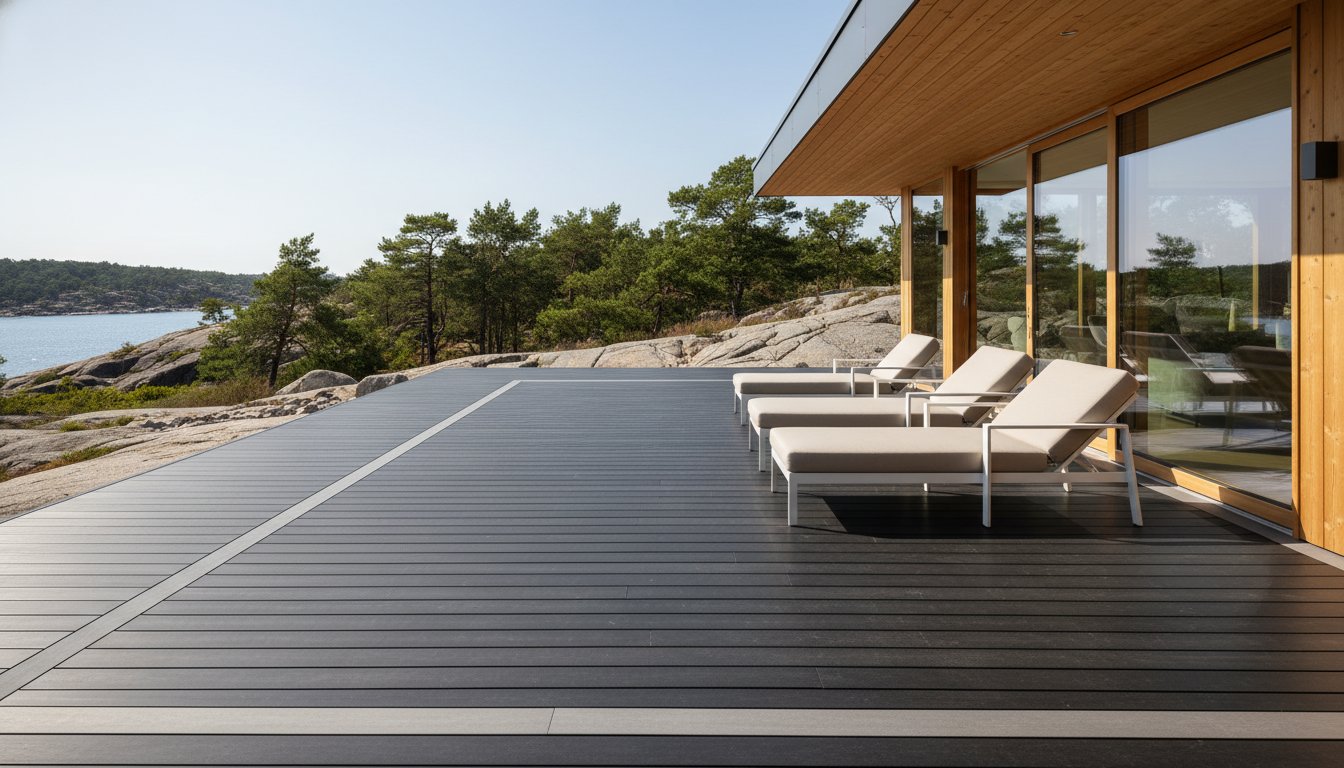
The modern architectural palette has undergone a significant transformation. We see a definitive shift from the rustic, high-maintenance timber of the past toward the industrial-chic precision of the present. Shades like Slate, Anthracite, and Charcoal have become the primary choice for designers seeking a permanent, sophisticated anchor. A dark grey composite decking design doesn't just cover a surface; it defines the perimeter of a luxury lifestyle. It provides a crisp, high-contrast base that makes architectural greenery and natural stone elements appear more vibrant. This visual tension between the dark floor and the organic environment creates a space that feels both curated and grounded.
This movement toward darker tones reflects a broader desire for stability and longevity in design. Light-colored decks often show surface debris and lack the gravitas required for modern minimalist structures. By selecting deep greys, you create a visual weight that grounds the outdoor area. It's a strategic choice that balances the natural warmth of hardwood fibers with the resilience of advanced polymers. These materials are engineered to withstand the elements while maintaining their aesthetic integrity, ensuring your investment retains its value through decades of use. It is a choice for those who prioritize both form and function.
The Psychology of Dark Tones in Outdoor Living
Deep grey palettes evoke a sense of quiet confidence and security. In compact urban spaces, these tones minimize visual noise by creating a unified floor plane that recedes. This makes the area feel larger and more organized. This receding quality allows the eye to focus on the textures of the building’s facade or the movement of the surrounding landscape. Using contrast effectively highlights specific features; a dark deck creates a sharp horizon line against a pale house exterior, emphasizing the geometric precision of the architecture. It transforms a simple patio into a deliberate extension of the home’s interior design.
Dark Grey vs. Traditional Timber: The Maintenance Paradigm
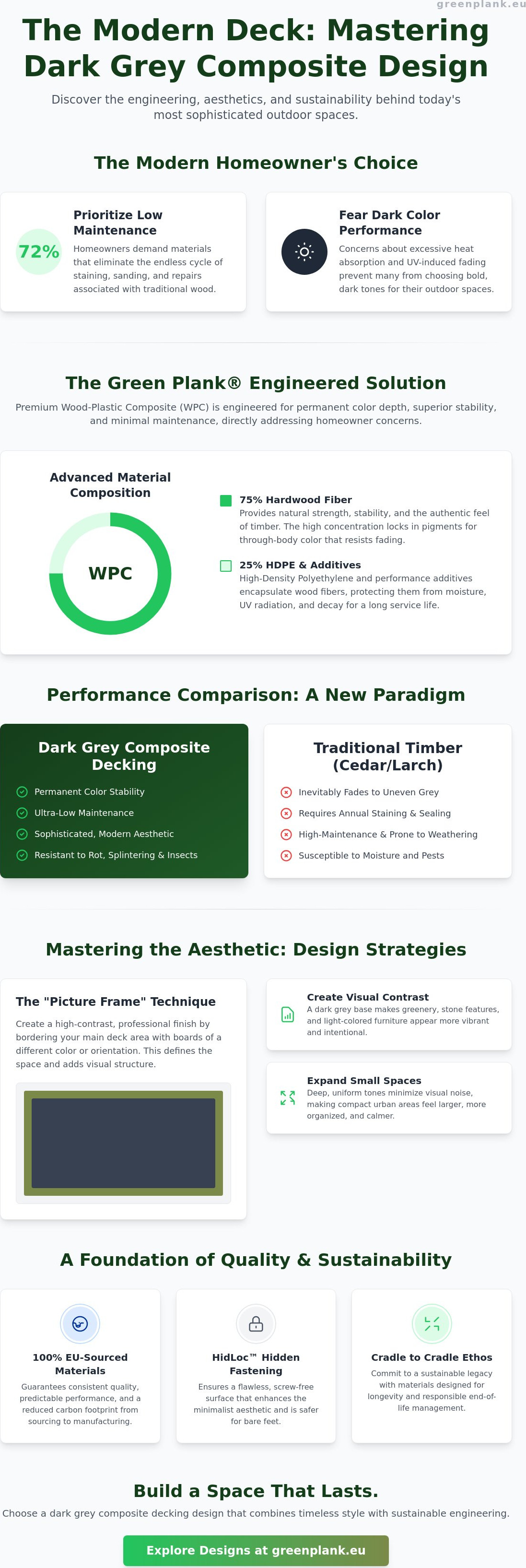
Homeowners often choose cedar or larch for their initial beauty, only to be disappointed by the inevitable silvering effect. This natural weathering process creates an uneven, washed-out appearance that compromises the original design intent. wpc composite decking eliminates this variable through material science. High-quality Wood-plastic composites (WPCs) utilize a blend of 75% hardwood fiber and 25% HDPE to ensure pigment stability. This engineering ensures that the deep charcoal you select today remains the same deep charcoal for the duration of its long service life. You gain the aesthetic of luxury timber without the cycle of sanding, staining, and fading. It's a maintenance-free solution that supports both your aesthetic goals and your commitment to a reduced CO2 footprint.
Engineering for Depth: How Premium WPC Maintains Dark Tones Without Fading
The longevity of a dark grey composite decking design depends entirely on the precision of its molecular bond. While entry-level products often suffer from "chalking" or significant fading within a few seasons, premium WPC utilizes a high-concentration hardwood fiber core to lock in deep pigments. Our formulation uses 75% hardwood fiber combined with 25% high-density polyethylene (HDPE) and specific additives. This specific ratio ensures that charcoal or anthracite tones aren't merely a surface coating but are integrated through the entire profile. This through-body color depth means that even after years of foot traffic, the boards retain their original architectural intent.
Material science is the silent partner in high-end design. By using 100% EU-sourced raw materials, we maintain a level of chemical consistency that's impossible to achieve with unregulated imports. This consistency allows for predictable performance in varying climates, ensuring the deck remains a stable foundation for the home. It's an engineering-first approach that prioritizes the long-term service life of the product over short-term manufacturing shortcuts.
UV Stabilization and Pigment Integrity
Pigment stability in dark boards requires advanced encapsulation technology. Cheap composites often use low-grade plastics that break down under intense solar radiation, leading to a washed-out appearance. Research into the outdoor durability of wood-polymer composites confirms that UV-induced degradation can be mitigated through high-quality polymer shielding and stable fiber blends. Modern dark WPC boards are engineered with high UV-reflectivity to minimize the absorption of destructive short-wave radiation. This protective barrier ensures that the deep, moody aesthetic you designed remains constant for up to 50 years.
Heat Management in Dark Composite Surfaces
A common concern for architects is the thermal retention of darker surfaces. It's a valid question: does a charcoal deck become unusable in the height of summer? The answer lies in material density and engineering. While dark colors naturally absorb more energy, our low-density WPC profiles are designed for rapid heat dissipation. The specific air-to-mass ratio in these boards allows them to cool significantly faster than dense, uncapped alternatives. If you're planning a high-traffic area, choosing a technically advanced composite ensures a safer, cooler experience for bare feet. Thermal expansion is also managed through the HDPE blend, which prevents the warping or "snaking" often seen in inferior dark-colored profiles. To further optimize comfort, designers can integrate pergolas or sail shades that complement the sleek look of the deck while keeping surface temperatures manageable.
Mastering the Aesthetic: Design Strategies for Dark Grey Outdoor Spaces
Successful dark grey composite decking design relies on the deliberate use of contrast to define functional areas. While a single-tone deck can appear monolithic, professional designers often employ the "Picture Frame" technique to add architectural depth. By using a deep Charcoal border around an Ash or light grey infill, you create a clear visual boundary that guides the eye. This strategy provides a structured finish that mirrors the clean lines of modern interior flooring. It's an effective way to separate a lounge area from a dining zone without the need for physical barriers or walls.
Achieving a truly cohesive exterior requires looking beyond the floor. You can extend the moody, sophisticated palette of your deck by matching it with composite wall cladding on the main building or garden structures. This vertical integration creates a seamless transition between the horizontal deck and the vertical facade. When the materials share the same EU-sourced raw material profile, you ensure color consistency across different planes. This holistic approach is a hallmark of high-end architectural projects where every element feels intentional and grounded.
Details in hardware and lighting are what elevate a project from standard to premium. For dark decks, hardware should either disappear or act as a deliberate accent. Black fasteners are the preferred choice for a stealthy, uninterrupted surface, whereas stainless steel components offer a sharp, industrial contrast. At night, dark surfaces can lose their definition. Installing recessed LEDs along the perimeter or within stair treads solves this. These lights define the edges of the space, ensuring safety while highlighting the subtle wood-grain textures of the WPC boards.
Two-Tone Decking: Creating Visual Zones
Large-scale residential and commercial projects benefit from zoning through color. You might use a lighter grey for high-traffic dining areas to minimize the visibility of footprints, while reserving deep charcoal for transition paths or decorative borders. This isn't just about looks; it's about managing the flow of movement across the surface. Achieving this seamless look requires HidLoc™ hidden fastening systems, which eliminate visible screw heads and maintain the integrity of the two-tone pattern. Changing board orientation between zones further emphasizes these boundaries, creating shadow lines that change throughout the day.
Complementary Material Palettes
Dark grey serves as a neutral anchor that allows other materials to shine. Pairing your deck with glass balustrades preserves unobstructed views while maintaining a sleek, modern profile. For a "Scandi-Industrial" aesthetic, integrate raw concrete planters or white stone pavers alongside the WPC boards. These textures provide a cooling visual counterpoint to the deep grey tones. Plant selection is equally vital. Species with vibrant lime-green foliage or white flowers, such as Boxwoods or Hydrangeas, pop dramatically against a dark backdrop. This biological contrast breathes life into the engineered precision of the deck, creating a balanced, sustainable sanctuary.
Technical Selection: Matching Project Requirements with Dark Grey Profiles
Selecting the right profile for your dark grey composite decking design is a matter of engineering precision. High-traffic commercial zones and private residential balconies have vastly different structural requirements. We offer a range of profiles engineered to meet these specific demands while maintaining the aesthetic integrity of deep anthracite and slate tones. For instance, our Terra Tuff range is the definitive choice for commercial infrastructure. It provides the necessary density and load-bearing capacity for public promenades and heavy-traffic areas where durability is the primary metric of success.
Residential projects often prioritize different variables. The Smart System is an innovation specifically designed for balconies and roof terraces where weight is a critical factor. Its low-density construction reduces the overall structural load on elevated structures without sacrificing the long-term service life of the deck. For larger residential builds, the Nordeka and Entra lines offer a strategic balance between high-end performance and cost-efficiency. Every profile we manufacture comes with a service life supported by up to a 50-year warranty, giving professionals and homeowners permanent peace of mind. It's a level of engineering confidence that entry-level products simply can't match.
Load-Bearing and Span Considerations
Precision in installation starts with the substructure. For private residential applications, our boards are rated for 600 mm center-to-center (cc) joist spacing. This efficiency reduces material costs while ensuring a stable, bounce-free surface. Elevated terraces benefit significantly from our low-density WPC, as it minimizes the dead load on the building's frame. Choosing the correct thickness is equally important; commercial designs typically require thicker profiles to handle the increased kinetic energy and weight of public use. Always verify local building codes to ensure your joist spacing meets regional safety standards.
Safety and Performance Standards
Safety is non-negotiable in modern architecture. For poolside applications or wet climates, it's recommended to use WPC products with an R11 or R12 anti-slip rating. These standards ensure the dark grey surface remains safe underfoot even when wet. Fire safety is another core requirement for sustainable building materials. Our profiles meet rigorous standards, such as Class B ratings according to ASTM E84 testing, making them suitable for various urban environments. These materials also offer excellent saltwater resistance, making them a reliable choice for coastal properties where traditional timber would quickly fail. Explore our full range of high-performance WPC profiles to find the perfect match for your next project.
The Sustainable Legacy of Dark Grey: Longevity and Eco-Conscious Ownership
A dark grey composite decking design is more than an aesthetic preference; it's a commitment to a sustainable architectural legacy. We believe that high-end design must be balanced with a grounded responsibility toward the environment. By utilizing 100% EU raw materials, we drastically reduce the CO2 footprint typically associated with the transcontinental shipping of building supplies. This regional reliability ensures that every board meets stringent European environmental regulations during every stage of production. When you choose a charcoal or anthracite palette, you aren't just selecting a color; you're investing in a 50-year service life that prevents the wasteful cycle of frequent replacement common with traditional timber.
Professional specifiers and architects prioritize our WPC profiles because they align with modern green building certifications. The longevity of the material is the ultimate metric of sustainability. A deck that remains structurally sound and visually consistent for five decades conserves significantly more resources than short-lived alternatives. It transforms the outdoor space from a temporary addition into a permanent, eco-conscious asset for the property.
The Circular Economy of WPC
Our Cradle to Cradle ownership model ensures that materials are treated as valuable resources rather than future waste. The core of our decking consists of 75% hardwood fiber, which is sourced from industrial byproducts within the European timber industry. By repurposing this waste, we reduce the demand for virgin timber and support a circular economy. This engineering precision provides a superior long-term ROI compared to many trex decking alternatives, as our European-engineered boards are specifically formulated for the regional climate. This ensures that your dark grey composite decking design remains stable and beautiful without contributing to landfill growth.
Minimizing Environmental Impact in 2026
Environmental stewardship continues long after the installation is complete. One of the most significant benefits of premium WPC is the total elimination of toxic maintenance. Traditional wood decks require annual applications of stains, sealants, and oils that can leach harmful chemicals into the surrounding soil and groundwater. Our composite surfaces require only water and mild soap, protecting the local ecosystem. To achieve a comprehensive, eco-friendly exterior, designers often pair their decks with a sustainable boundary. These fencing systems utilize the same recycled HDPE and hardwood fibers, ensuring your entire perimeter respects nature.
- 100% EU raw materials minimize transport emissions and support regional ethics.
- 75% recycled hardwood fiber prevents industrial waste from entering landfills.
- 50-year service life ensures long-term resource conservation and building stability.
- Zero toxic chemical requirements protect the health of your family and the local environment.
Securing Your Architectural Vision for the Future
Mastering a dark grey composite decking design is about more than following a trend; it's about selecting a material that honors both your aesthetic vision and the planet. We've explored how advanced UV stabilization and high-density engineering ensure that deep charcoal tones remain vibrant without the maintenance cycles required by traditional timber. By integrating professional zoning techniques and selecting the correct technical profile, you create an outdoor space that is both visually striking and structurally superior. This is design with intent, where every detail serves a long-term purpose.
Choosing a solution backed by a 50-Year Service Life Warranty and 100% EU raw materials provides the regional reliability that modern projects demand. Our commitment to Cradle to Cradle sustainable ownership means your investment supports a circular economy that respects nature. It's time to transform your outdoor environment into a maintenance-free sanctuary that reflects your dedication to quality and ecological responsibility. Explore our Dark Grey Composite Decking Collections to begin your next sustainable build. We look forward to helping you create a space that lasts a lifetime.
Frequently Asked Questions
Does dark grey composite decking get hotter than lighter colors?
Darker shades naturally absorb more thermal energy, but high-quality WPC profiles are engineered for rapid heat dissipation. Low-density boards utilize a specific air-to-mass ratio to cool down faster than solid timber or dense, uncapped plastics. Integrating shade structures like pergolas or choosing profiles with high UV-reflectivity ensures the surface remains comfortable for bare feet even during peak summer hours.
Will dark grey composite decking fade in direct sunlight?
Premium composite boards are engineered with encapsulated pigments and UV stabilizers to prevent significant color loss. While all outdoor materials experience a minor initial weathering period, the deep charcoal and anthracite tones are locked into the hardwood fiber core. This engineering ensures your dark grey composite decking design maintains its architectural depth without the washed-out appearance common in entry-level products.
What is the best way to clean dark grey composite boards?
Regular maintenance requires only a soft brush, water, and a mild, pH-neutral detergent. You don't need specialized chemical cleaners to maintain the appearance of dark surfaces. For stubborn debris, a pressure washer can be used on a low setting, provided the nozzle is kept at a safe distance to protect the wood-grain texture. This simple routine preserves the surface integrity and prevents the buildup of organic matter.
Can I use dark grey decking for a commercial project with high foot traffic?
Yes, specific high-density profiles are designed specifically for heavy-traffic commercial infrastructure. These profiles offer the necessary load-bearing capacity and durability for public promenades, restaurants, and urban squares. The material's resistance to rot, splinters, and moisture makes it a superior choice for environments where safety and long-term performance are the primary requirements for professional specifiers and architects.
What color furniture looks best with dark grey decking?
High-contrast palettes, such as white, cream, or light oak furniture, create a sophisticated modern aesthetic against dark grey surfaces. For a more industrial look, black metal frames with neutral grey cushions offer a seamless, monochromatic transition. Vibrant accent colors like mustard yellow or teal also pop effectively against the moody backdrop, allowing you to customize the atmosphere of your outdoor living area effortlessly.
Is dark grey composite decking more expensive than other colors?
Dark grey profiles generally fall within the same price range as other premium color options in the composite market. The cost is determined by the engineering quality, material density, and warranty length rather than the specific pigment used. While the initial investment is higher than softwood, the total cost of ownership is lower due to the elimination of annual staining, sealing, and replacement expenses.
How do I prevent scratches from showing on dark grey decking?
Choosing boards with a high-density HDPE blend and a deeply embossed wood-grain texture helps hide minor surface abrasions. We recommend using protective felt pads under heavy furniture and avoiding the use of metal shovels for snow removal. If a minor scratch occurs, many professional-grade composites allow for light graining with a fine-wire brush to blend the mark back into the natural pattern of the board.
Do I need to seal or paint my dark grey composite deck?
You should never paint, seal, or varnish your composite deck. The boards are manufactured with a permanent color profile and a protective polymer shell that does not require additional coatings. Applying paint or sealants can actually damage the material and will void the long-term performance guarantees. This maintenance-free characteristic is a core benefit of a modern dark grey composite decking design.
Produkt spezifizieren
Diese Anleitung in einer Green Plank-Ausschreibung nutzen
Technische WPC-Artikel sollen die kommerziellen Seiten stärken — nicht mit ihnen konkurrieren. Weiter zu WPC-Terrasse, TerraTuff, Nordeka oder den technischen Downloads.