



A 50-year warranty on an outdoor deck sounds like a lifetime of security, but the true value of your investment often hides in the fine print. You likely expect your guarantee to remain constant, yet many industry standard contracts include pro-rated clauses that aggressively reduce your coverage as the years pass. Finding accurate composite decking warranty information is the only way to distinguish between a surface-level marketing claim and a genuine performance commitment from a manufacturer.
We share your commitment to long-term quality and regional reliability. This guide provides the technical clarity required to navigate the complexities of structural versus aesthetic coverage. You'll gain a clear understanding of how EU-standard manufacturing ensures material durability even in the most demanding climates. We also detail the specific installation requirements, such as proper joist spacing and ventilation, that prevent common warranty voids. This overview delivers the assurance you need to choose materials built on a foundation of engineering precision and ecological responsibility, ensuring your project remains a sustainable asset for decades to come.
Key Takeaways
- Identify the financial risks of prorated clauses and how non-prorated warranties provide superior long-term asset protection for your outdoor space.
- Explore the material science behind the 75% hardwood and 25% HDPE blend that enables a reliable service life of up to 50 years.
- Access essential composite decking warranty information regarding strict installation standards, such as 600 cc joist spacing and the use of HidLoc™ fastening systems.
- Differentiate between residential aesthetic standards and the rigorous durability requirements necessary for high-traffic commercial infrastructure profiles.
- Verify the performance advantages of 100% EU raw materials and how they contribute to a reduced CO2 footprint through cradle-to-cradle ownership.
Table of Contents
- Decoding Warranty Terms: Prorated vs. Non-Prorated Coverage
- The Science of Durability: Engineering a 50-Year Service Life
- Residential vs. Commercial Infrastructure Warranty Requirements
- Installation Protocols: How to Keep Your Warranty Valid
- The Green Plank Guarantee: European Quality and Reliability
Decoding Warranty Terms: Prorated vs. Non-Prorated Coverage
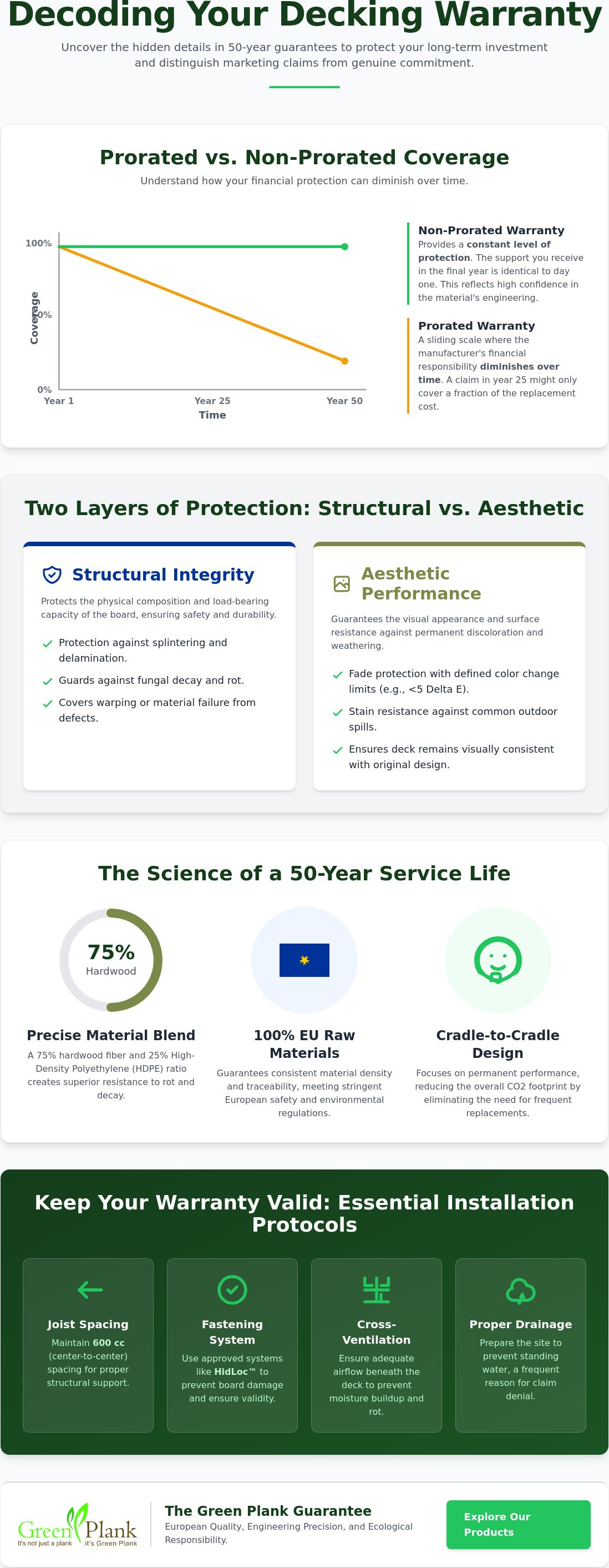
Selecting a decking material involves more than choosing a color; it requires a technical analysis of the legal protections that safeguard your capital. Not all 50-year guarantees are equal. A prorated warranty functions as a sliding scale where the manufacturer's financial responsibility diminishes as the product ages. For instance, a claim filed in year 25 might only cover a small fraction of the original material cost, leaving you to fund the majority of the restoration. This depreciation is a common industry tactic used to limit long-term liability for lower-density materials.
In contrast, non-prorated warranties provide a constant level of protection throughout the entire term. This flat-rate coverage means the support you receive in the final year of the agreement is identical to the support provided on day one. Such terms reflect a high degree of engineering confidence in the underlying Wood-Plastic Composite (WPC) technology. When reviewing composite decking warranty information, look for these non-depreciating terms to ensure your asset maintains its value without hidden future costs.
Why Prorated Clauses Matter for Commercial Projects
For large-scale infrastructure, the financial gap created by a prorated clause can be significant. If a public walkway or commercial terrace requires material replacement after two decades, a prorated agreement could result in a 50% or 60% loss in covered value. Non-prorated terms eliminate this uncertainty. They allow facility managers to forecast maintenance budgets with precision, knowing the manufacturer stands behind the material's performance for the full duration. This stability is essential for projects prioritizing long-term asset management over short-term savings.
Structural Integrity vs. Aesthetic Performance
Warranties typically operate in two distinct layers: structural and aesthetic. Structural coverage focuses on the physical composition of the board. It protects against:
- Splintering and delamination that could cause injury.
- Fungal decay and rot that compromise load-bearing capacity.
- Material defects resulting in warping or structural failure.
Aesthetic coverage, or fade and stain protection, is separate. While some natural weathering is expected, premium warranties define specific limits for color change, often measured as 5 Delta E units. This technical threshold ensures your deck remains visually consistent with your original design intent. Structural warranties protect the physical safety and load-bearing capacity of the board, while fade and stain warranties guarantee the visual appearance and surface resistance against permanent discoloration.
Exclusions are equally vital to understand. Most agreements don't cover "acts of God" or damage resulting from improper site preparation. Poor drainage that leads to standing water or a lack of cross-ventilation are frequent reasons for claim denial. Adhering to professional installation standards isn't just about aesthetics; it's a mandatory step to keep your legal protections intact.
The Science of Durability: Engineering a 50-Year Service Life
Longevity in composite materials is a result of molecular precision. We utilize a specific ratio of 75% hardwood fiber and 25% High-Density Polyethylene (HDPE). This blend creates a material that resists rot and biological decay far better than traditional wood. By sourcing 100% EU raw materials, we ensure the density remains consistent across every batch. This predictability is why composite decking warranty information often highlights the material's origin as a key indicator of reliability. European sourcing guarantees that every component meets stringent safety and environmental regulations, unlike materials sourced from regions with less oversight. This traceability is a cornerstone of our professional standards.
Our "Cradle to Cradle" ownership model shifts the focus from temporary aesthetics to permanent performance. We design for a 50-year service life because true sustainability requires products that don't need frequent replacement. This approach reduces the CO2 footprint by keeping materials in use for decades. Our low-density engineering reduces the overall weight of the boards, which simplifies installation and lowers shipping costs without compromising the load-bearing capacity of the deck. It's a balance of efficiency and strength. Reducing the weight of the profiles also lowers the environmental impact of transportation, further aligning with our ethical manufacturing standards.
High-Performance HDPE vs. Traditional PVC
HDPE offers superior impact resistance compared to PVC, especially in climates with extreme temperature fluctuations. It remains flexible under stress and doesn't become brittle in the cold. From an environmental perspective, HDPE is a cornerstone of sustainable building materials. It's fully recyclable, supporting a circular construction economy that respects natural resources. This material choice ensures your deck can withstand heavy foot traffic and falling objects without cracking or surface failure.
Hardwood Fiber: The Backbone of WPC Strength
Hardwood fibers serve as the foundational strength of the board. They provide greater thermal stability than softwoods, meaning the deck expands and contracts less during heat cycles. We incorporate specialized additives to ensure complete moisture resistance, preventing the delamination that often plagues inferior products. Understanding What is WPC Composite Decking? requires looking at these internal reinforcements. All our profiles meet ASTM D7032 Performance Standards, verifying their capacity for load-bearing and environmental endurance. These rigorous tests confirm that our engineering choices translate into real-world durability. You can explore our full range of high-performance profiles at greenplank.eu to find the right fit for your project.
Residential vs. Commercial Infrastructure Warranty Requirements
The distinction between residential and commercial applications isn't merely about the size of the project; it's about the intensity of the environment. Residential warranties prioritize the human experience, focusing on barefoot-friendly, splinter-free surfaces and aesthetic permanence. These agreements often extend up to 50 years because private use involves predictable foot traffic and lower mechanical stress. In contrast, composite decking warranty information for commercial sectors shifts the focus toward structural resilience and public safety. Because commercial spaces like restaurant terraces or public plazas face constant use, their warranty periods are typically shorter, often ranging from 10 to 20 years, reflecting the high-cycle wear they must endure.
Maritime environments and public infrastructure demand an even higher level of engineering precision. Saltwater is notoriously aggressive, causing traditional timber to warp and metal fasteners to corrode. Our WPC materials are non-porous, meaning they don't absorb brine or harbor the microorganisms that thrive in damp, coastal areas. This resistance is a core component of the protection provided for our infrastructure-grade profiles. Whether it's a public pier or a private boardwalk, the material's ability to withstand constant moisture exposure is a primary signature of our manufacturing quality and regional reliability.
Evaluating Decking for Public Infrastructure
Safety is the primary concern for any public works project. This involves meeting specific load-bearing expectations and rigorous slip resistance ratings to limit liability. Profiles like Terra Tuff are designed for these extreme durability needs, providing the necessary friction to prevent accidents while resisting the indentation caused by heavy public use. Choosing a profile specifically engineered for infrastructure ensures the warranty remains valid under high-traffic conditions that would otherwise void a standard residential agreement. It's a matter of matching the material's density to the project's demands.
Warranty Transferability: A Value-Add for Property Sales
A deck is a long-term asset, and its warranty should be a transferable benefit. Transferable warranties allow the protection to pass to a second owner, which significantly increases the resale value of a residential property. It provides the new buyer with documented assurance of material quality and performance. To ensure a seamless transfer, homeowners must maintain original purchase records and typically notify the manufacturer within a specific window, such as the first five years after installation. This transparency builds trust and reinforces the deck's status as a premium, maintenance-free architectural feature that respects the investment of future generations.
Installation Protocols: How to Keep Your Warranty Valid
The validity of a long-term guarantee rests entirely on the precision of the substructure. Even the most advanced WPC profiles will fail if the underlying frame is incorrectly engineered. For private residential projects, maintaining a joist spacing of 600 cc is a non-negotiable standard for warranty compliance. Exceeding this distance creates excessive deflection, which leads to board sagging and structural stress over time. When reviewing composite decking warranty information, you'll find that nearly every manufacturer cites improper joist spacing as a primary reason for claim denial. It's a technical requirement that ensures the load is distributed exactly as the material science intended.
Ventilation and drainage represent the second pillar of warranty protection. Composite decks require a constant flow of air beneath the surface to prevent heat buildup and moisture accumulation. Obstruction of this airflow or the presence of standing water can cause the boards to expand beyond their design limits. Professional installers must also maintain meticulous records. You should keep all original purchase receipts and specific production batch numbers for the entire 50-year term. These documents serve as your primary evidence of material origin and quality control if you ever need to file a claim. This level of diligence protects your investment from the risks of improper installation voids.
The HidLoc™ Advantage for Professional Installers
Utilizing a dedicated fastening system like HidLoc™ is more than an aesthetic choice; it's a structural necessity. These clips allow the boards to move naturally through thermal expansion and contraction cycles without putting stress on the material. Because they eliminate the need for face-screwing, the HDPE surface remains intact and free from the entry points that lead to localized moisture ingress. For a step-by-step breakdown of these techniques, consult our Professional Deck Installation Guide. This approach ensures a flawless finish while maintaining the full integrity of your performance guarantee.
Maintenance Myths and Warranty Safety
While WPC is celebrated for its low-maintenance profile, the HDPE surface still requires specific care to remain protected. You should avoid harsh chemical cleaners, bleach, or solvent-based products that can degrade the material's protective additives. Standard cleaning involves little more than warm water and mild soap to remove environmental debris. Maintaining precise expansion gaps between board ends is a mandatory technical requirement for ensuring adequate moisture drainage and airflow. By following these simple protocols, you protect both the visual appeal and the legal security of your outdoor space. You can find our full range of compliant installation accessories and profiles to ensure your project is built to last.
The Green Plank Guarantee: European Quality and Reliability
The "Made in EU" designation serves as a hallmark of warranty reliability and public safety. It signifies that every board is produced under the world's most stringent environmental and labor regulations. Our commitment to 100% EU raw materials ensures that we don't just meet industry standards; we set them. This level of quality control is essential when interpreting composite decking warranty information, as it guarantees the material will perform exactly as specified in the technical data sheets. Our Terra Tuff and Smart System lines represent the peak of this engineering philosophy, designed specifically for high-traffic areas and harsh climates. We prioritize regional heritage. We prioritize engineering precision. We prioritize ecological responsibility.
Registering your Green Plank warranty is the final step in securing your investment. This process creates a digital record of your project, linking your specific batch numbers to your installation date. It's a simple protocol that provides long-term peace of mind. By documenting your purchase and confirming adherence to our 600 cc joist spacing requirements, you activate a 50-year performance promise. Accessing accurate composite decking warranty information during this registration phase ensures you have all the necessary documentation to maintain your guarantee for decades. It's a transparent system built on mutual trust and material excellence.
Sustainable Manufacturing as a Durability Strategy
Reducing the CO2 footprint of a project is no longer optional; it's a core requirement of modern architecture. We achieve this by increasing the service life of our products, which reduces the need for raw material extraction over time. This high-performance engineering is paired with ethical sourcing to satisfy the requirements of BREEAM and LEED certified developments. Architects prefer our profiles because they offer a verifiable path to circular construction through cradle-to-cradle ownership. A deck that lasts longer is a deck that respects nature.
Next Steps: Planning Your Sustainable Deck
Planning a sustainable deck requires precision. We invite you to request samples to verify the material density and surface quality of our WPC boards. Our technical team provides expert consulting on commercial infrastructure specifications, helping you navigate load-bearing requirements and slip-resistance ratings. Explore our Terra Tuff Composite Decking for your next project to see how European quality transforms outdoor spaces. We're here to ensure your vision is supported by the strongest technical foundation in the industry.
Securing Your Architectural Legacy
A deck is an investment in both your property and the planet. Understanding the technical nuances of composite decking warranty information ensures that your outdoor space remains a high-performance asset rather than a future liability. By prioritizing non-prorated terms and adhering to strict installation protocols, you protect the structural integrity of your project for decades. Don't leave your investment to chance when engineering precision is available. Professional standards require verified performance.
Our commitment to 100% EU-sourced raw materials provides the engineering confidence necessary to offer up to a 50-year residential warranty. This longevity is further supported by our Cradle to Cradle ownership model; every profile is designed for a circular economy that respects natural resources. Ready to finalize your plans? Request a Technical Specification for Your Project to ensure every detail aligns with professional standards. Build with the confidence that comes from regional reliability and sustainable craftsmanship.
Frequently Asked Questions
What is the difference between a pro-rated and non-pro-rated warranty?
A non-pro-rated warranty maintains 100% replacement value for the entire duration of the term. Pro-rated agreements see the manufacturer's financial obligation decrease as the deck ages, meaning a claim in year 40 might only cover a small percentage of the material cost. We prioritize non-depreciating terms to ensure your long-term asset management remains predictable and secure.
Does the Green Plank warranty cover labor costs for replacement?
Standard material warranties typically cover the replacement of the WPC profiles themselves rather than the labor required for removal or re-installation. This is a common industry standard designed to focus on material science and manufacturing quality. We recommend consulting with your professional installer to discuss separate labor guarantees for your specific project.
Can I install composite decking myself and still be covered by the warranty?
Self-installation is permitted provided you strictly adhere to the technical guidelines specified in our installation manuals. You must maintain 600 cc joist spacing for private residential use and utilize HidLoc™ hidden fastening systems. Failure to follow these precise engineering standards will void your legal protections. Professional-grade results require professional-level attention to detail.
What specific maintenance is required to keep my composite decking warranty valid?
Maintaining your warranty requires periodic cleaning with mild soap and warm water to prevent the accumulation of debris. You must avoid using solvent-based cleaners or harsh chemicals that could damage the HDPE surface. Ensuring that expansion gaps remain clear of obstructions is also vital for moisture drainage and thermal stability. These simple steps protect the material's structural integrity and aesthetic performance.
Is the 50-year warranty transferable if I sell my home?
Our residential warranties are typically transferable to a second owner, providing a significant value-add for property resale. This transfer usually must occur within a specific window, such as the first five years after purchase, and requires proper documentation. Providing the new owner with original receipts and batch numbers ensures a seamless transition of the performance guarantee.
Does the warranty cover fading or staining from outdoor furniture?
Warranties cover fading and staining that exceeds technical thresholds under normal environmental conditions. However, damage caused by rubber-backed mats or certain furniture materials that trap moisture or chemicals against the surface may be excluded. Our high-density HDPE blend is engineered for superior resistance to permanent discoloration from standard outdoor use.
What happens if my decking is installed with non-approved fasteners?
Using non-approved fasteners immediately voids your warranty because they can compromise the structural integrity of the boards. Standard screws can cause localized cracking or prevent the natural thermal expansion required for WPC materials. We recommend the HidLoc™ system to ensure the boards move freely and remain securely anchored without surface damage.
How do I register my Green Plank warranty after installation?
You can register your warranty through our official online portal by providing proof of purchase and production batch numbers. It's vital to complete this process shortly after installation to ensure your composite decking warranty information is correctly logged in our system. This registration creates a permanent record that simplifies any future technical inquiries or performance claims.
Produkt spezifizieren
Diese Anleitung in einer Green Plank-Ausschreibung nutzen
Technische WPC-Artikel sollen die kommerziellen Seiten stärken — nicht mit ihnen konkurrieren. Weiter zu WPC-Terrasse, TerraTuff, Nordeka oder den technischen Downloads.