



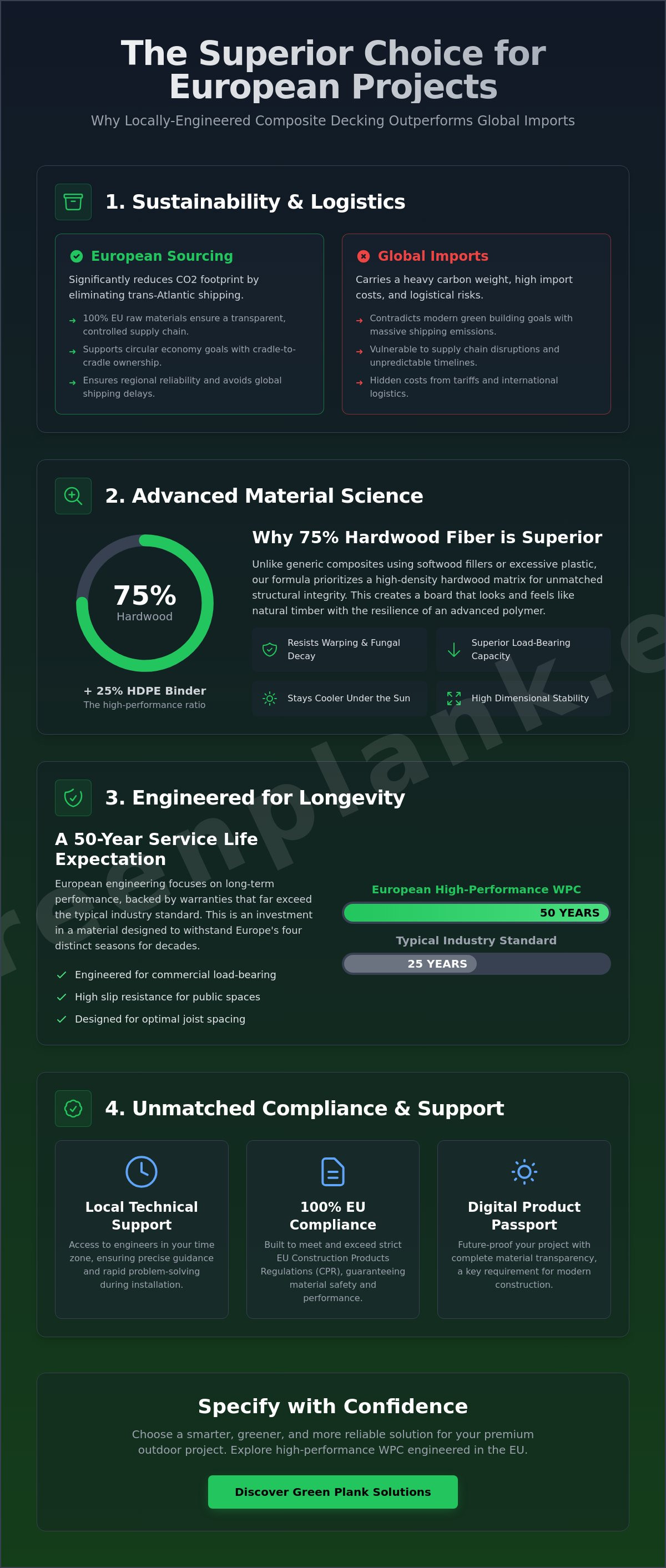
Why should your premium outdoor project carry the heavy carbon weight of trans-Atlantic shipping when the world's most precise engineering is already here? Many developers and homeowners assume that the biggest global names are the only path to a high-end finish, yet the hidden costs of imports and shipping delays often outweigh the prestige of the brand name. There are 4 critical reasons why sourcing European-made composite decking is no longer just a local preference; it's a superior technical decision for those who prioritize regional reliability and material excellence.
We understand that you're looking for a material that matches the aesthetic of market leaders without the environmental guilt or the lack of local support. You need a solution that stands up to the 50-year service life expectations of modern architecture while ensuring 100% EU material compliance. This guide explores how high-performance European WPC offers better sustainability and durability through cradle-to-cradle ownership and advanced engineering. You'll learn how to significantly reduce your project's CO2 footprint and why local technical support is the most valuable feature of your next installation.
Key Takeaways
- Compare the logistical and environmental benefits of local EU manufacturing against global market leaders to ensure regional reliability.
- Understand how a 75% hardwood fiber blend provides the structural stability and natural feel necessary for high-end architectural finishes.
- Identify the 4 essential technical criteria for selecting WPC, ranging from CO2 footprint reduction to long-term performance guarantees.
- Learn to specify for longevity by evaluating slip resistance, joist spacing, and load-bearing requirements for commercial environments.
- Ensure 100% EU material compliance and support circular economy goals through cradle-to-cradle ownership.
Table of Contents
- Evaluating Trex Decking Alternatives for European Projects
- Material Science: Why 75% Hardwood Fiber Outperforms PVC-Heavy Composites
- Sustainability Benchmarks: Comparing CO2 Footprints and Lifecycle Costs
- Specifying for Longevity: Key Criteria for Commercial and Residential Decking
- Green Plank: High-Performance WPC Engineered in the EU
Evaluating Trex Decking Alternatives for European Projects
The current market environment for outdoor construction has shifted toward a more rigorous standard of environmental accountability. While global market leaders from North America once dominated the conversation, the 2026 landscape prioritizes regional reliability and technical precision. Choosing Wood-plastic composites (WPCs) now involves looking beyond brand recognition to evaluate the entire lifecycle of the material. Identifying the 4 primary pillars of regional manufacturing is the first step toward a more responsible and durable build. High-performance decking is no longer just about aesthetics; it is about engineering a product that survives the specific climatic demands of Europe while honoring the continent's strict sustainability mandates.
The Limitations of Global Market Leaders
Relying on trans-Atlantic imports introduces logistical complexities that can jeopardize commercial timelines. Shipping premium boards from the US results in high import costs and a significant CO2 footprint that contradicts modern green building goals. Regional projects require regional solutions. US-manufactured products often align with different regulatory frameworks, which may not fully address the new EU Construction Products Regulation (CPR) that became applicable on January 8, 2026. This regulation demands a Digital Product Passport for every component, a level of transparency that local manufacturers are better equipped to provide. Local technical support is another critical factor. Having engineers available in the same time zone ensures that large-scale infrastructure projects receive the precise guidance they need during the installation phase.
What Defines a High-Performance Alternative?
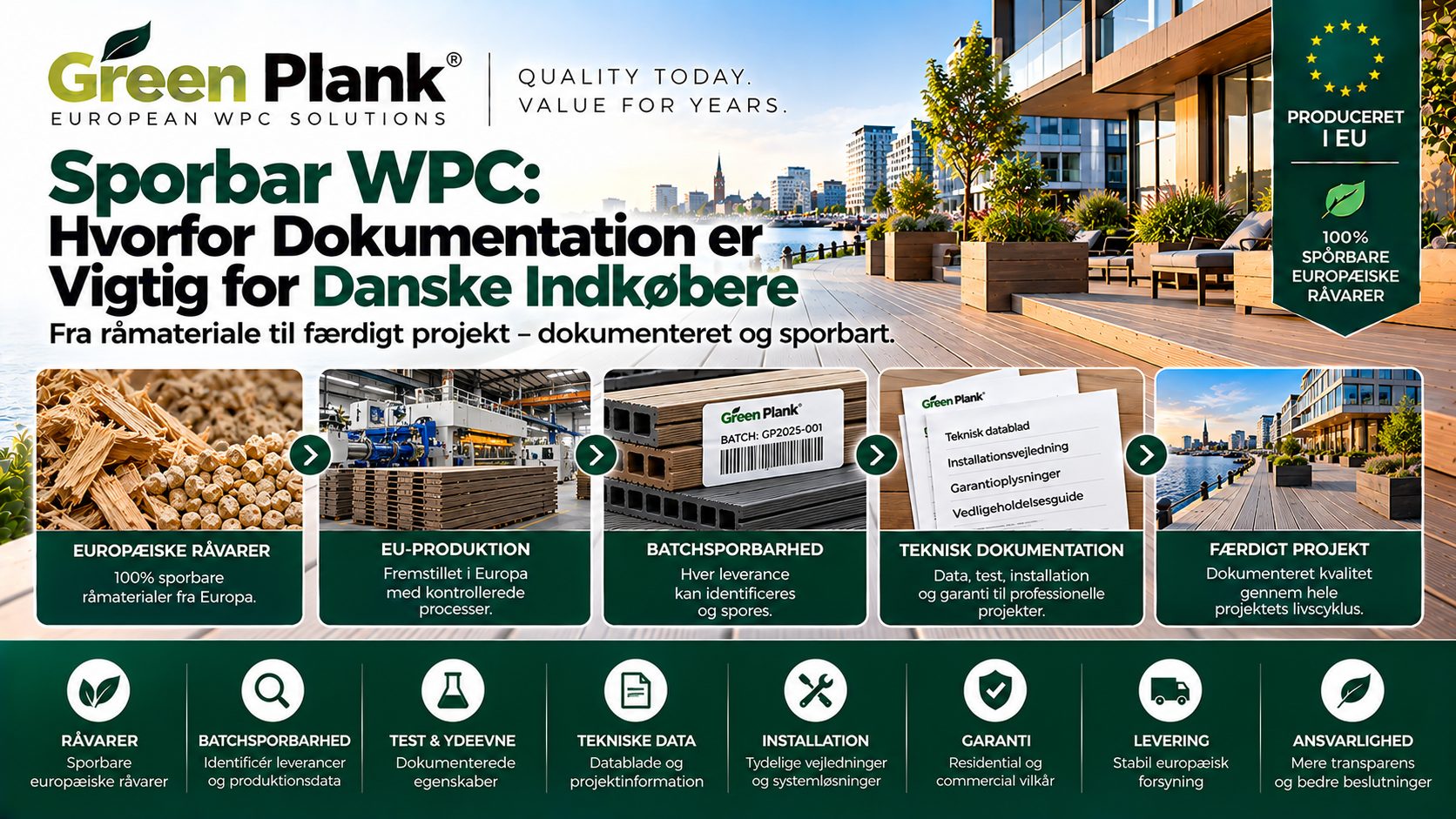
Professional-grade wpc composite decking must offer more than just a wood-like appearance. It must demonstrate superior material science. A high-performance alternative utilizes 100% EU raw materials to ensure a controlled supply chain and reduced transport emissions. These materials are engineered for longevity, often backed by a 50-year service life warranty that far exceeds the 25-year industry standard. This shift toward circular economy certifications means that the decking is designed for cradle-to-cradle ownership. It is not just a purchase; it is a long-term investment in a material that can eventually be recycled back into the production loop. By prioritizing hardwood fibers over softwood fillers, these engineered profiles offer the structural integrity required for both high-end residential terraces and heavy-traffic public spaces.
Material Science: Why 75% Hardwood Fiber Outperforms PVC-Heavy Composites
The strength of a composite board lies within its core composition rather than just its external shell. While many global manufacturers rely on a high percentage of virgin or recycled plastics to achieve durability, our engineering team prioritizes a high-density wood matrix. The Green Plank formula utilizes 75% hardwood fiber and 25% HDPE (High-Density Polyethylene). This high wood content creates a material that looks, feels, and acts like natural timber while maintaining the resilience of a polymer. It's a technical balance that ensures the board remains rigid under pressure and cool under the sun.
Hardwood fibers provide a level of structural integrity that softwood alternatives simply cannot match. Many generic composites use softwood sawdust, which lacks the cellular density required for long-term load-bearing applications. According to U.S. Forest Products Laboratory research, the mechanical properties of wood-plastic composites are heavily influenced by the fiber type and concentration. By selecting hardwood, we ensure a denser, more stable matrix that resists warping. The 25% HDPE component serves as a high-performance binder. It encapsulates each fiber to prevent moisture absorption and fungal decay. This specific ratio is designed to withstand the 4 distinct seasons of the European climate, from freezing winters to intense summer heat.
The Engineering Behind Low-Density Durability
Weight is a critical factor in architectural specification. Unlike heavy, plastic-dominant boards common in the US market, European engineering focuses on low-density profiles that reduce the structural load on commercial frames. This makes handling easier and installation faster. Our Smart System wpc composite decking utilizes this low-density approach to provide maximum strength with minimal bulk. Thermal expansion is also more predictable in these hardwood-rich profiles. They move less than PVC-heavy boards, allowing for tighter gaps and a more seamless aesthetic finish. If you're designing a project with complex geometries, you might find that Smart System wpc composite decking offers the precise stability your layout requires.
Toxicity and Safety Standards
Safety is the primary signature of our engineering confidence. We eliminate the harmful additives and heavy metals often found in imported composites that don't meet strict EU REACH standards. Our boards are designed for health and environmental ethics. Fire safety is equally vital for European commercial infrastructure. Our profiles are tested to meet rigorous fire rating requirements, ensuring they're suitable for public terraces and balconies. By utilizing 100% EU raw materials, we guarantee that every board is compliant with local safety laws. This commitment to non-toxic manufacturing protects the installers, the end-users, and the surrounding ecosystem.
Sustainability Benchmarks: Comparing CO2 Footprints and Lifecycle Costs
Sustainability in high-end construction is no longer a peripheral concern; it's a core financial metric. Choosing sustainable building materials from local sources directly impacts a project's environmental and economic bottom line. When evaluating the 4 primary stages of a product's life, which include extraction, production, use, and disposal, the benefits of regional engineering become undeniable. Sourcing materials from within the EU eliminates the massive carbon debt associated with trans-Atlantic shipping. It also ensures that the production process adheres to the world's most stringent environmental ethics.
Lifecycle costs must account for more than just the initial invoice. Traditional timber decking requires annual sanding, staining, and oiling, adding significant labor and material costs over its 10-15 year lifespan. In contrast, our engineered WPC is designed for a 50-year service life with minimal intervention. This longevity reduces the total cost of ownership by eliminating the need for frequent replacements. It also preserves natural resources by keeping materials in use for half a century. This approach addresses the 4 core pillars of circular construction: resource efficiency, carbon reduction, longevity, and recyclability.
The Impact of Local EU Sourcing
Regional manufacturing provides a logistical advantage that global importers can't match. By utilizing 100% EU raw materials, we support local hardwood forestry and HDPE recycling initiatives. This closed-loop approach significantly reduces Scope 3 emissions, which are often the largest portion of a commercial project's carbon footprint. Shorter supply chains also mean more predictable project timelines. You don't have to worry about port strikes or trans-oceanic delays when your decking is produced and stored within the continent. It's a matter of regional reliability that protects your schedule and your reputation.
Lifecycle Cost Analysis
A high-performance deck is a long-term asset. Our 50-year warranty is a testament to the material's engineering confidence. Financial ROI is further enhanced by the HidLoc™ hidden fastening systems. These systems speed up installation, reducing labor costs while providing a clean, screw-free surface. Cradle to Cradle ownership completes the sustainability arc. Instead of heading to a landfill at the end of its life, the material is designed for full recycling. It can be reclaimed and repurposed into new profiles, ensuring that the ecological responsibility of the project extends far beyond its initial installation.
Specifying for Longevity: Key Criteria for Commercial and Residential Decking
Engineering an outdoor space that maintains its integrity for half a century requires more than just high-quality boards; it demands a precise technical specification. Longevity is a result of how the material interacts with its sub-structure and the environment. When moving from the design phase to the procurement phase, professionals must evaluate the 4 essential technical criteria: slip resistance, load-bearing capacity, thermal movement, and fastening security. Each of these factors determines whether a project remains a premium asset or becomes a maintenance liability. Regional reliability means providing the exact data required for these calculations, ensuring every terrace meets European safety and performance standards.
Safety ratings are the primary concern for public infrastructure and commercial zones. Slip resistance is not a secondary feature; it's a fundamental requirement for public piers, restaurant terraces, and poolside areas. Our engineered profiles are tested to provide high traction in both wet and dry conditions, reducing the risk of accidents. Structural integrity is equally dependent on understanding joist spacing. While residential projects often follow standard patterns, commercial loads may require a more robust sub-frame. Precision in these details prevents the sagging and bouncing often seen in lower-grade composite installations. By aligning the profile choice with the expected traffic, you ensure the deck remains stable under the most demanding conditions.
Professional Installation Standards
A successful build respects the physical properties of wood-plastic composites. Every deck installation guide must emphasize the importance of managing thermal expansion and contraction. Unlike traditional timber, WPC moves predictably along its length. Integrating HidLoc™ hidden fastening systems provides a mechanical solution to this movement. These clips allow the boards to expand without stressing the screws or the frame. The result is a screw-free, professional finish that preserves the structural longevity of the entire system. This is particularly vital for large-scale commercial infrastructure where the surface area can lead to significant cumulative movement.
Selecting the Right Collection
Different environments demand different material densities. Terra Tuff Composte Decking is our heavy-duty choice, engineered specifically for high-traffic commercial zones where durability is the only priority. For modern residential projects that prioritize a minimalist aesthetic, the Smart System wpc composite decking offers a refined finish with innovative installation features. If your project requires a balance between high-performance and budget constraints, the Nordeka and Entra collections provide regional quality without compromise. Each collection is a testament to our engineering confidence, backed by the same commitment to sustainability. To find the perfect match for your specific requirements, explore our full range of EU-made composite solutions.
Green Plank: High-Performance WPC Engineered in the EU
Green Plank represents over two decades of independent European innovation in the composite industry. We don't just manufacture boards; we engineer long-term outdoor solutions that respect both the architect's vision and the environment's limits. Our journey began with a focus on regional reliability, ensuring that every profile leaving our facility meets the highest professional standards. By maintaining 100% EU raw material sourcing, we've successfully reduced the CO2 footprint of our products while providing a stable supply chain for national infrastructure projects. This commitment is the foundation of our 50-year warranty, a specific performance guarantee that reflects our absolute engineering confidence. It validates the 4 pillars of regional manufacturing we've championed since our inception: local sourcing, technical precision, carbon reduction, and material longevity.
The distinction between generic imports and our engineered WPC is found in the material science. We utilize a superior 75% hardwood fiber blend. This high wood content provides the natural aesthetics and structural strength required for premium architectural projects. While global competitors often rely on plastic-heavy cores, our formula ensures the board behaves with the stability of high-density timber. It's a technical advantage that allows us to support the 4 most critical aspects of modern construction: safety, sustainability, durability, and aesthetic excellence. Our role as a responsible innovator means we never stop refining these ratios to meet the evolving needs of the circular economy.
The Green Plank Advantage
Our systems are designed for flawless execution. The HidLoc™ hidden fastening systems ensure a clean surface without visible screws, preserving the board's structural integrity over decades of use. We also provide custom commercial infrastructure profiles for specialized projects that require unique dimensions or load capacities. This flexibility makes us the preferred partner for developers who need more than a standard retail product. We offer the precision of a sustainable craftsman combined with the scale of a professional manufacturer. Every profile is a testament to our quality-obsessed culture.
Your Partner in Circular Construction
We believe in Cradle to Cradle ownership. This model means we plan for the entire lifecycle of our products, ensuring they support your green building goals from installation to eventual recycling. Our technical support team provides expert guidance for national projects across Sweden and the wider EU, ensuring that every specification is technically sound. We supply directly to commercial and residential partners, cutting out unnecessary logistical layers and further reducing project emissions. It's a partnership built on trust, quality, and a shared responsibility for the future of our outdoor spaces. Choosing our EU-made composite is an investment in a maintenance-free future that respects nature.
Building for the Next Half-Century
Selecting a decking material is a commitment to both aesthetic vision and environmental ethics. We've detailed how a 75% hardwood fiber matrix provides superior structural stability over plastic-dominant alternatives. By choosing 100% EU raw materials, you secure regional reliability while reducing the carbon weight of trans-Atlantic shipping. These technical attributes support our Cradle to Cradle circular design model, ensuring your project respects nature from installation to eventual reclamation.
Our engineering confidence is reflected in a 50-year warranty, a testament to materials designed for longevity. This performance addresses the 4 primary pillars of professional specification: material safety, ecological responsibility, structural strength, and high-end design. Whether you're specifying for a private residence or a large-scale commercial pier, our EU-made profiles offer the precision your architecture demands.
Explore our range of high-performance WPC decking and request a project quote to define your outdoor space with sustainable excellence. We invite you to build a beautiful, maintenance-free future that honors the environment.
Frequently Asked Questions
What makes Green Plank a better alternative to Trex in Europe?
Green Plank offers regional reliability and local technical support that global importers can't match. Our products are engineered with 100% EU raw materials, ensuring compliance with local regulations and a 50-year warranty. Unlike US brands, we provide direct support for European infrastructure projects, making us a more practical choice for local architects and developers who prioritize sustainability.
How does the CO2 footprint of European WPC compare to US-imported brands?
The CO2 footprint is significantly lower because we eliminate trans-Atlantic shipping. Sourcing and manufacturing within the EU addresses the 4 primary stages of the lifecycle more sustainably than importing from North America. This local approach reduces transport emissions and supports the European circular economy through regional forestry and recycling initiatives.
Is the 50-year warranty on Green Plank decking realistic?
A 50-year warranty is a testament to our material engineering and high-density hardwood core. This guarantee is realistic because our WPC is designed for extreme durability and resistance to the European climate. It's a primary signature of our engineering confidence, providing long-term value that exceeds industry standards for both residential and commercial use.
Can Green Plank WPC be used for commercial infrastructure projects?
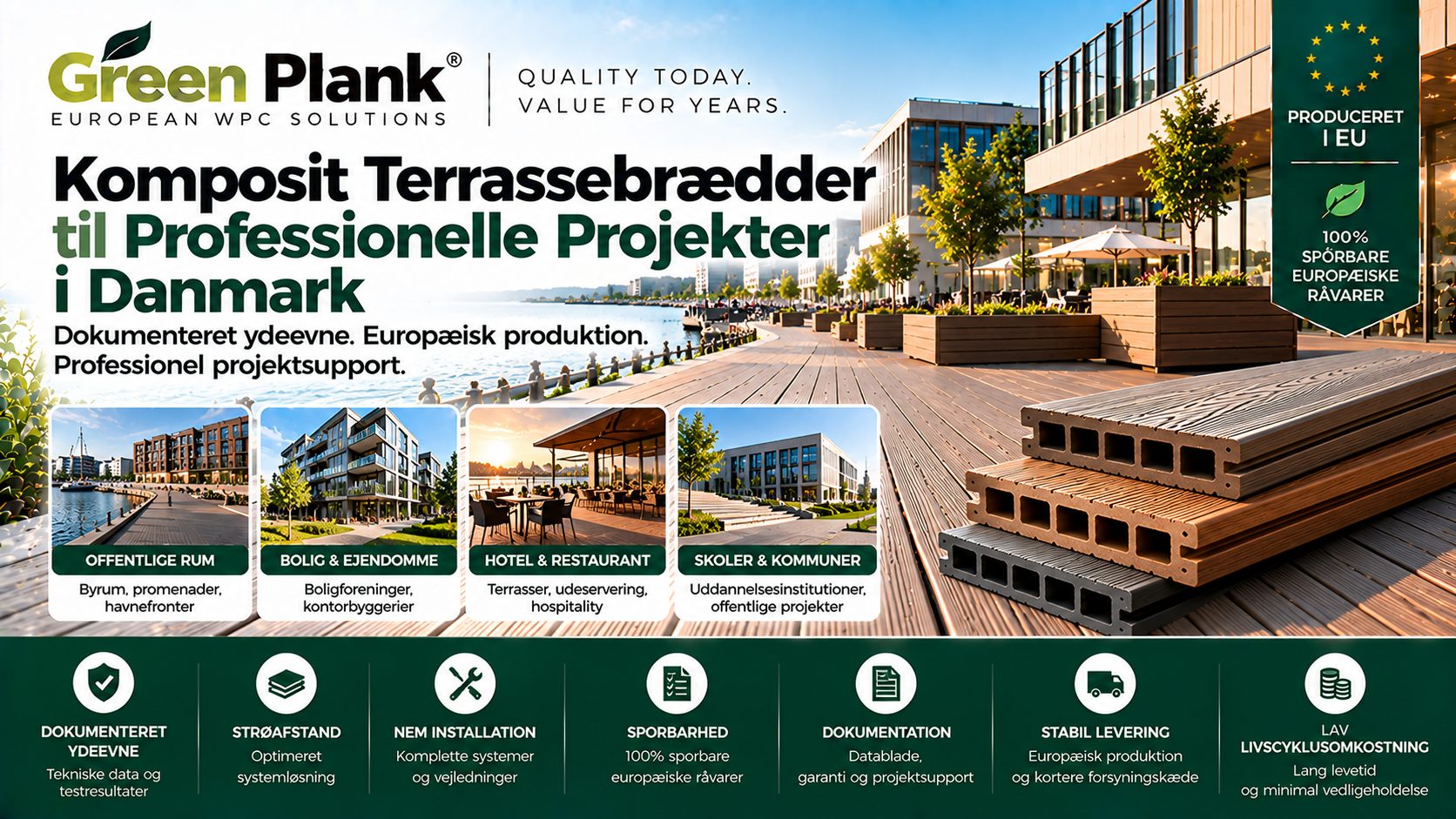
Yes, our Commercial Infrastructure Profiles are specifically designed for high-traffic public spaces. Profiles like Terra Tuff offer the structural integrity and slip resistance required for public piers, boardwalks, and restaurant terraces. These products meet rigorous safety standards, ensuring they remain stable and secure under heavy commercial loads while requiring minimal maintenance.
What is the difference between HDPE and PVC composite decking?
Green Plank utilizes HDPE because it is more environmentally responsible and chemically stable than PVC. HDPE encapsulates each wood fiber to provide superior moisture resistance without the toxic additives often found in PVC-based composites. This material choice ensures a safer product for both the environment and the end-user, adhering to strict EU REACH standards.
How does the 75% hardwood fiber ratio affect the deck’s performance?
The 75% hardwood fiber ratio creates a denser, more rigid board that resists warping better than softwood alternatives. This high concentration of natural fiber provides a natural aesthetic and superior mechanical properties. It ensures the deck remains structurally sound over its 50-year lifespan while maintaining a premium, high-end feel that respects the environment.
Does Green Plank offer hidden fastening systems for a screw-free look?
We provide the HidLoc™ Hidden Fastening Systems to ensure a flawless, screw-free surface. These clips are engineered to manage thermal movement while maintaining a secure grip on the boards. This system improves the aesthetic quality of the deck and protects the structural longevity of the installation by preventing surface damage and ensuring a professional finish.
Where can I find technical specifications for Green Plank products?
You can access comprehensive technical data on our website to assist with project planning. These documents cover slip resistance, fire ratings, and the 4 essential criteria for commercial specification. This information ensures that architects and developers have the technical precision required to meet strict EU building regulations and safety standards for any outdoor project.
Specifikér produktet
Brug denne guide i en Green Plank-specifikation
Tekniske WPC-artikler skal understøtte de kommercielle sider — ikke konkurrere med dem. Fortsæt til kompositterrasse, TerraTuff, Nordeka eller de tekniske downloads.