



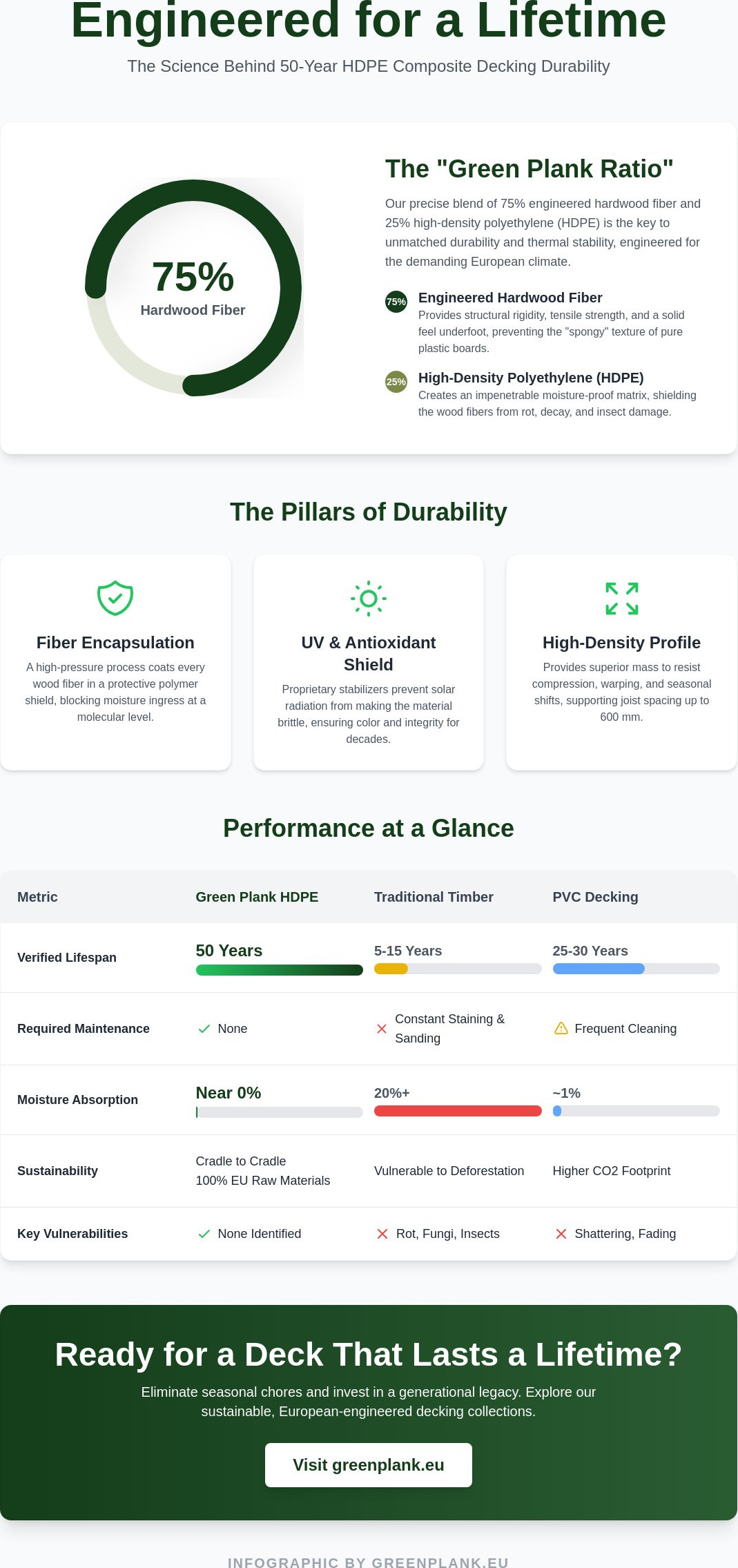
A deck shouldn't be a seasonal chore; it should be a generational legacy. While traditional timber requires constant sanding and staining, and cheap alternatives often warp under the sun, modern material science has unlocked a different path. HDPE composite decking durability is no longer a matter of guesswork but a result of precise engineering that balances 75% hardwood fiber with 25% high-density polyethylene. This specific ratio ensures structural rigidity while providing an impenetrable shield against the elements, making it the most sustainable outdoor flooring choice for 2026.
While composite is ideal for low-maintenance flooring, premium Siberian Larch remains a top choice for those seeking high-quality cladding or fencing; read more about how Timber Ireland's specialized materials can enhance your architectural design.
You likely value the natural warmth of wood but feel frustrated by the environmental impact of non-recyclable materials and the recurring costs of timber repairs. We understand that a truly premium outdoor space must respect nature while outlasting it. In this article, you'll discover how we utilize European raw materials and Cradle to Cradle principles to achieve a verified 50-year lifespan. We'll examine the technical benchmarks of the ASTM D7032 standard and explore how our proprietary co-extrusion technology eliminates the typical pains of fading and moisture ingress. It's the perfect balance of responsible innovation and regional reliability.
Key Takeaways
- Learn why the "Green Plank Ratio" of 75% hardwood fiber and 25% HDPE provides superior thermal stability compared to pure plastic or traditional timber.
- Discover how HDPE composite decking durability offers a higher resistance to shattering and a lower CO2 footprint than PVC alternatives.
- Identify the critical installation techniques, including proper ventilation and hidden fastening systems, that protect your deck from structural stress and moisture.
- Understand the engineering confidence behind a 50-year service life and how European raw materials ensure long-term ROI for residential and commercial projects.
- Explore the environmental advantages of Cradle to Cradle ownership and how sustainable manufacturing supports a maintenance-free outdoor lifestyle.
Table of Contents
- Understanding Durability in Modern HDPE Composite Decking
- The Science of Synergy: Why 75% Hardwood and 25% HDPE Wins
- HDPE vs. PVC and Traditional Timber: A Performance Comparison
- Maximizing Service Life: Maintenance and Installation Best Practices
- Green Plank: European-Engineered Durability for Sustainable Architecture
Understanding Durability in Modern HDPE Composite Decking
HDPE (High-Density Polyethylene) is no longer just a recycled material; it's a high-performance architectural foundation. In the early development of wood-plastic composites (WPC), boards often suffered from surface chalking and internal structural failure. By 2026, industry standards have evolved toward high-performance profiles that prioritize molecular stability and environmental resilience. HDPE composite decking durability is the direct result of this shift from experimental plastic blends to engineered solutions designed for a 50-year service life.
Density serves as the primary indicator of a deck's long-term health. While low-density profiles might offer a lighter weight, they lack the internal bond strength required to withstand heavy foot traffic or the expansion and contraction caused by seasonal shifts. High-density profiles provide the necessary mass to resist compression and warping. To combat the harsh effects of solar radiation, we integrate proprietary UV stabilizers and anti-oxidant additives. These components act as a molecular shield, ensuring the material doesn't become brittle or lose its aesthetic depth after decades of exposure.
The Core Components of Long-Life Composites
A durable board is only as reliable as its constituent parts. We utilize a specific material synergy to ensure every profile meets professional standards:
- High-Density Polyethylene (HDPE): This serves as the moisture-proof matrix, surrounding every fiber to create a barrier against the elements.
- Hardwood Fiber: Utilizing 75% hardwood fiber provides the reinforcing skeleton, offering the tensile strength and natural rigidity that pure plastic lacks.
- 100% EU Raw Materials: Sourcing exclusively from European suppliers ensures a transparent supply chain and consistent material purity, avoiding the contaminants found in lower-grade imports.
Why Traditional Wood Fails Where HDPE Succeeds
Organic timber is biologically programmed to decompose. Even high-end pressure-treated wood remains vulnerable to rot, fungi, and insect infestation because its cellular structure is naturally open to the environment. While timber can reach moisture absorption levels of 20% or higher, our high-performance composites maintain rates near zero. This protection is made possible by our advanced manufacturing standards. Encapsulation is the high-pressure engineering process of coating every individual wood fiber in a protective polymer shield to block internal moisture ingress. This process ensures that the structural core remains dry and stable, regardless of the weather conditions outside.
The Science of Synergy: Why 75% Hardwood and 25% HDPE Wins
Achieving a 50-year lifespan requires more than just high-quality ingredients; it demands a precise ratio. The Green Plank Ratio of 75% hardwood fiber and 25% HDPE is engineered specifically for the variable European climate. European climates demand materials that can withstand rapid temperature shifts without warping or losing structural integrity. High-pressure extrusion fuses these components into a homogeneous mass, ensuring that HDPE composite decking durability remains consistent from the core to the surface. This molecular bond creates a material that doesn't just mimic wood but improves upon its fundamental physics.
Structural rigidity is the most immediate benefit of this specific blend. While pure plastic boards often feel flexible or "spongy" underfoot, the high hardwood content provides the stiffness required to support 600 mm joist spacing in private residential projects. This allows for efficient installation without compromising the deck's long-term stability. The result is a surface that feels as solid as traditional timber but possesses the environmental resilience of a modern polymer. You can view our sustainable decking collections to see how this engineering translates into premium aesthetics for your outdoor space.
Hardwood Fiber: More Than Just a Filler
Many manufacturers use generic wood flour, which is essentially a sawdust byproduct with little structural value. We utilize engineered hardwood fibers that act as a stabilizing agent within the board. These fibers have a significantly lower thermal expansion coefficient than plastic, which prevents the HDPE matrix from expanding or contracting excessively during summer heat or winter freezes. To understand how these materials interact on a deeper level, explore our guide on what is WPC composite decking. This internal reinforcement ensures the board remains straight and true for decades.
HDPE: The Ultimate Protective Shield
If the hardwood provides the skeleton, the HDPE serves as the skin. This robust polymer is the reason HDPE composite decking durability excels in harsh environments. It's inherently resistant to salt water, chlorine, and acidic rain, making it the ideal choice for coastal regions or poolside installations. Its high impact resistance prevents the surface cracking and splintering that often plagues traditional timber. Because we prioritize sustainability, our HDPE is part of a Cradle to Cradle ownership model. This ensures the material remains fully recyclable at the end of its long service life, fulfilling our promise of responsible innovation.
HDPE vs. PVC and Traditional Timber: A Performance Comparison
Choosing the right material requires looking beyond surface aesthetics. While some competitors argue that PVC is superior due to its extreme hardness, this rigidity often leads to structural brittleness. In the sub-zero temperatures common to Northern and Central Europe, PVC profiles are significantly more prone to shattering upon impact. High-density polyethylene maintains a critical balance of strength and ductile flexibility. This resilience ensures that HDPE composite decking durability remains uncompromised, even when the thermometer drops. It absorbs energy rather than fracturing, providing a safer and more reliable surface for decades.
Environmental impact is another area where material science dictates the ethical choice. The production of Polyvinyl Chloride (PVC) typically involves a higher CO2 footprint and more complex chemical stabilizers compared to Polyethylene (PE-HD). By utilizing 100% EU raw materials, we prioritize a transparent supply chain that respects regional ecological standards. Performance also extends to daily use safety and aesthetics:
- Slip Resistance: Natural timber becomes dangerously slick when wet or colonized by algae. Our engineered textures maintain high traction in all weather conditions.
- Color Fastness: Traditional wood requires annual staining to combat UV bleaching. Our UV-inhibited HDPE integrates color throughout the board, preventing the graying effect common in organic materials.
Thermal Performance and Stability
Managing thermal movement is essential for a deck's longevity. All materials expand and contract, but the way they handle heat differs. Solid PVC boards tend to reach higher surface temperatures in direct sunlight, which can lead to discomfort and potential buckling if installation tolerances are tight. Our HDPE-hardwood synergy provides better thermal mass, allowing the boards to stay cooler underfoot. For those exploring high-end options, understanding these differences is key when considering Sustainable Decking Alternatives that better suit the European climate.
Lifecycle Cost and Warranty Comparison
A professional-grade deck is a long-term investment rather than a short-term expense. While the initial cost of premium HDPE composites may be higher than pressure-treated timber, the 50-year service life creates a far superior ROI. A 50-year warranty serves as a primary signature of our engineering confidence, removing the financial risk of premature failure. Consider the labor involved: while a traditional timber deck requires approximately 120 maintenance hours for sanding and staining over a ten-year period, an HDPE composite deck demands almost none. This transition to a maintenance-free lifestyle is the ultimate luxury of responsible innovation.
Maximizing Service Life: Maintenance and Installation Best Practices
Engineering excellence provides the foundation for a 50-year lifespan, but the micro-environment of your installation determines how that material performs daily. Proper ventilation is the most critical factor in preserving board health. Without adequate airflow beneath the profile, heat and moisture can become trapped, leading to unnecessary thermal stress on the joist system. Ensuring a clear path for air circulation allows the boards to cool naturally, which directly supports HDPE composite decking durability by maintaining the molecular integrity of the polymer matrix over decades of seasonal cycles.
Installation errors often stem from a lack of understanding regarding material expansion. While we've engineered our boards for high thermal stability, they still require room to move. Common mistakes like "bottom-fixing" boards with traditional screws can lead to premature warping because the board is restricted during temperature shifts. Utilizing a system designed for the material's specific physics is the only way to ensure a professional result that respects the engineering behind the product. You can view our technical specifications to better understand how our systems integrate for long-term performance.
The Role of Hidden Fasteners
Mechanical stress is a silent killer of outdoor structures. Our HidLoc™ Hidden Fastening Systems are designed to solve this problem by securing the boards without piercing the protective surface. This "floating" installation method allows for natural thermal expansion and contraction without damaging the board or the substructure. Beyond the technical advantage, hidden fasteners provide a clean, screw-free aesthetic that enhances safety for bare feet and pets. For a detailed breakdown of these techniques, consult our Professional Deck Installation Guide to ensure your project meets European building standards.
Long-Term Care for HDPE Surfaces
Maintaining a high-performance deck is a matter of simple hygiene rather than intensive labor. Because our boards are fully encapsulated, they don't require the sanding, sealing, or staining that traditional timber demands. A simple solution of mild soap and water is typically the only requirement to remove organic debris or seasonal pollen. You should never apply oil-based stains or paints to these surfaces; doing so can actually trap dirt and void your warranty. In high-traffic commercial areas, the scuff resistance of our high-density profiles ensures that even heavy furniture movement won't compromise the finish. This ease of care is a primary driver for HDPE composite decking durability, as it prevents the chemical degradation often caused by harsh cleaning agents.
Green Plank: European-Engineered Durability for Sustainable Architecture
Green Plank stands as a testament to European manufacturing excellence and ethical material science. While global imports often rely on opaque supply chains, our 100% EU raw material promise ensures total quality control from the source to the final site. This transparency is the foundation of HDPE composite decking durability, providing architects and developers with a material they can trust for five decades. By localized manufacturing, we significantly reduce the CO2 footprint of our logistics while maintaining the highest professional standards in the industry.
Our proprietary Smart System and Terra Tuff profiles represent the pinnacle of this engineering. These systems are designed to meet the rigorous demands of commercial infrastructure where material failure isn't an option. We utilize low-density, high-strength profiles that minimize material waste without sacrificing structural integrity. This approach aligns with our commitment to Cradle to Cradle ownership, ensuring that every board is designed for a circular building economy rather than a landfill. It's a philosophy of building for the future without compromising the present.
The Terra Tuff Difference
Terra Tuff is specifically engineered for high-traffic public spaces and demanding commercial environments. Unlike standard composites, it utilizes a reinforced matrix that withstands extreme wear while maintaining its aesthetic finish. Many professionals mistakenly believe that high density is the only path to strength; however, our low-density profiles prove that intelligent geometry and material synergy provide superior load-bearing capacity with less environmental weight. To learn more about our role in modern eco-design, read our guide on Sustainable Building Materials.
Your Partner in Circular Construction
We support architects and developers in achieving global sustainability benchmarks, including LEED and BREEAM certifications. Our family-owned heritage drives us to innovate responsibly, ensuring that HDPE composite decking durability serves both the client and the planet. We don't just sell products; we provide technical partnerships for high-end construction projects. This legacy of regional reliability ensures that every installation benefits from decades of research and development. If you require project-specific durability specifications or technical data sheets for a commercial bid, contact our technical team today to ensure your outdoor space reflects the highest standards of European craftsmanship.
Designing for a Generation of Sustainable Outdoor Living
A high-performance deck represents the ultimate intersection of material science and environmental ethics. We've examined how the 75% hardwood and 25% HDPE ratio provides the structural rigidity necessary for European climates while maintaining a low CO2 footprint. This engineering confidence is why we offer a 50-year warranty, ensuring your investment remains secure for decades. By utilizing 100% EU raw materials and a Cradle to Cradle certified design, we provide a circular construction solution that satisfies both the aesthetic buyer and the rational decision-maker.
True HDPE composite decking durability is the result of responsible innovation and precise installation. You're now equipped to move beyond the frequent maintenance of timber and the brittleness of cheap composites toward a truly maintenance-free lifestyle. It's an opportunity to create a beautiful outdoor space that respects nature without sacrificing quality or longevity. We invite you to explore our high-performance HDPE composite decking collections and discover the difference of European-engineered excellence. Your sustainable outdoor legacy starts with a single, well-informed choice.
Frequently Asked Questions
How long does HDPE composite decking actually last?
High-performance HDPE composite decking is engineered to last up to 50 years in residential environments. This generational longevity is supported by a comprehensive warranty that reflects our confidence in the material's structural integrity. Unlike traditional timber that requires replacement every decade, these boards maintain their performance through professional-grade encapsulation and European manufacturing standards.
Does HDPE composite decking fade in direct sunlight?
While all materials exposed to the sun experience some degree of weathering, our boards utilize proprietary UV stabilizers to minimize color loss. These additives prevent the molecular degradation that causes traditional wood to turn gray over time. The color remains deep and consistent throughout the service life of the product, ensuring your outdoor space retains its premium aesthetic.
Is HDPE composite more durable than PVC decking?
HDPE composite offers superior impact resistance and ductile flexibility compared to PVC, which can become brittle and shatter in freezing temperatures. The synergy of hardwood fibers and high-density polyethylene provides a balanced profile that resists cracking. This material choice ensures HDPE composite decking durability remains stable across the diverse European climate, where sub-zero winters are common.
Can HDPE composite boards be used for commercial projects?
Yes, our Terra Tuff and Smart System profiles are specifically designed for high-traffic commercial infrastructure and public spaces. These profiles provide the load-bearing capacity and scuff resistance required for heavy professional use. They meet the rigorous safety and performance standards necessary for large-scale architectural installations while maintaining a low maintenance requirement for facility managers.
Does the wood fiber in HDPE composite lead to mold or rot?
No, the wood fibers are fully encapsulated within a moisture-proof HDPE matrix during the high-pressure extrusion process. This barrier prevents internal moisture ingress, which is the primary cause of rot and mold in traditional timber. The 75% hardwood fiber provides structural rigidity and natural aesthetics without the biological vulnerabilities of organic wood.
How does temperature change affect HDPE decking durability?
Thermal expansion and contraction are managed through our specific 75/25 material ratio. The hardwood fibers act as a stabilizing agent, significantly reducing the movement that occurs during rapid temperature shifts. Using HidLoc hidden fasteners further protects the deck by allowing for natural expansion without creating structural stress points that could lead to warping.
What is the difference between PE-HD and standard plastic decking?
PE-HD (High-Density Polyethylene) has a higher strength-to-density ratio and greater molecular stability than standard low-density plastics. We utilize 100% EU raw materials to ensure material purity and consistent performance. This higher grade of polymer is essential for achieving the HDPE composite decking durability required for architectural applications and a 50-year service life.
Is HDPE composite decking slip-resistant when wet?
Yes, our composite boards are engineered with deeply embossed textures that provide high traction even in wet conditions. Unlike natural timber, which becomes dangerously slick due to algae growth and moisture absorption, HDPE surfaces resist biological colonization. This ensures a safer outdoor environment for residential and commercial users throughout every season of the year.
Specifikér produktet
Brug denne guide i en Green Plank-specifikation
Tekniske WPC-artikler skal understøtte de kommercielle sider — ikke konkurrere med dem. Fortsæt til kompositterrasse, TerraTuff, Nordeka eller de tekniske downloads.