



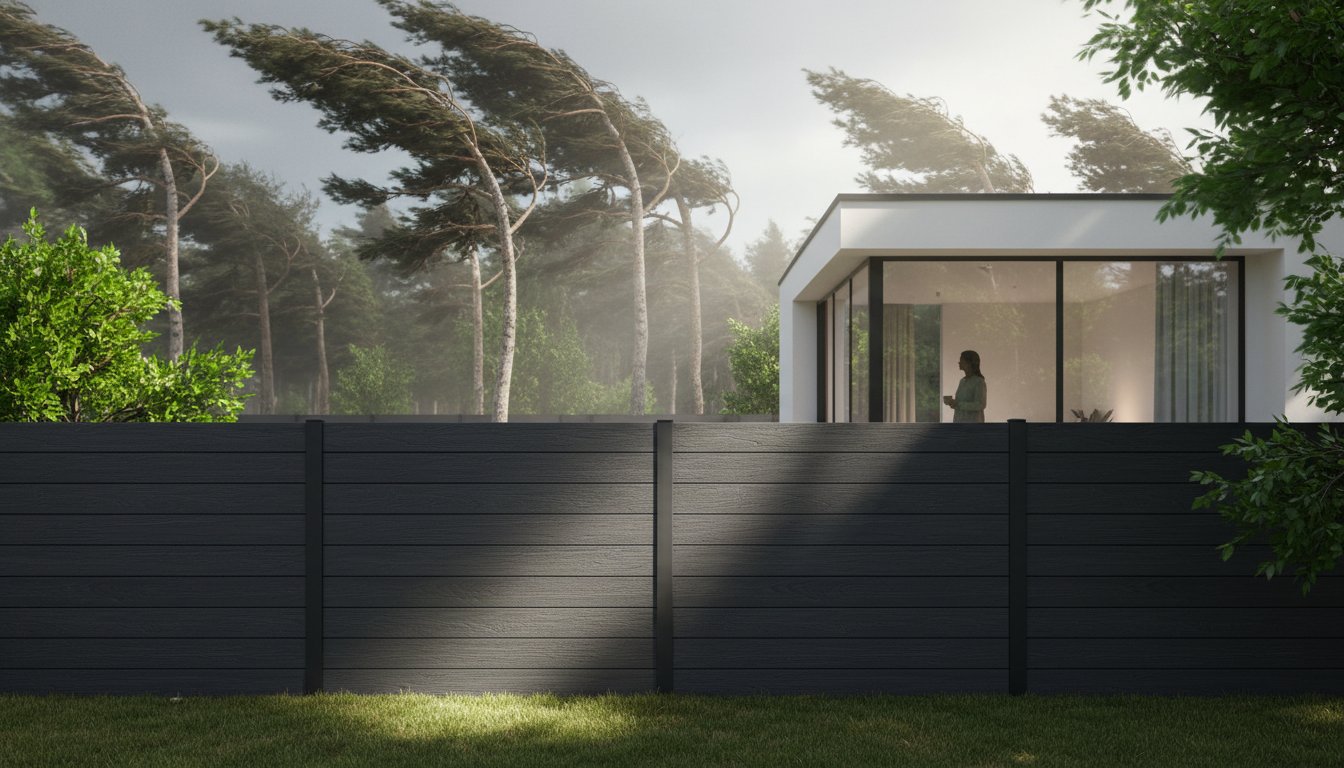
The common assumption that a fence's strength relies solely on the depth of its post holes is a dangerous oversimplification in an era of intensifying weather patterns. You likely worry about the structural integrity of your perimeter during high-wind events; you might even fear that composite alternatives are too flexible to withstand a true storm. It's challenging to specify the right solution when you're caught between conflicting US mph ratings and European pressure standards. This guide clarifies the technical science behind a professional composite fence wind load rating, proving that durability is a result of engineering precision rather than just post depth.
You'll discover how a blend of 75% hardwood fiber and 25% HDPE provides the high-density foundation necessary for extreme weather resilience. We examine the shift toward the 9th Edition of the Florida Building Code and the rigor of EN 15534-1 standards to give you data-backed confidence in your specifications. This article provides a clear framework for selecting fencing systems designed for a 50-year service life; it ensures your outdoor space remains a beautiful, secure sanctuary regardless of the forecast.
Key Takeaways
- Learn the technical distinction between 3-second gusts and sustained pressure to accurately evaluate a composite fence wind load rating for your specific climate.
- Understand how a high-density composition of 75% hardwood fiber and 25% HDPE minimizes material bowing and maintains structural integrity during extreme weather events.
- Decode the engineering requirements of Eurocode 1 and EN 1991-1-4 to ensure your fencing system meets rigorous European pressure standards.
- Identify the critical installation variables, including concrete footing specifications and internal post reinforcements, that prevent system failure in high-wind zones.
- Discover the environmental benefits of engineering for longevity, where a 50-year service life reduces your project's total CO2 footprint and supports sustainable land use.
Table of Contents
- Understanding Composite Fence Wind Load Ratings: Why They Matter
- The Science of Stability: How Material Composition Influences Wind Resistance
- Decoding Wind Load Standards: Eurocodes and Testing Protocols
- Critical Installation Factors for High-Wind Environments
- Long-Term Performance: Wind Resistance as a Sustainability Metric
Understanding Composite Fence Wind Load Ratings: Why They Matter
Wind isn't just air in motion; it's a kinetic force that applies physical pressure to every vertical surface it encounters. A composite fence wind load rating serves as a critical engineering benchmark, defining the maximum pressure a fencing system can withstand before its structural integrity is compromised. While many consumers focus on simple wind speed, professionals understand that pressure, measured in Pascals or kilonewtons per square meter, is the true metric of safety. Designing for the peak 3-second gust rather than average sustained speeds is the standard for ensuring a perimeter doesn't become a liability during a storm.
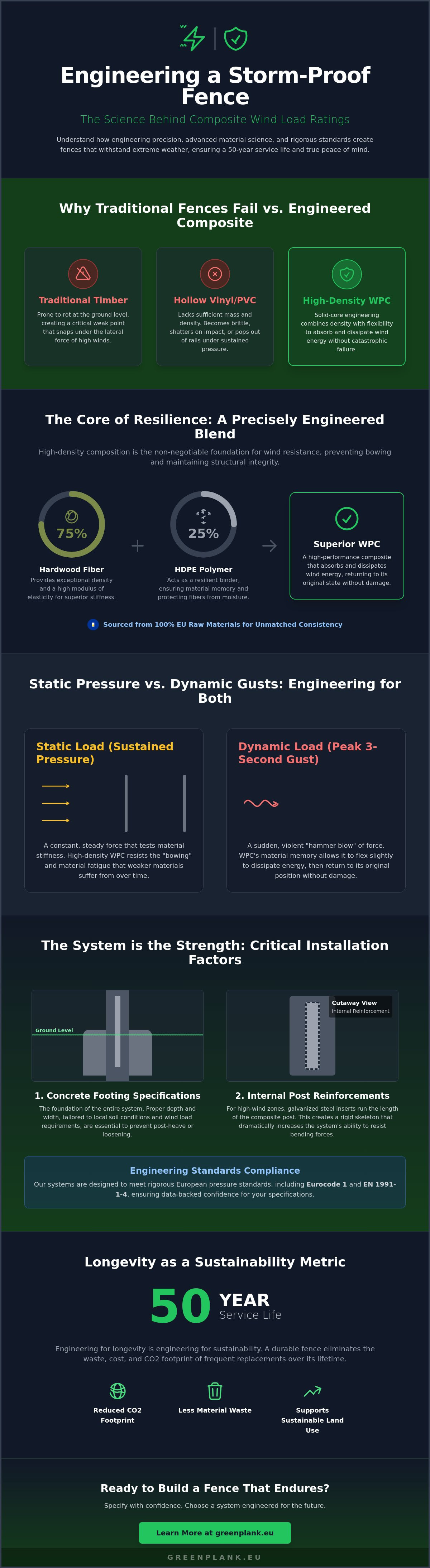
Specifying an under-rated fence in exposed or coastal areas leads to more than just aesthetic failure. It creates a cycle of waste and financial loss that contradicts the principles of sustainable construction. Traditional timber fences often fail because wood rots at the ground level, creating a weak point that snaps under lateral force. Hollow vinyl fences frequently shatter or "pop" out of their rails because they lack the mass to absorb impact. High-performance Wood Plastic Composite (WPC) succeeds because it combines the density of 75% hardwood fiber with the resilient binding of HDPE. This material composition allows the system to absorb and dissipate energy rather than resisting it to the point of catastrophic breakage.
The Physics of Wind Pressure on Fencing
A solid privacy fence essentially functions as a massive sail. When wind hits a solid surface, it cannot pass through; it must push against it. This interaction is governed by "drag coefficients," which determine how much force is transferred from the moving air to the fence boards and posts. While the Beaufort scale offers a helpful visual guide for wind intensity, modern engineering relies on precise wind maps and The Science of Stability to calculate local requirements. Using these maps ensures that a fence in a high-velocity hurricane zone is engineered with the necessary mass and reinforcement to remain standing when lesser structures fail.
Static vs. Dynamic Wind Loads
Understanding the difference between static and dynamic loads is essential for long-term performance. Static pressure refers to a constant, steady wind that applies consistent force over time. This can lead to material fatigue if the fence is not dense enough. Dynamic loads are the sudden, violent gusts that act like a hammer blow against the structure. A superior WPC system is designed with material "memory." It allows for slight, calculated flexibility to dissipate the energy of a gust, then returns to its original vertical position without permanent deformation. This balance of strength and elasticity is what allows high-quality composite systems to offer a 50-year service life. By choosing a system engineered for both load types, you reduce the long-term CO2 footprint of your project through the avoidance of frequent replacements.
The Science of Stability: How Material Composition Influences Wind Resistance
The structural integrity of a perimeter is defined long before the first post is set; it begins in the laboratory where the raw material is formulated. A superior composite fence wind load rating is not an accidental byproduct of thickness, but a calculated result of material density and fiber orientation. While generic PVC fencing often relies on a hollow, flexible structure, professional-grade Wood Plastic Composite (WPC) utilizes a dense, solid-core philosophy. This high-density approach is essential for reducing the "bowing" effect, where wind pressure forces a panel to curve until it eventually unseats from its post channel.
Green Plank engineering utilizes a precise ratio of 75% hardwood fiber and 25% HDPE. This specific blend creates a material with a significantly higher modulus of elasticity compared to standard plastic alternatives. In engineering terms, this means the material is stiffer and more resistant to bending under load. By sourcing 100% EU raw materials, we maintain a level of structural consistency that imported, low-density composites cannot match. This regional reliability ensures that every board in the fence line performs identically when the wind shifts, preventing localized failures that can compromise the entire system.
Rigidity vs. Brittleness: The Hardwood Advantage
The 75% hardwood fiber content acts as the structural skeleton of the board. This organic reinforcement provides the rigidity necessary to resist "wind-whip," a phenomenon where high-plastic composites vibrate and oscillate violently during gusts. High-plastic alternatives often suffer from excessive thermal expansion; they soften in the sun and become overly flexible, which drastically lowers their wind resistance. Conversely, traditional timber offers rigidity but is prone to internal cracking and rot. Our WPC formulation provides the best of both worlds: the strength of hardwood and the weather-resistant encapsulation of HDPE. Discover how our engineered fencing solutions combine this material science with elegant, maintenance-free design.
Interlocking Engineering and Load Distribution
Stability is also a function of how individual components interact. Our tongue-and-groove systems are designed to create a unified "wall of strength" rather than a series of independent slats. When wind hits a single board, the interlocking profile distributes that pressure across the entire fence line. This reduces the concentrated stress points on individual fasteners and posts, which are the most common points of failure in inferior systems. The synergy between our HidLoc™ hidden fastening systems and these interlocking profiles ensures that the boards remain locked in place. This engineering approach allows the fence to act as a singular, resilient structure that manages wind loads with quiet confidence.
Decoding Wind Load Standards: Eurocodes and Testing Protocols
Technical specifications provide the necessary assurance that a perimeter will remain standing when environmental conditions deteriorate. While many markets rely on simplified wind speed charts, professional European manufacturing adheres to Eurocode 1: Actions on structures (EN 1991-1-4). This rigorous standard moves beyond simple velocity to calculate the actual wind actions and pressures exerted on a surface. It ensures that a composite fence wind load rating is based on predictable physical laws rather than optimistic estimates. By focusing on pressure measured in Pascals or kilonewtons, specifiers can account for the complex turbulence and gust factors that a simple mph rating often ignores.
Verifying these standards requires a careful review of a product's technical data sheet. A professional report should clearly state the testing protocols used, such as EN 15534-1:2004, which characterizes the properties of wood-polymer composites. Beyond structural metrics, high-performance materials often carry "Cradle to Cradle" ownership credentials. This certification signals that the fence is not only engineered for extreme resilience but also designed for a circular economy. It reflects a commitment to 100% EU raw materials and a reduced CO2 footprint, proving that engineering strength and environmental ethics can coexist in a single profile.
Calculating Local Wind Actions
Local geography dictates the specific structural requirements for any fencing project. Engineers categorize terrain into different classes, ranging from Category I (exposed coastal areas) to Category IV (dense urban environments with high wind shielding). The height of the fence also introduces a leverage variable; a 2.0m privacy fence experiences significantly higher bending moments at the base than a standard garden border. These height-above-ground variables must be factored into the post spacing and footing diameter to maintain the integrity of the system in high-wind zones.
Interpreting Laboratory Test Results
Reading a wind load report requires an understanding of the "solidity ratio," which compares the solid area of the fence to the total area. European test benchmarks are often more stringent than North American ASTM standards because they emphasize long-term material fatigue under constant pressure. A standard 1.8m high-performance WPC fence system is typically engineered to withstand nominal wind speeds of up to 150 mph when installed according to professional manufacturer specifications. When you compare these lab results, look for the peak pressure values to ensure the system can handle the 3-second gusts common in coastal regions.
Critical Installation Factors for High-Wind Environments
Engineering a resilient perimeter requires a shift from viewing a fence as a series of panels to treating it as a unified structural system. Even the highest composite fence wind load rating becomes irrelevant if the installation fails to account for the leverage exerted during a storm. Professional installation focuses on the "Foundation Rule," which dictates that concrete footings must provide sufficient ballast to counter lateral wind pressure. In high-wind zones, footings should typically reach a depth equal to one-third of the total post height; this ensures the ground remains the strongest point of the assembly.
Structural stability is further enhanced through the use of internal reinforcements. While WPC profiles offer exceptional density, inserting steel or aluminum sleeves into composite posts provides the rigid backbone necessary for extreme weather. Optimal post spacing is equally vital. Maintaining 1.8m centers remains the engineering standard for stability because it limits the "sail area" of each panel. Wider spans often lead to excessive flexing, which can eventually fatigue the material or the fasteners. To prevent wind-tunneling and ground-level erosion, the integration of gravel boards is essential. These boards seal the base of the fence, protecting the soil around the footings and preventing high-pressure air from lifting the panels from below.
Post Anchoring and Soil Types
Foundation design must be adapted to local geological conditions to maintain structural integrity. Sandy coastal soils offer less resistance than heavy clay; they require footings with a wider diameter to increase the surface area of the concrete against the earth. Utilizing heavy-duty Commercial Infrastructure Profiles for support posts provides an additional layer of security in these challenging environments. This regional reliability ensures that the post-to-foundation connection remains the strongest point of the system. Explore our full range of Composite Fencing Systems to find the ideal match for your local wind and soil requirements.
Fastener Integrity and HidLoc™ Systems
The hardware used to secure the fence is as critical as the boards themselves. Stainless steel fasteners are non-negotiable for wind-resistant fencing because they resist the corrosion that can lead to "snap failures" during high-stress events. Our HidLoc™ hidden fastening systems are engineered to prevent "pull-through," a common issue where wind force causes boards to tear away from traditional screws. By distributing load across a wider surface area, these systems maintain a secure grip even during violent gusts. Following the rigorous standards found in a deck installation guide for professional WPC projects ensures that your warranty remains intact and your outdoor space remains safe for decades.
Long-Term Performance: Wind Resistance as a Sustainability Metric
In the context of modern architecture, durability is the highest form of environmental responsibility. A high composite fence wind load rating is more than a safety feature; it's a commitment to reducing a project's total CO2 footprint. When a fencing system survives a severe storm, it prevents the immediate need for replacement materials, additional transport, and energy-intensive manufacturing cycles. This "Sustainability of Strength" ensures that resources remain in use for decades rather than ending up in a landfill after a single extreme weather event. Every storm-resilient installation represents a victory for circular construction and long-term land stewardship.
High-performance WPC is an essential sustainable building material because it embraces the principles of longevity. By utilizing 75% hardwood fiber and 100% EU raw materials, the production process prioritizes regional reliability and ethical sourcing. This material confidence allows for a Cradle to Cradle Ownership model, where the fence serves its primary purpose for a half-century and can eventually be reintegrated into new high-quality infrastructure profiles. By engineering for resilience, we ensure that the environmental cost of production is amortized over a lifespan that is three to four times longer than traditional alternatives.
The 50-Year Warranty and Material Confidence
Engineering for wind resistance is a fundamental prerequisite for offering a 50-year service life. Unlike traditional timber posts that often rot and weaken within 8 to 15 years, our WPC profiles maintain their structural density throughout their entire lifespan. While the initial investment for a premium system might be higher, a life-cycle cost analysis reveals significant financial and ecological savings. You avoid the recurring costs of maintenance, chemical treatments, and total replacements that plague inferior, low-density alternatives. It's a choice that respects both the project budget and the natural world.
Specifying for the Future Climate
As we move through 2026, building codes globally are shifting toward stricter structural requirements to address intensifying weather patterns. Resilient urban and commercial infrastructure must be designed to withstand an increased frequency of high-velocity wind events without failure. Our systems provide the technical assurance needed for these demanding environments, combining material science with a refined aesthetic. Explore our composite fencing systems to ensure your next high-wind project is built on a foundation of engineering excellence and ecological integrity.
Secure Your Perimeter with Engineering Precision
Specifying a boundary that withstands the intensifying storms of 2026 requires a shift from aesthetic selection to rigorous material science. We've established that a high-performance composite fence wind load rating is the result of a precise 75% hardwood fiber and 25% HDPE blend. This density provides the structural "skeleton" necessary to resist bowing and fatigue. By adhering to Eurocode 1 standards and utilizing 100% EU raw materials, you ensure your project benefits from regional reliability and world-class manufacturing quality. This engineering confidence is the foundation of our 50-year service life warranty; it protects your investment while significantly reducing your project's long-term CO2 footprint.
Resilience is the ultimate form of sustainability. When you prioritize structural integrity, you eliminate the cycle of waste associated with storm-damaged timber or brittle plastic alternatives. It's time to transition toward outdoor spaces that respect nature through longevity and superior craftsmanship. Request a Technical Specification for Your Project to integrate these high-performance standards into your next design. You can build with the quiet confidence that your boundary will remain a beautiful, secure sanctuary for decades to come.
Frequently Asked Questions
What is a good wind load rating for a residential composite fence?
A residential fencing system should ideally be rated to withstand wind speeds of at least 110 to 130 mph for standard inland locations. In exposed coastal regions or high-velocity hurricane zones, you should specify a composite fence wind load rating that reaches up to 150 mph. This ensures the structure can handle both sustained pressure and the violent 3-second gusts that often cause structural failure in lower-density materials.
Can composite fencing withstand hurricane-force winds?
High-performance composite fencing can withstand hurricane-force winds when it's engineered with a high-density core and installed according to professional standards. Systems utilizing a 75% hardwood fiber and 25% HDPE blend provide the necessary mass and rigidity to remain stable during extreme weather events. The success of the perimeter depends on the entire system, including the interlocking boards and reinforced posts, working together to dissipate kinetic energy.
Do I need special posts for a high-wind area?
Reinforced posts are essential for maintaining structural integrity in high-wind environments. You should utilize internal steel or aluminum sleeves within the composite posts to provide the rigid backbone required to counter lateral pressure. For demanding projects, specifying commercial infrastructure profiles offers an additional layer of security. These heavy-duty supports ensure that the fence remains upright even when the wind acts as a powerful sail against the privacy panels.
How does post spacing affect the wind resistance of a fence?
Narrower post spacing significantly increases a fence's ability to resist wind loads by reducing the leverage exerted on each individual support. Maintaining the engineering standard of 1.8m centers is critical for stability in storm-prone areas. If you increase the span between posts, you increase the surface area of the panel; this places excessive stress on the fasteners and can lead to permanent material deformation or system failure.
Is a slatted fence better for wind than a solid privacy fence?
Slatted fences are technically superior for wind resistance because they have a lower "solidity ratio," which allows air to pass through the gaps. This reduces the total wind pressure exerted on the structure compared to a solid privacy fence that captures the full force of the wind. If privacy is your primary goal, ensuring your solid fence has a high composite fence wind load rating and robust footings is the only way to guarantee long-term performance.
What happens to WPC fencing if the wind load exceeds its rating?
If wind loads exceed the rated capacity, the fencing system may experience material fatigue, excessive bowing, or fastener pull-through. Unlike brittle PVC that can shatter upon impact, high-quality WPC is designed to be resilient. While extreme force might eventually cause structural compromise, the high-density hardwood blend is engineered to absorb significant energy. Professional installation and correct post-depth are the best defenses against these catastrophic failures.
How do I find the wind zone for my specific property location?
You can identify your specific wind zone by consulting local building codes or national wind maps, such as the ASCE 7-22 standards in the US or Eurocode 1 in Europe. These resources categorize geographic areas based on historical weather data and terrain types. Property owners in coastal or open-field regions must adhere to stricter requirements than those in shielded urban environments to ensure their perimeter meets regional reliability standards.
Does the 50-year warranty cover wind damage?
A 50-year service life warranty typically covers manufacturing defects, rot, and material degradation rather than accidental damage from extreme weather events that exceed the product's rated limits. However, engineering a fence to meet high wind standards is a prerequisite for ensuring the material doesn't fail prematurely. Maintaining a valid warranty requires following professional installation guides, as the longevity of the WPC is tied to how well the system was anchored and supported from day one.
Specifikér produktet
Brug denne guide i en Green Plank-specifikation
Tekniske WPC-artikler skal understøtte de kommercielle sider — ikke konkurrere med dem. Fortsæt til kompositterrasse, TerraTuff, Nordeka eller de tekniske downloads.